Search

BURNING HOUSE PRESS

Not For Profit/For Prophecy

Tag

Nonfiction

Walking In Circles by Paul Tritschler

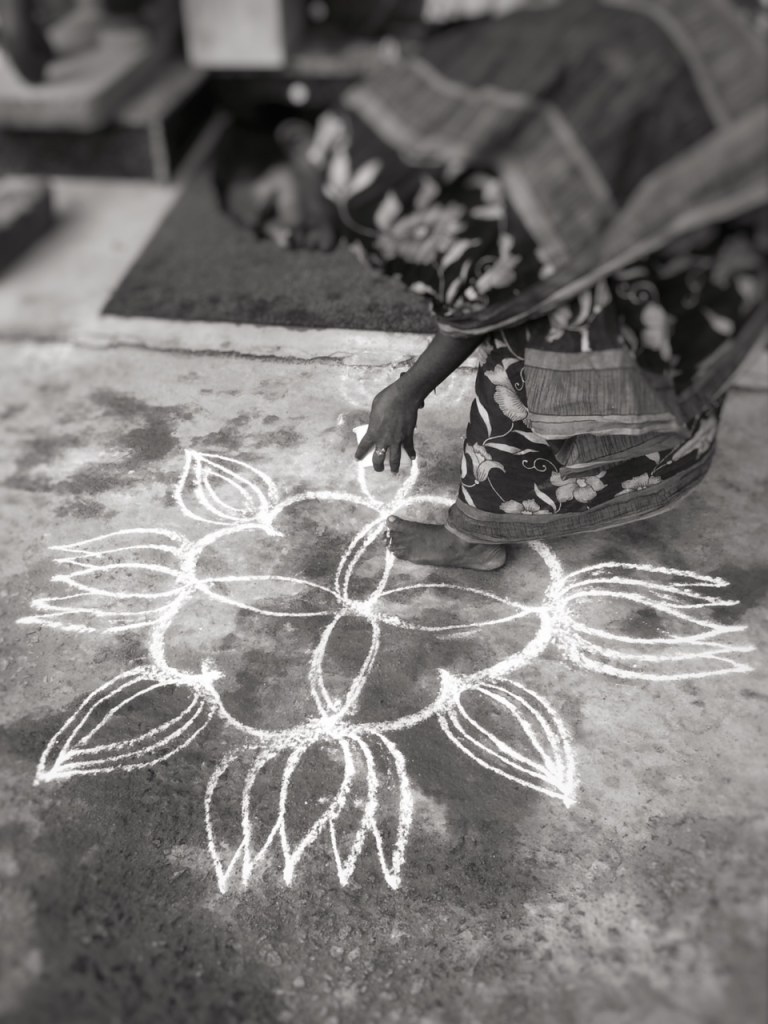
Photo by Paul Tritschler

Midway through the event, a woman seated in the front row of the audience asked the panel of four authors, all of whom had made an appearance for the purpose of promoting their recently published travelogues, if they could explain in simple terms how their notion of travel differed from what most ordinary folk called holidays. Nothing is more difficult than to be simple, but the elitist charge implicit in her question, one that was somehow rendered more pointed by her affected pleasantness, laid another layer of complexity. The moment demanded deflection by way of a pithy response — l’espirit de l’escalier might have suggested a poignant quote from Ibn Battuta or something whimsical from Rabelais. Instead the panel, with a tad too much haste, dug themselves into a defensive trench, and in the process shovelled dirt on what they ill-advisedly and repeatedly referred to as common tourism. And they wouldn’t stop digging.

Conversations erupted throughout the room but eventually settled into silence, and no indication was given that the audience would assist her in pushing the panel off its platform, if indeed that was her intention. That being said, it most likely nudged it a little; peering through the newly created cracks in the edifice, the panel’s itinerant forays and desultory wanderings would have appeared to some people as lofty peregrinations wrapped in pompous superiority…or thoughts to that effect. Their somewhat clumsy efforts to enumerate the differences between what they get up to and what everyone else does would not have helped in that determination. On the other hand, some would have interpreted her question as self-aggrandising, one motivated by conceit, point-scoring and the desire for audience adulation. Either way, the nourishing conversations that were until that moment shared between the panel of authors and what felt like a roomful of friends, now a breathing mass of strangers, failed to revive.

Possessing an air of originality, mystery and spirited adventure, the mention of travel arouses more curiosity than that of the humble holiday, and there can be little doubt that by describing oneself as a travel writer rather than a holiday writer one gathers greater cachet. Yet it often seems that, at core, there is no difference between them. Indeed, the travel writers sharing the podium might easily have described their journeys as holidays. After all, three were promoting books about relatively short stays in what many would deem holiday destinations, including a fortnight in Paris, three weeks in a wine-growing region of France, and a month in Tuscany. Only one took a longer and more varied route, that resulting from an unplanned year of backpacking.

Putting it this way perhaps challenges their street cred, yet many philosophers, among them Seneca and Thoreau, were greatly inspired by the odd holiday, during which they created notable works of reflection on nature, on the human condition, and on life’s meaning or purpose. The same is true of literature. Agatha Christie developed the idea for a well-known detective mystery whilst on a leisure cruise down the Nile. Virginia Woolf wrote To the Lighthouse whilst on vacation on the Isle of Skye, and Elizabeth von Arnim’s The Enchanted April was inspired by a month-long holiday to the Italian Riviera. The list goes on. In the end what matters most are the stories, and to this one might add a degree of self-discovery.

. . .

Old Cathy used to come into our house to wash her money. Though she scrubbed the stairs of every last one of them, and had done so for years, ours was the only flat in a long street of tall black-sooted tenements where she could come and go as she pleased. She even had a key. Some people would rinse out and refill her bucket, but she would have to remain at the doorstep, door closed. To be fair, Old Cathy wasn’t one for conversation, and in fact blanked most people, but that wasn’t the only reason people covered their doors. For much of her life she lived between the mental asylum, as it was then known, and the street, and when that information got around the neighbourhood by the usual whispering campaign people kept a watchful eye. During the time our family knew Old Cathy she had secured permanent residency in a Salvation Army hostel not far from where we lived: a small room with an iron-framed bed, a chair, a cabinet, and a cross on an otherwise bare white wall. Visitors were not allowed, but we visited anyway, my sister and me, and whilst some residents occasionally looked at us with suspicion, neither the warden nor anyone else ever refused entry.

My sister always firmly insisted that if anyone were to question us I should stay silent and let her do the talking. When neighbours or anyone else asked questions she generally cut in to finish my sentences in ways I could never anticipate. Three years my senior but in reality much older, I guess my sister would have been around eleven or twelve when we visited Old Cathy. She doted on us, and was always steady and sunny, but I doubt if many people saw that side. She just kept her head down as she scrubbed the stairs, her metal bucket echoing in the close as it clanked down each step, then reached back up to draw intricate floral patterns with white chalk on the margins of every step. This was a common custom in our neighbourhood, an area that outsiders called slums, but unlike Old Cathy most women just chalked a quick zig-zag or squiggle. Either way they only lasted a day at best.

A woman notorious for malicious gossip once stopped us to ask if our dad knew that our mother allowed a pauper lunatic to wander in and out of our house when he was at work (he worked almost all the time). We of course knew who she meant, but as instructed I buttoned up. I would have liked to have said that we loved Old Cathy, who was one of the kindest people on Earth, and that not only did she visit us, we visited her; but as my sister later reminded me she would most likely have called the police and had her thrown out of her residence and into the street. Adults were a different breed, and I dreaded the thought of mingling with them. Even at the early stages of adulthood most people showed signs of becoming distinctly unpleasant. I think Old Cathy felt the same way.

This was a time when mothers who took to their bed for days or weeks or maybe even months were generally considered to be indolent rather than depressed, a time when postpartum depression was for the most part unknown, and a time when having a stillbirth — regardless of the sadness, guilt and anxiety that were at heart a cry for help — was hushed up as a shameful failure. Mrs Bogus, a pathologically nosey upstairs neighbour of ours — listening at the letterbox, she fell into our hall one time when my dad opened the door on his way to work — stopped me and my sister on the stair to ask if my mother was still lying in her bed. She called her a lazy article, jolting her miserable mongrel on a choke chain before briskly walking on. No one ever explained to me the meaning of article, but I got the gist. Just ignore her, my sister said, and don’t repeat what she said to anyone. I didn’t have to: everyone seemed to know that my mum had sunk under the covers and let the house go to hell. It even got around the school.

For the best part my sister looked after things at home, organising clothes, tidying up, making meals, but after a while things began to slip there too, and the mess just piled up. We made a space on the sofa between heaps of clothes and coat hangers and ate cereal from the box. On one occasion we heard our mum mumble to herself that she wanted to cut her throat, and I was told never to repeat that either, not to anyone, not even to dad — especially dad! She didn’t mean it, my sister insisted, but I couldn’t quite dismiss the possibility. For all their promises to the contrary, adults were notoriously unpredictable. My friend’s sister killed herself over a stupid fiancé, the mother of a boy at my school was murdered by his dad — just one punch, they said, whilst she was doing the ironing — someone sunk an axe into someone’s front door, another put a petrol bomb through a letterbox, men filled with rage and hearts of hate fought to the death outside pubs, and psychopathic razor gangs roamed the streets and alleyways. No adult could be trusted entirely.

We came home from school one day to find all the mirrors in the house had been smashed — why mirrors? — and immediately I wondered if my mum had taken a shard of glass to her throat. I envisaged it. My sister made me wait in the hall until she checked out the bedroom. Mum was sobbing under the blankets, but otherwise okay. Old Cathy was there, calm and calming, picking up the pieces. She would have known worse, and most likely understood the situation better than anyone. For several weeks no stairs were washed as Old Cathy stepped in as our femme de ménage, arriving before we went to school, and leaving in the evening. Between those hours she did the shopping, made breakfast and prepared dinner, looked after my mum, washed clothes, tidied the house, and even found time to play board games with us — she was a master at draughts. In time, when my mother got back into harness, Old Cathy got back down on her kneeling mat to scrub and chalk the tenement stair, the distinctive sound of her metal bucket once more echoing in the close as it clanked on each step. Thereafter she would rinse out her bucket, brushes and money in our small scullery whilst the kettle boiled before settling down to sit with my mum, gazing into the embers in silence.

. . .

For some people, travel writers are escape artists sharing their secrets on how to break loose from sameness. Others live to wander, to find stillness in motion, and perhaps by chance to find missing parts of the story that made them who they are. It was whilst perched on a doorstep under a hot sun in Tamil Nadu that Old Cathy, for the first time since childhood, wandered into my thoughts. I was watching a woman take great care to create a kolam at the entrance to her home, a decorative chalk circle with floral designs that is said to bring good luck and prosperity to the occupants. The drawings are walked on, scuffed and washed out every day, and whilst illustrations and meanings vary, each in their own way presage the transience of our existence and the impermanence of all things. The process was hypnotic. With eyes squeezed shut I remembered Old Cathy with head bowed drawing similar floral patterns with her piece of chalk on the steps to our door, and for a moment that door opened. The long journey to India had led me back to the start, and perhaps, after all, that was the point.

. . .
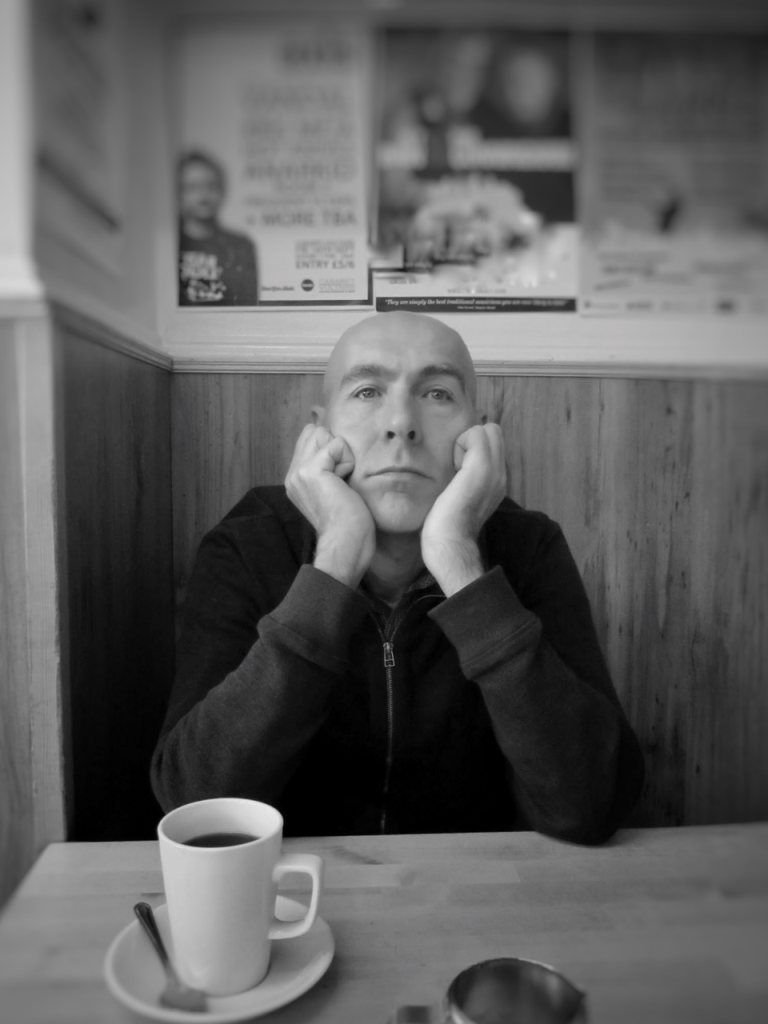
In addition to teaching psychology in universities, adult education and colleges across the UK, Paul Tritschler has managed organisations within the fields of brain injury, sensory impairment, mental health and community activism. He has written for a variety of magazines, including Aeon, Psychology Review, Bella Caledonia, Counterpunch and Open Democracy.

JULY 2020 Guest Editor Is MAPULE MOHULATSI!!! THEME: SINK

Burning House Press are excited to welcome MAPULE MOHULATSI as our JULY 2020 guest editor! As of today MAPULE will take over editorship of Burning House Press online for the month of JULY.

Submissions are open from today – and will remain open until 25TH JULY.

MAPULE’S theme for the month is as follows

Continue reading “JULY 2020 Guest Editor Is MAPULE MOHULATSI!!! THEME: SINK”

Essay by Rosa Jones

annie-spratt-QTp2mbvQI60-unsplash

Photo by Annie Spratt on Unsplash


essay: Insipid / Intrepid


As the adventurous person talks on, I am struck by a sense that they are confident and unperturbed by minor setbacks. I find myself specifically interested in the banal logistics of what it means to be that way, more than being interested in their actual stories. I feel that there’s no way for me to think cleverly about what it means to live an interesting life, or what it means to be fluid and graceful as you move through the world.  Continue reading “Essay by Rosa Jones”

of two orders by Clark Chatlain

of two orders

something else entirely. some other thing to see. not only at night or when lost in the basements of this world but in the bright day. in the brightness of the day. to see something else among the common. to see something else even there in the light in the house in the street. something revealed. something that in the past might have inspired a new line. a new belief. to see it. so that two visions could hold me. that of the eyes and that of this other sight. whatever it might be. whatever it might have been. Continue reading “of two orders by Clark Chatlain”

KETA-ME: My Ketamine Experience by Joseph Ellison Brockway

KETA-ME: My Ketamine Experience

I’m not certain of the order of each moment once the ketamine infusion began. But I do feel certain that I was aware of everything that was happening and that I was consciously guiding my experience and my thoughts while this mind-altering drug was filtering through my bloodstream. This, of course, stems from my penchant for controlling everything. Continue reading “KETA-ME: My Ketamine Experience by Joseph Ellison Brockway”

A short story by Meryl Baer

Continue reading “A short story by Meryl Baer”

Christina Tudor-Sideri: PASSING THROUGH THE HOME OF THE DYING

Screen Shot 2018-12-28 at 1.00.18 PM

Tachypsychia. The word we use for defining the neurological condition which alters our perception of time. Time lengthening, time moving slower, time contracting. A blurred vision of time as response to a traumatic event. Time as a collection of unrelated passages. Time as red lines on the temptation to exist. Time as well-captured intentions, the same throughout all journeys. Every inked reflection, a paradise lost. Continue reading “Christina Tudor-Sideri: PASSING THROUGH THE HOME OF THE DYING”

NON-NONFICTION // E D I T I O N – SELECTED/CURATED/PRESENTED BY AUGUST 2018 GUEST EDITOR JOHN TREFRY

Burning House Press would like to thank August’s Guest Editor John Trefry for selecting a fantastic theme in // NON-NONFICTION // – and for all of the endeavour and hard work that has gone into selecting/curating/presenting the contributions received over the month  – THANK YOU FOR EVERYTHING, JOHN!!!

Massive thank you also goes to everyone who contributed to John’s theme and who continues to send BHP your  writing and art – we are so happy and grateful that you entrust us with your work, thank you!!! xX

Here it is, the NON-NONFICTION edition – every selection in one place for you to read/peruse – enjoy!!! xX

Continue reading “NON-NONFICTION // E D I T I O N – SELECTED/CURATED/PRESENTED BY AUGUST 2018 GUEST EDITOR JOHN TREFRY”

Translations of a Post-Apocalyptic Love by Jessica Ciccarelli

I stand in the shower and let the water pound against the knot in my neck until the spasm seems so strong I register pain before terror. Every possible nerve I can find rests against the jarring freeze of the granite. Water drenches my arms, face, and stretch-marked body – kissing parts of me I used to reserve for your masochistic ego. Continue reading “Translations of a Post-Apocalyptic Love by Jessica Ciccarelli”

The Unforgiving Season by Paula Geanau

1.

Out of all four seasons, summer is the least inviting to love. Continue reading “The Unforgiving Season by Paula Geanau”

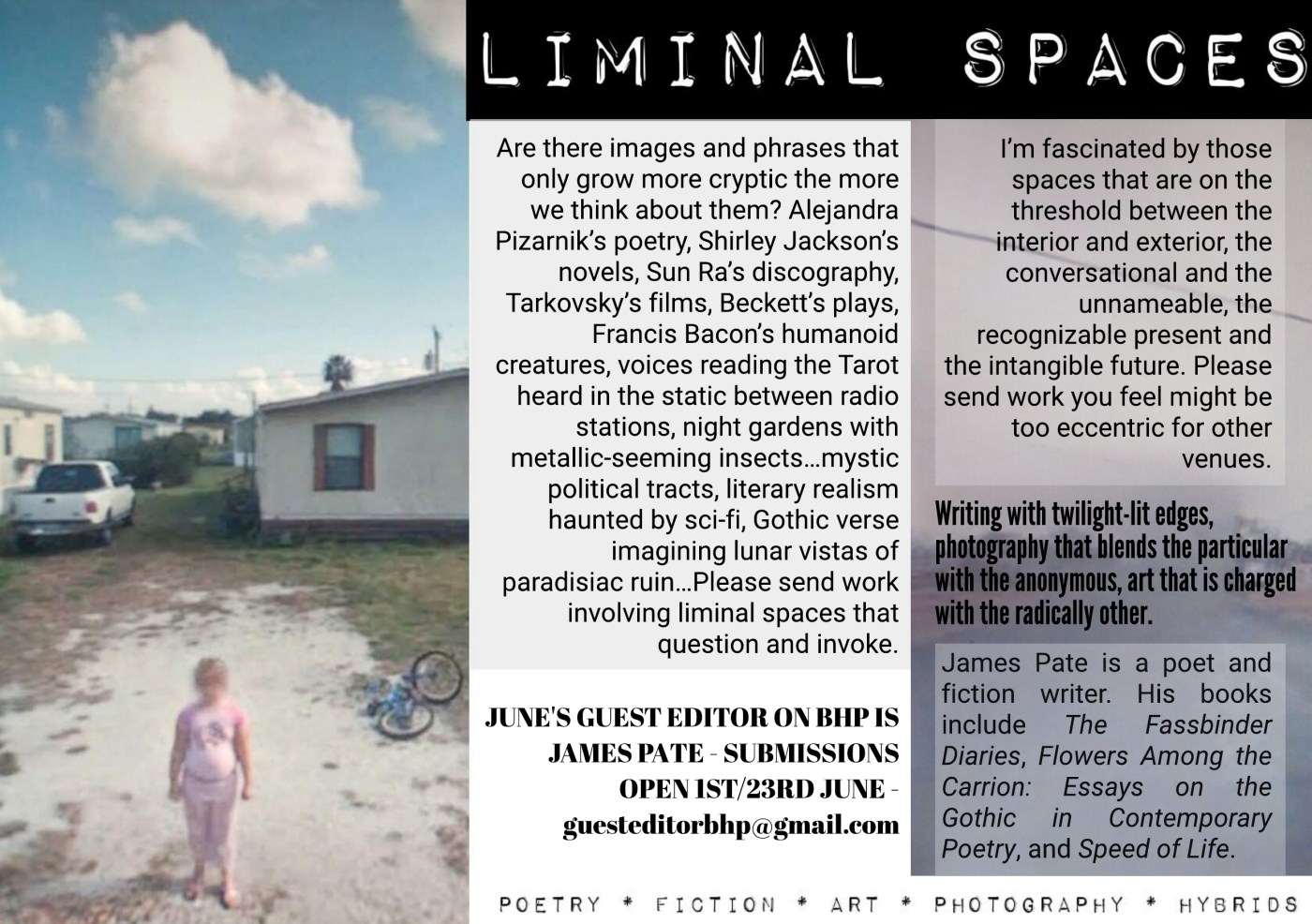
Guest Editor For June Is James Pate!!! Theme is: LIMINAL SPACES

Burning House Press are excited to welcome JAMES PATE as our fifth guest editor! James will take over editorship of Burning House Press online for the full month of June – when he will then hand over the reins to our sixth guest editor for the month of July.

Submissions for James are open from today – 1st June and will remain open until 23rd June.

James’ Theme/s for the month are as follows

Liminal Spaces


James has introduced his theme for your guidance:

I’m fascinated by those spaces that are on the threshold between the interior and exterior, the conversational and the unnamable, the recognizable present and the intangible future. Please send work you feel might be too eccentric for other venues—writing with twilight-lit edges, photography that blends the particular with the anonymous, art that is charged with the radically other.


Are there images and phrase that only grow more cryptic the more we think about them? Are there barely audible voices still waiting to be recorded? Alejandra Pizarnik’s poetry, Shirley Jackson’s novels, Sun Ra’s discography, Tarkovsky’s films, Beckett’s plays, Francis Bacon’s humanoid creatures, voices reading the Tarot heard in the static between radio stations, night gardens with metallic-seeming insects…mystic political tracts, literary realism haunted by sci-fi, Gothic verse imagining lunar vistas of paradisiac ruin…Please send work involving liminal spaces that question and invoke.

jamespatepic


James Pate is a poet and fiction writer. His books include The Fassbinder Diaries (Civil Coping Mechanisms), Flowers Among the Carrion: Essays on the Gothic in Contemporary Poetry (Action Books Salvo Series), and Speed of Life (Fahrenheit Press). He teaches creative writing at Shepherd University, in Shepherdstown, WV.


* * *

For submissions, James is looking for your poetry, short stories, flash fiction, prose poems, art, collage, painting, photography – as well as non-fiction submissions: essays, reviews, commentary, features, interviews – and all hybrids and cross-forms.


Submission Guidelines

All submissions should be sent as attachments to guesteditorbhp@gmail.com

Please state the theme and form of your submission in the subject of the email. For example: LIMINAL SPACES/POETRY

Poetry and Fiction
For poetry submissions, submit no more than three of your best poems. Short stories should be limited to 1,500 words or (preferably) less. We encourage flash fiction submissions, no more than three at a time. Send these in as a .doc or .docx file, along with a short third-person bio, and (optional) photograph of yourself.

Art
Submit hi-res images of your works (drawings, paintings, illustrations, collages, photography, etc) with descriptions of the work (Title, Year, Medium, etc) in the body of the email. Files should be in .JPEG unless they are GIFs or videos, and should not exceed 2MB in size for each work. File names should correspond with the work titles. Video submissions can be uploaded onto Youtube or Vimeo for feature on our website. Send these submissions along with a short third-person bio, and (optional) photograph of yourself.

Non-fiction
Non-fiction submissions (essays, reviews, commentary, interviews, etc) should be no more than 1, 500 words and sent as a .doc or .docx file along with your third-person bio/and optional photograph.

Submissions are open from 1st June til 23rd June – and will reopen again on 1st July for our sixth guest editor.

BHP online is now in the capable hands of the amazing JAMES PATE – friends, send him your best!

Masks, Transformations, Cosmos, & Personal Myth

March 2018

Guest Editor: Amee Nassrene Broumand


4 March


Professional Mermaid by Megan Dunn

After the 10th Date by Sam Frost

gibbous moon waxing by Lewis Ellingham

Three Poems by Jared A. Carnie

Charon’s Amusement Arcade by BR Williams


10 March


Three Poems by Laura Potts

Plastic Eggs by C.B. Auder

Night Photos of Newstead Village & a Poem by Sophie Pitchford*

L’Idole by Laura Izabela

Two Poems by Annette Skade

A Bacon Sandwich by Jim Gibson

Solitaire by Attracta Fahy


17 March


Three Poems by Ivan de Monbrison

Forgotten Astronaut by Spangle McQueen

What Else Can I Do? by Rob True

How to Tell Men Apart by Breslin White

Invitation To Move On by Jonathan Humble

Two Poems by Kate Garrett

Stealing Sleipnir by Alison Lock

The Transformation by Emma McKervey


24 March


Three Poems by Samuel J Fox

Sing a Song of Ever Changing Perception by Michelle Diaz

Photographs of Bristol & a Poem by Jason Jackson*

When Food Goes Bad by Kelly Froh

Two Poems by Anna Wall

7yrs bad luck by Richard Biddle

Jack by Gene Farmer


30 March


Two Pieces by Erin Calabria

genesis by Clark Chatlain

Baroclinic Instability by katillac tweed

A Catalogue of Small Shatterings by Makensi Ceriani

Bear off a Leash by Stephen Lightbown

Photographs of New Orleans by Julia Skop*

Two Poems by Kate Dlugosz

Interminatus by Cory Willingham

The Boyfriend Pinch by Christopher John Eggett

Dissociation in a Museum Café by Belinda Rimmer

Two Poems by Soodabeh Saeidnia

The Linen Man Suite by Lorie Broumand

An Interview with Poet Laura Potts by Amee Nassrene Broumand*


Featured Image: Solar Eclipse from Salem, Oregon 2017 by Amee Nassrene Broumand

Individual featured images by Amee Nassrene Broumand unless marked with an asterisk

A Catalogue of Small Shatterings by Makensi Ceriani

I have always had a fascination with transformation. With taking incongruent parts to make a whole. With cutting and stripping and building up from the bottom and the artist as self-portrait. I could easily be found in childhood obsessing over the arrangement of furniture and décor of my Laura Ashley doll house. Today this is a dining room with a red velvet tablecloth and a chandelier light that chimes a segment from the Four Seasons because my Polly Pocket is the queen and she’s having the tour group Bratz over for tea. Tomorrow it is a miniature of my family’s dining room with boxes and old paint chips and no tablecloth and striped walls that look like silk and show damage easily.

Most of my toys were dolls, the easiest to buy for a girl, the easiest to buy for a child who liked to imagine new worlds. I remember the Betty Spaghetti dolls with neon bodies and plastic hair whose arms and torsos and heads could pop out to be interchangeable. To be made anew. How many times did I snap and unshape the forms of girls to get the end result I wanted. How many times did I teach myself what is, is not always. I remember the What’s Her Face dolls with smooth, blank complexions I could stamp their expressions on. This one is surprised. This one is happy. This one has stars for eyes and an eye for a mouth. The stars were permanent marker, the eye easily removed. My mother did not buy me anymore of those dolls after that. She would tell me not to cut Barbie’s hair because it did not grow back; I could not understand her anger when I cut my own bangs with clunky construction paper scissors. I thought we both knew it would grow back. It must have been the shock, of my swift reveal from one face to another. She must not have recognized me. I was not allowed to cut my hair again. Continue reading “A Catalogue of Small Shatterings by Makensi Ceriani”

When Food Goes Bad by Kelly Froh

My younger brother just scheduled bariatric surgery.

They will reduce his stomach to the size of a banana.

He said he can’t go another decade being heavy.

He asked me to remember when our parents got divorced, when he was 10 and I was 15 and I said, “See ya later!” as he filled time and loneliness with dry cereal and Swiss cake rolls.

I tried to commiserate, even though I knew I risked insulting him, since his weight issues have always been much greater than mine — said we both snacked way too much, and paired it with convenience eating:

Hamburger Helper on the countertop was mom telling us what’s for dinner

And award systems:

1 visit to church on Sunday = 1 sausage biscuit with egg at the drive-thru

We fell into negative routines: Dad yelled at me, I yelled at my brother, and then we nursed our wounds together with salt, sweet, repeat. Continue reading “When Food Goes Bad by Kelly Froh”

After the 10th Date by Sam Frost

I’ll make jokes about death. Give names to the bunnies locked between coyote teeth as we walk through the forest with bare feet. Go to your apartment. Drop to the floor. Hide under blankets until the air is too warm. Stick heads out and kiss. Stand up, I’ll watch as the covers shift off, leave you naked. Grab a bottle from the counter. Come back. Take the first sip then pass it to me. I’ll crinkle my face and say no more. But that just means I want you to get a glass of water for me to sip after each pull. You’ll know that.

Play music. Dance with me. Wait till our eyes are clouded just a bit. I’ll look up at you. You’ll look down. The whole world between my nose and yours. Eyes lock. We’ll have to fill the gap. Lace your fingers through my hair. Sit on the ground. Grab the bottle. Continue reading “After the 10th Date by Sam Frost”

Wolfspeak by Lara Alonso Corona

for Daniela Cascella

Last August, in one of his habitual Sunday trips to the flea market my father found an old dictionary of Bable – Bable being the dialect of our region Asturias. Unlike the Basque or the Catalonian, we didn’t have a strong independence movement to help preserve the mountain languages, and by the time I was born most of it was lost. We are getting it back little by little. But how do you recover sounds no one has heard in generations?

Like this: my father started taking pictures of the dictionary, and sending them to me, one page per day. He intends to do this until he runs out of pages, until he runs out of words to recover.

I should have started like this: I apologize for my accent. (I always do) Continue reading “Wolfspeak by Lara Alonso Corona”

Poetry Letters by Dan Dorman

Speech always moves.

When a person speaks they drive lung fulls of air through disruptive muscles that vibrate the flowing air before it moves in an open space. Language on a page, however, is generally static.

Meaning, most people would have us read against the text rather than into it.

Because letters in English are only phonetic signifiers, which in no consistent way relate to their sounds, neither speech (an object in the all-being type of way) or the object to which they refer, written language actually doesn’t say a thing. Usually… Continue reading “Poetry Letters by Dan Dorman”

Blog at WordPress.com.

Up ↑