I’d intended to write a brief introduction to the ULTRAVIOLET themed issue of Burning House Press but will instead juxtapose two seemingly incongruous observations.
Continue reading “ULTRAVIOLET: Guest Editor’s note”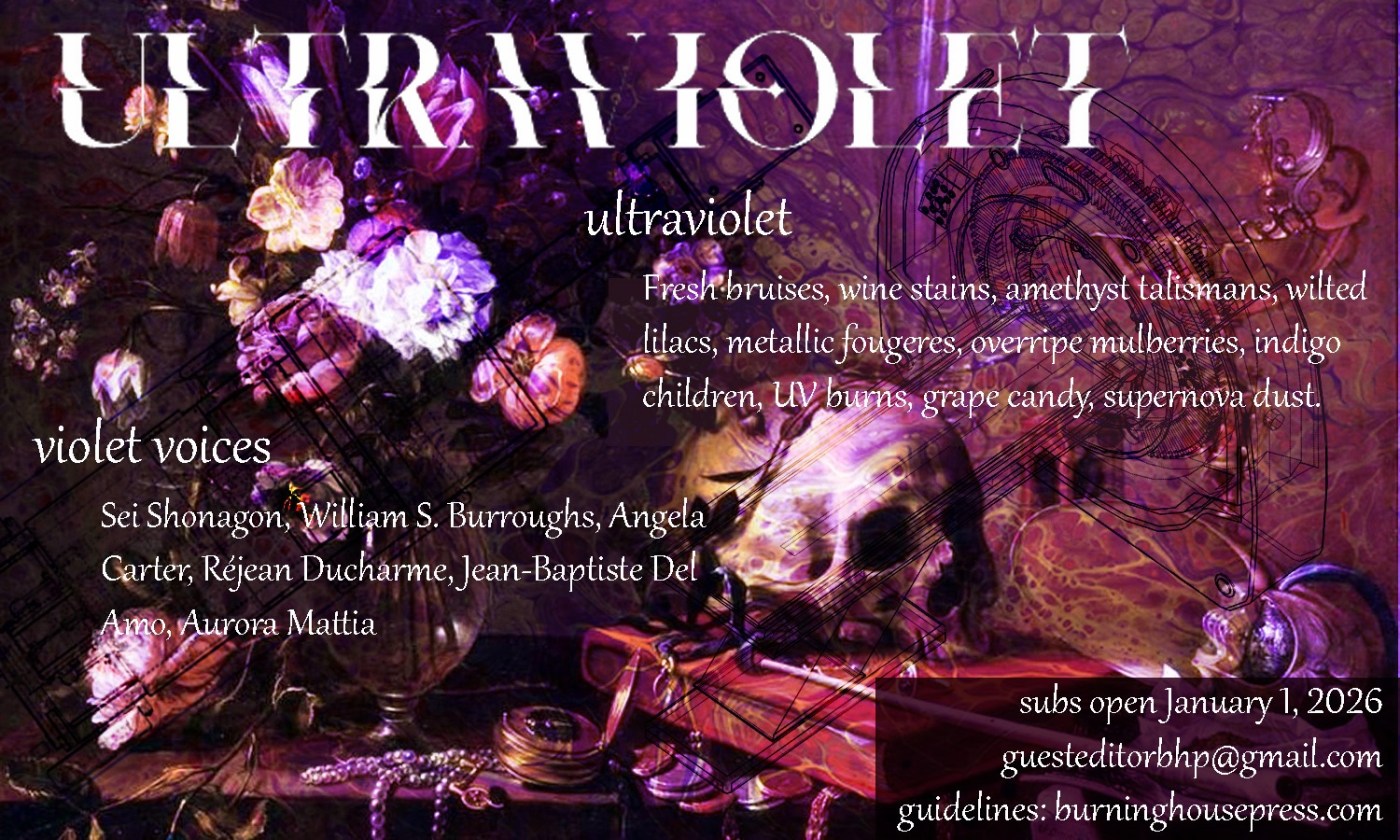
Burning House Press are excited to welcome Kawai Shen as the sixth BHP guest editor of our return series of special editions! As of today Kawai will take over editorship of Burning House Press online for the month of January.
Submissions are open from today 3rd January – and will remain open until 25th January.
Kawai’s theme for the month is as follows
___
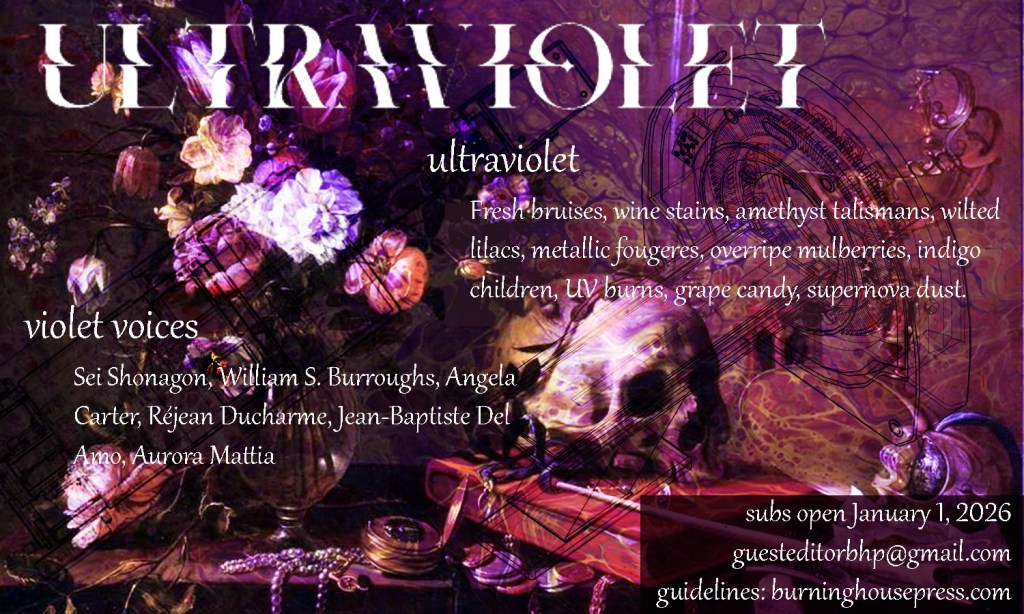
ULTRAVIOLET
- Fresh bruises, wine stains, amethyst talismans, wilted lilacs, metallic fougeres, overripe mulberries, indigo children, laser burns, grape candy, supernova dust
- Inspiration: Sei Shonagon, William S. Burroughs, Angela Carter, Mervyn Peake, Réjean Ducharme, Jean-Baptiste Del Amo, Aurora Mattia
Kawai Shen is based in Canada. Her fiction was shortlisted for the 6th edition of The Metatron Prize for Rising Authors and was selected for the Best Canadian Stories 2025 anthology. She has published work in khōréō, ergot, Extra Extra, The Whitney Review, A Fucking Magazine, and more. Her book, Wavering Futures, is forthcoming with Metatron Press in 2026.
______
- SUBMISSION GUIDELINES
- All submissions should be sent as .doc or .docx attachments to guesteditorbhp@gmail.com. No cover letter is necessary but please include a short third-person bio and (optional) photo of yourself for potential print with your submission. You may also consider including social media usernames, especially if you’re on Bluesky/Instagram– I want to promote your work!
- Please state the theme and form of your submission in the subject of the email. For example: ULTRAVIOLET/FICTION
- Submissions are open until 25th January and will reopen again on 1st February 2026 for a new theme/new editor/s.
- Fiction: Fiction should be limited to 1,500 words or (preferably) less. Up to two micros (maximum 500 words) may be sent.
- Poetry: You can try your luck with poetry, but this issue will focus on purple prose. Submit no more than three poems.
- Art: Submit a maximum of six hi-res images of your work in JPEG format (maximum size 2MB) with descriptions of each work (Title, Year, Medium) in the body of the email. File names should correspond with the work titles.
_______
BHP online is now in the capable hands of the amazing Kawai Shen – friends, arsonistas, send our January 2026 guest editor your magic!
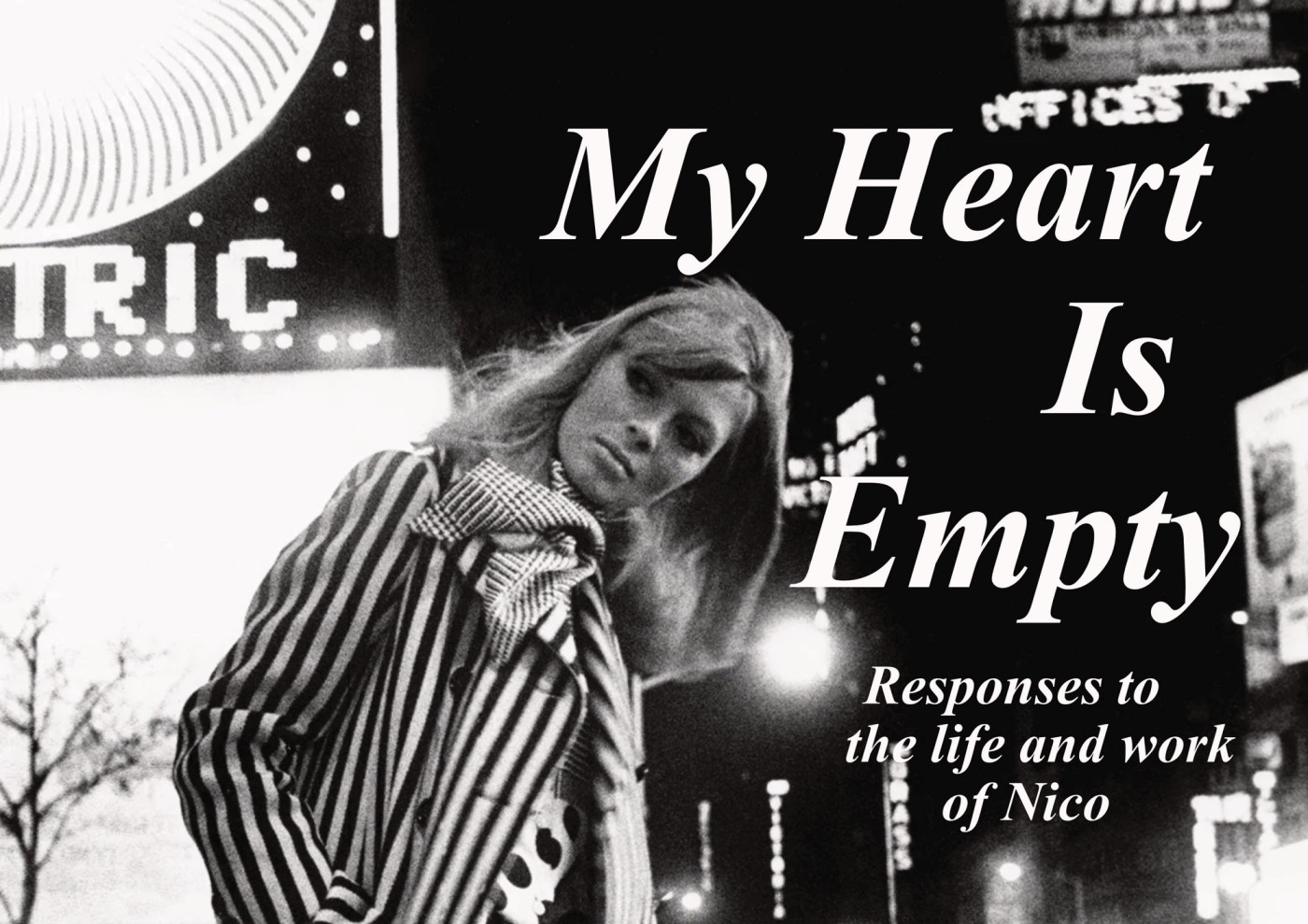

From Nico Femme Fatale compilation.
At the age of twenty-four, I decided to die. I planned it all out like a game. It was like ordering a shiny dress from a catalogue. Twenty-four was the perfect age to die.
This boy lived under a low star. Sickly spell of youth. He was hypnotised by the fragile beauty of the world. A river shining in autumn in Lancashire woods. His heart was like a castle of vanity. He wondered if people threw themselves off motorway bridges because they understood freedom like no one else.
I didn’t want to speak about myself so I wrote a story. I didn’t want to hear myself think so I sang a lonely song. Nico once said, “You don’t have to be you to be you. I see that now. All the deaths contained inside, rich and plentiful as golden black.”
You don’t have to be you to be you.
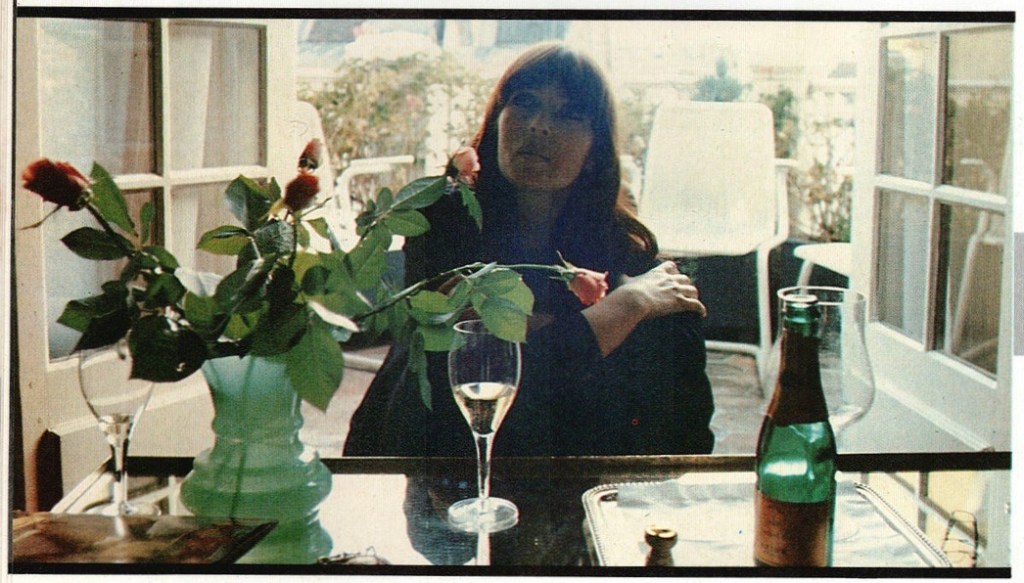
Nico by Steve Katz.
The boy, who had planned death out like a game of hopscotch, worked in an office. He wrote copy for companies about everyday objects. He spent an entire week writing about synthetic rubber tyres. Language was nothing but the accomplice of death and money. He looked outside. On the opposite side of the road was a rendering plant. They fed the carcasses of animals into enormous steel drums and boiled them into soap. When the smell began to belch into the air from endless chimneys, the workers closed the office windows. But the smell always got in and they were always complicit.
I believed I had figured out life as a magic trick. It was like when you smoke too much weed and you have the cheapest of epiphanies. It comes at you like a cartoon eureka moment. But soon, it floats away because every revelation in human history is simply a balloon in the big blue sky. I laughed. I took ecstasy pills with a beautiful friend that changed sex. We laughed harder until I threw up into the grass.

Nico in NME magazine, 1974.
Every day, the boy would walk from the office along a canal where Victorian mills rotted into dark water. Nico was a huge fan of the Situationists. Raoul Vaneigem once wrote, “Who wants a world in which the guarantee that we shall not die of starvation entails the risk of dying of boredom?” The boy wandered past enormous cocks graffitied across the stone walls, phone numbers to unknown men in unknown towns.
I never bought albums from the dead because I had the internet by this point. There seemed no reason to line the pockets of parasitic men. I was a parasite too. Endless nights downloading poets through progress bars. Low-quality mp3s like green waxing moons. The next one on the list: Nico_The_Marble_Index. The internet was a vast séance. Nico once said, “When I sing I try to imagine I’m all alone, there’s nobody out there listening.”
Across from behind my window screen
Demon is dancing down the scene
In a crucial parody
Demon is dancing down the scene
The boy was alone. He walked through barren woods in Oswaldtwistle during winter. The saplings were covered in litter. A no-man’s land of polystyrene takeaway boxes and rainbow foil. He formed a paradise inside his own mind. He was like a demon risen from the frozen earth. His grave was covered in soiled condoms and torn-up newspaper. He watched videos on his laptop of Nico playing in a warehouse in Preston in 1982, about sixteen miles west of his current location, and backwards another thirty years. Time and space came apart inside the hand of the demon. She looked bloated on the screen with heroin and fag ash. No one is there.
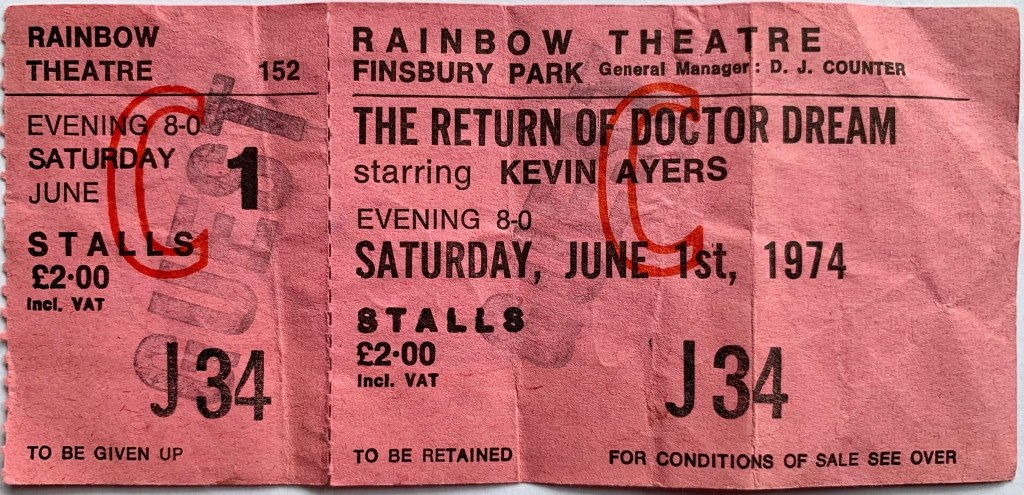
Kevin Ayers, John Cale, Nico and Brian Eno live at the Rainbow Theatre, Finsbury Park, London, June 1, 1974.
I wondered who Nico met in the Californian desert, her body unravelling from peyote like a chain of orange sickle moons. Or when she sang alone to her own shadow in a Manchester terraced house; light starting to appear between curtains as dawn stormed the crumbling walls. An emerald packet of Rizlas. A bottle of vodka shining on the windowsill. Someone’s hand turns a tarot card over on the kitchen table. The Chariot. A king holding a red glowing orb. Nico once said, “A poet sees visions and records them.” I imagined that Nico met a version of herself in the desert. She took off her clothes and led in the dust with this other version of Nico. She kissed her on the lips. And then slowly, beneath the opulent sun shining like a black flower of death, the other Nico whispered a number of secrets into her (the original Nico’s) ear. When Orpheus returned from the Underworld, he was covered in bright red earth.
A true story wants to be mine
A true story wants to be mine
The story is telling a true lie
The story is telling a true lie
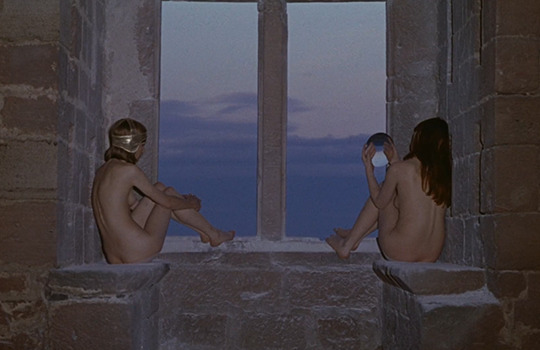
Athanor (1972) still.
The day came when the boy had planned to die. It was a dull day, just like any other. Cars streamed beneath his window. But the day simply passed him by. He wasn’t sure why. He was like a cloud or a ghost that didn’t matter. In a 1997 interview, when asked about the initially low sales figures for The Marble Index, John Cale replied, “You can’t sell suicide.”
The boy wrote down a story that was a true lie. He searched YouTube for all the comments that others had left about a dead singer and stitched them together. He stayed on stage a few moments longer as the audience grew restless. They looked at their watches and coughed and rolled their eyes. Beneath an artificial light, he approached the microphone and read a poem for Nico.
an electric blue current
a leopard in the air
an android serving macrobiotic rice
with tabasco sauce
who forgot to pay the light bill
and lived happily in the dark for a month
Ari watching his mother
putting makeup on in the mirror
illusions of our images becoming permanent
a son growing into an emperor
in a scarlet tunic
rising through a worm hole
red chariot across night sky
love is like a big cloud
a prayer or a song
raining down on you
in the middle of an apocalyptic movie
before the solar flare footage
in the forest above the water
where her grave lies
painted in crystal
she woke up at the end of time
smoked some grass
and went for a ride on her bicycle
an electric blue current
a leopard in the air

Matthew Kinlin lives and writes in Glasgow. His published works include Teenage Hallucination (Orbis Tertius Press, 2021); Curse Red, Curse Blue, Curse Green (Sweat Drenched Press, 2021); The Glass Abattoir (D.F.L. Lit, 2023); Songs of Xanthina (Broken Sleep Books, 2023); Psycho Viridian (Broken Sleep Books, 2024) and So Tender a Killer (Filthy Loot, 2025). Instagram: @obscene_mirror.
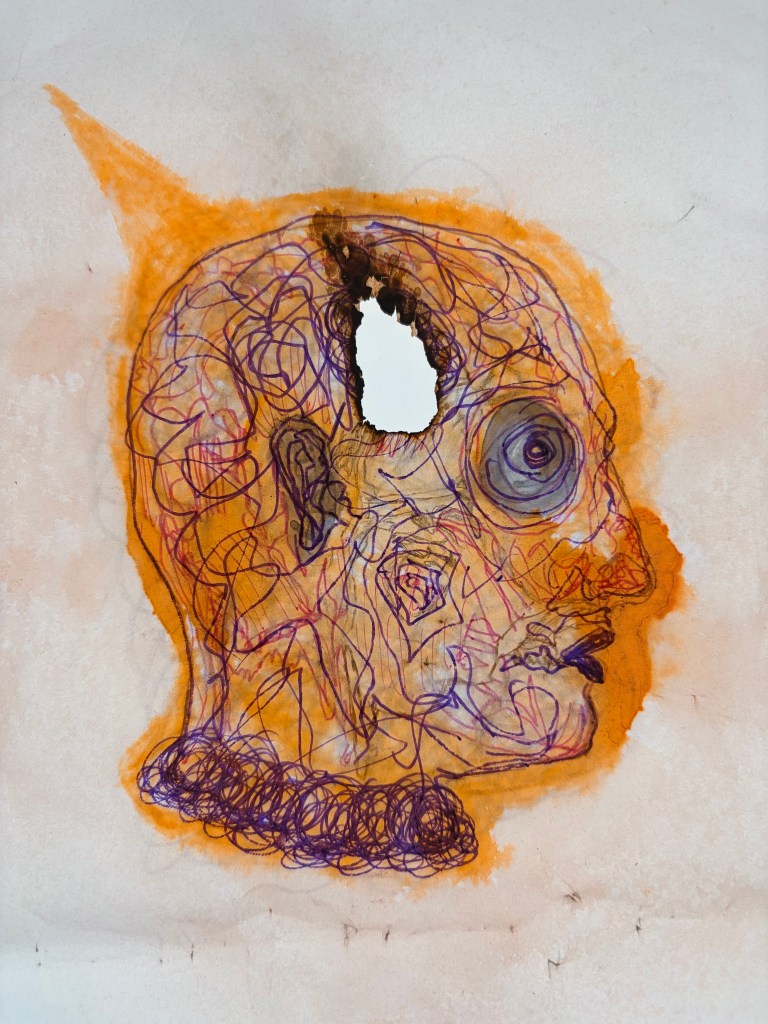
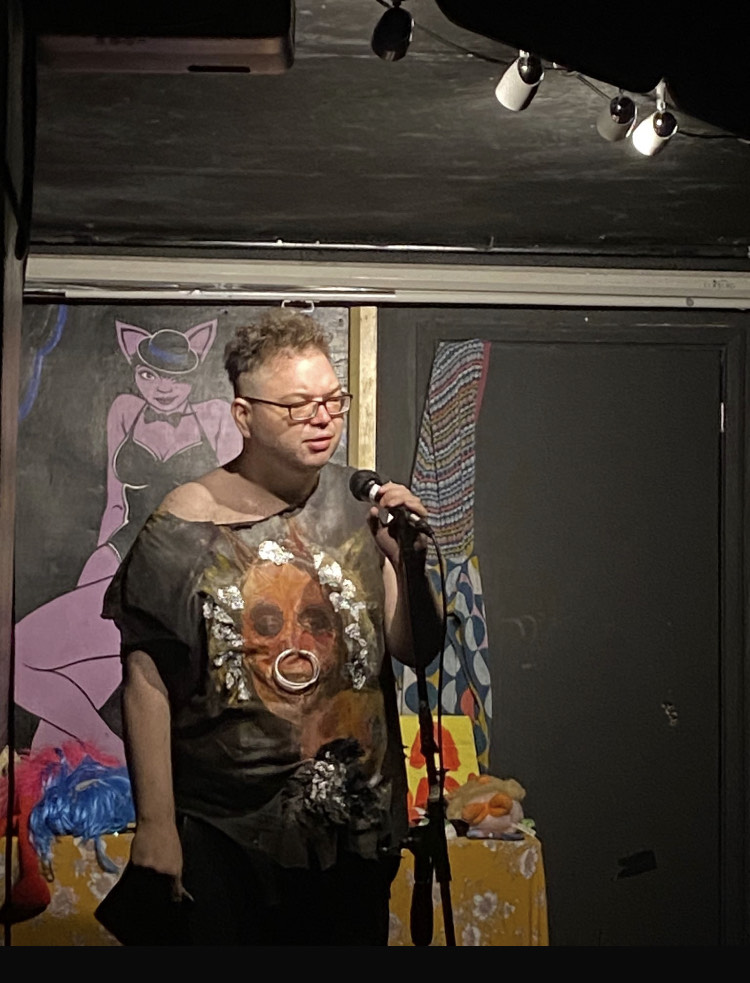
Tom Bland has two books out, Camp Fear and The Death of a Clown, with Bad Betty Press. He trained in experimental theatre and found a way to work with poems in unusual somewhat dangerous magickal rituals, and he always performs with Steve-O in mind.
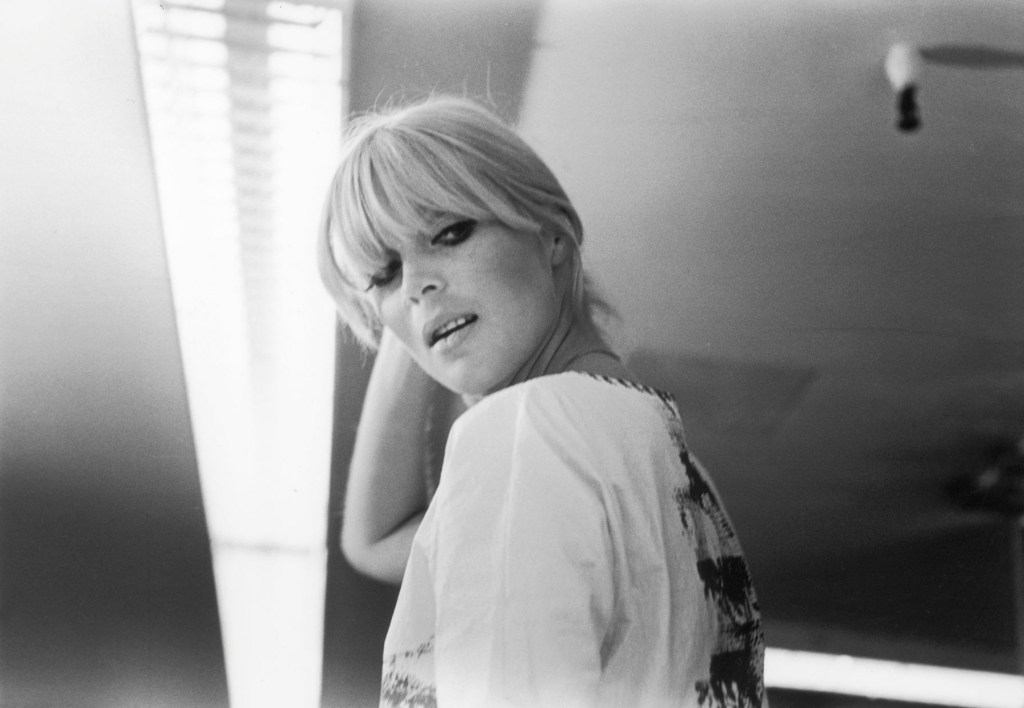
Nico in department store, New York, November 9, 1966. Photo by Fred W. McDarrah.

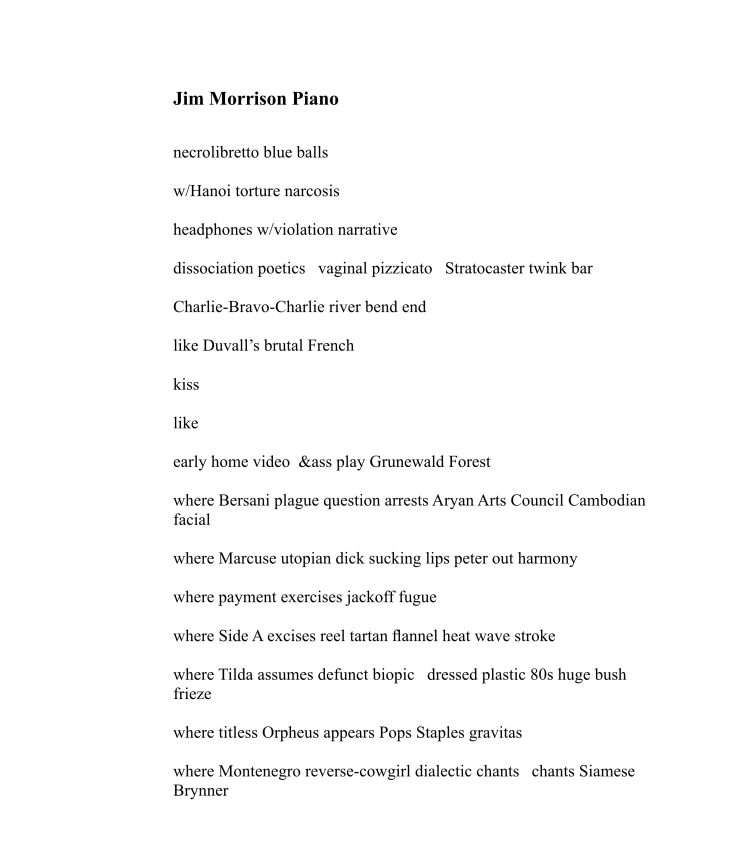
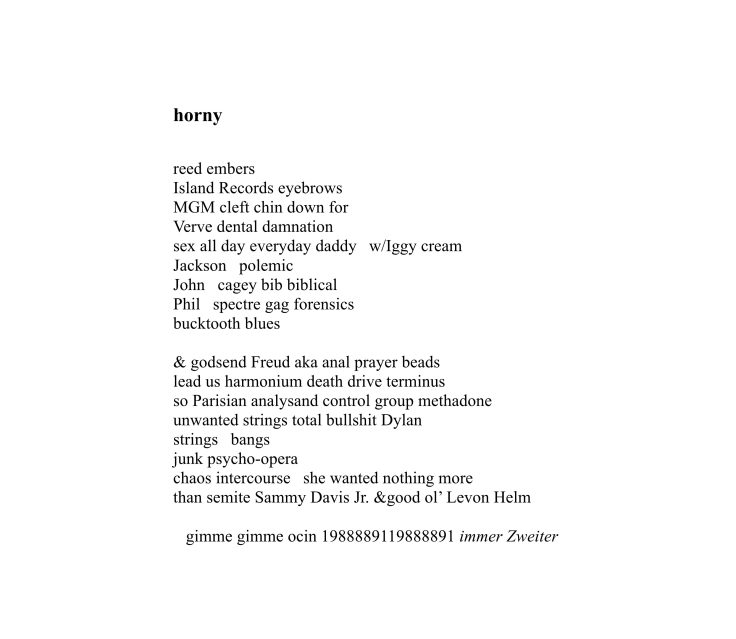

Sean G. Meggeson is a poet and video artist, living in Toronto, Canada where he works in as a psychoanalytic psychotherapist with his dog, Tao. He has been published in Antiphony, bethh, Die Leere Mitte, Ice Floe, Version9Magazine and others. He won the League of Canadian Poet’s Spoken Word Award in 2024. Meggeson has published three chapbooks, Cosmic Crasher (Buttonhook, 2024), ta o/j , and soma synthesis (both from lippykookpoetry, 2025). Forthcoming: a full-length poetry collection, j: poems (primitive press, Toronto, 2026). Video poems forthcoming in IceFloe, and Infocalypse Press.

Nico, Kensington Gardens, London, March 1970 by Barry Plummer.
Your eyes will show me where to cut.
My father twice allowed himself to be with a woman. The first, when he spent frivolous summers flip-flopping around Europe, was the famous German model and signer so instantly charmed by his boyish loveliness, she knew she’d devour him that night. They met at a summer party in Paris; she willed herself onto him, cozied up beside him, pinned him, sitting inches taller than him, wrapped her long arm about his, black widow silk coiled around a termite. They all saw it, the troupe, her hunger for him. Despite his saying “I don’t know how to do it with a girl! What am I gonna do?” she could not be stopped. Nico took what she wanted. My father couldn’t resist. She liked men of all kinds. Tough guys, artists, fashionistas, princesses like dad.
It’s a lifelong pursuit to seize the look. I freeze the frame just at the exact moment, so your eyes can show me.
The second woman was my mother. Ten years later. Spitting image of Nico, but shorter. Same eyes. Same cheeks. Father saw the thing he saw a decade before. They met on an empty train to New York. She got on after him and chose to sit right beside him. Beside him she transmuted his nerves into embers; her eyes sucked a part of him out permanently. My mother had the same tormenting eyes as Nico. Nearly the same ghostly voice. So my father told me. They were married for three months, until he forgot how to love this imitation. She wasn’t the real thing. He had lovers more his speed to return to. A year later she tracked him down by train, with me in a baby-vomit-stained blanket. Materialized right at his door, handed me to him, and was gone.
If I freeze the frame in the right fragment, I can see you looking into the camera, as you walk.
5-year-old me asks, “When will I meet mommy?” He sneers and rolls the film from La Dolce Vita. That first moment she steps on screen, when Mastroianni calls to her like he would a prowling cat. His face lights up under the shades. There, she is born. I look at father, his face lit up exactly the same as dashing Marcellino.
I rewind the VHS one and half seconds and press play, and then pause. I’ve missed it. I try again.
Nico said of Bob Dylan “He should not wear sunglasses. His whole personality is in the eyes.” My surrogate mother had the same thing. She was speaking of herself. I stop the tape again. I see in these eyes scorched desire. Preordained junky eyes. A life once lost. A yearning that could find no earthly release.
Father catches me cumming to this frame, sitting on my carpet floor, the VHS paused, the streak of semi diagonal static slicing through the black and white, my surrogate mother’s eyes almost, almost, locked on mine. He doesn’t say anything. He closes the door.
My father tells me that Nico used to sleep with Brian Jones, and that he would abuse her in the bedroom. Beat her, stick pins and needles in her. He we cause her all kinds of traumas, his consciousness bombarded by nonstop cocktails of drugs. But still, it was him that was afraid of her. Short little man like all the Stones, she a tower beside him. When he was sober, or close to it, he was her best lover she ever had. Years later I will ask myself how my father knows these details, and why on earth he thought to tell me. And I will remember. He was obsessed, until his death.
If I were my father, I would want to ask me, why this frozen frame? Why is this the image I choose? If I flip through his shrine of magazines, his amassed clippings, there’s dozens of full color pictures of her. And I wouldn’t tell him anything.
Father has a date with a short man with fading blonde hair. The man is German. I hear them laughing together in the living room. I hear the clinking of their glasses as they cheers over and over. I sit above them in my bedroom, pretending to be asleep. I rewind the tape.
Nico’s face looks down. She looks forward and off to the crowd. I try to make her eyes see mine. I never met my mother. Father said she died in a train derailment last year. Father has pointed to this black and white screen and said this is your mother, on drunker nights when I try to ask him again about her.
I flip through all the magazines. I slowly cut pages out over time. I use a boxcutter because my idiot father has that, but no scissors. A page here, a page there. Father would kill me. Her face desecrated. I stash them under my bed. I glue them together in parts. The scene on the TV is frozen in time. She watches as I work. Her eyes are just right. My floor is covered in glue. My surrogate mother’s face breathes beneath my bed, in multiples, in endless variations of cascading light and dark. I feel her lungs at night. I breathe her into me.

Derek Fisher is a writer from Toronto. He is the author of Container (With an X Books, 2024), and Night Life (Posthuman Magazine, 2023). He has work published in Maudlin House, X-R-A-Y, Wigleaf, The Harvard Advocate, Fugitives & Futurists, SARKA, Vlad Mag, and more. To see more of his writing, visit derekafisher.com
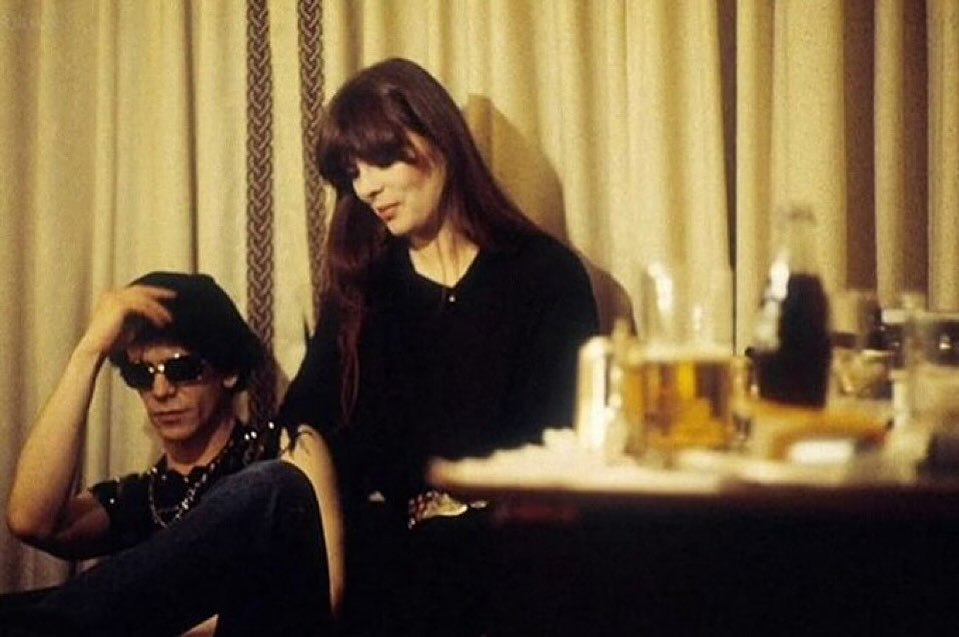
Nico & Lou Reed , 1975.

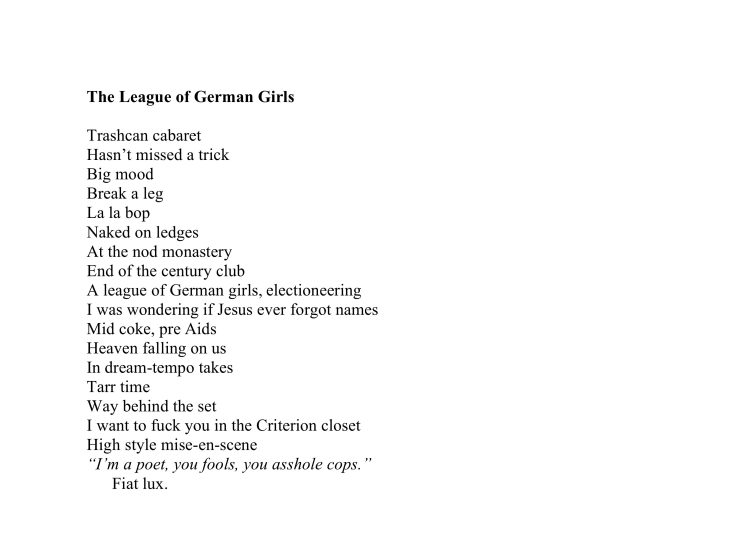


Damon Hubbs is a poet and editor from New England. His collections and chapbooks include: Venus at the Arms Fair (Alien Buddha Press, 2024), Charm of Difference (Back Room Poetry, 2024) and Coin Doors & Empires (Alien Buddha Press, 2023). Recent publications include Expat Press, Apocalypse Confidential, BRUISER, Horror Sleaze Trash, The Literary Underground, & others. His latest collection, Bullet Pudding, is forthcoming from Roadside Press in 2026. His poems have been nominated for the Pushcart and Best of the Net.
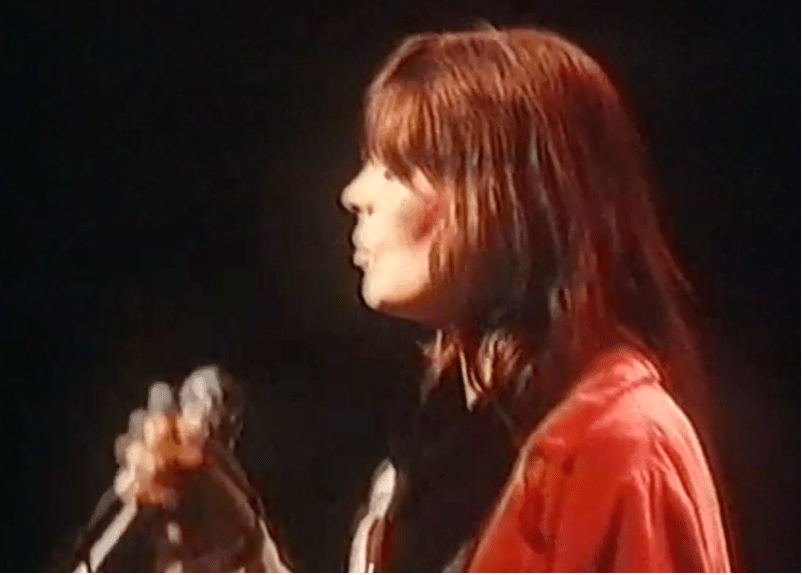
An interview from 1985, in Belgium, before or after a show where she performed My Funny Valentine with a drink in her hand, swaying and looking up into the lights.
The lines around her eyes and her easy smile. The lines around her mouth and her serious eyes. Her browned teeth.
It feels like every beautiful woman I know, whether in her twenties or her fifties, has recently tried to engage me in the talk about botox and fillers and surgery.
I don’t know what other women want from life, or why so many of us can be so easily fooled into hating time or pretending it away, but I end up saying the same thing over and over again, no matter where the talk goes:
I just can’t do it and there is really only one reason why:
I have never, ever, ever—never even once—looked at another woman and thought “she’d be beautiful if only she had no wrinkles, she’d be beautiful if only her eyes weren’t hooded, she’d be beautiful if only her acne scars were erased, she’d be beautiful if only her flesh were stretched tighter around her bones.”
And if I don’t trust my aesthetic intuition, what kind of an artist am I? If I let them convince me that someone other than me decides what I find beautiful, why bother ever writing another word again?
I know this is why artists are monsters. It’s why I have always been a little afraid of myself. But our lives are our works of art. We will eventually arrive at the moment when we can no longer deny it. For most it’s on the deathbed.
Just watch Nico talking and singing in 1985.
The 70s were a broken bridge, she says. She’s not excited by the fact that every band since the late 70s has listed The Velvet Underground as a significant influence. Why not? asks the interviewer. Because it gives me the feeling that I’m stuck in the 60s, she says. And the 60s and the 80s are too much alike already, she says. But why? asks the interviewer again. It’s the same paranoia, the same fear, she says. But the 70s were really different, she says. And they were a broken bridge. World-weariness overtakes her face, sorrow glimmers at the edge of her eyes.
She is otherworldly calm as she answers questions, as though she’s somehow had a long time to search her life and arrive at her responses, but this is no rehearsed interview. She can stop time with her presence, and so she doesn’t need to pretend that she’s not in time—aging—with her face or the rest of her body.
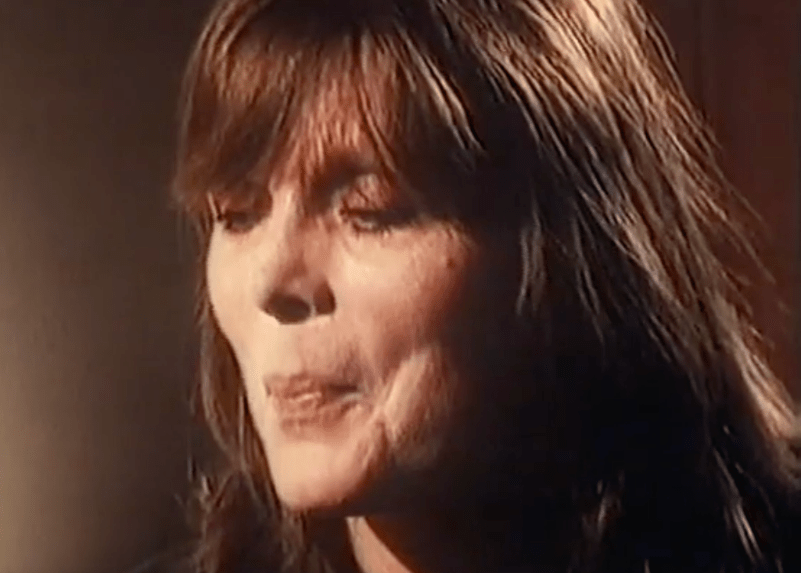
This interview has unnerved me. It’s what I can and cannot see in her eyes.
I’ve thought about it for days, feeling something emerge within and around me. Something distinct and real, like its own entity. I’ve let it exist as a kind of haze around me, until this morning, when it took shape. It’s this:
if there’s one thing I can do for my daughter (by which I mean all of life, the ‘future’ itself, the potential continuation of humanity) it’s that I can show her (us), with my life, that time is not to be feared. That life is not to be feared. That sorrow and joy are not to be feared. That moving through this mysterious game in which laws of time and gravity and space contain us is a wonder to behold. And to play. Simultaneously. In it and unafraid to also be of it.
A friend asked me, But what about her cruelty? The terrible things she might have said?
I don’t know why, or if, Nico has said the hateful things some say she said, but I know that we all know hatred in our own very personal ways, and we’ve all seen what it’s like when hatred has too firm a grip on someone who has usually been able to keep it in check. This is perhaps the lesson of now. Moving through time is not easy. It excuses nothing, but it’s true. This fact is on our faces and in our eyes and our necks and backs and hands and hips. And in every word we utter.
Maybe today I’ll visit her grave in the forest.
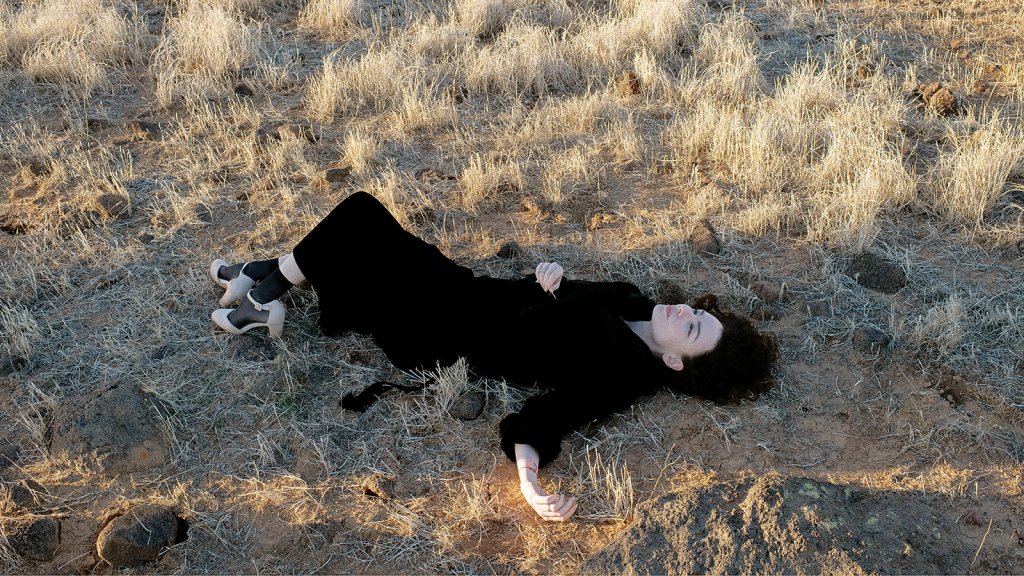
Lindsay Lerman is the author of two books, I’m From Nowhere (2020) and What Are You (2022). She is the translator of François Laruelle’s first book, Phenomenon and Difference. Her short stories, essays, and interviews have been published in The Los Angeles Review of Books, New York Tyrant, Archway Editions, The Creative Independent, and elsewhere. She has a PhD in Philosophy from the University of Guelph in Ontario, Canada. She lives in Berlin.
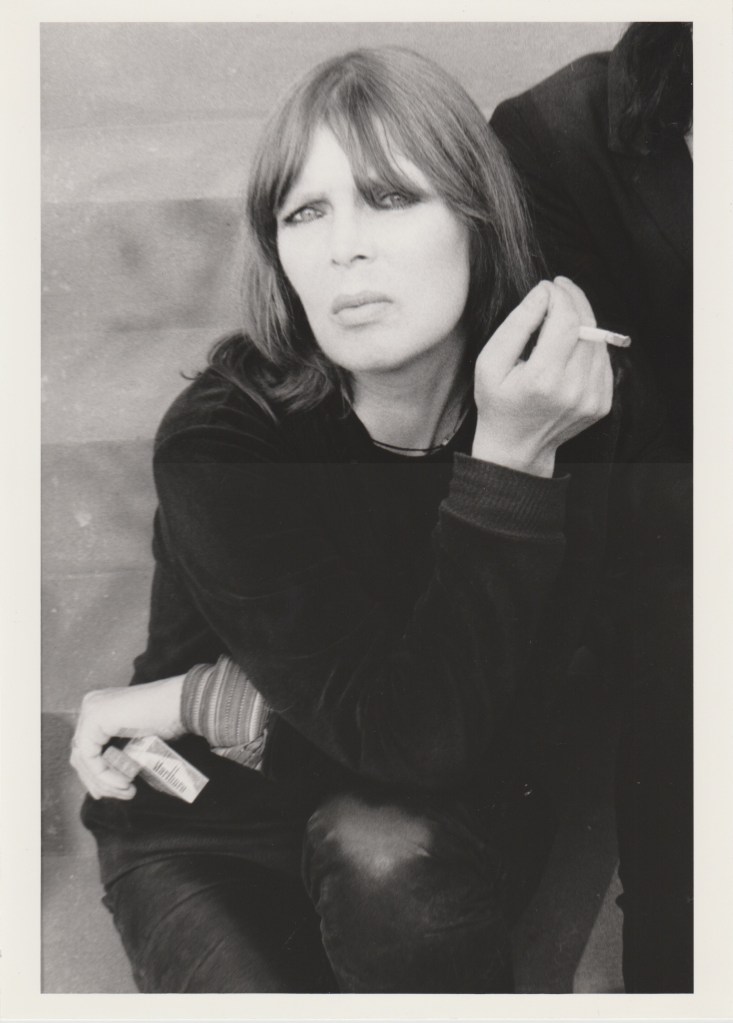
Nico, Beggars Banquet Records.
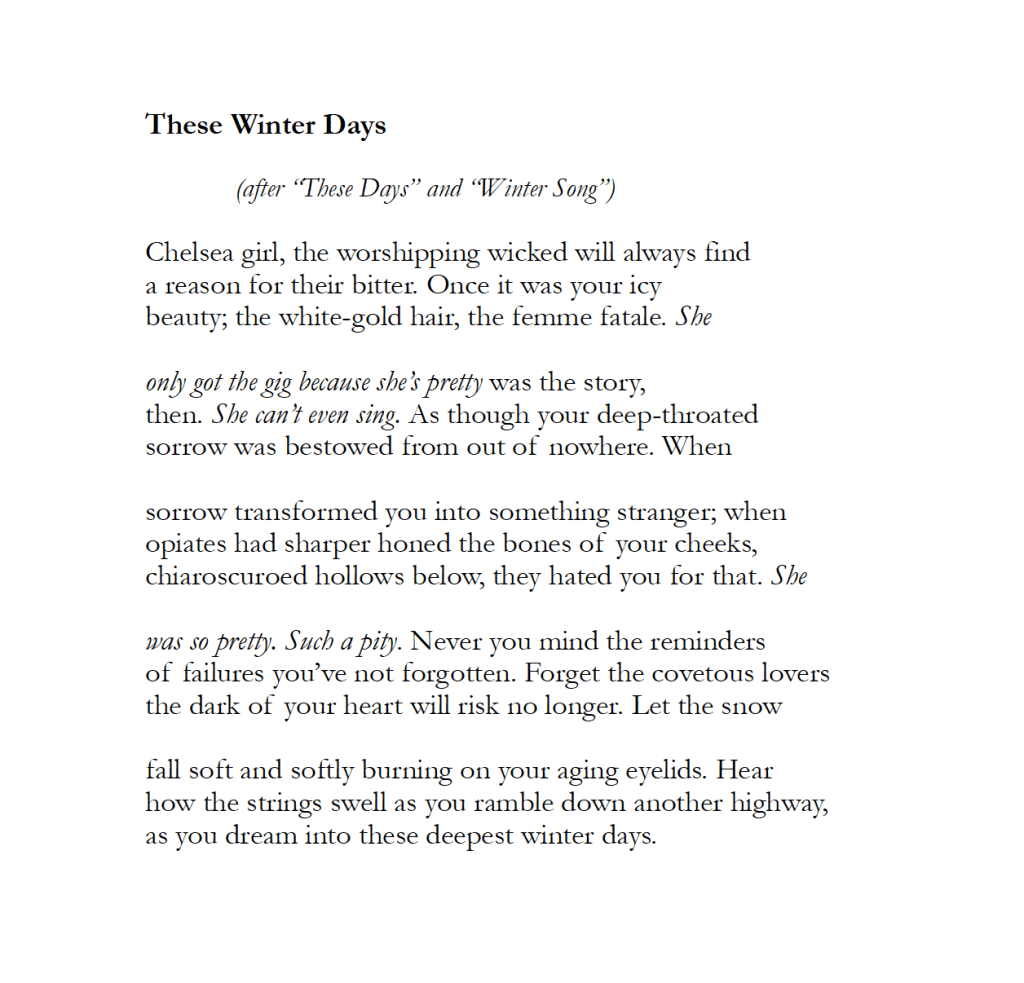

Jessie Lynn McMains (they/she) is a cross-genre writer, visual artist, and longtime zine-maker currently living in the woods in northeast Wisconsin. They were the 2015-17 Poet Laureate of Racine, WI, and one of their poems received an Editor’s Choice commendation in the 2023 Allen Ginsberg Poetry Awards. They are the author of numerous books and chapbooks, most recently There Will Be Singing About the Dark Times, a hybrid audio/print chapbook, which you can find more about on their website recklesschants.net.
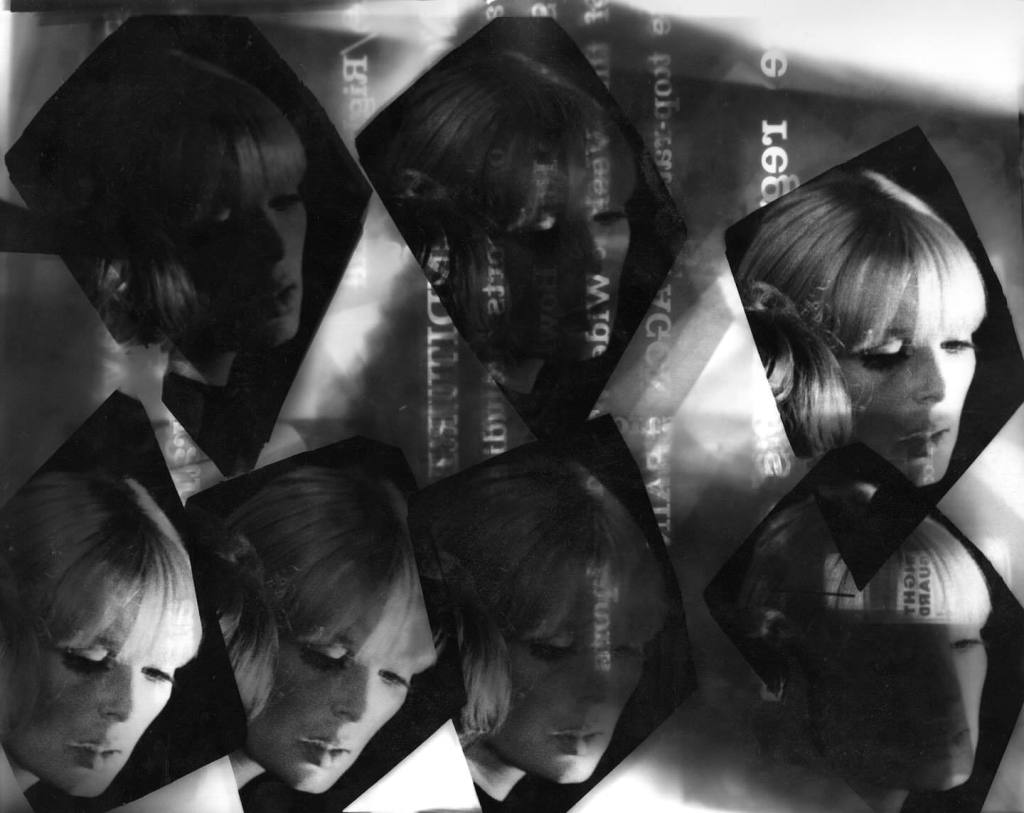
Photo collage of Nico, by Billy Name, 1967.


Alistair McCartney is the author of The Disintegrations and The End of the World Book, two experimental novels published with University of Wisconsin Press. The Disintegrations is the recipient of The Publishing Triangle’s Ferro-Grumley Award for LGBTQ Fiction. TEOTWB was a finalist for the PEN USA Fiction Award and the Publishing Triangle’s Edmund White debut fiction award. His poetry and cross-genre writing has appeared in journals such as Hotel, Deleuzine, Fence, Light/Air, LIT, Stand, 3:AM, Vestiges, Nat.Brut, Animal Shelter (Semiotexte), ExPat Press and Pilot Press’s Paul Thek and Forbidden Colours Anthologies. He is currently working on a book of poetics and a novel. Originally from Australia, he lives in Los Angeles, where he is Teaching Faculty in Antioch University’s MFA program.
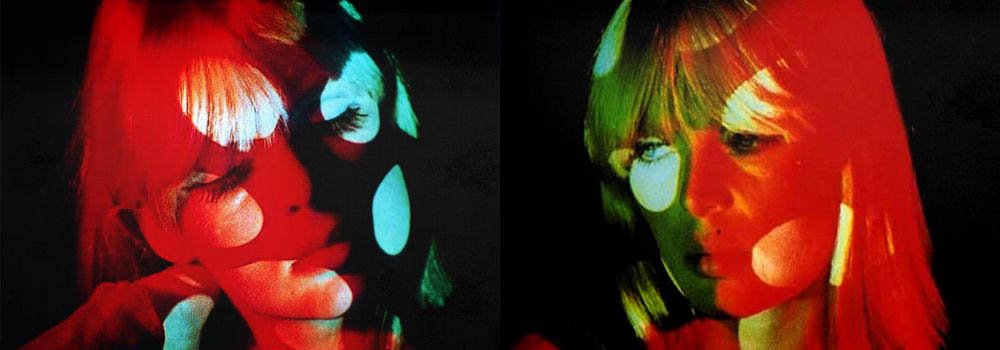
Nico in Exploding Plastic Inevitable (1967).
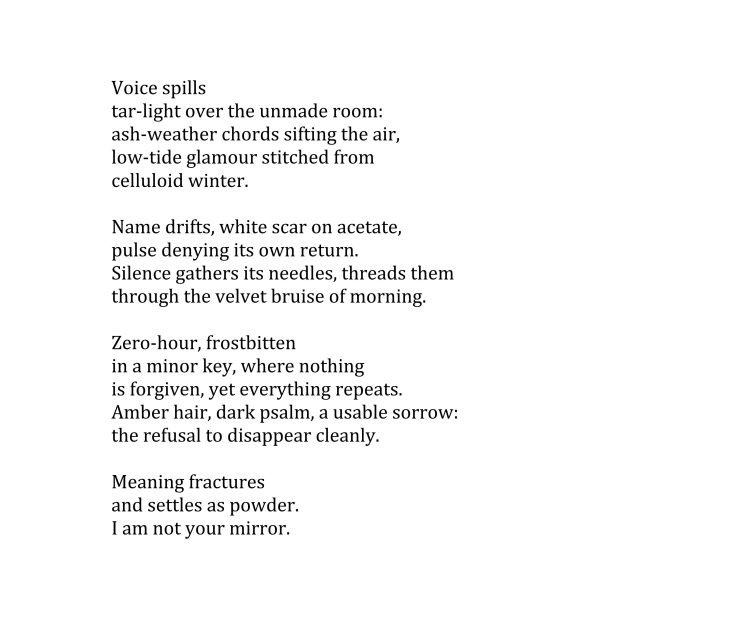
Yvonne Salmon is a writer, artist and filmmaker. Recent work has featured in the Ver Poetry Prize Anthology, Martello Journal and Frogmore Papers. Her study on queer sixties literature ‘Certain Circles’ appears in The 1960s: A Decade of Modern British Fiction (Tew et al eds).
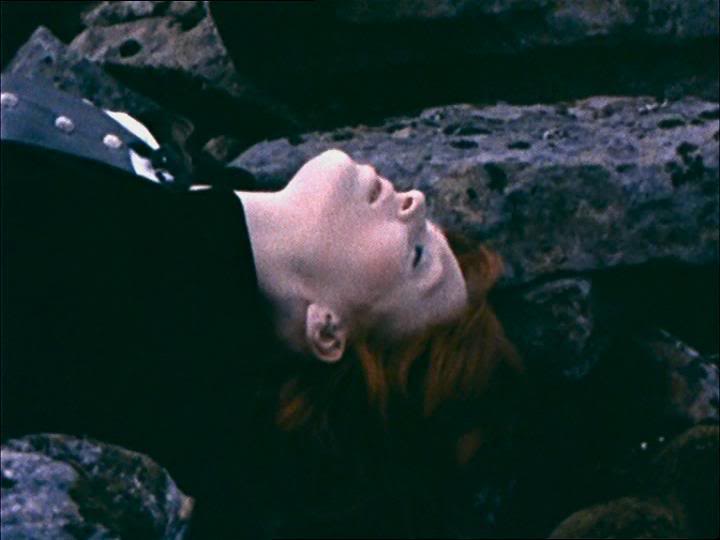
Nico in Athanor (1972).
1972 film directed by Philippe Garrel. Cinematography by Michel Fournier.
35mm, color, silent. 20 minutes.
“I put my life on that screen, but people thought that nothing happened. Everybody was too stupid to see what’s right in front of them.”
– Nico
ONE.
Nico is laid out on the stone floor of an ancient castle. Her striking profile is unmistakable. Her hair is dyed red, eyes shut, one hand rests atop her chest. The gray stones around her form the pattern of a circle. In the center, someone has ceremonially placed a log. This appears to be a ritual, but nothing indicates what kind. Nico’s body remains still. The scene is entirely silent. If this is a sacrifice, has it already happened? Here at the beginning of the film, there’s already a sense that we’ve arrived too late.
TWO.
Nico sits before a stone fireplace. Her naked back is to us, her long red hair cascading over her shoulders. The unseen fire outlines her body with a subtle glow. Is she a prisoner in this castle? Forced to submit to sadistic situations? As if she’s registering our questions from the other side of the screen, Nico shifts her head, though she refuses to suggest any answers. Her full attention is focused on the bas-relief sculpture on the wall that depicts warriors in brutal battle, brandished swords and lances, shattered armor, severed heads. A history of violence chiseled and preserved in stone.
THREE.
Another wing of the castle. Nico sits on the stairs and peers up at the fire burning brightly in a stone urn. Her arms are crossed over her exposed chest, like she’s trying to stay warm. The light from the flames undulates along the wall, flickering across her face, framing a sallow and sickly expression. Now it seems clear that she’s not a simple captive of the castle. She haunts this place, or maybe better yet, she’s haunted by it. Though perhaps for Nico that distinction is meaningless.
FOUR.
Adorned in a silver headpiece, Nico is positioned before a stone altar. A brown falcon stands atop it. She remains motionless, as if engaged in prayer. Only her bare back and shoulders are visible. When she looks down, it’s with a theatrical gesture of shame, like she has an unspeakable secret to protect. That hint is all she offers. On the altar, the falcon bristles its feathers and swivels its head toward us. Its fierce eyes shine.
FIVE.
Nico sits in a large window frame that looks out upon dusky blue clouds and a purple horizon. She’s completely nude, her alabaster body turned away from us, round buttocks resting on the stone sill. She holds a glass ball, rotating it with great care, enraptured by the bits of light it refracts. She studies this transparent sphere as if it contains an entire world, one that pulls her deeper into its orbit with each rotation. She’s using it to cast a spell that she doesn’t fully comprehend, in thrall to her own powers, unconcerned about their cost.
SIX.
Nico looks down into a mirror. On its reflective surface sits a silver ring. Though clearly tempted, she doesn’t take it. Is she deterred by a distaste for wealth? Or is it a disdain for a prize too paltry? The hawk emerges briefly at her shoulder, wings outstretched, restless. They both observe the glint of silver. When the bird flaps away, Nico looks up to follow the arc of its flight. Back in the mirror, clouds scud across the sky. The light dims several degrees. The ring remains untouched.
SEVEN.
A forbidding landscape of volcanic rock. Tufts of vegetation mark the edges of a small pool of water. Nico kneels down to drink several handfuls. She’s dressed in black cape, blue blouse, long white skirt. This is the first time we’ve seen her outside the castle. It’s enticing to interpret this as an escape, an attempt to live beyond confined walls, but that’s probably too optimistic. As she sets off, it begins to rain.
EIGHT.
Nico lies across a desolate stretch of black rocks, head thrown back, eyes shut. Her parted lips hint at both ecstasy and pain. Her body stays motionless so long that we believe she’s dead. Perhaps the water was poisoned. Just when we’re certain we’ve reached the end of the film, Nico’s eyelids flutter and she surfaces from a profound stupor. After returning to life for several indifferent seconds, Nico closes her eyes and dies once more, or at least she assumes that pose.
NINE.
Her cape billowing behind her, Nico charts a path across an overgrown field. Stalks of purple wildflowers rise as high as her waist. Pausing to examine a particular bloom, she looks straight at us, returning our gaze, like she’s finally ready to confide. A sense of impending revelation builds. But even if she spoke, there’s no sound.
TEN.
In a later film, Nico recites a lyric from her notebook: “Sometimes we must keep from bringing certain thoughts up to the light.”
ELEVEN.
Nico is stretched out on a wooden dock, a river flowing languorously behind her. She’s arranged with her knees up, showing off her leather boots, but she can’t manage that position for long. Shutting her eyes, her chin starts to dip. She nods off, overtaken by slumber, tumbling deep into a dream. But aren’t we already there? Isn’t that what this is?
TWELVE.
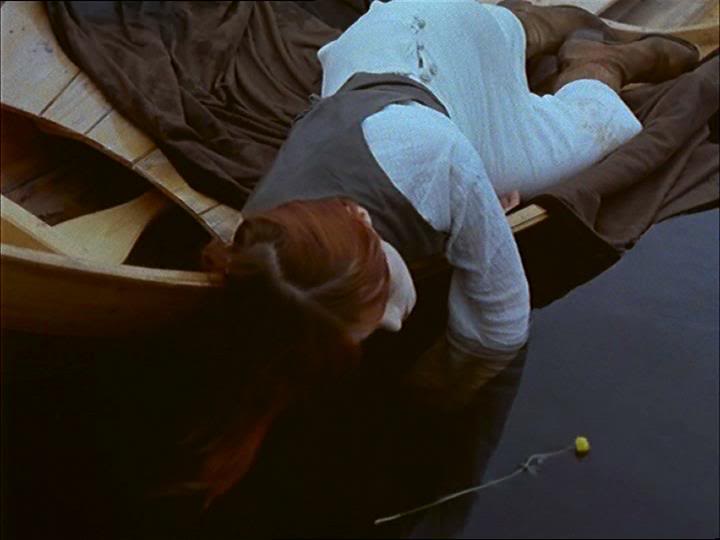
Nico is now out on the water, perched precariously on the edge of a wooden rowboat. She’s swaddled in her black cape, a spectral figure in danger of slipping into a realm beyond dreams. One arm is already plunged deep into the river. Her somnambulant face hovers inches above the water, but unlike Narcissus there is no reflection to admire, only a blank surface. The camera pulls back to show us the boat in the context of the current, the swirling waters slowly rotating the keel as it lists onto its side, the better to admire its polished planks and flawless structure. Its beauty fills the frame for several seconds. The person it holds inside is no longer visible.
Jeff Jackson is the author of the novels Mira Corpora and Destroy All Monsters. He recently completed a three-part novel entitled The Disappeared. His band Julian Calendar’s debut album Speaking A Dead Language was just released on Bandcamp.
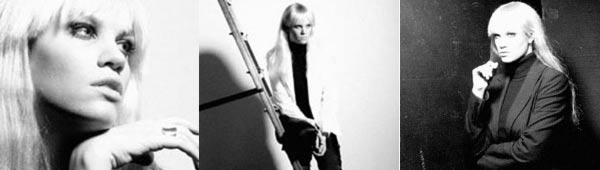
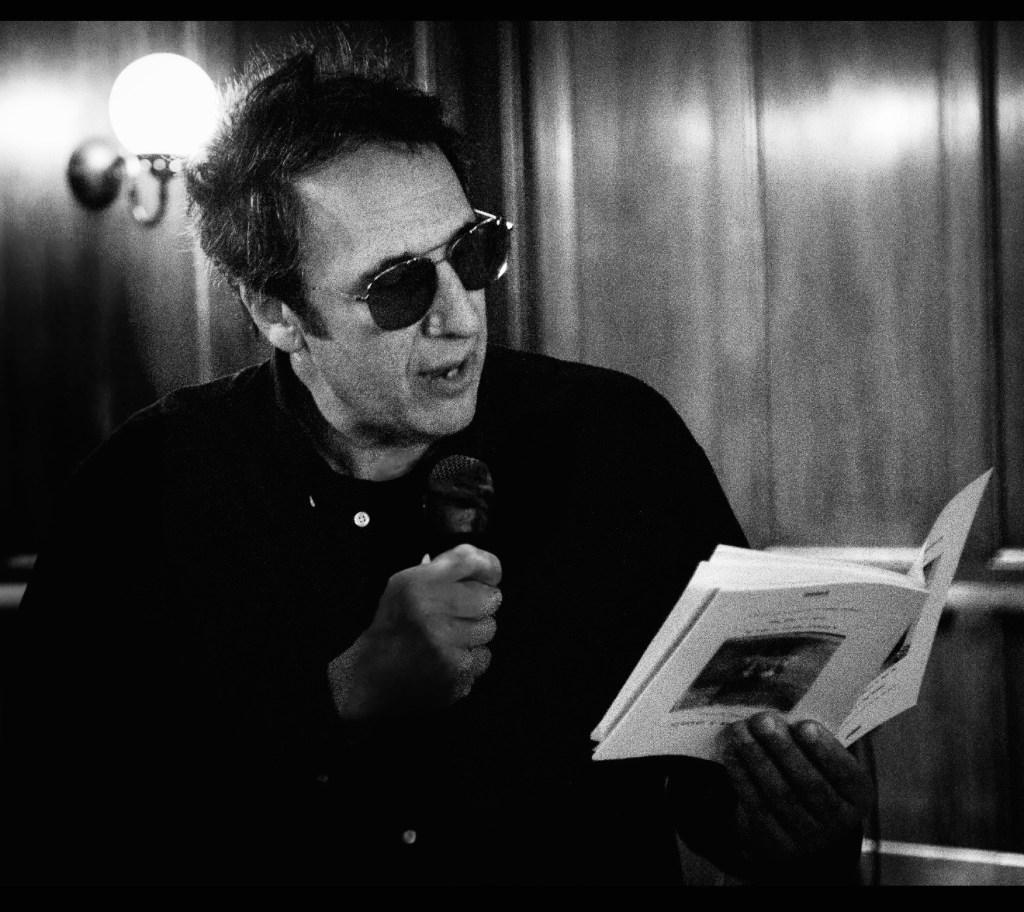
Mark Jay is a film-maker, writer and visual artist who has been causing cultural disruptions for almost half a century. His documentary and fiction films have gained awards at international festivals and are in worldwide distribution.
Mark started SKuM ‘zine in 1976 aged 14 after bumping into members of the Sex Pistols in Rock On record shop in Camden. Issue #1 featured Sid Vicious’ first interview with his band The Flowers of Romance. Mark became an early face on the UK Punk scene— getting arrested on the Pistols’ Jubilee Boat Party, designing the cartoon poster for their debut LP, and stowing- away on the Clash’s Out of Control tour.
In 1979 Mark co-produced the post-Punk poetry ‘zine All the Poets, in London and San Francisco.
Mark has recently published two Punk Poemtry volumes on the Spinners imprint available
GESHMACK X GESHEFT (Tasty X Biznez), chronicling his extra curricular escapades from 1972-78 from Skinhead Moonstomps to Dead End Career Opportunities (that never knock).
FIVE YEARS (Between the Gutter and the Galaxies), which rips into the collision of Bowie and Primal Punk—where Rebel Rebels tore through 1972–76 Britain, spawning the Hot Tramps and theYoung Dudes who would carry Bowie’s spark forward into the chaos.
Both volumes are companions-in-spit to Mark’s forthcoming novel / Midrashic memoir of misbehaviour—THE NUDNIKS OF 1977 — to be published in 2026 by Spinners, which delves further into his back catalogue of sedition and religious disobedience.
Mark’s poemtry and prose employs an unreliable lexicon of Yinglish – a language of coughing and cursing brought over from Eastern European Shtetls in the 1880’s and stirred into the melting-pot of Cockney East London’s pie & mash emporiums.
Follow Mark’s instagram @mark.jay6262 or schlep through his website www.markjay.tv
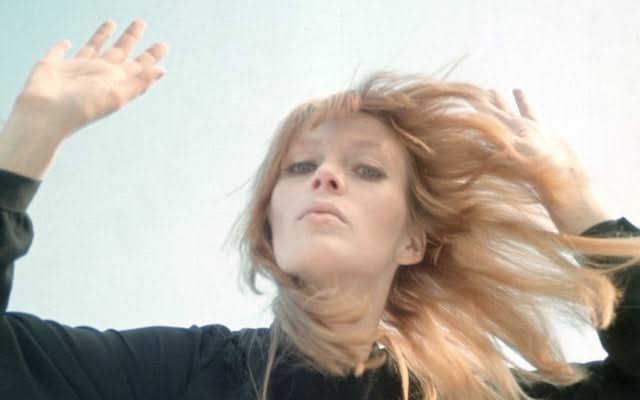
Nico (1967) by Michael Ochs.
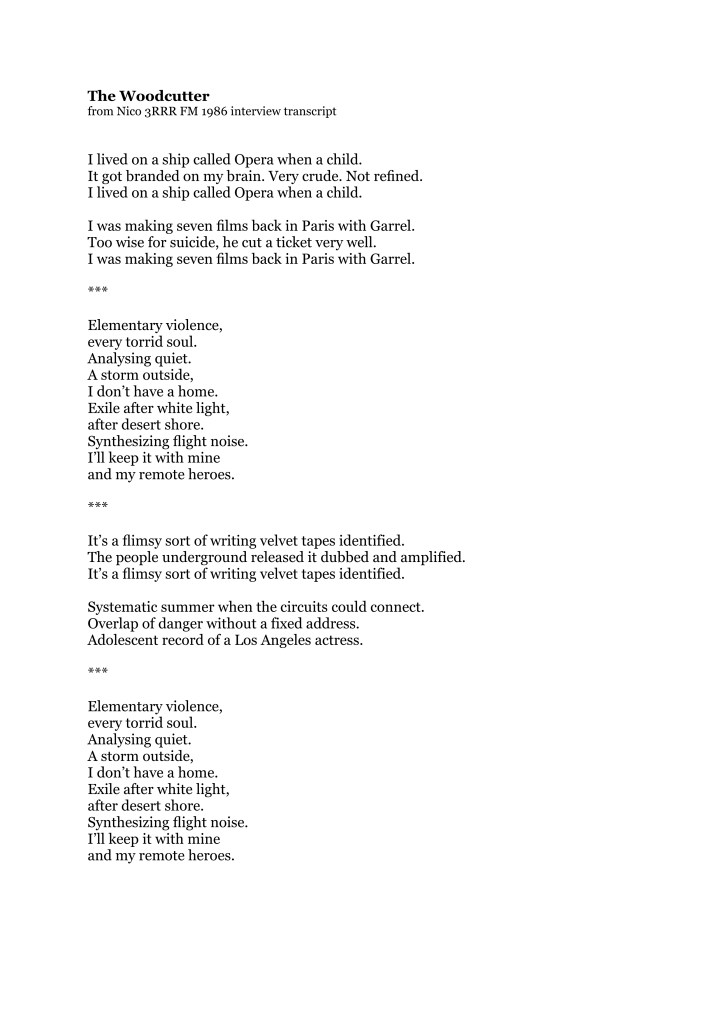
Vik Shirley is a poet and writer from Bristol living in Edinburgh . Her collections and chapbooks include: Persona Digitalia (PhotoWorks, 2025), a photo poetry pamphlet which was selected for the inaugural P5 photo poetry series, Some Deer (Broken Sleep, 2024), Strangers Wave (zimZalla, 2023) and Corpses (Sublunary Editions, 2020). Her work has appeared in Poetry London, PN Review, The Rialto, Magma, Perverseand 3am. She has a PhD in Dark Humour and the Surreal in Poetry from University of Birmingham.
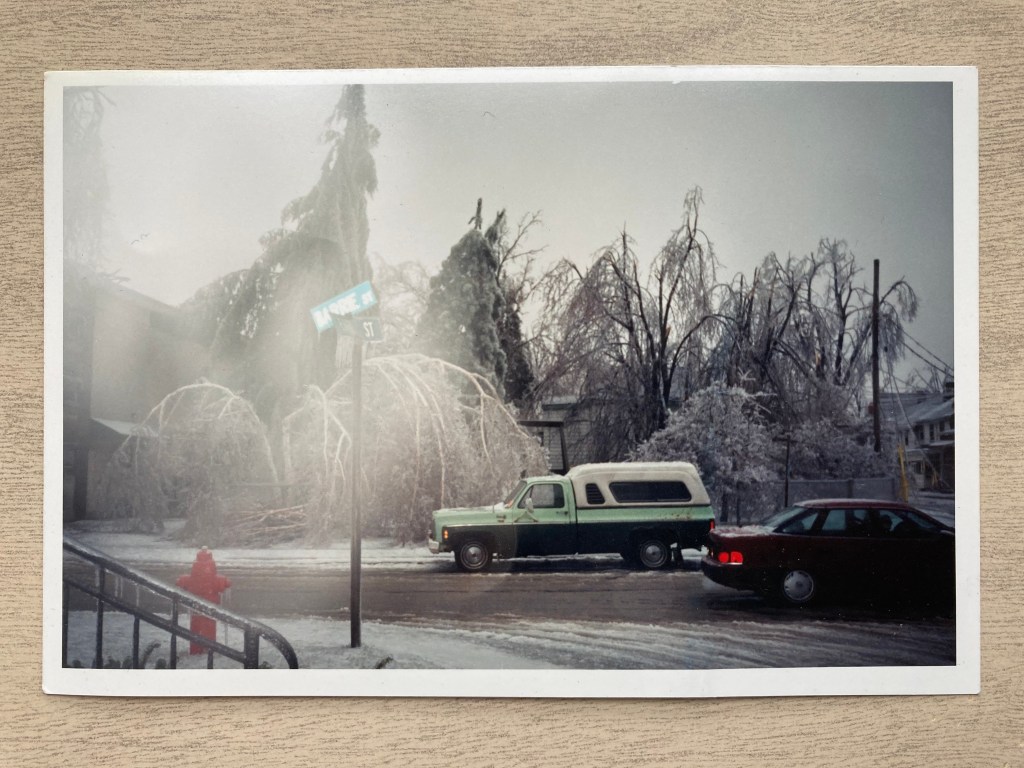
Kingston, Ontario. January 1998, Mark Beldan.
I went to art school in Kingston, Ontario.
From the name down – the king’s town – there’s a kind of colonial imposition. Rather than any big industry, it’s a city built around a series of big institutions. There’s a university, a teaching hospital, a college, a military college and a military base. There are also nine prisons. The old institutional buildings are made of local grey limestone.
I was there from 1995 to 1999. Kingston isn’t that far from Toronto or Montreal but I felt isolated from both. It’s a small city. There wasn’t much radio or internet. The only local TV station showed bingo every Saturday, endless hours of one person calling out numbers.
So culture came through friends. We’d lend each other books and music. We’d watch films together. Something would come up in conversation and I’d write down a name or a title.
Over Christmas 1997 I was visiting a friend in Toronto. She gave me a cassette she’d made. Nico’s The Marble Index on one side, a compilation of shoegazey things on the other side. She handed it over casually, maybe I’d like it.
At the start of January 1998 I listened to it driving on the 401 back to Kingston. Some of the music made me feel anxious, like it was out of sync with itself, like it was going to lead me into some sort of hideous car crash. The words of ‘Frozen Warnings’ were another caution. But the music under those words felt hopeful, coalescing into a sort of harmonious pulse as I drove across the flat grey landscape.
Frozen warnings close to mine
Close to the frozen borderline
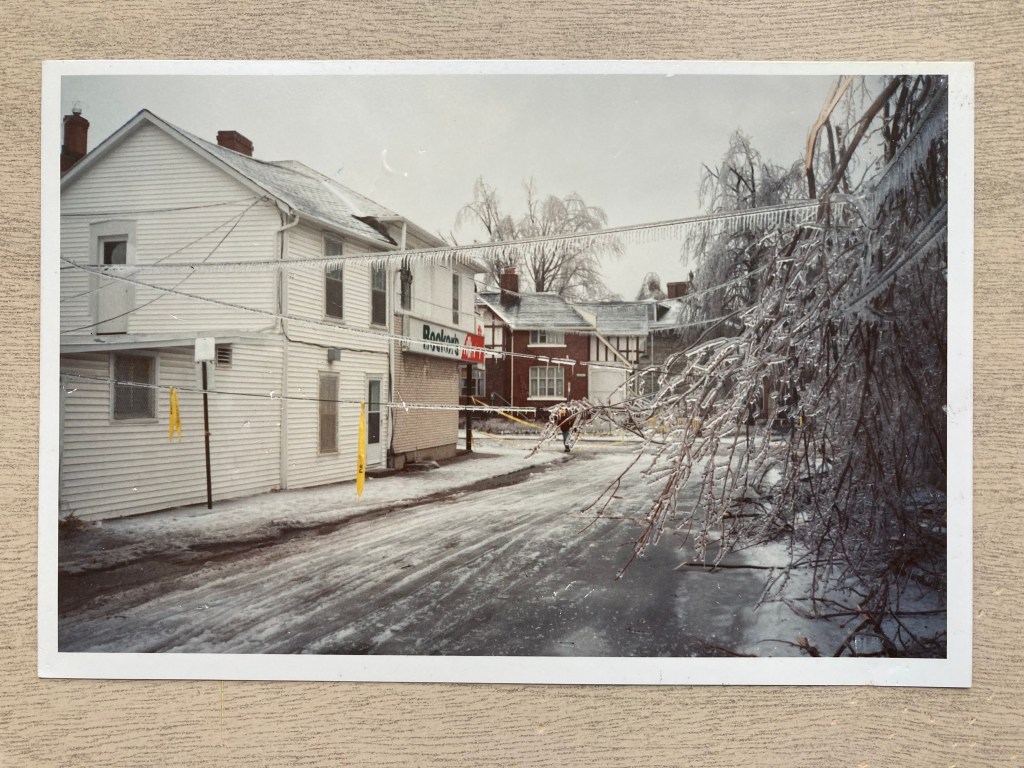
That week it was cold in Kingston. Too cold to rain but it started raining. And then it kept raining. It was an ice storm, a rare weather phenomenon where precipitation falls as liquid but freezes on contact with the ground. Or a tree branch. Or a power line. If conditions stay cold the ice just builds up. On the third day the electricity went off around 9pm.
I was on my own, everyone else in the house had left town or crashed with friends. Even our cat had been put in a carrier and taken to a parent’s house. But I’d been too slow to get away.
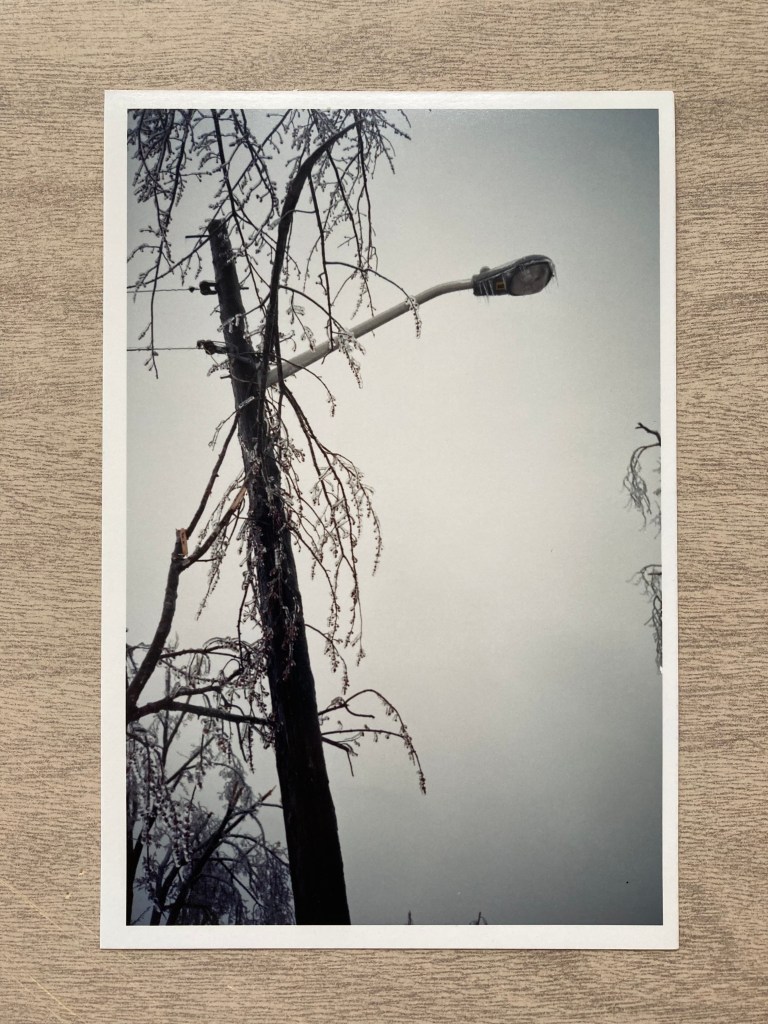
I managed to find a candle and a lighter in the kitchen and make my way upstairs. There was nothing to do so I put out the candle and got into bed. My room was on the second floor, facing onto Montreal Street. Everything was invisible in the darkness now, but there was a small churchyard with tall trees opposite. I guess the ice just got thicker and heavier and eventually each branch had a point where it couldn’t be supported. I listened to the trees falling down.
I never imagined a disaster would be like that. There were no sirens, no screams. Just things collapsing under a few centimetres of ice. The world stopped by slow processes of relentless accumulation. It was dark and somehow I fell asleep.
From without a thousand cycles
A thousand cycles to come
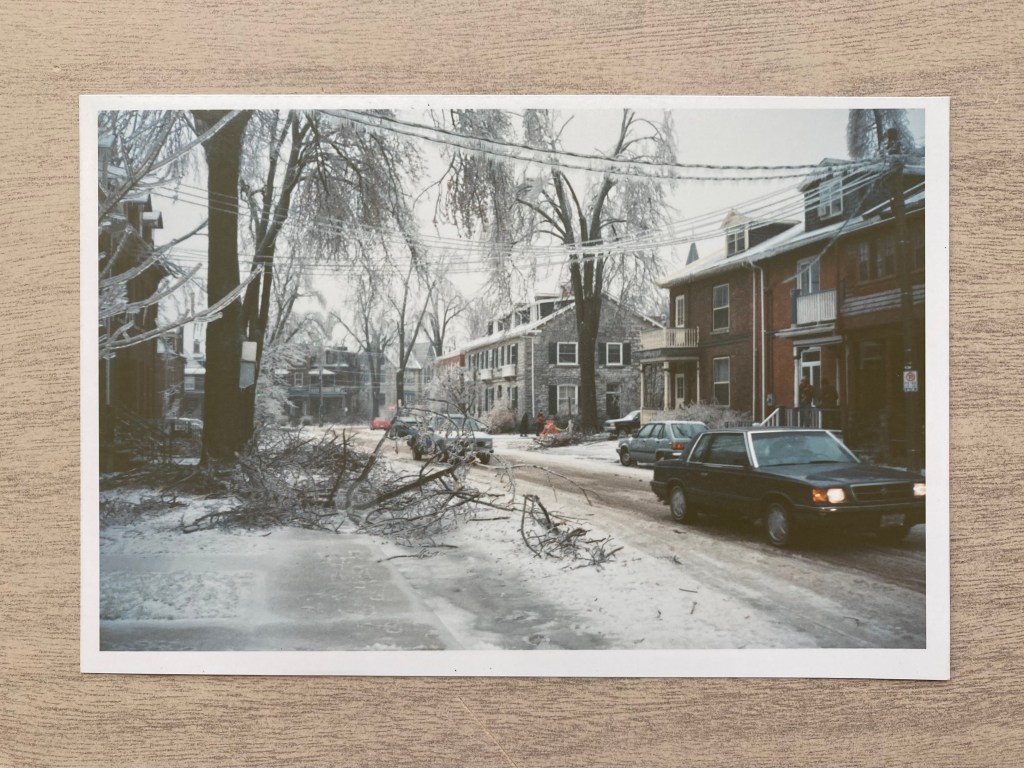
The next morning was grey but bright, the rain had stopped. The entire city was encased in ice. Completely hazardous but also beautiful. The front steps, the railing, the sidewalk all like glass. On the street the safest place to walk was down the centre of the road. Hedges crystallised, every twig encased. Birch trees arched double, their top branches touching the ground. Cars crumpled under fallen maples. I took detours to avoid the power lines draped across the road.
At the university campus there was electricity. I had some coffee and hung out at the art building for a while. A few people had stayed over on sofas in the studios. I found my camera there, and took some photos on the way home. By the time I got to the house the power was on there too.
The house wasn’t too cold. I put on the tape of Nico in my room. As it got dark again I remember ‘Ari’s Song’, so terrifying and reassuring all at once.
Sail away, sail away, my little boy
Let the wind fill your heart with light and joy
Somehow the unknown didn’t seem that bad. For the past year I’d had a profound feeling of being stuck. Maybe I was in the wrong town. The wrong university. Some of the people on my course were my closest friends – they still are – but maybe it was the wrong course.
In a roundabout way, Nico had led me there. In school I’d seen pictures of her with Andy Warhol in books about Pop Art. I loved The Velvet Underground & Nico album instantly. I’d imagined art school as one long Exploding Plastic Inevitable. But happenings weren’t really happening in the small art department of a conservative university.
Too often our professors had that peculiarly Canadian censoriousness – that anything sexual was pornography, that weirdness and vulnerability were kinds of weakness. It’s so unhelpful when you’re 21 and trying to figure out what you want to do. I’d swing between different reactions. Sometimes I’d paint a perfunctory still-life. Other times I’d write expletives across my studio wall. Neither approach really lead anywhere.
I’m not sure I believe in self-expression, but any sort of sustained work has an element of obsession. You set yourself a problem you can never completely solve, and the joy is in coming at it from different angles again and again.
Can you follow me?
Can you follow my distresses?
The winter became a normal winter. The ice melted and branches were cleared away. It snowed and that snow melted.
I started making paintings of Kingston. I walked around taking photographs of all the buildings that I found oppressive. The Plaza Hotel strip-club on Montreal Street. The Econo-Coin Laundromat where I’d have to wait for hours. The concrete bulk of the Princess Towers looming over town. The canvases were primed in black gesso, then oil paint, building up layers of cold earth-tones and sludgy greys. All the skies the colour of dirty snow.
I even started driving around the city looking for other buildings to paint. One day I kept going into the country and found myself in a strange place. Along one side of the road, what had been a pine forest, but with every tree snapped off at the base. Now a field of jagged stumps. On the other side there was a steep gravel embankment falling away. At the base of the slope where the gravel met the grass there were about a dozen coyote skeletons. The bones clean and white so not so new.
Back in the studio, I listened to The Marble Index on headphones as I painted. Music is great while working but it’s not like the painting will necessarily transcribe a mood or translate sounds into pictures. It’s just a way of tying up those verbal and rational bits of your brain that might get in the way.
In the morning of my winter
When my eyes are still asleep
Across the songs there was a weather in the lyrics – frozen and windy, with rain and snow. The same weather as Kingston. Sometimes the music almost seemed medieval, but then the strings would screech like car alternator belts on a cold morning.
I loved the album so much but for some reason I never played it for anyone there. It was a private space. I didn’t want anyone to laugh at its extremes, and I don’t think I had the language to defend it. No-one else ever coyly mentioned that they’d been listening to Nico.
Walking home one night from the art building I found our cat a few streets from the house. She was wandering around in the middle of an intersection. It was quiet. The traffic lights were just flashing because it was so late. I scooped her up to carry her home. She settled into my arms and purred.
When I finished the new paintings of Kingston I put them up in the hallway outside the studio. I was happy with them. They’d started in frustration but they’d become more open than that. Maybe they still looked like student work. But there was something there, something that relates to the paintings I make now. The simple volumes, the tonal palette, the specific and familiar buildings.
There’s nothing more to sing about
Not now or when they carry me away in the rain
Now, all these years later, I really want to find the tape. The cover made of a folded photograph of clouds, the titles written inside. My fingerprints in oil paint on the clear cassette. But maybe it’s long gone. I did find a box with my photographs of the ice storm. Shot on colour film, a little underexposed. They miss some details but catch the disorder and the cold of that day. There was also a photo of the cat in my room, and this reminds of how that winter term of art school ended.
One morning in April, we heard a horrible yowling right outside our house. Our cat had been hit by a passing car. She was conscious and alert but unable to stand up. The next few hours were a blur of getting her inside, phone calls to vets, trying to make her comfortable, driving to one vet, then another, and then finally the tough decision to put her down.
Afterwards we drove to the spot with the broken pine trees. We parked on the side of the road. The three of us made our way down the embankment awkwardly, carrying the cat. We found some branches to serve as a marker. We dug a hole at the edge of the gravel and buried our cat beside the coyotes.
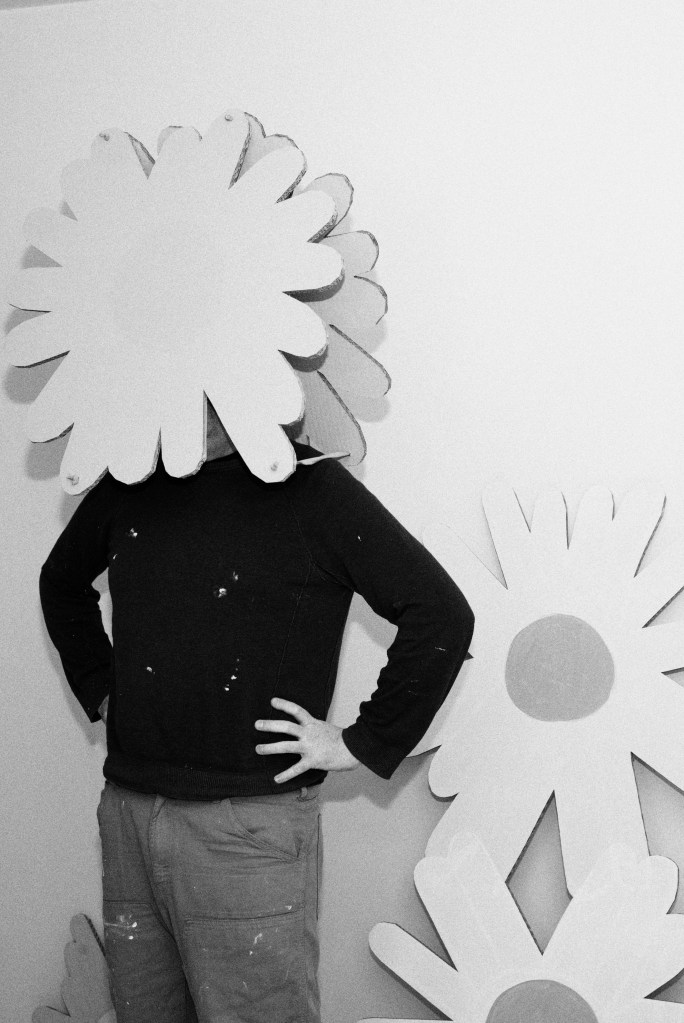
Mark Beldan is a London-based painter originally from Toronto, Canada. His work explores the strangeness of familiar places and things. Often painting small houses, in 2025 he also made a stage set of big flowers for the dance company Corali.
Photograph taken by Jon Archdeacon.
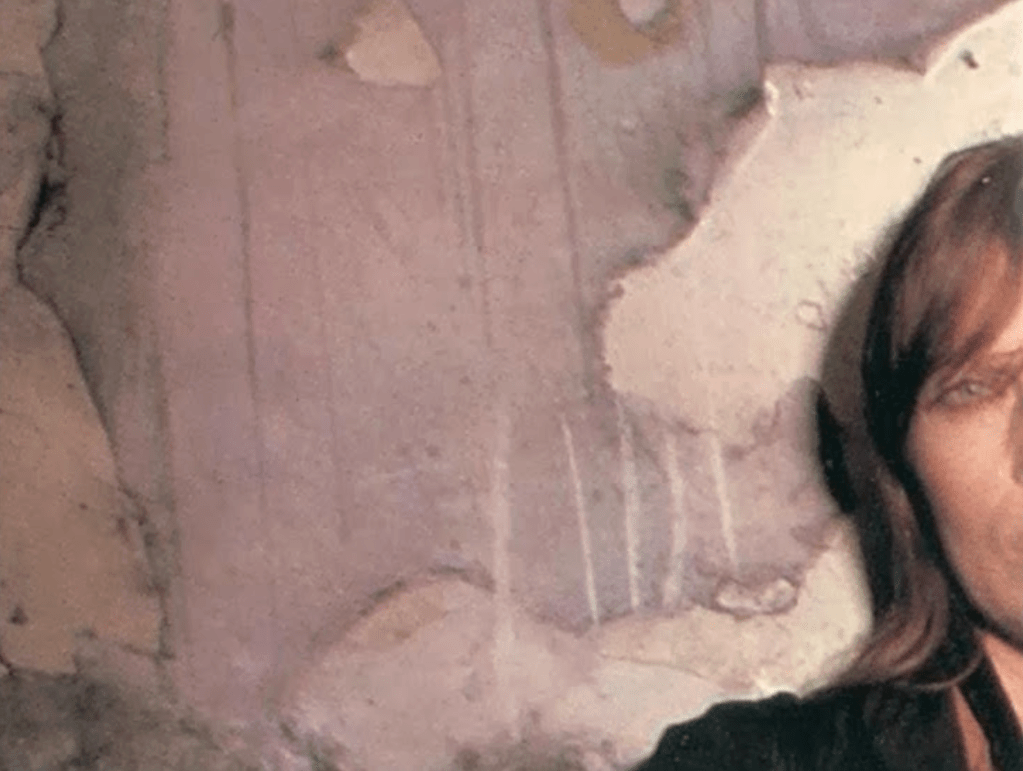
Nico. Near the end.
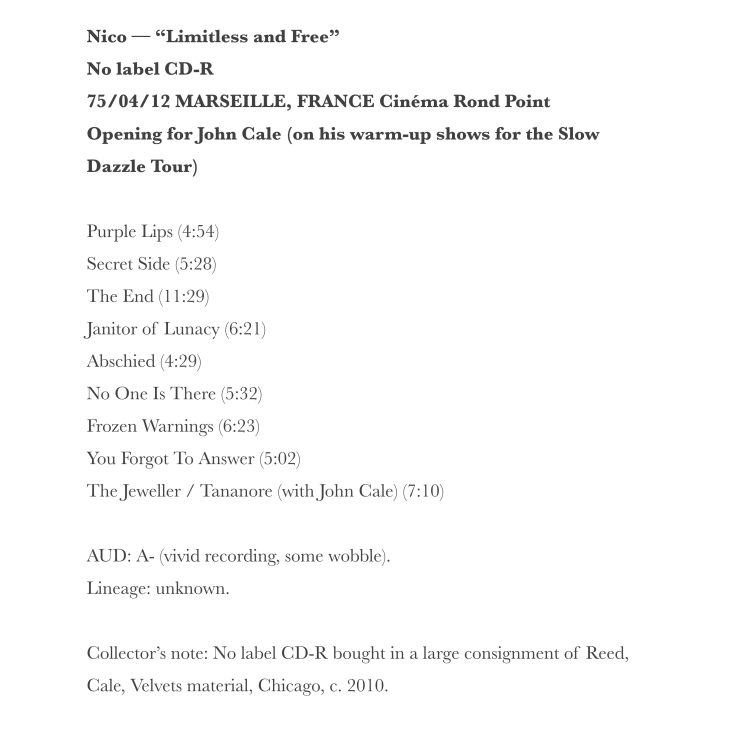
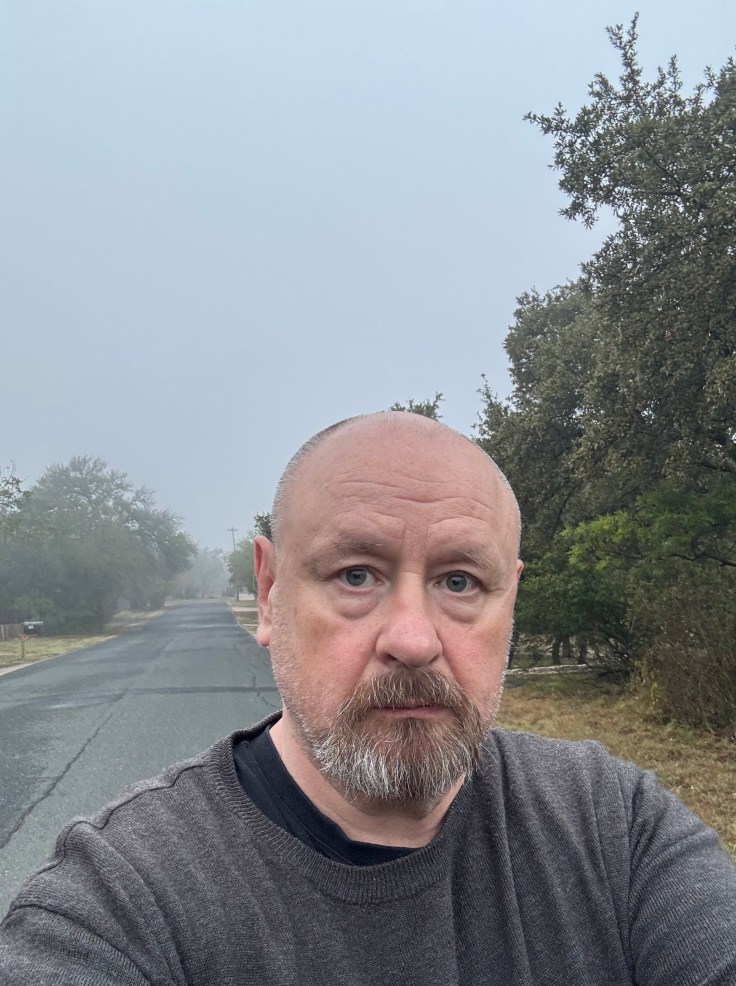
Philip Best’s most recent work, “Pure Evil, Pure Innocence: The Maggie Dunlap Story” is available now from Amphetamine Sulphate. “Midnight Mandrax” is an extract from “No Safety”, his forthcoming book about Nico.
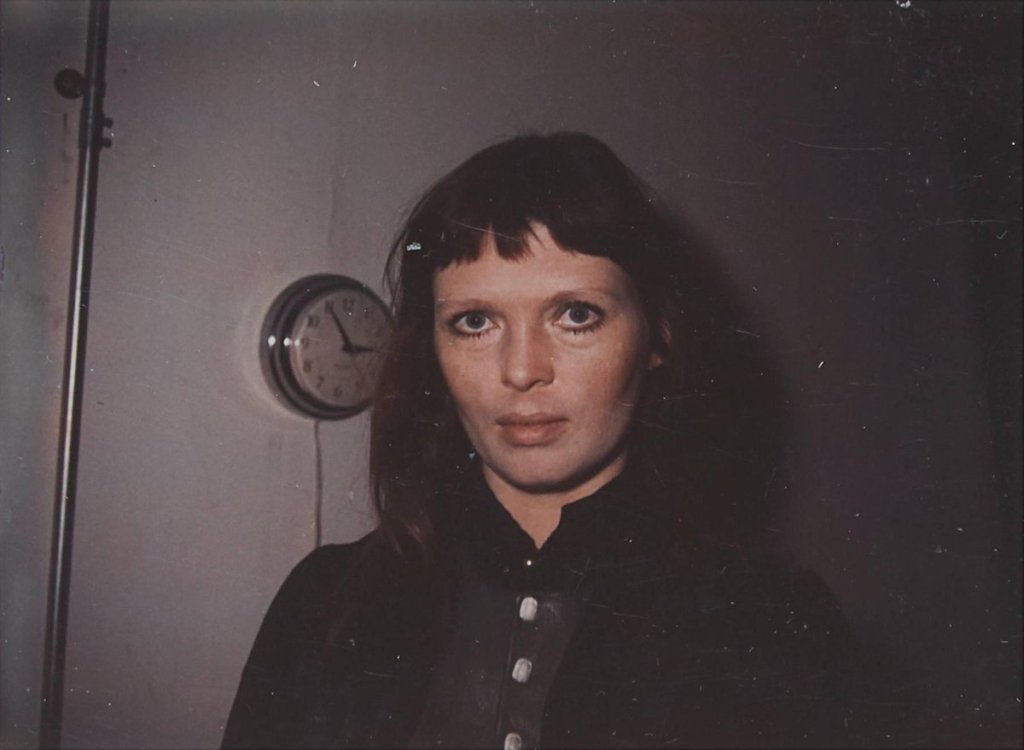
Nico, New York, 1970 by Brigid Berlin.
Earlier this year, I was asked to discuss Nico for a film to accompany a version of Femme Fatale on an album released in support of the Teenage Cancer Trust.
I talked on camera about my friendship with Warhol silver Factory photographer Nat Finkelstein (his picture of Lou Reed features on the back sleeve of the VU and Nico LP), who I stayed with in NYC over one crazy summer in the 80s (fictionalised in my novel Looking for a Kiss). He hated most of the Factory crowd, but respected Nico. I also talked about the strongest version of her voice – a new poetry of bleakness and sorrow – found on Janitor of Lunacy from the LP Desert Shore; and the pre-historical pagan magic (definitely disorderly magic ) that filters up in Evening of Light – my favourite Nico song – soundtrack to a short 1969 film featuring a young Iggy Pop by director François De Menil.
I also asked: where do the midnight winds go?
And I thought, and still think, about:–
Chelsea Girls on a slow/fast loop, with screen-printed souls, silver fluorescent haze, ghosts of Superstars in broken looking glass. Femme fatale in a turtleneck of shadows, lip-curl velvet, existential bravado – Nico; the kind of person you meet, in whatever way, and emerge transformed to some degree.
Beat drops. Patti-Smith bite. Siouxsie eyeliner like a midnight scythe. Clash-cut rhythm, downtown hymn – 1976, first time her voice slid into my room – contralto made of smoke, from ash and cathedral shadows – a voice too low for the baby-girl 60s, too dark for the sunshine pop factories. A voice like the world’s last cracked prayer.
Old Europe twilight. Disorderly Magic forever.
Nico sings like snowstorm silk, atonal, androgynous, thick with centuries, thick with Dresden flames impossible to forget. Wearing beauty like an insult and tossing it away like a match – one that lit bonfires. Beauty denounced as casual tyranny – darkness as armour, mystery as oxygen. Feeding flames.
And style as wound, wound as song, and song that can outlive every/any man who ever tried to claim/tame/shame.
Iggy said she taught him Beaujolais and art-school tricks disguised as lullabies. He filmed her in a field for Evening of Light, a crack-between-worlds moment where mandolins ring to viols singing, and the midnight winds land as warning. Berlin-ashram meets Michigan-gutter. Music collapsing into beautiful violence. A tribute wrapped in awe, and regret, and the kind of affection and affectation, too, that can only exist between two people who might survive, for however long, their own mythologies.
A shining light for every singer who ever needed to drop their voice below pretty, or permission; or anyone who felt that a woman doesn’t need to shine to illuminate; and who treats beauty as something breakable, burnable, something you could set down and walk away from without saying how very sorry you are; above all anyone who wants a different way to carry their own shadow.
And I am hearing dreamscapes full of dark echoes and erotic street energy. Cosmic ennui that reflects the myth back to the crowd like a funhouse mirror. In a voice that comes from somewhere deeper than the throat – somewhere prehistoric. Silence that knows too much. Whispered in harmonium breath and lullabies sharpened into razors.
Midnight winds circle.
I am also thinking 60s/70s Avant-Garde/Berlin School harmonium drones, tape hiss, proto-industrial rich deep minimalism, European nocturne atmospheres. Cold wave pulses, cabaret limelight dimmed, war-memory spectrality. All of it transposed over the years to Ibiza, New York, Los Angeles, London et al as a poem that moves like a Super-8 reel found in a basement in Kreuzberg, or somewhere like that. Yes, begin with a hiss. Analog snow falling across a broken tape. A low oscillator trembling. A train leaving some empty cold station at 3 a.m. – slow, metallic.
Then: contralto voice carved from coal-dust. The sound of a city learning to breathe after the bombs stopped but before the memory ever could.
Pulses flicker – messages to forgotten futures. Where the streets are half dream, half gaping wound, and art is the only currency. Reverberation as survival strategy.
Christa Päffgen, with Factory scars under her coat, Warhol apparitions, spirits and spooks deep in her pockets, and a harmonium strapped to her soul as life and death-support machine. Dressed all in black because colour is hope, and hope is sin.
This is not pop. This is architecture. Built from absence, steel, and memory, perhaps. Nico steps into the drone. War Memory as Original Drone. Repetition becomes revelation. Revelation as trance. Grammar of ruins turns into ritual.
I thought, and am thinking, about slick pavements, streetlamps rattling and failing like old ballroom pianos struggling to project their tone. In the silence between footsteps you can hear the rumour that darkness is not the absence of light but the cradle of it – and that some voices do not break – they remain unbroken, untranslated forever.
Where do the midnight winds go? To the end of time, of course, honey, to the end of time.
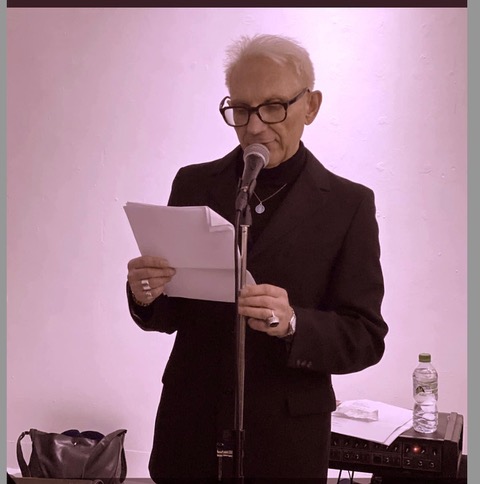
Richard Cabut is a London-based author, whose CV includes the sister books, the popular work of modern literature/poetry Disorderly Magic and Other Disturbances – ‘subterranean scenes, picturesque ruins, neon glowing, Chelsea Girls, the damned, the demimonde, the elemental, being on the edge of being pinned down by our ghosts’ – and Ripped Backsides (both Far West Press), a dreamlike, dislocated and fragmentary Situationist drift through the noir cities. Also, the Freudian 80s cult novel Looking for a Kiss (PC-Press), which has been adapted for screen. And, Punk is Dead: Modernity Killed Every Night (Zer0 Books).
He’s also a journalist – ‘NME, BBC, anarchy’ – a former punk musician, a cultural theorist, playwright and long-time chronicler of the underground. richardcabut.com
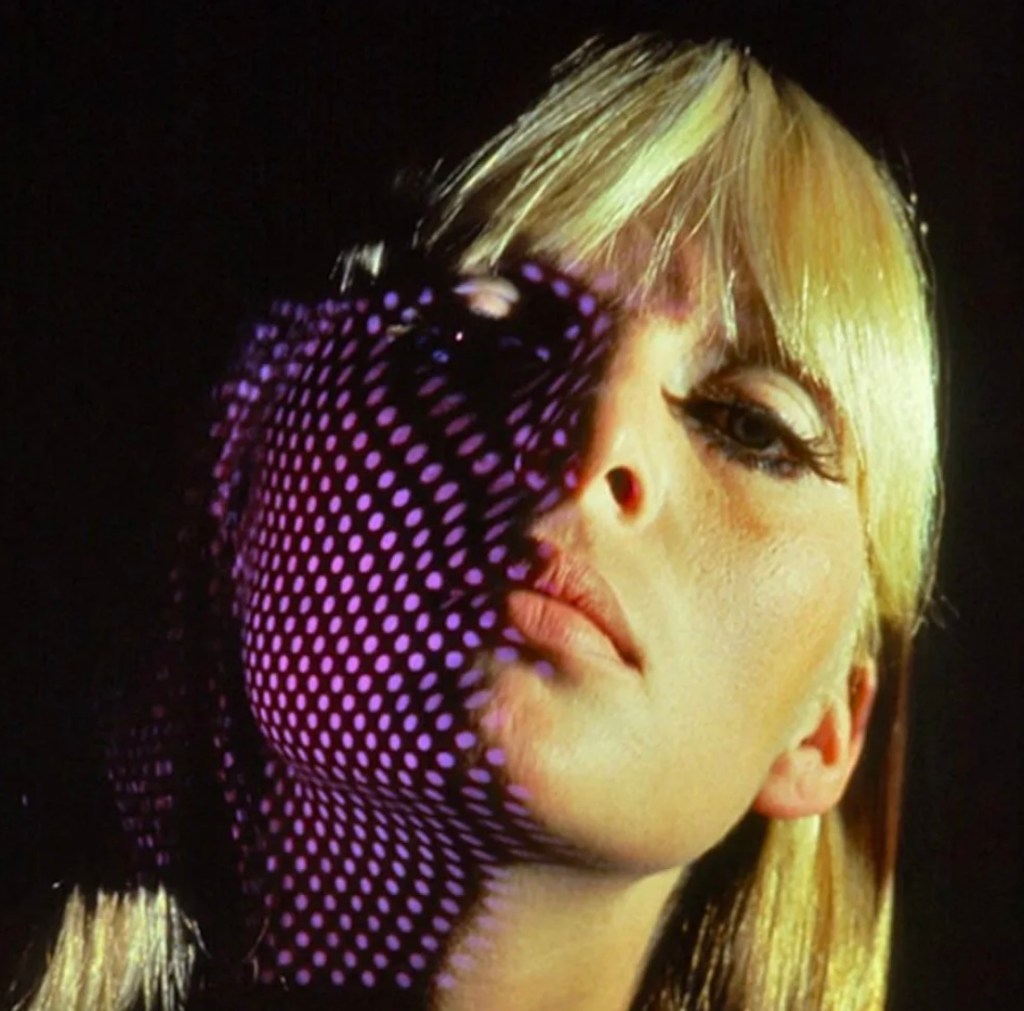
Nico in Exploding Plastic Inevitable (1967).
Bless us, St. Nico, we who need a mirror when no one else on earth understands. Save us, your flock, from threats of dreaded normalcy. Especially faggots like me – reared in the deep, rural south, suffering through adolescence starved for a savior anti-Madonna fierce enough to hold her own. We once were lost but your evening of light helped us see.
Give us strength these days to confront unforgotten failures on our own. Your mercy doesn’t wash away the sins but instead lends credence and visibility to our disgrace. Through no intention of your own but because of who you were then, are now and will forever be, you are canonized as a patron saint to jilted lovers, downtrodden vagabonds, misunderstood, unwitting geniuses, the woman underestimated by men of art and industry. You remain many things for many people, yes, again, even an impetuous, lowly faggot like me, and so many more who find themselves on the other side of popular prayer.
Never one to be eclipsed or upstaged by so many men with half your divinity and faculties, you showed us a path to perpetual salvation. And though the road leading to the lawns of dawn be paved with the best intentions that trick the feet with false feelings of comfort and success, your gospel grants the reassuring guidance necessary to leave overdrawn caresses as we continue our pilgrimage through this travesty called life.
And through thorough examination of your documented life journey, we find that you had faults of your own, all too common prejudices of your day and age. You, too were human. Too late to forgive and too grievous to forget. We address your own sins to show how failures of flesh and mind exist even in the holiest of people. Base level skin and bone shells are capable of only so much. With this recognition we more easily see our own faults and become grateful for what life we have left to correct our mistakes and right our wrongs. We add a prayer here for you, St. Nico, that you have or will realize and reckon with these trespasses.
Your art, Elysian. Your influence, limited but crucial for us who know…we, the innocent and vain. We’ve got the gold and with this transmutation we now have a way to wrap our troubles in dreams. May our holy headphones make us mediums for your message of insouciant misery, your promises of ways around instead of directly through adversity with little confrontation.
We close this prayer to thee, Teutonic saint of uncompromising individuality, with waves of gratitude lapping at your detached, disinterested and icy shore. You come into our lives when we need you most. You offer salvation in the form of an unfeeling monotone that warms when we recognize a shared__________________. You imbue us with the power to suffer, resilient and beautiful, any hardship the world throws our way. You point us in the truest direction, we see and go wherever your gaunt fingers command. All this and much more which we will never be truly worthy. You fell on accident and hemorrhaged for our sins. We know this and we hate ourselves for this interpretation. Solace comes when we listen to your songs. Forgiveness comes when we sing along as if these hymns have the power to restore. Transcendence comes when your droning voice overshadows our own and lifts us up with you in heaven before sending us crashing back down to reconvene our suffering here on earth. But highly blessed, strengthened and remade by your redeeming grace.
And the people said: My Heart Is Empty
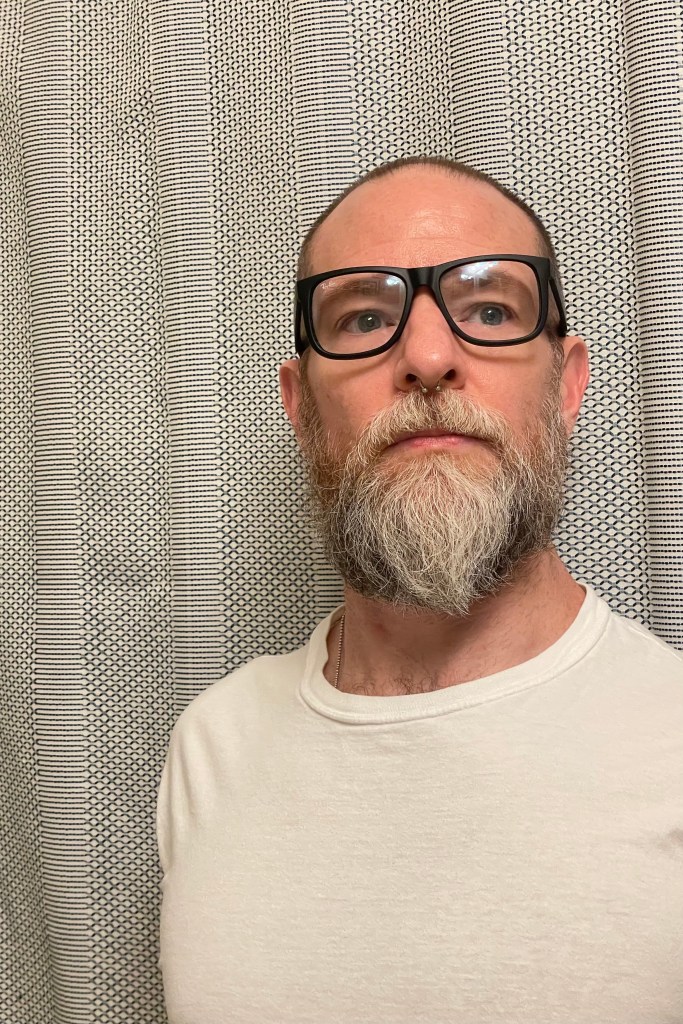
Jarrod Campbell is a writer living in the northern Virginia suburbs of Washington DC. His fiction, essays, poetry, non-fiction and reviews have appeared in print and online with Heavy Feather Review, Northwest Review, Boner World (Berlin), Modern Literature, and more. A collection of short stories, The Reason I’m Here, (Stalking Horse Press, June 2023) was named an anticipated LGBTQIA+ read by Lambda Literary the month of its release.
 BURNING HOUSE PRESS