Search

BURNING HOUSE PRESS

Not For Profit/For Prophecy

Tag

Travel

Mizmaze by Sylvia Warren

The first time I walked a city without direction was in Florence. Before that trip each day was regimented by parents—a designated set of sites to visit, walking through the streets was a chore between destinations rather than a reason to travel. This time I was fifteen; I made my case that I wanted to go back to a gallery to draw some of the statues, and on the way there I got deliberately lost. It is an intentional form of being lost, formed by noticing buildings or landmarks or quirks of the way two streets intersect into an impossibly narrow corner of a house that begin to build up a map of a place in your head. Medieval cities, souk cities, old towns are all particularly good for this. Ideally this is an act that should be done alone without headphones or distractions, but there is pleasure in doing it with someone you love to share in the ornamentation given to houses, the peculiar shape of that window, the way this street links two parts of the city you might have visited via a different route and then the contours of the place become connected. It is also worth doing the same path at night, but that is not always possible, it depends on who you are. I am very envious of those who feel safe to do so alone.

In Bolivia, high up in the Andean mountain town of Cochabamba, the Spanish phonetic translation of its Quechua name, Quchapampa, or ‘lake plain’, my friend and I were told explicitly not to walk around the city alone. Another person, a man no less, had been beaten up when out for a morning run. To escape being chaperoned was a release, and my habit of wandering down side streets only got me into minor trouble with our host mother, but without this I would never have seen the southern cross from the top of a children’s slide in a playground at night or stumbled upon the embassy quarter with the manicured lawns that were so different from the rest of the city. I looked up the Quechua name for the correct spelling and the city looks different now, with sleek light rail services instead of the converted minibuses decorated with rugs and tinsel that I remember. My memories of the route from where we stayed to the outskirts to the orphanage might be only a shadow now, confined to my memory of walking and recognising the advertisement that was put up that indicated where we would have to ask the minibus driver to stop so we could run across a four-lane road to get to work.

I have repeated these walks in almost every place I have visited, from Hà Nội to Lisbon. London is a special case, a set of villages of sorts that I can navigate around like fruiting mushrooms emerging from the myceliae of the underground system, distinct but not truly linked in my mind. Something strange happens when I live in a place: the urge to wander is all but lost. During lockdown I found an area of the city in which I had lived for over a decade for the first time, as though being forced to stay in place gave me the permission to deviate from the boring routes that I stuck to so rigidly. It was an island, formed over a reclaimed rubbish dump. In autumn the trees are heavy with apples, in winter you can see muntjac deer through the bare branches, breath steaming into the mist. 18th century pottery and old scientific glassware can be picked up when the ground is soft, and in summer there are trees to climb and one spot where you can slip into the river to swim. Take another route, another turn, and you are in a metal processing plant, all noise and smells of oil and burning. This is not an essay about psychogeography or being a flâneur, it is a question of what about settling somewhere is it that resists what is otherwise one of life’s great pleasures.

One of my earliest memories is of walking the mizmaze at the top of a local hill. You pass the plague pits and beech trees before ascending the chalk-based soil that produces scrubby grass and strange orchids. In front of a copse of copper beeches is an old turf maze, but that name is wrong. There are no wanderings and wrong turnings here, the route curls around itself from the entrance to the centre and back out, all it requires is patience and to put one foot in front of the other. I have walked it in winter so thick with frost that the grass appears as a ghost and drunk in summer when the scents of rock rose and thyme mix with bonfire smoke. The turf is cut so as when you begin you put one step in the narrow furrow and the next pace just ahead, it is too small for you not to move forward with each footstep unless you run out of path to tread. There is a peace in walking this mizmaze, an hypnotic action in the movement that compels you to complete the circuit until you walk out of the parallel exit to the entrance and the spell breaks. I have never dared to step through or across the turf to exit more quickly, to do so would feel wrong on a level I cannot articulate.

Perhaps we build our own mizmazes for our hometowns? This journey, this shop, this route between places we need to go, this side of the street to walk down? This does not feel like a spell, however, more as though one is placed on a track that is so practiced that looking around ceases to be of any interest. Yet to deviate from the known routes feels stupid, almost embarrassing. This is not to say that routine is uniformly bad; it is a requirement of becoming a local in a pub or café, which can open up a place where you reside into a place where you live and are known.

After the pandemic I moved to a different town and I despised it. I found it cramped and ugly, and my walks were restricted to going into the town (through an unlit alley, down a residential street that floods when it rains, turn right past the fish shop and across the bridge), to the station (turn right just after the bridge), and around the small park behind my block of flats (enter across a wooden bridge past the teenagers and their dog, walk eight times around the circular loop of tarmac past the unused outdoor exercise machines and the playground with men drinking from plastic two litre cider bottles on a bench, go back via the teenagers). The more I repeated these routes the more I hated the place I had moved. The stench of the canal, the soggy leaves underfoot in winter slippery and hateful, the dark passages I had to navigate to leave my flat.

Eight months after I had moved in I felt furious with everything, most of all with myself. I set out in the opposite direction from the unlit alley and walked aimlessly. An underpass called to me, so I took my time seeing the graffiti, some illustrating a cartoon of the history of the area, half covered up with tags and original art. A manor house that had been converted into a school, then a railway bridge that opened up onto fields with grazing cows and horses, a rock processing plant with large lorries ferrying gravel out, and then a reservoir that fed a river with a set of invitingly large stepping stones. The sound of the water led me to the wrong side of an underpass that opened up into a park that I hadn’t known linked up to the main canal that runs through the town. Walking through the woodland and spiralling back, the single route took me back home.

This will never be my final hometown, but I feel an affection for it in the way I do towards the city where I was born; its ugliness and architectural surprises. Down the residential street one house has a Victorian door and beautifully moulded brickwork that gives texture and beauty to an otherwise uninteresting house. One of the houses by the river is a palimpsest of workhouse and glass conservatories jutting over the water, and just off the main square a bust of Shakespeare stares, weather beaten and softened with pigeon shit, over a town that once was cared for enough to have people decorate it.

. . .

Sylvia Warren is a writer and academic editor. Their work has been featured in Open Pen, Minor Literature[s], the Brick Lane Short Story Anthology, and more. They consider AI an affront to the joyous act of creation but refuse to stop using em-dashes. They enjoy writing, the sea, and sketching the architecture of pubs over a pint.
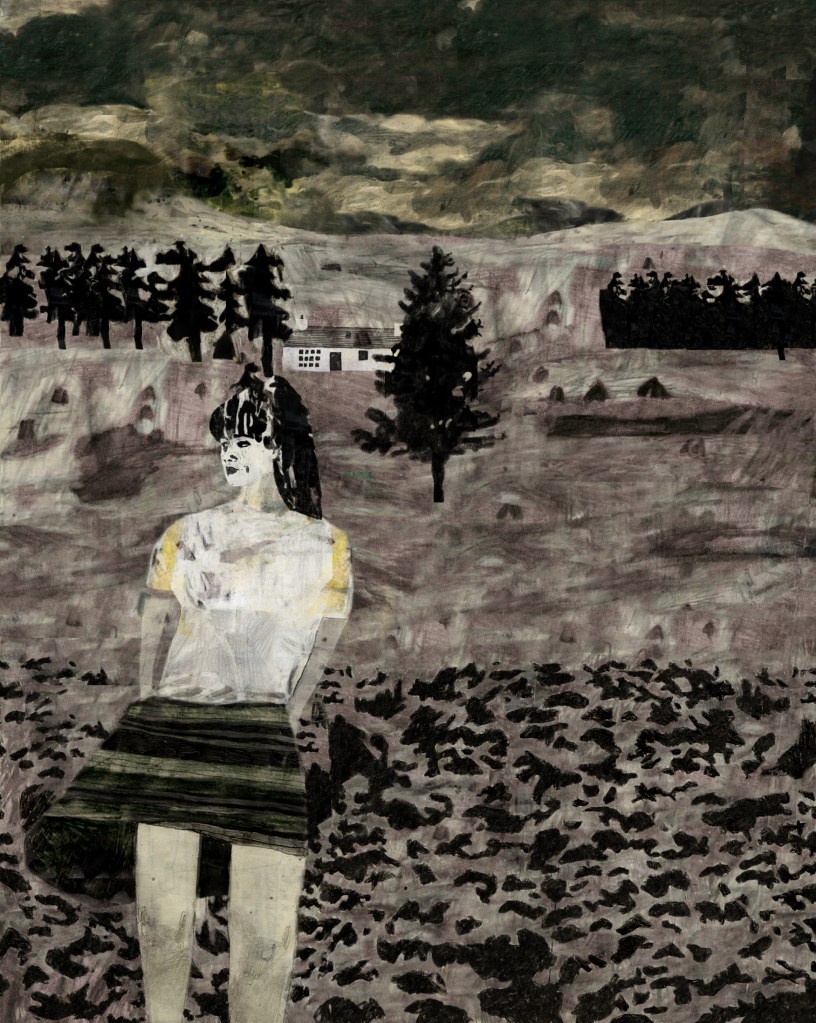
Everything Is Far Away by Brian McHenry

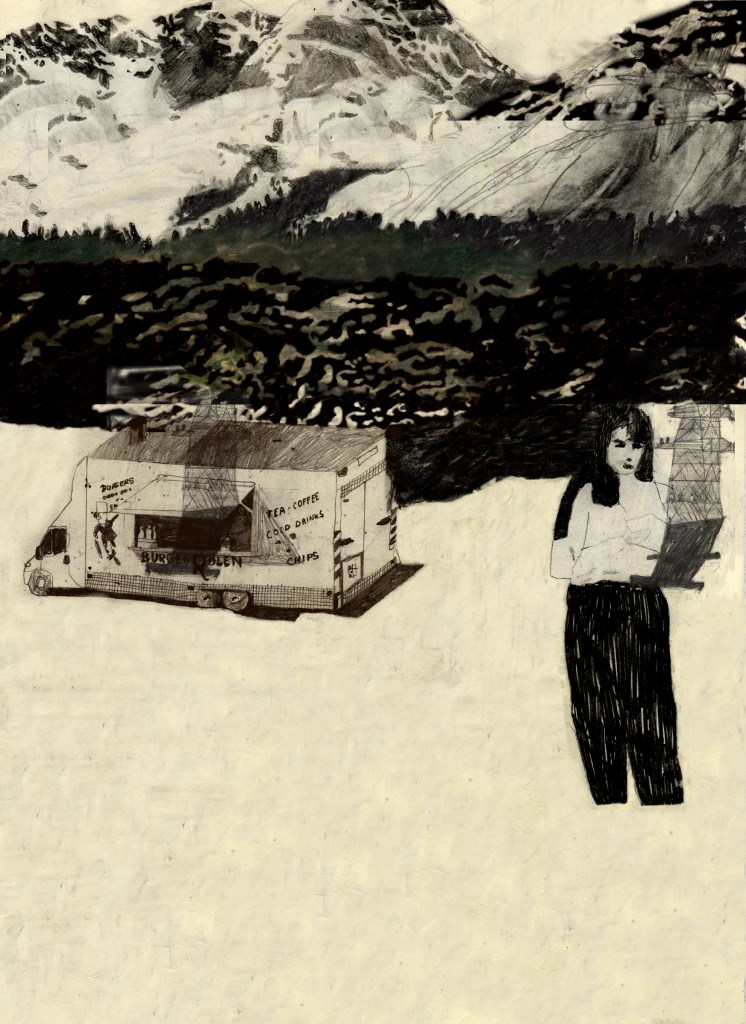
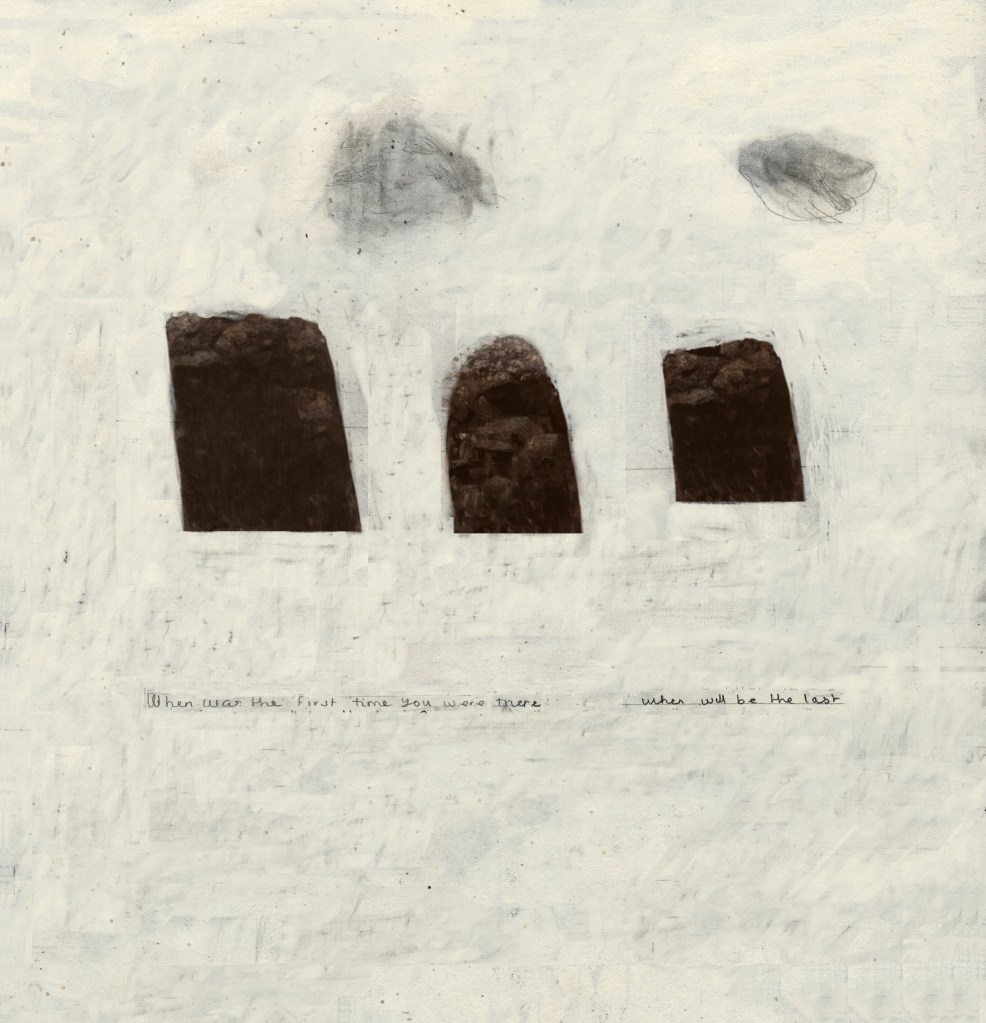
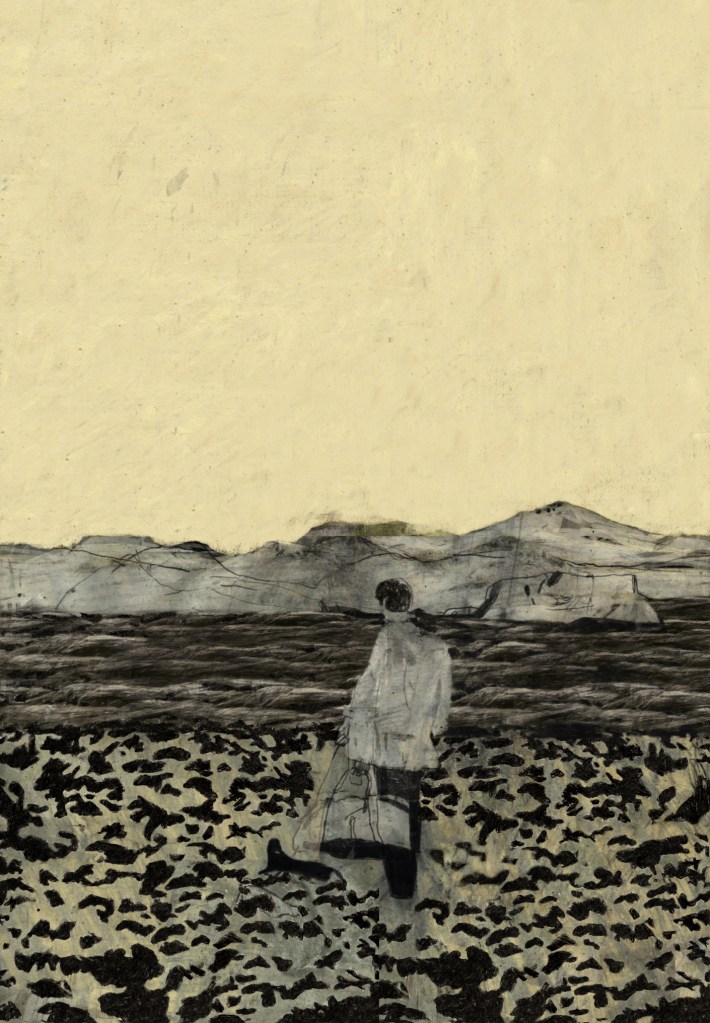
Drawings by Brian McHenry

I have a favourite road.

There is a moment in the film version of Gavin Maxwell’s Ring of Bright Water when the main character, Graham, gets off the MacBraynes’ bus and for the first time looks across the Firth of Lorne towards Mull in the distance.

Ben Buie, Sgùrr Dearg, Dùn da Ghaoithe are all there in front of him, each a distant grace note to something that isn’t there anymore. Of course the movie takes vast liberties with both the book and indeed the story of Gavin Maxwell himself but somehow for me, with that scene, it all gets forgotten.

And so I watch the grass as it gets moved by the wind

and the sound of it

And I think of us there in Fishnish all those years later

The sweetness of that sound on Aird a’Mhorain.

Traigh Iar

and I think of those landscapes now that we’re not there,

the spaces where we used to be.

Your presence as it shifts into abstraction

and distant thought now

the space between you and me and the lines that I draw.

. . .

Born in Belfast, Northern Ireland, Brian McHenry is an artist and illustrator whose work has appeared in various publications — including The New Yorker — and featured on record covers, books, and even the odd beer can. He currently lives on the north-east coast of Ireland with his two children. His recent combines elements of portraiture, symbolism, and abstraction to explore the physical and emotional landscape of remembering.

https://brianmchenry.bigcartel.com/

Walking In Circles by Paul Tritschler

Photo by Paul Tritschler

Midway through the event, a woman seated in the front row of the audience asked the panel of four authors, all of whom had made an appearance for the purpose of promoting their recently published travelogues, if they could explain in simple terms how their notion of travel differed from what most ordinary folk called holidays. Nothing is more difficult than to be simple, but the elitist charge implicit in her question, one that was somehow rendered more pointed by her affected pleasantness, laid another layer of complexity. The moment demanded deflection by way of a pithy response — l’espirit de l’escalier might have suggested a poignant quote from Ibn Battuta or something whimsical from Rabelais. Instead the panel, with a tad too much haste, dug themselves into a defensive trench, and in the process shovelled dirt on what they ill-advisedly and repeatedly referred to as common tourism. And they wouldn’t stop digging.

Conversations erupted throughout the room but eventually settled into silence, and no indication was given that the audience would assist her in pushing the panel off its platform, if indeed that was her intention. That being said, it most likely nudged it a little; peering through the newly created cracks in the edifice, the panel’s itinerant forays and desultory wanderings would have appeared to some people as lofty peregrinations wrapped in pompous superiority…or thoughts to that effect. Their somewhat clumsy efforts to enumerate the differences between what they get up to and what everyone else does would not have helped in that determination. On the other hand, some would have interpreted her question as self-aggrandising, one motivated by conceit, point-scoring and the desire for audience adulation. Either way, the nourishing conversations that were until that moment shared between the panel of authors and what felt like a roomful of friends, now a breathing mass of strangers, failed to revive.

Possessing an air of originality, mystery and spirited adventure, the mention of travel arouses more curiosity than that of the humble holiday, and there can be little doubt that by describing oneself as a travel writer rather than a holiday writer one gathers greater cachet. Yet it often seems that, at core, there is no difference between them. Indeed, the travel writers sharing the podium might easily have described their journeys as holidays. After all, three were promoting books about relatively short stays in what many would deem holiday destinations, including a fortnight in Paris, three weeks in a wine-growing region of France, and a month in Tuscany. Only one took a longer and more varied route, that resulting from an unplanned year of backpacking.

Putting it this way perhaps challenges their street cred, yet many philosophers, among them Seneca and Thoreau, were greatly inspired by the odd holiday, during which they created notable works of reflection on nature, on the human condition, and on life’s meaning or purpose. The same is true of literature. Agatha Christie developed the idea for a well-known detective mystery whilst on a leisure cruise down the Nile. Virginia Woolf wrote To the Lighthouse whilst on vacation on the Isle of Skye, and Elizabeth von Arnim’s The Enchanted April was inspired by a month-long holiday to the Italian Riviera. The list goes on. In the end what matters most are the stories, and to this one might add a degree of self-discovery.

. . .

Old Cathy used to come into our house to wash her money. Though she scrubbed the stairs of every last one of them, and had done so for years, ours was the only flat in a long street of tall black-sooted tenements where she could come and go as she pleased. She even had a key. Some people would rinse out and refill her bucket, but she would have to remain at the doorstep, door closed. To be fair, Old Cathy wasn’t one for conversation, and in fact blanked most people, but that wasn’t the only reason people covered their doors. For much of her life she lived between the mental asylum, as it was then known, and the street, and when that information got around the neighbourhood by the usual whispering campaign people kept a watchful eye. During the time our family knew Old Cathy she had secured permanent residency in a Salvation Army hostel not far from where we lived: a small room with an iron-framed bed, a chair, a cabinet, and a cross on an otherwise bare white wall. Visitors were not allowed, but we visited anyway, my sister and me, and whilst some residents occasionally looked at us with suspicion, neither the warden nor anyone else ever refused entry.

My sister always firmly insisted that if anyone were to question us I should stay silent and let her do the talking. When neighbours or anyone else asked questions she generally cut in to finish my sentences in ways I could never anticipate. Three years my senior but in reality much older, I guess my sister would have been around eleven or twelve when we visited Old Cathy. She doted on us, and was always steady and sunny, but I doubt if many people saw that side. She just kept her head down as she scrubbed the stairs, her metal bucket echoing in the close as it clanked down each step, then reached back up to draw intricate floral patterns with white chalk on the margins of every step. This was a common custom in our neighbourhood, an area that outsiders called slums, but unlike Old Cathy most women just chalked a quick zig-zag or squiggle. Either way they only lasted a day at best.

A woman notorious for malicious gossip once stopped us to ask if our dad knew that our mother allowed a pauper lunatic to wander in and out of our house when he was at work (he worked almost all the time). We of course knew who she meant, but as instructed I buttoned up. I would have liked to have said that we loved Old Cathy, who was one of the kindest people on Earth, and that not only did she visit us, we visited her; but as my sister later reminded me she would most likely have called the police and had her thrown out of her residence and into the street. Adults were a different breed, and I dreaded the thought of mingling with them. Even at the early stages of adulthood most people showed signs of becoming distinctly unpleasant. I think Old Cathy felt the same way.

This was a time when mothers who took to their bed for days or weeks or maybe even months were generally considered to be indolent rather than depressed, a time when postpartum depression was for the most part unknown, and a time when having a stillbirth — regardless of the sadness, guilt and anxiety that were at heart a cry for help — was hushed up as a shameful failure. Mrs Bogus, a pathologically nosey upstairs neighbour of ours — listening at the letterbox, she fell into our hall one time when my dad opened the door on his way to work — stopped me and my sister on the stair to ask if my mother was still lying in her bed. She called her a lazy article, jolting her miserable mongrel on a choke chain before briskly walking on. No one ever explained to me the meaning of article, but I got the gist. Just ignore her, my sister said, and don’t repeat what she said to anyone. I didn’t have to: everyone seemed to know that my mum had sunk under the covers and let the house go to hell. It even got around the school.

For the best part my sister looked after things at home, organising clothes, tidying up, making meals, but after a while things began to slip there too, and the mess just piled up. We made a space on the sofa between heaps of clothes and coat hangers and ate cereal from the box. On one occasion we heard our mum mumble to herself that she wanted to cut her throat, and I was told never to repeat that either, not to anyone, not even to dad — especially dad! She didn’t mean it, my sister insisted, but I couldn’t quite dismiss the possibility. For all their promises to the contrary, adults were notoriously unpredictable. My friend’s sister killed herself over a stupid fiancé, the mother of a boy at my school was murdered by his dad — just one punch, they said, whilst she was doing the ironing — someone sunk an axe into someone’s front door, another put a petrol bomb through a letterbox, men filled with rage and hearts of hate fought to the death outside pubs, and psychopathic razor gangs roamed the streets and alleyways. No adult could be trusted entirely.

We came home from school one day to find all the mirrors in the house had been smashed — why mirrors? — and immediately I wondered if my mum had taken a shard of glass to her throat. I envisaged it. My sister made me wait in the hall until she checked out the bedroom. Mum was sobbing under the blankets, but otherwise okay. Old Cathy was there, calm and calming, picking up the pieces. She would have known worse, and most likely understood the situation better than anyone. For several weeks no stairs were washed as Old Cathy stepped in as our femme de ménage, arriving before we went to school, and leaving in the evening. Between those hours she did the shopping, made breakfast and prepared dinner, looked after my mum, washed clothes, tidied the house, and even found time to play board games with us — she was a master at draughts. In time, when my mother got back into harness, Old Cathy got back down on her kneeling mat to scrub and chalk the tenement stair, the distinctive sound of her metal bucket once more echoing in the close as it clanked on each step. Thereafter she would rinse out her bucket, brushes and money in our small scullery whilst the kettle boiled before settling down to sit with my mum, gazing into the embers in silence.

. . .

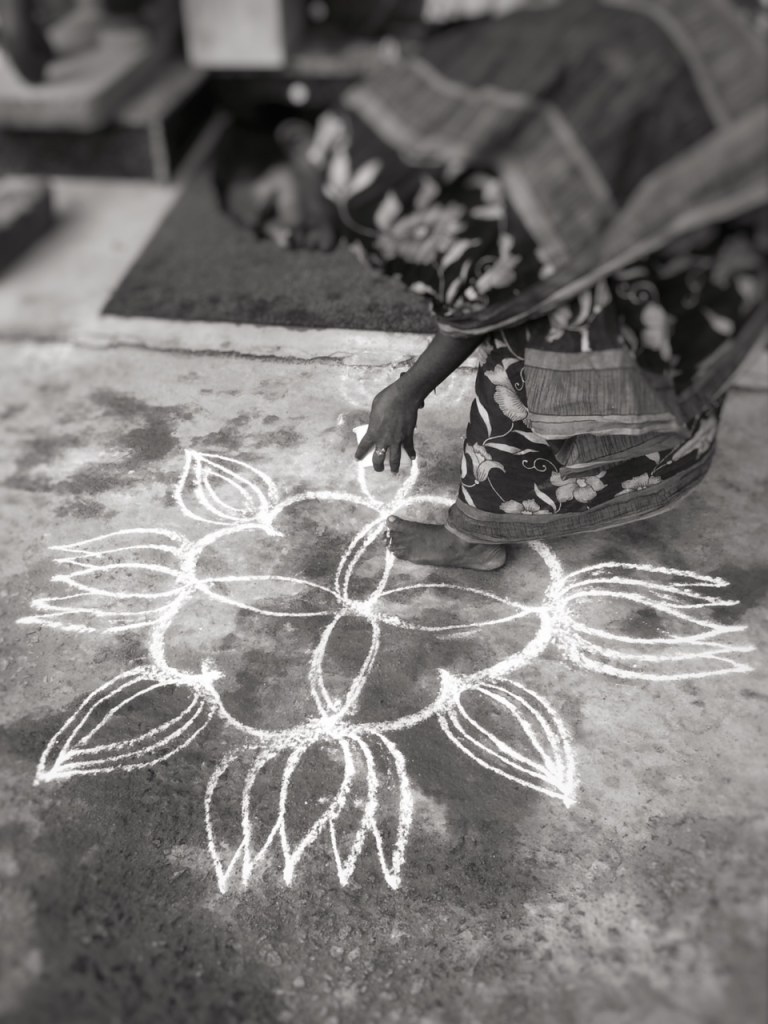
For some people, travel writers are escape artists sharing their secrets on how to break loose from sameness. Others live to wander, to find stillness in motion, and perhaps by chance to find missing parts of the story that made them who they are. It was whilst perched on a doorstep under a hot sun in Tamil Nadu that Old Cathy, for the first time since childhood, wandered into my thoughts. I was watching a woman take great care to create a kolam at the entrance to her home, a decorative chalk circle with floral designs that is said to bring good luck and prosperity to the occupants. The drawings are walked on, scuffed and washed out every day, and whilst illustrations and meanings vary, each in their own way presage the transience of our existence and the impermanence of all things. The process was hypnotic. With eyes squeezed shut I remembered Old Cathy with head bowed drawing similar floral patterns with her piece of chalk on the steps to our door, and for a moment that door opened. The long journey to India had led me back to the start, and perhaps, after all, that was the point.

. . .

In addition to teaching psychology in universities, adult education and colleges across the UK, Paul Tritschler has managed organisations within the fields of brain injury, sensory impairment, mental health and community activism. He has written for a variety of magazines, including Aeon, Psychology Review, Bella Caledonia, Counterpunch and Open Democracy.

3 POEMS by Simon Ravenscroft

Dry Chaconne

the air was parched                the earth in drought                   when you left me
thinking of Lorca                the desire of the rain            remembrance
of the earth          the smooth earth when it rains               has a scent
as you did           when you came to me                     in splinters
a weight of longing          a turning wheel                straining the fibres
of your countenance             blurred visions              flecks of silvering light
the smallest gestures of your eyes         arabesque, interlacing
rhythmic in the shimmering air            shivers of electric blue
a tapestry of shadow              layers of ice melting
the rain falling            the desire of the rain               a memory
of the earth              in Lorca shards falling
splinters of rain               the dry earth around me
our ritual gestures                  fragility of longing                       the suffering
of the rain                    in the chasms of your eyes                    an infinite waiting
for the simplest things                  infinite light                       infinite heat
a daze of deep yellow                     layers of ice melting
a tapestry of shadow                            the unsparing earth
the rain in Lorca                    the fibres of your eyes
all the fevers of the seas

as you wish

line bright with horizon
golden residues of day


α        hours of the dwindling warmth
β          warmth of the dwindling hours
γ         dwindling warmth of the hours


dwindling sadness of the river
shoreline bright with stone
glistening time under starry moonlight
now quiet, all is becoming

Delta Oscillations

iterate

calm stream of aporetic present
oblivion of sleep
dreams grow more lively after dawn
close your peepers

reiterate

brief moments of gloss contentment
needs of obsidian
sleep will wash you with slow waves
night will keep us

Two Poems by K. Eltinaé

Continue reading “Two Poems by K. Eltinaé”

Three poems by Adrian Ernesto Cepeda

¿A Dónde Vas?

She asked watching me
float farther away through
the Great Lakes as I crossed
rivers in Mississippi… Rios
Grande, passing through oceans
Atlantic, in France it was all
about the Seine even the Salton
could see… I would drift further
inside every time with every wave
hoping with each low and high
tide, I could finally find the current
flow of my own rio. Although
I would sail alone, I felt her stirring
aviso’s as I rowed, I always paddled
deeper rippling to create surges
of poems skin pruned, frio waves
her treasured reminders always
carry me sailing towards
home. Continue reading “Three poems by Adrian Ernesto Cepeda”

Last of the Barbary Lions and other poems; a haibun sequence by Rico Craig

Last of the Barbary Lions


ii.

There’s no Hippocratic Oath for vets;

in this world a man is what morals make him. I’m indentured to a thug

with a pocket full of mobile phones,

two weeks into a handshake pact of pills and powders.

I’ve been paid to wait, collude

in the plaza haze, my feet

kicking alleys of August wind.

Perched on a stool in Calle Melos limestone glower,

watching ocean and sea blur in the Strait.

I’m doling tablets to door knocks,

cutting chorizo with a necktie knife; listing

on a nightly lullaby of horse tranquillisers.

I breathe in the dry air, breath out

a stem of opioid desire

and settle at the bar,

petals in my mouth.

This is my last night swallowing broken Spanish,

feet on the solstice line

a half step ahead of winter shade.

The ferries from Morocco

are on endless loop, red hulls

split sky and sea.

  Continue reading “Last of the Barbary Lions and other poems; a haibun sequence by Rico Craig”

The Colossus of Estacada by Matthew Spencer

The name misleads, slightly, and was coined for marketing purposes. In fact, the bronze figure measures thirteen feet tall—outsized, monumental perhaps, but not colossal. It stands contrapposto with one hand outstretched, palm inward, as if beckoning the visitor to approach.  A thin but charitable smile creases the face, although patina has rendered the expression somewhat difficult to read, as have the iron security bars installed to ward off scrap hunters. Continue reading “The Colossus of Estacada by Matthew Spencer”

Schedule of Somnambulist Roads #46 – #49 by Alec Ivan Fugate

ROAD #46 – FOLLIS AVE. TIME: 10:45 PM. WEATHER: DRIZZLING. PAVEMENT STATE: SOLID / NO CRACKS OR BREAKS / CLEAN OF DEBRIS.

[ Darkness uncovers certain predictions in the trees. The grey breath of the stars and moon show me the surrounding area, heavily forested; thick green hovers above the ground, the leaves healthy, hearty for summer. Coyotes can be heard faintly behind the treeline. A quick walk works up a sweat. Temperature outside recorded at 81 degrees Fahrenheit. Small mice skitter just out of reach in the ditch. No homes can be found, though lights in the distance betray somebody or something. Maybe a porch. Smell a campfire nearby. Smell no voices. Continue reading “Schedule of Somnambulist Roads #46 – #49 by Alec Ivan Fugate”

Phrygians In The Rigging by Caroline Stockford

“I seek a place that can never be destroyed, one that is pure, and that fadeth not away, and is laid up in heaven, and safe there, to be given, at the time appointed, to them that seek it with all their heart.”
– John Bunyan, The Pilgrim’s Progress

Our pilgrimage almost came to an end under the wheels of a 10-ton truck on the D650 from Istanbul to Eskişehir, on a summer night made darker by no highway illumination and no towns for miles around. The four-lane highway was flanked on one side by dry,  empty country and on the other by two-hundred-feet-tall black crags, out of which the silhouettes of pine trees leered, high up. Continue reading “Phrygians In The Rigging by Caroline Stockford”

Jo Tinsley: In Conversation with C.C. O’Hanlon

Jo Tinsley is the founder and editor of Ernest Journal – “an independent magazine for the curious and adventurous”. She is also the co-author of two books, The Odditorium: The tricksters, eccentrics, deviants and inventors whose obsessions changed the world and The Mysterium: Unexplained and extraordinary stories for a post-Nessie generation, and editor of Waterfront, a magazine celebrating a connection with water for the Canal & River Trust. Somehow, she also finds time to work as a freelance writer and curator. Continue reading “Jo Tinsley: In Conversation with C.C. O’Hanlon”

A Believing Place by Nina Foushee

For months before going to Alaska, I thought about how six hours of daylight would feel. In California, I’d lay in bed and imagine the darkness as a hand closing around my throat. Continue reading “A Believing Place by Nina Foushee”

In Casablanca by Ganzeer

In Casablanca you will expect buildings to be white, based solely on the city’s name, which translates to ‘white house’. But there will hardly be a truly white building in sight. How odd is it to call a city a house? Once you spend a little time in Casablanca, it will make perfect sense. Continue reading “In Casablanca by Ganzeer”

This Is Not A Memorial, And Other Stories Of Remembrance by Alan Nance

When he died, they covered his tracks and made him hard to trace. Eighty years on, he’s the talk of a frontier town. Philosopher, critic, storyteller, Jew. A father who never knew his granddaughters, born later to an exiled son in London. Continue reading “This Is Not A Memorial, And Other Stories Of Remembrance by Alan Nance”

The Tyranny of the Horizon by Laurence Mitchell

“A frontier region… the resort of brigands and bandits”
– Sir Clifford Darby, from The Medieval Fenland

Two summers ago I walked coast to coast across England and Wales, from Great Yarmouth in Norfolk to Aberystwyth on the Welsh coast. The idea was to etch a furrow in the map along a route that traced familiar haunts and places of personal significance. My aim was to rekindle the memory of places I once knew in East Anglia and the Midlands; join up the dots, to connect all the places along the way with a line made by walking – a pagan pilgrimage, if you like, a personal songline. Continue reading “The Tyranny of the Horizon by Laurence Mitchell”

Tom Jeffreys: In Conversation with C.C. O’Hanlon

Tom Jeffreys is an English author, critic, and editor. He is also, in his own words, “a reluctant traveller”.

In 2013, he was made redundant just as he and his wife – artist and writer Crystal Bennes – had to leave their flat in east London. They travelled for six months in South America, then lived for two years in Helsinki, where Crystal completed a masters’ degree in fine art. There was a year in Paris after that. Now they’re in Edinburgh. Continue reading “Tom Jeffreys: In Conversation with C.C. O’Hanlon”

Nothing Dries Sooner Than A Tear* by Joanna Pickering

Marrakesh, Old Town

Everyone seemed to have rotten, black, and missing front teeth. They were friendly and kept smiling and that’s how I saw they mostly had rotten, black and missing front teeth.

I couldn’t see a lot of the women’s teeth, only their eyes, and often not even. There were many women dressed from head to ankle, in long black fabrics, with layer upon layer covering skin, hands, hair, and some that covered the eyes, and with only a marginally thinner veil, so that everything was hidden, nothing to determine soul, being, nor Continue reading “Nothing Dries Sooner Than A Tear* by Joanna Pickering”

Blog at WordPress.com.

Up ↑