As the room done deep.
Told to, by, and, so, that it cold is a truth.
throne stretches mark, maid, bare muscle

As the room done deep.
Told to, by, and, so, that it cold is a truth.
throne stretches mark, maid, bare muscle
(INCLUDING BUT NOT LIMITED TO THE FOLLOWING)
AND YET Inventory. Trivial Pursuit, but not that, this: You Think Therefore You Are (Disney Edition). Continue reading “Inventory/History by Simon Henry Stein”

ITEMS RETRIEVED FROM THE WRECK OF THE IGS MALVA, WITH POTENTIALLY DISTINGUISHING DETAILS AND SPECULATED PURPOSES PROVIDED IN ITALICS
6 human bodies: identified overleaf – likely deceased through drowning, all male, flight crew Continue reading “Items Retrieved from the Wreck by Emma-Louise Adams”
Silent Long-Distance Mail-Order Auction Catalogue Item #20:
BEFORE PREDATION COMES NOTHINGNESS, FLOATING. A FLOTILLA OF DANCERS ON FLOTATION DEVICES. THIS BEING THE ANABOLIC STEROIDAL EDICT EDITION, THERE ARE ONLY 3 LEFT IN STOCK.

Editor’s Note: New Library of Revised Classics Series
Get ready for the future: It is murder, Leonard Cohen sang in 1992. Nearly two decades into the twenty-first century and it is clear that his warning is an understatement. What refuge for the thinking person in the face of the End Times? The classics of the Western canon, of course. But who has the time to plunge the depths of literature in the Instagram era? The aim of the current project is to create a digestible, collectible library to inspire and comfort the spirit, stimulate and disorient the imagination.
Each volume in this tastefully appointed series is the product of judicious, computer-aided pruning, social media/graffiti-friendly quote selection, and apocalyptically-toned imagery. The inaugural Condensed and Illustrated for the End Times offerings will include classic works by Herodotus, Marcus Aurelius, Dante Alighieri, Teresa d’Avila, John Bunyan, and Voltaire. Available individually and by subscription, Spring 2019. Continue reading “The Soul of a Man: A Meditation by Joseph Schreiber”

This page informs you of my policies regarding the collection,
use
and disclosure
of Personal Information I receive.
I use your Personal Information only for mechanical purposes.
By existing, you agree to the collection and use of information in accordance with this policy. Continue reading “Privacy Policy by Germán Sierra”

Prophet of the Sixteenth—what happened over in Vietnam—the BMV of Mr. Monroe found at the bottom of the lake—seaweed that glows at night—waves of pollution—ordering an aperitif with no intent to stay—political turmoil—a concept that is foreign to everyone else in the room but Maurice—fringe benefits—a lawyer from the 90s—the maggots of Deh’N’yyii’l—a metal container overflowing with people—the position of the sun after he drinks the potion—the tusk of an elephant and your uncle who says, African steel—the sound of your heart as you climb the mountain—pastiche moments—Edward saying he is Edwardian—footrace in the middle of the forest with no shoes—snapping zir tibia to teach zir a lesson—valleys of the moon—squeezing the life out of that goldfish just to say you now know what that feels like—some blowtorches covered in Vaseline—a ridiculous amount of knowledge for someone who is only going to live to 53—cliffs at darq—she’s cutting her hand because the daemon said so—the blind man says he hears the waves of despair—there is a hill in Australia and they call it Vanity Hill.
Mike Kleine is a writer and avid player of tennis.
About the banner image: When a new furrow is to be started the derrick raises the plow and the car moves down the track with it to the point where the furrow is to start.

In our ever-accelerating and ambiguous world, the force majeure clause, a standard provision in most legal agreements, becomes more important than ever. Here are three samples, courtesy of LawInsider.com..
1. Force Majeure. In no event shall the Trustee be responsible or liable for any failure or delay in the performance of its obligations hereunder arising out of or caused by, directly or indirectly, forces beyond its control, including, without limitation, strikes, work stoppages, accidents, acts of war or terrorism, civil or military disturbances, nuclear or natural catastrophes or acts of God, and interruptions, loss or malfunctions of utilities, communications or computer (software and hardware) services; it being understood that the Trustee shall use reasonable efforts which are consistent with accepted practices in the banking industry to resume performance as soon as practicable under the circumstances. Continue reading “Farce Majeure by Voima Oy”

Ayuko Fujii (1903–1926)
Ayuko Fujii was born in Berlin; her father was an attaché at the Japanese embassy. She attended a francophone gymnasium, and by age fifteen, she was capable in five languages. Her passion was for English. “It is a funny, cozy language, full of misshapen words,” she wrote in her diary. “Any other language would be ashamed to own a word such as ‘dollop’ or ‘shrub.’ But not English—that is its genius.” Continue reading “Four Minor Modernists by Ryan Napier”

CAPUCHIN CRYPT
After Cordovani’s guide
Bones. Bones. Stack on the clavicles. Bones. Bones.
Gift relic sacred base passageway base sacred relic gift.
Bones. Bones. Stack on the clavicles. Bones. Bones.
Vault coat spin ornamentation spin coat vault.
Bones. Bones. Stack on the clavicles. Bones. Bones.
Circular scythe scale
Cross wall central blades frontal
Floral wrapped thigh wings Continue reading “Placename Triptych by Kelly Gangeness Le”

I seek only the gestures of a lonely ruthless
quest.
To resurrect if only for a day the marvellous
dressed corpse of my desire.
Larvae, moths, necrophors.
To perpetuate the cemetery,
to plaster you with sea-weed,
To open up a gap
and produce a breakdown.
Conroy Maddox – Poem, unpublished. 1941. (written on the cover of a blue notebook [2011?],
ink largely unsuccessful, reproduced here from pen nib pressure marks (by the thin paper, soft 5b pencil rapidly
shading back and forth over indentations method)) Continue reading “Notation by Andrew Robert Hodgson”
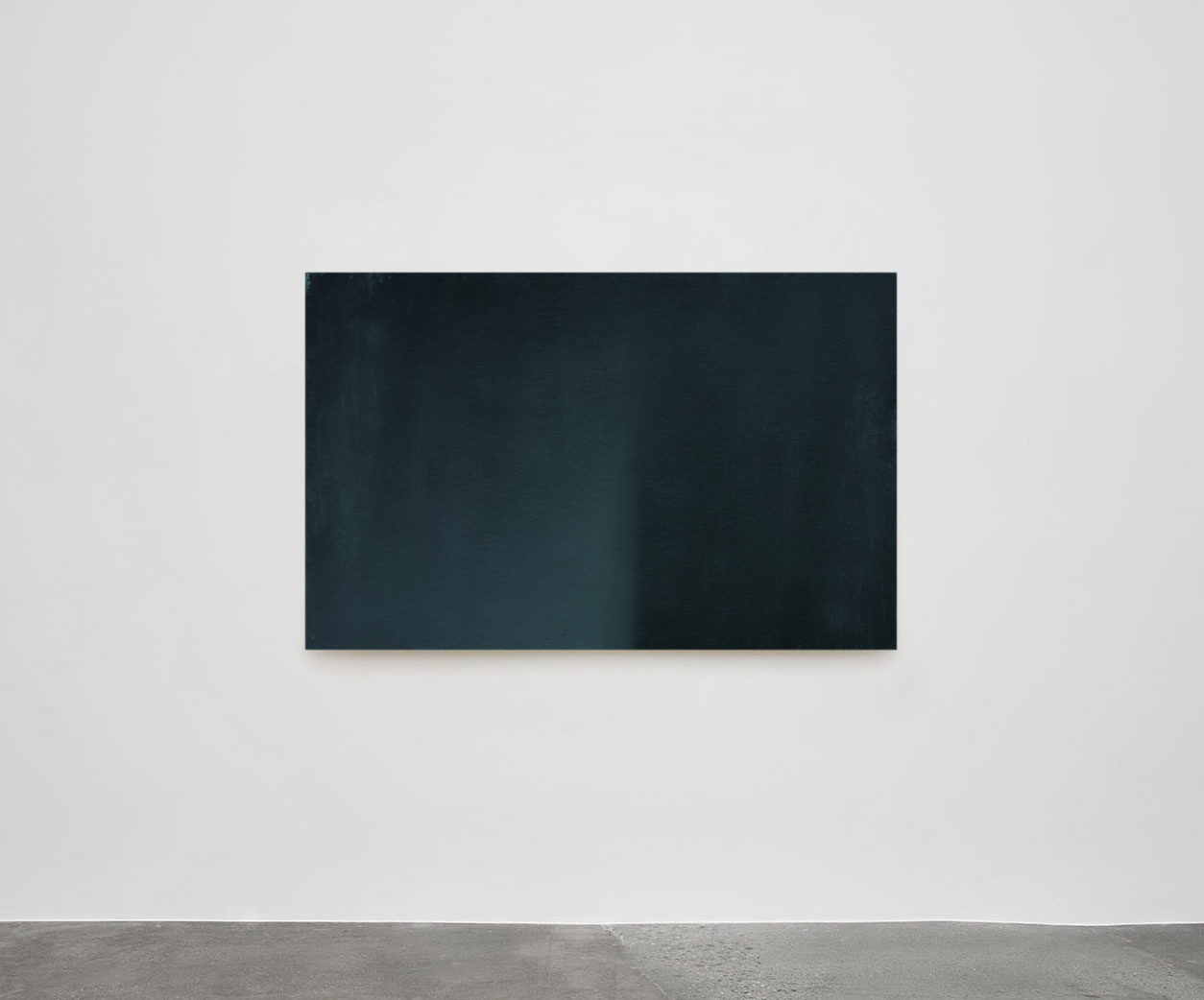
“In the end, I would like it to be said that I have been a silent conversationalist with the world, a patient interlocutor devoid of names and arguments, seeking and at odds with, always, the atomic.” — Anton Aubinov, 1998
For a while, he graced a footnote in a biography of Clyfford Still1, removed in subsequent editions, purged as too obscure, adding no value to the lay reader. He is heavily rumored to have been the young artist called a “pissant” by Barnett Newman in a story attached to but never actually recounted by Betty Parsons. He may or may not have been able to do hands.
The late painter Anton Aubinov remained near-hidden throughout his career, subsumed into the greater wave of late American abstraction. His lone New York exhibition, at a here-today-gone-tomorrow space in Chelsea in 1952, was thrown together to capitalize on the recent fame of Mark Rothko, who had displayed, for the first time, his multiforms the year before. As the story of Aubinov’s opening goes, the drywall on which his works were mounted had been improperly adhered to the concrete casing, and the collapse of one wall was the subject of much of the subsequent press. So it went, so frequently. Continue reading “The New Atomist: A Selection from the Catalogue Raisonné of Anton Aubinov by Joshua Rothes”

Burning House Press are excited to welcome JOHN TREFRY as our seventh guest editor! John will take over editorship of Burning House Press online for the full month of August.
Submissions for John are open from today – 1st August and will remain open until 24th August.
John’s Theme for the month is as follows
Continue reading “August 2018 Guest Editor Is JOHN TREFRY!!! Theme: NON-NONFICTION”
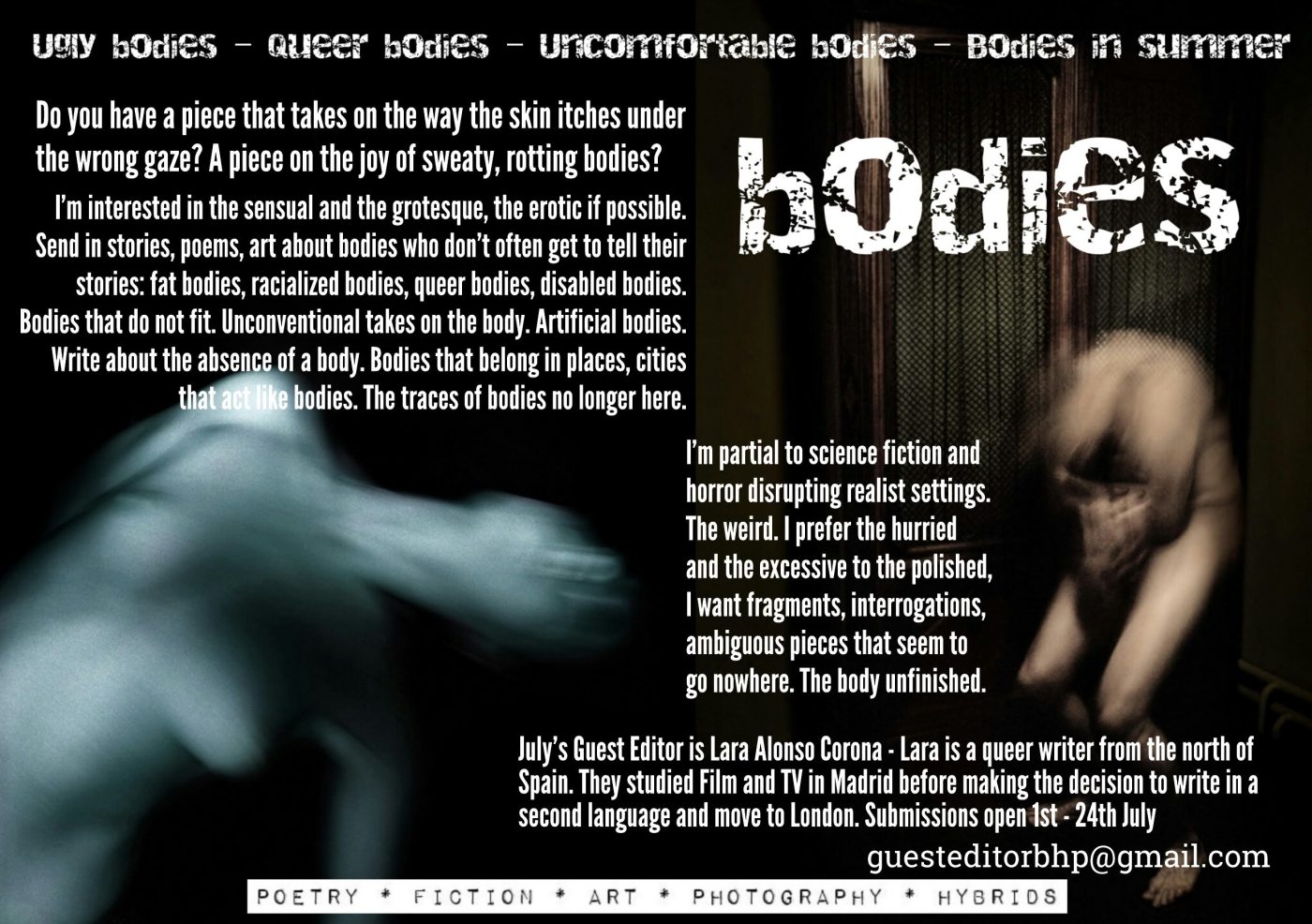
Burning House Press are excited to welcome Lara Alonso Corona as our sixth guest editor! Lara will take over editorship of Burning House Press online for the full month of July.
Submissions for Lara are open from today – 1st July and will remain open until 24th July.
Lara’s Theme/s for the month are as follows
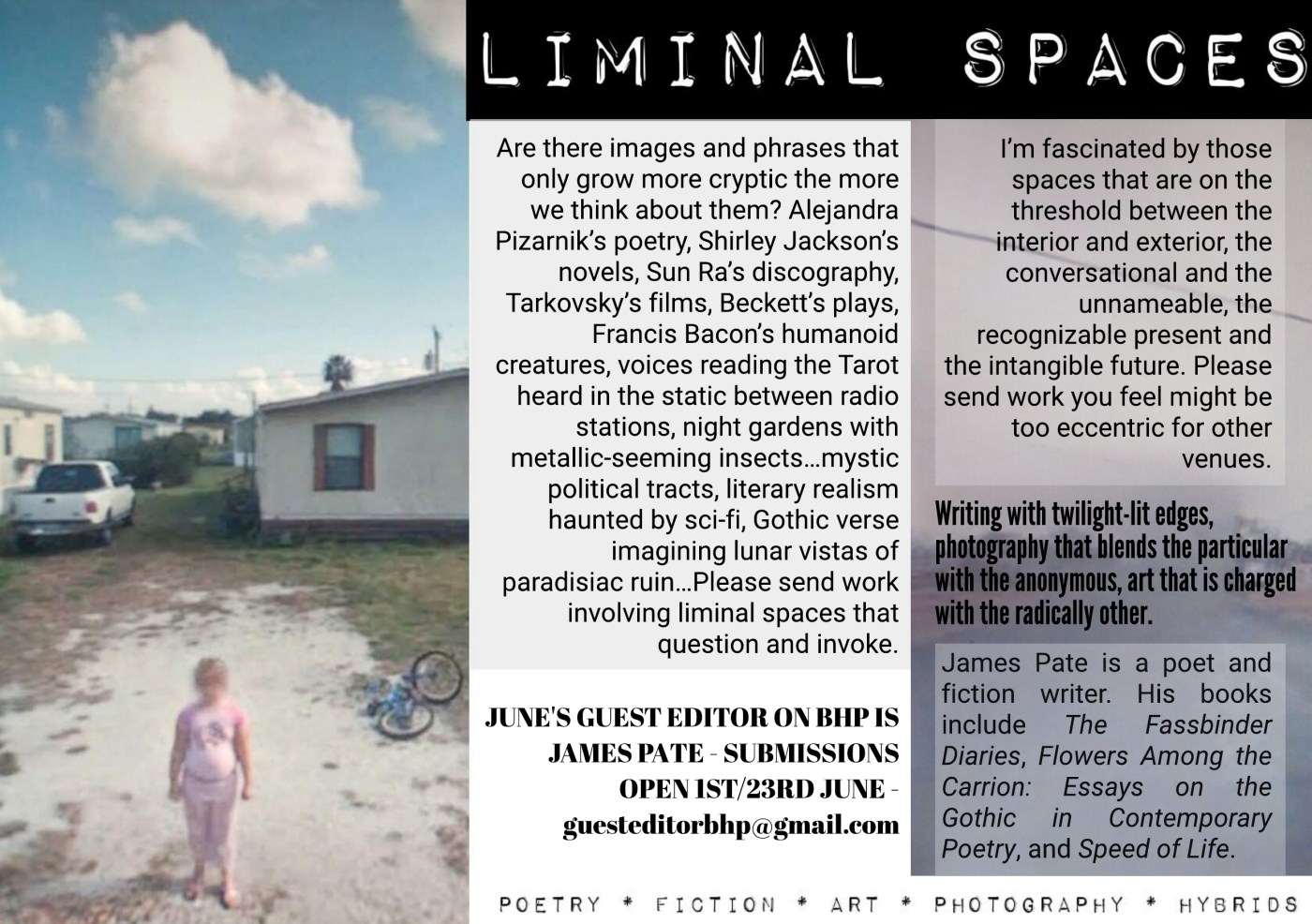
Liminal Spaces – June 2018 Guest Editor James Pate – here is the final edition of all selections curated by James Pate during the month of June 2018 for his theme of Liminal Spaces – thank you so much to James for all his hard work during the month and for the impeccable way he managed and curated his month’s editorship. To have been avid readers and fans of James’ writing – especially his essays during the days of the incredible and much-missed Montevidayo site – to have James collaborate on BHP for a month has been such a dream experience. Thanks, James! – and Thank You So Much to all who contributed such magic work to the theme – Here it is, June 2018 guest editor James Pate’s Liminal Spaces edition – enjoy! Continue reading “Liminal Spaces – June 2018 Guest Editor James Pate”
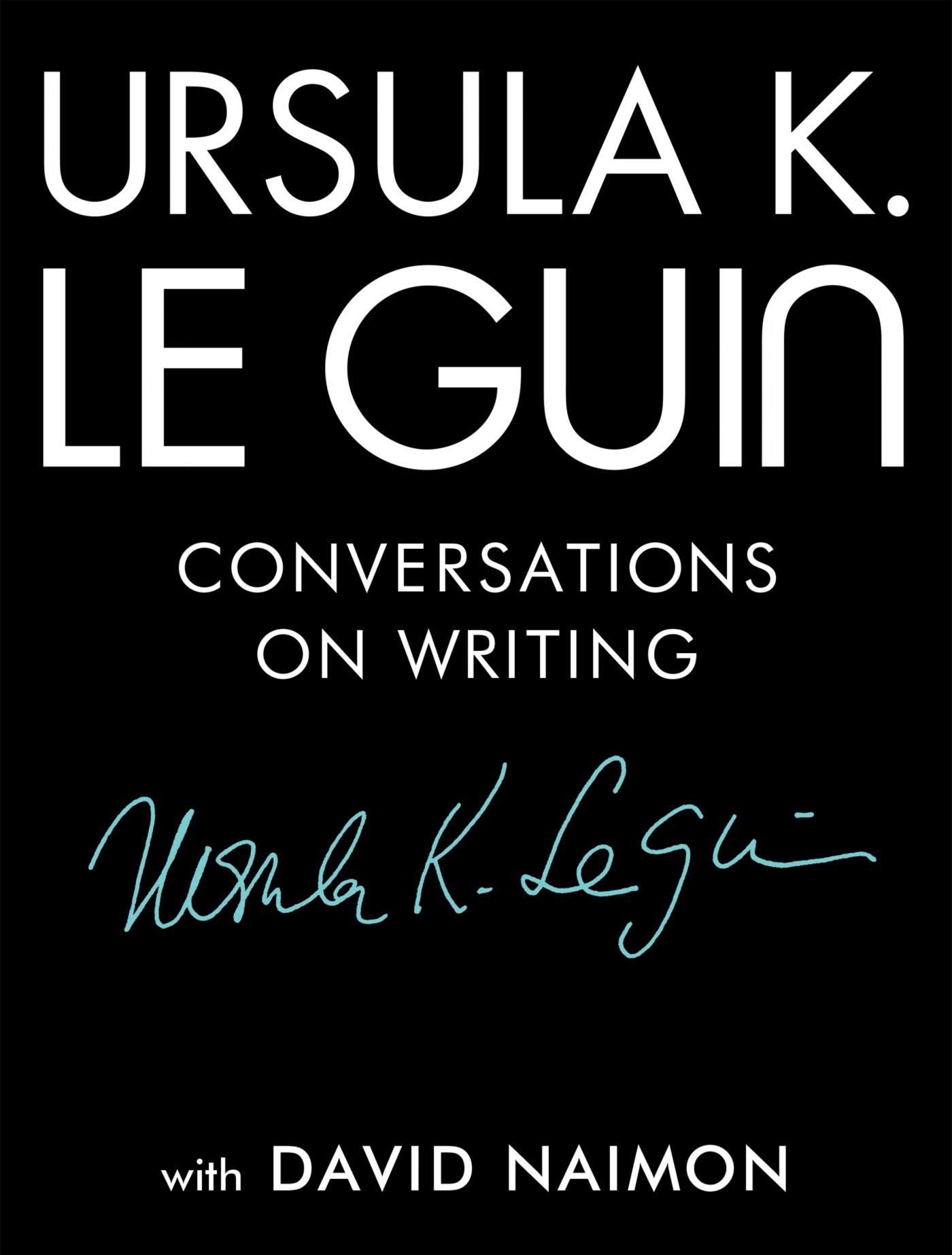
Over the course of her extraordinary career, Ursula K. Le Guin wrote dozens of books that explored the essential issues of our time, including gender, race, and the degradation of the environment. David Naimon is the host of the radio show and podcast, Between the Covers, which features exceptional interviews with some of the most important writers of our time. When Naimon and Le Guin met for his show, it’s no surprise that their discussions were insightful and unforgettable, and they’ve now been collected into a new book, Ursula K. Le Guin: Conversations on Writing, published by Tin House Books. I previously interviewed Naimon for Burning House Press, and he was kind enough to speak with me again about his bond with Le Guin, how she impacted his life, and how their new book carries on her radical legacy.
–Caitlin, Nonfiction Editor for Burning House Press
Burning House Press: It’s impossible not to mention the circumstances under which this book is coming out, with Le Guin passing away shortly before its publication. You write a heartfelt and moving “In Memoriam” at the beginning of the book. How are you holding up as you—and the literary world at large—continue to grieve? How has it been to launch this book without her?
David Naimon: This is such a hard question to answer Caitlin. It was just a matter of days after Ursula had handed over her final edits of the manuscript when she passed away. It happened so suddenly that at first I was just stunned, paralyzed. But then, quite quickly, because Tin House pushed up the publication date from July to April I was swept up in the whirlwind of an accelerated publication schedule. I had no idea just how much work there would be between then and now, the In Memoriam that they needed on short notice at a time when I felt like I had no words for what was happening, and then several essays about Ursula that I was asked to write, to be published in concert with the launch of the book. On the upside, I’ve been steeped in a deep engagement with what Ursula meant to me and to the world. But I haven’t had a moment to be with my feelings, to experience them fully. The public memorial for Ursula is not until June. The city and state, which she has influenced in so many ways, has not had the chance to mourn her as a community yet. I could’ve used something like that, something public, communal, back in January. Now, with the book out, there are no launch events planned. It felt strange to do that without her. I didn’t want to be the focal point of a launch party. But, on the other hand, perhaps a launch event could’ve been a first moment of public remembrance.
Continue reading ““From the sentence to the world” : A Conversation with David Naimon”
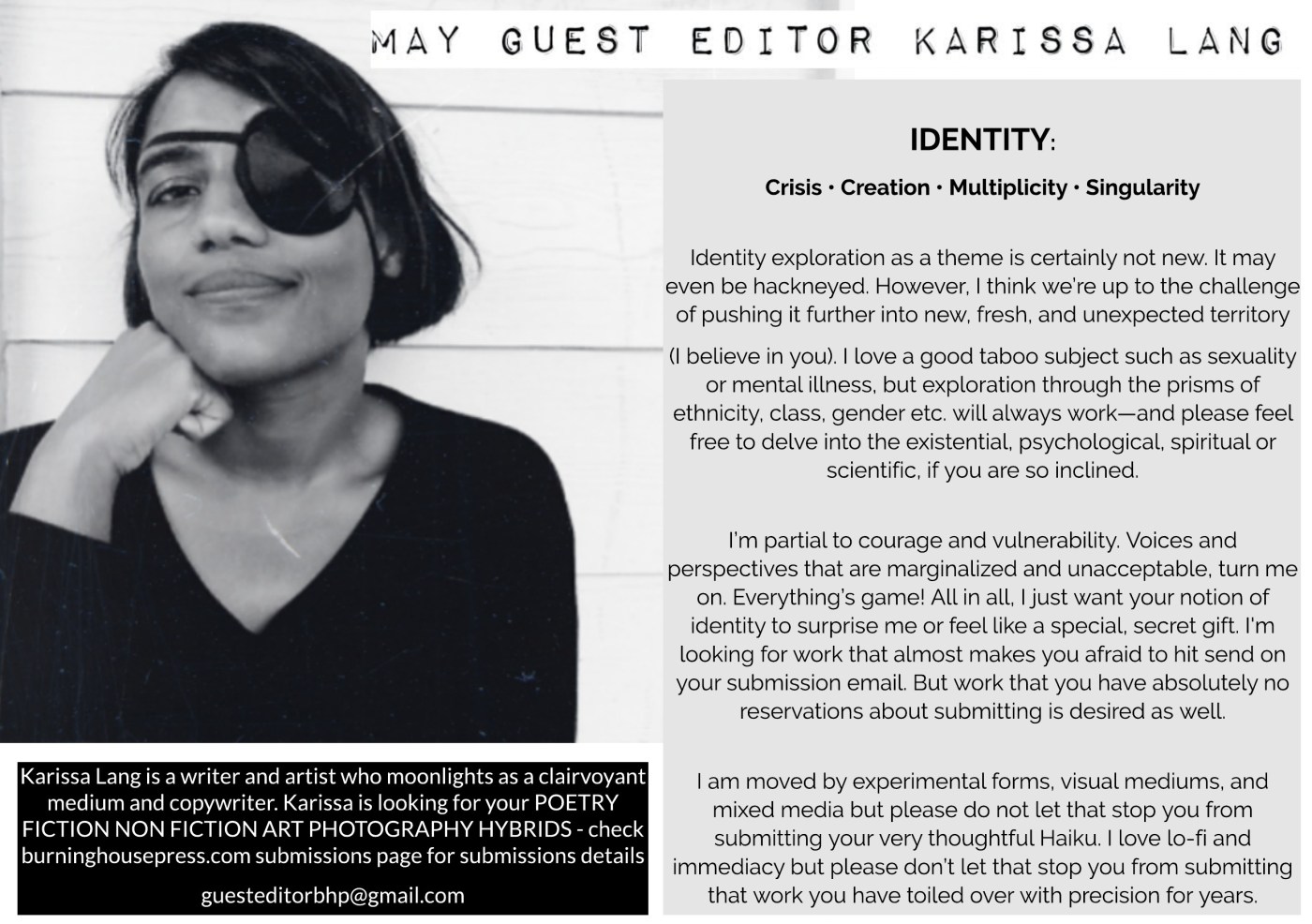
Burning House Press are excited to welcome KARISSA LANG as our fourth guest editor! Karissa will take over editorship of Burning House Press online for the full month of May – when she will then hand over the reins to our fifth guest editor for the month of June.
Submissions for Karissa are open from today – 1st May and will remain open until 24th May.
Karissa’s Theme/s for the month are as follows
Identity:
Crisis • Creation • Multiplicity • Singularity
Continue reading “MAY’S GUEST EDITOR FOR BHP ONLINE IS KARISSA LANG!!!!”

Burning House Press are excited to welcome C.C. O’HANLON as our third guest editor! C.C. will take over editorship of Burning House Press online for the full month of April – when he will then hand over the reins to our fourth guest editor for the month of May.
Submissions for C.C. are open from today – 1st April and will remain open until 23rd April.
C.C. will be responding and publishing your submissions on a rolling basis during the month of April – and has chosen his themes for submissions!
C.C.’s Themes are
Place: Movement, Escape, Exploration, Architecture.
C.C. has introduced the themes himself for your guidance:
“The act of journeying contributes to a sense of physical and mental well-being, while the monotony of prolonged settlement or regular work weaves patterns in the brain that engender fatigue and a sense of personal inadequacy…”
– Bruce Chatwin, from Nomad Invasions
Overall, I’m not looking to reassure, but rather, to some extent, to unsettle.
For submissions, C.C. is looking for your poetry, short stories, flash fiction, prose poems, art, collage, painting, photography – as well as non-fiction submissions: essays, reviews, commentary, features, interviews.
Submission Guidelines
All submissions should be sent as attachments to guesteditorbhp@gmail.com
Please state the theme and form of your submission in the subject of the email. For example: ARCHITECTURE/POETRY
Poetry and Fiction
For poetry submissions, submit no more than three of your best poems. Short stories should be limited to 1,500 words or (preferably) less. We encourage flash fiction submissions, no more than three at a time. Send these in as a .doc or .docx file, along with a short third-person bio, and (optional) photograph of yourself.
Art
Submit hi-res images of your works (drawings, paintings, illustrations, collages, photography, etc) with descriptions of the work (Title, Year, Medium, etc) in the body of the email. Files should be in .JPEG unless they are GIFs or videos, and should not exceed 2MB in size for each work. File names should correspond with the work titles. Video submissions can be uploaded onto Youtube or Vimeo for feature on our website. Send these submissions along with a short third-person bio, and (optional) photograph of yourself.
Non-fiction
Non-fiction submissions (essays, reviews, commentary, interviews, etc) should be no more than 1, 500 words and sent as a .doc or .docx file along with your third-person bio/and optional photograph.
Submissions are open from 1st March til 24th March – and will reopen again on 1st April for our third guest editor.
BHP online is now in the capable hands of the amazing C.C. O’HANLON – Friends, send him your best!
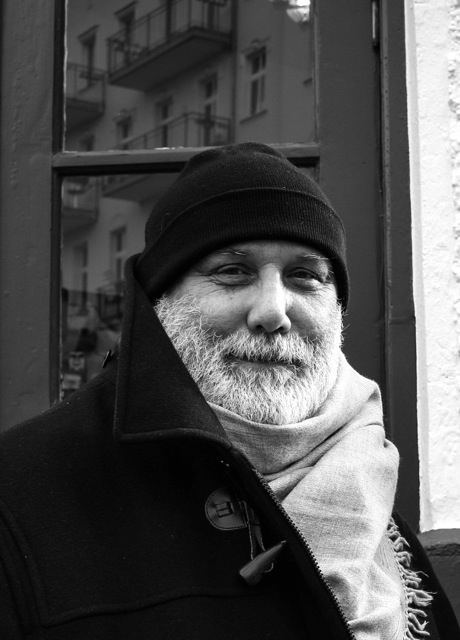
C.C. O’Hanlon is a relentless traveller, polymath and occasional diarist. His work has been featured in numerous publications, including The New York Times, Ernest, Minor Literatures and The Learned Pig. It has also been included in several anthologies and ‘best of…’ collections. Born in Sydney, and raised nearly everywhere else, he has lived for the past five years in Berlin. He is now en route to somewhere else.

Burning House Press are excited to welcome Amee Nassrene Broumand as our second guest editor! Amee will take over editorship of Burning House Press online for the full month of March – when she will then hand over the reins to our third guest editor for the month of April.
Submissions for Amee are open from today – 1st March and will remain open until 24th March.
Amee will be responding and publishing your submissions on a rolling basis during the month of March – and has chosen her themes for submissions!
Amee’s Themes are Masks // Transformations // Cosmos // Personal Myth.
Amee has introduced the themes herself for your guidance:
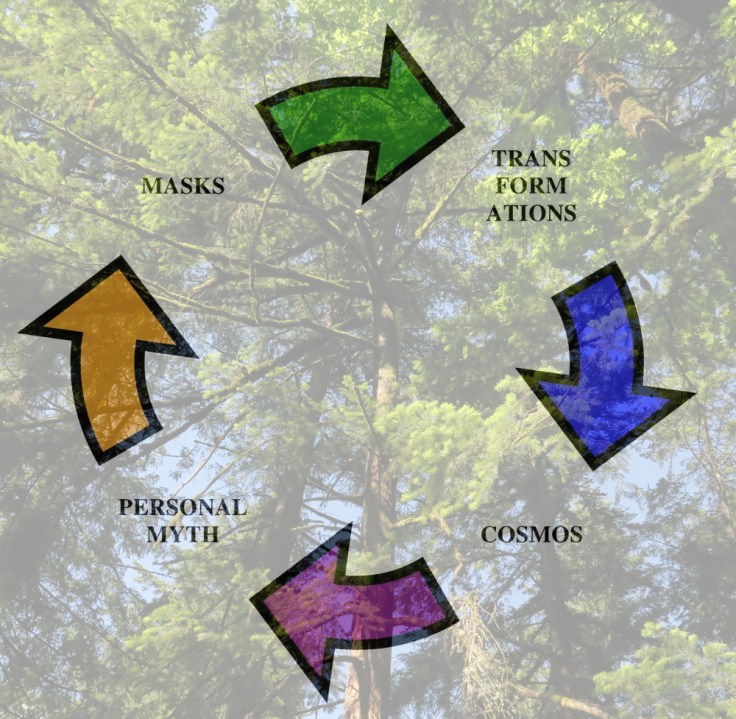
Wrestle with illusion, seek truth. See your various aspects as masks; consider their individual appearances & reflect upon why they’re shaped as they are. We all have masks; what are yours? Play with this idea, infuse it with mystery. Perhaps make yourself a new mask, one that taps into important yet hidden aspects of your life or mind. Create something that intrigues you, not as a product but as a catalyst for personal transformation. Make something magical; give yourself chills. Mark it with the fire that comes from grappling with your own consciousness. “We are made of star stuff.” –Carl Sagan. Create work inspired by astronomy or cosmology. Contemplate time & the universe & how it all began. Consider the origins of matter & your place in All This. Note the night sky, the turning earth, auroras, eclipses, & the solar system; contemplate nebulae where stars form over eons, contemplate supermassive black holes brooding like giant spiders in a great intergalactic web. Forge a connection to the vastness; create a personal myth that integrates your own mind / dreams / experiences / family / heritage / community / culture / local plants or animals or natural landmarks with the universe at large. Become a drop swimming in an ancient & sublime night. Astrophotography welcome!
GENERAL SUBMISSIONS: If you have work that doesn’t fall into any of these categories, submit it anyway! Hybrid, experimental, & highly imaginative work encouraged. My taste in all media is eclectic but tends towards the strange (in both subject & style). I love clarity, complexity, intelligence, genuineness, introspection, mystery, risk, & symbolism. If it’s too weird for the average literary journal, send it my way; if you walk to the beat of your own drum, I want to hear from you.
NOTE: I especially encourage submissions from women, POC, immigrants, members of the LGBTQ community, the neurodiverse, and other traditionally marginalized groups.
* * *
For submissions, Amee is looking for your poetry, short stories, flash fiction, prose poems, art, collage, painting, photography – as well as non-fiction submissions: essays, reviews, commentary, features, interviews.
Submission Guidelines
All submissions should be sent as attachments to guesteditorbhp@gmail.com
Please state the theme and form of your submission in the subject of the email. For example: MASKS/POETRY
Poetry and Fiction
For poetry submissions, submit no more than three of your best poems. Short stories should be limited to 1,500 words or (preferably) less. We encourage flash fiction submissions, no more than three at a time. Send these in as a .doc or .docx file, along with a short third-person bio, and (optional) photograph of yourself.
Art
Submit hi-res images of your works (drawings, paintings, illustrations, collages, photography, etc) with descriptions of the work (Title, Year, Medium, etc) in the body of the email. Files should be in .JPEG unless they are GIFs or videos, and should not exceed 2MB in size for each work. File names should correspond with the work titles. Video submissions can be uploaded onto Youtube or Vimeo for feature on our website. Send these submissions along with a short third-person bio, and (optional) photograph of yourself.
Non-fiction
Non-fiction submissions (essays, reviews, commentary, interviews, etc) should be no more than 1, 500 words and sent as a .doc or .docx file along with your third-person bio/and optional photograph.
Submissions are open from 1st March til 24th March – and will reopen again on 1st April for our third guest editor.
BHP online is now in the capable hands of the amazing Amee Nassrene Broumand– friends, send her your best!
 BURNING HOUSE PRESS
Gov’t Queries by Katherine DeCoste
During the purplest midnight the time comes to repurpose and scavenge the deepest recesses of the pancreas, sugar-processor and liquefier, mushy and shapeless, which is the least necessary of every twinkling lump of flesh under the round belly. This is major surgery.
A procedure is in order, to be followed precisely.
First, wetness settles: stretch in it, breathe it and swell up, an oversalted fish. Water is made up of many parts and layers: the sunlight, the twilight, and the midnight. The operation must be completed in the dim part where dust particles are zooplankton and speak with urgency to each visitor. Dust spins through air, little animals through water. Dust is silent, but the ocean buzzes and they wiggle their weak legs, incapable of standing.
Second, the endemic, veined skin is stickily plastered onto the inner red eyelids. Bodies are simple, paper-maiche collections of wallpaper. Outside, floral patterns. Inside, the abdominal organs all run together—root around until you find the one you’re removing. It’s easiest with closed eyes.
Third, the sea grows weary of pressing and pressure fades but darkness doesn’t.
Fourthly, the patient will grow distressed as you sever their energy-delivery-system. Explain it like this: I had the bends once and an angel appeared. She glowed brightly in the midnight zone. Said, “we’ve carbonated your bloodstream and these are not simple growing pains. There are impassable meters between you and the heavenly sphere spinning.” Around my finger she tied a white ribbon glowing green in her eerie radioactivity—it read, “eat me.”
Finally they will need to be sustained somehow—choke down sugared green Jell-O and butterscotch pudding cups. Only foods that wobble and can only be partially-chewed are acceptable. The fluorescent lights never fully go off in the hall. Force jittery insulin into their veins.
Katherine DeCoste is a writer and undergraduate English student in Edmonton, Alberta. Her work has appeared or is forthcoming in Sybil Journal, Rag Queen Periodical, Structural Damage, and others. She likes to write about anxiety, dissociation, and decay. You can find her @katydecoste on Twitter and Instagram.
About the banner image: The operating room orderly, a 1-W, Voluntary Service worker, wheels a patient from the elevator to the operating room. VS workers in the Mennonite Hospital at La Junta, Colo., contribute much through their sacrificial service.
Share this: