Search

BURNING HOUSE PRESS

Not For Profit/For Prophecy

Category

Non-Fiction

Tom Jeffreys: In Conversation with C.C. O’Hanlon

Tom Jeffreys is an English author, critic, and editor. He is also, in his own words, “a reluctant traveller”.

In 2013, he was made redundant just as he and his wife – artist and writer Crystal Bennes – had to leave their flat in east London. They travelled for six months in South America, then lived for two years in Helsinki, where Crystal completed a masters’ degree in fine art. There was a year in Paris after that. Now they’re in Edinburgh. Continue reading “Tom Jeffreys: In Conversation with C.C. O’Hanlon”

Nothing Dries Sooner Than A Tear* by Joanna Pickering

Marrakesh, Old Town

Everyone seemed to have rotten, black, and missing front teeth. They were friendly and kept smiling and that’s how I saw they mostly had rotten, black and missing front teeth.

I couldn’t see a lot of the women’s teeth, only their eyes, and often not even. There were many women dressed from head to ankle, in long black fabrics, with layer upon layer covering skin, hands, hair, and some that covered the eyes, and with only a marginally thinner veil, so that everything was hidden, nothing to determine soul, being, nor Continue reading “Nothing Dries Sooner Than A Tear* by Joanna Pickering”

A Catalogue of Small Shatterings by Makensi Ceriani

I have always had a fascination with transformation. With taking incongruent parts to make a whole. With cutting and stripping and building up from the bottom and the artist as self-portrait. I could easily be found in childhood obsessing over the arrangement of furniture and décor of my Laura Ashley doll house. Today this is a dining room with a red velvet tablecloth and a chandelier light that chimes a segment from the Four Seasons because my Polly Pocket is the queen and she’s having the tour group Bratz over for tea. Tomorrow it is a miniature of my family’s dining room with boxes and old paint chips and no tablecloth and striped walls that look like silk and show damage easily.

Most of my toys were dolls, the easiest to buy for a girl, the easiest to buy for a child who liked to imagine new worlds. I remember the Betty Spaghetti dolls with neon bodies and plastic hair whose arms and torsos and heads could pop out to be interchangeable. To be made anew. How many times did I snap and unshape the forms of girls to get the end result I wanted. How many times did I teach myself what is, is not always. I remember the What’s Her Face dolls with smooth, blank complexions I could stamp their expressions on. This one is surprised. This one is happy. This one has stars for eyes and an eye for a mouth. The stars were permanent marker, the eye easily removed. My mother did not buy me anymore of those dolls after that. She would tell me not to cut Barbie’s hair because it did not grow back; I could not understand her anger when I cut my own bangs with clunky construction paper scissors. I thought we both knew it would grow back. It must have been the shock, of my swift reveal from one face to another. She must not have recognized me. I was not allowed to cut my hair again. Continue reading “A Catalogue of Small Shatterings by Makensi Ceriani”

When Food Goes Bad by Kelly Froh

My younger brother just scheduled bariatric surgery.

They will reduce his stomach to the size of a banana.

He said he can’t go another decade being heavy.

He asked me to remember when our parents got divorced, when he was 10 and I was 15 and I said, “See ya later!” as he filled time and loneliness with dry cereal and Swiss cake rolls.

I tried to commiserate, even though I knew I risked insulting him, since his weight issues have always been much greater than mine — said we both snacked way too much, and paired it with convenience eating:

Hamburger Helper on the countertop was mom telling us what’s for dinner

And award systems:

1 visit to church on Sunday = 1 sausage biscuit with egg at the drive-thru

We fell into negative routines: Dad yelled at me, I yelled at my brother, and then we nursed our wounds together with salt, sweet, repeat. Continue reading “When Food Goes Bad by Kelly Froh”

After the 10th Date by Sam Frost

I’ll make jokes about death. Give names to the bunnies locked between coyote teeth as we walk through the forest with bare feet. Go to your apartment. Drop to the floor. Hide under blankets until the air is too warm. Stick heads out and kiss. Stand up, I’ll watch as the covers shift off, leave you naked. Grab a bottle from the counter. Come back. Take the first sip then pass it to me. I’ll crinkle my face and say no more. But that just means I want you to get a glass of water for me to sip after each pull. You’ll know that.

Play music. Dance with me. Wait till our eyes are clouded just a bit. I’ll look up at you. You’ll look down. The whole world between my nose and yours. Eyes lock. We’ll have to fill the gap. Lace your fingers through my hair. Sit on the ground. Grab the bottle. Continue reading “After the 10th Date by Sam Frost”

Ash and Stardust ii: Trauma and The Lovers

Ash and Stardust, a monthly column by artist and writer DHIYANAH HASSAN, explores the intersections of tarot with healing and creativity. These are personal essays sharing experiences of growth as someone who has recently found a deep connection to tarot. You can read the first piece here.

On a night I was forced to lose a war to my father’s rage, I stopped myself from crying by carving the word ‘HATE’ into my leg. The conclusion of these encounters with either of my parents had never meant the end of physical abuse. Their anger grew inside me like an infection.

A huge part of my history is that I grew up with adults who couldn’t protect me from their own ugliness, who refused to remember what they did after the fact, who until today won’t say anything when decades of their choices landed me in hospitals and finally on the disability spectrum.

Since childhood, I was not given the tools necessary to know how to love myself. What I saw in my parents’ eyes as my body absorbed impact after impact was what I mirrored back to myself; hate. And that ruined so much of my life, as this still does to countless children all over the world, crying quietly in places they have to call home.

Children know things on a raw and intuitive frequency before they find the language for articulation, so I knew there was something wrong with it all. To cope with the terror no one else could see, I developed imaginary worlds I’d submerge myself in for hours – days, even. In this world, I was loved by a group of adults who’d co-parent me through the perils of daily life. In the external world, I couldn’t talk about what was happening to me without being pegged as too difficult or ‘too much.’

Continue reading “Ash and Stardust ii: Trauma and The Lovers”

Wolfspeak by Lara Alonso Corona

for Daniela Cascella

Last August, in one of his habitual Sunday trips to the flea market my father found an old dictionary of Bable – Bable being the dialect of our region Asturias. Unlike the Basque or the Catalonian, we didn’t have a strong independence movement to help preserve the mountain languages, and by the time I was born most of it was lost. We are getting it back little by little. But how do you recover sounds no one has heard in generations?

Like this: my father started taking pictures of the dictionary, and sending them to me, one page per day. He intends to do this until he runs out of pages, until he runs out of words to recover.

I should have started like this: I apologize for my accent. (I always do) Continue reading “Wolfspeak by Lara Alonso Corona”

Poetry Letters by Dan Dorman

Speech always moves.

When a person speaks they drive lung fulls of air through disruptive muscles that vibrate the flowing air before it moves in an open space. Language on a page, however, is generally static.

Meaning, most people would have us read against the text rather than into it.

Because letters in English are only phonetic signifiers, which in no consistent way relate to their sounds, neither speech (an object in the all-being type of way) or the object to which they refer, written language actually doesn’t say a thing. Usually… Continue reading “Poetry Letters by Dan Dorman”

Ash and Stardust i: Here We Are

This is the first instalment of Ash and Stardust, a monthly column exploring how my tarot practice intersects with self-care, healing, and creativity. Note: I don’t claim to be a tarot expert! This is me learning as I go, overcoming creative blocks along the way.

“Everyone deserves an outlet; a reservoir of safety – a comforting warmth in the ribcage – the space surrounding the heart.”
– from the guidebook of The Next World Tarot by Cristy C. Road

I can’t say exactly when I was introduced to tarot. It would appear or get mentioned in passing here and there during my teenage years. I remember once-upon-a-time friends spreading cards on bedroom floors to articulate desires and what-ifs. They’d ask if I wanted a reading done and I had always said no. It didn’t feel right. I don’t mean that I had trouble with the idea of cartomancy – the mystical world fascinated me. I was, however, having trouble seeing myself as someone who could hold these archetypes in my hands, to shuffle and create a narrative out of them that can serve not as divination, but as guidance – or even to satisfy curiosity.

In those earlier years, I was nowhere near okay enough to claim my own story, let alone see it as part of something bigger.

Continue reading “Ash and Stardust i: Here We Are”

The Breathing Body in the Act of Creation: A Writing Experiment

For much of my life, I’ve written in a journal. In the last few years, I’ve almost exclusively started writing fragments. I’m interested in the possibility of the form, how it allows me to write in a compact way, to capture sudden revelations and epiphanies, to acknowledge the limits of language within its very structure. Because of trauma, my mind has been changed, my way of thinking has been altered. I often describe myself as “shattered.” Fragments are the physical manifestation of that shatteredness. It is language that is in shards, but the accumulation of those shards creates a new form, creates a whole where there was once an absence or just random bits and pieces. As Muriel Rukeyser once wrote in “The Poem as Mask“:

Now, for the first time, the god lifts his hand,
the fragments join in me with their own music.

I see my own writing in that way. I am taking my brokenness and assembling my own ruins into something new, something that is still broken and cracked but alive. I view writing as a very personal act. I know other writers will have a different conception of writing, but this is mine. I want to articulate the wordlessness inside me. I want to speak the unspeakable. I want to write myself. I want to give voice to my alienation, grief, loneliness, fear, suffering, and trauma. I need to write these things not so that they will disappear or diminish–that is impossible–but so that I can bear them.

Continue reading “The Breathing Body in the Act of Creation: A Writing Experiment”

Reading and Grieving: Review of The High Priestess Never Marries by Sharanya Manivannan

“We can forecast nothing. It arrives when it arrives. It disappears when it disappears.” (from ‘Take the Weather With You’)

The stories in this collection by Sharanya Manivannan (Harper Collins India, 2016) undulate – this book is a sea of women, each voice honoring the collective memories, hearts, and bodies of women. Earthbound, the voice of each character rises up from the pages like wind – arriving and departing, breath-giving, season-changing. We see them facing their deepest selves. We see them give space to their rawness and their desires. Fierce and utterly unforgettable.

“It’s like someone aimed a rubber band at my heart and didn’t miss. I have waited my whole fucking life for someone to call me kannamma.” (from ‘The High Priestess Never Marries’)

Continue reading “Reading and Grieving: Review of The High Priestess Never Marries by Sharanya Manivannan”

Cinematic Shadows: Fragments on Two Films by Bill Morrison

The Mesmerist (2003)

I used to think that art was eternal, that being an artist made you immortal. But I’ve come to realize that who and what gets remembered is often haphazard. Books are forgotten. Film reels are destroyed. So little survives.

James Young directed a 1926 silent film called The Bells, starring Lionel Barrymore and Boris Karloff. In 2003, Bill Morrison reconstructed a surviving nitrate print of the movie into a new short film, adding a soundtrack by Bill Frisell. The print is damaged, creating a fascinating distortion of the images. Faces blur. Splotches dominate many of the scenes, though there is still a story that you can follow. Morrison calls his film a “revision” of Young’s original.

In Morrison’s film, Lionel Barrymore plays a character who, on Christmas,  kills a Jewish man for his money. Boris Karloff is a mesmerist who tries to get Barrymore to confess his grisly crime. Morrison destabilizes the narrative by editing Young’s original scenes together in a way that suggests that much of what we are seeing is a dream. By the end of the film, we don’t know what is real and what is not.

Continue reading “Cinematic Shadows: Fragments on Two Films by Bill Morrison”

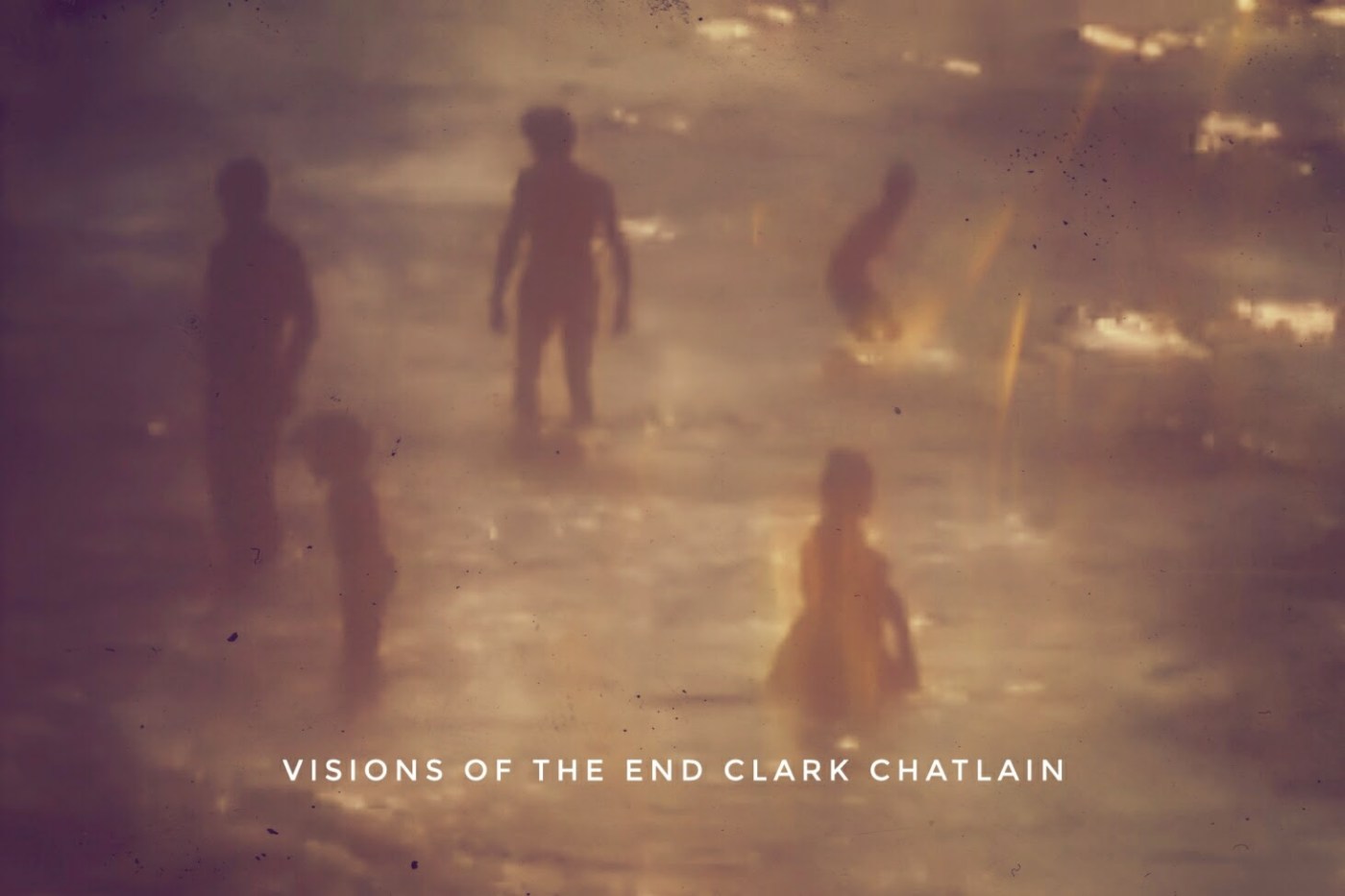
‘visions of the end’ by Clark Chatlain

we live today with the sense that the apocalypse is underway. our world is a world lit by revelation. we believe we have seen our own end, that it has been revealed to us, for that is one meaning of the term apocalypse: to reveal, to uncover. when John of Patmos narrated his vision he gave us his apocalypse, and though it was rooted in his Christianity and even more in his time and his world, it is still now our most common exemplar of an apocalypse. this meaning of apocalypse, this revelation and uncovering of the end, is closer to our understanding of our world than we might think. while the generations and centuries before us found themselves, for the first time, living in a disenchanted universe, we are today the generations that hear and read daily that our world is ending. Continue reading “‘visions of the end’ by Clark Chatlain”

What trumps love

by Fredric Nord

You complete me, he says. In the movie. Manufacturing swoon and meme for the masses. Romance aside: I stare at art. I’m stunned by some lines of charcoal on paper. I’m liberated. It completes me. A moment of Eureka soft as morning. An Oh Snap gentle as the night. Our habit is of completeness: each irregularity will eventually be found by a being that seems born to complete it. Our habit is of individuality, and then overcoming it. Continue reading “What trumps love”

‘Walking Towards Death’ – 5 Essays on Mortality by Arathi Devandran

Part 5: ‘Dear Younger Me’

Dear Younger Me,

The first, and most important thing I want to tell you is this – growing up is hard, but things will always work out in the end.

Becoming older will teach you a couple of big lessons about life.

There will be times where you will wonder if you will ever recover from some of these experiences – heartbreak, failure, bad habits, illnesses. The answer is, yes, you will. You may not be the same person at the end of the experience, but you will recover, and you will find that you will be better for it.

Often, even as you are growing older, you will feel like a child – lost and confused. You will wonder if you’ll ever stop feeling this way. You won’t, not really. But you will get better at dealing with it.

Continue reading “‘Walking Towards Death’ – 5 Essays on Mortality by Arathi Devandran”

‘Walking Towards Death’ – 5 Essays on Mortality by Arathi Devandran

Part 4: ‘Fighting Ageing’

My father stopped taking his cholesterol tablets for two weeks. At his regular health check-up, his cholesterol levels were higher than usual; that was when he confessed that he had decided to abstain from his tablets, just to “see how it goes”. Needless to say, it did not go very well – he was promptly chastised by his doctor and his wife, and he’s been dutifully taking his tablets again.

Then there was the time when he thought it was a good idea to take virgin coconut oil everyday – a spoonful a day goes a long way, or so he was told. As most things in life go, too much of anything is never a good idea, and so he ended up with a hacking cough and cold that lasted for weeks.

My father does this often. He tests the boundaries of what he should and should not do, being purposefully stubborn and insistent in doing certain things his own way (be it right or wrong), and then suffering the consequences of his actions. There is a stubborn mule headedness to him that is usually absent in his demeanor.

My father’s not the only one.

Continue reading “‘Walking Towards Death’ – 5 Essays on Mortality by Arathi Devandran”

“She Begins Again To Live in the Past”: On The Ravishing of Lol Stein by Marguerite Duras

I don’t know how to write about Lol Stein. I’ll start there, with an admission of my own limitations, a confession that any review that I write will fail to encompass all that I felt while reading it and all that I feel all these months and years later. Anything I write about it will be mired in my own history and my own memories.

I hate writing reviews because words never touch the experience of reading a book. This review can’t make you feel what I felt, holding the book in my hands, discovering the words on the page, all the moments in which images and scenes have flashed in my mind. But I want to say something about this book. I have so much that I want to say.

Continue reading ““She Begins Again To Live in the Past”: On The Ravishing of Lol Stein by Marguerite Duras”

‘Walking Towards Death’ – 5 Essays on Mortality by Arathi Devandran

Part 3: ‘Discussing Death’

My first memory of death is linked to a man I never knew. My mother’s father died of a heart attack before I was born; the irony is that I know more about his death than I do about his life.

The entirety of the man has been reduced to a single black-and-white obituary photograph that my mother faithfully keeps at her prayer altar. Then, there are the stories. The stories of what an influence he was in my mother’s life, how he used to work with the British Royal Navy (this was in the 1940s and 1950s, in a pre-independent Singapore that seems as much of a myth as my late grandfather), and of course, the stories about how he died, and how that changed his entire family’s life.

It is funny, what death does. It slowly morphs to form the central narrative of a person’s life, as if only through death did his life gain meaning and importance and weight.

Continue reading “‘Walking Towards Death’ – 5 Essays on Mortality by Arathi Devandran”

On Margaret Atwood’s The Handmaid’s Tale and Yearning

I started reading Margaret Atwood’s The Handmaid’s Tale after the 2016 election. The book felt timely as we, as a people, confronted an uncertain political future. To be honest,  I was gutted by what happened. I was troubled and grief-stricken that a man who boasted about sexually assaulting women, a man who dehumanized every group of people except straight white men, a man who lied every time he opened his mouth, was elected President of the United States. I know many of us are still reeling, maybe we’re even numb.

I decided that I would turn to literature as a way to cope with what happened. Writers give me hope. Writers are always dangerous because they ask us to empathize with The Other and they engage in complex, critical thinking. At least the best writers do. They challenge the status quo. They force us to rethink our assumptions, prejudices, and traditions.

Continue reading “On Margaret Atwood’s The Handmaid’s Tale and Yearning”

‘Walking Towards Death’ – 5 Essays on Mortality by Arathi Devandran

Part 2: ‘Mixing Memories’

One of my most beloved memories is that of gnarled hands plaiting my long, curly hair, fingers slowly sifting through tangles, gently unfurling errant curls, and tucking them neatly into the beginnings of a French plait. In my ear, the sound of my grandmother’s voice softly admonishes me, telling me to sit still if I want my French braid to turn out properly.

My grandmother was very good at French plaits, and, as her beloved youngest granddaughter, I took it upon myself to have my hair done whenever I could. It was one of the many perks that came with living with my grandmother, who was my principal caretaker during my childhood years, while my parents were off working and doing other adult things.

Continue reading “‘Walking Towards Death’ – 5 Essays on Mortality by Arathi Devandran”

Blog at WordPress.com.

Up ↑