Search

BURNING HOUSE PRESS

Not For Profit/For Prophecy

Category

Essay

Visions Of Morandi

By Fredric Nord

I realize how this obsession has gone too far. I’m on a bus cutting through Stockholm, it’s a smug city but easy on the eyes. I’ve dressed up for this. I’m on my way to see Morandi at Artipelag, beautifully situated in the archipelago. My expectations are high, feeling a bit too happy for paintings, a bit nervous. I’ve seen so few of his works in real life, only once before, and they affected me so profoundly that the big painting next door, some ceiling job by some dude named Michelangelo, left me cold and meh. I seem to have something at stake here.
And for this text, I will be Don Quixote de la Costanza.

Continue reading “Visions Of Morandi”

What trumps love

by Fredric Nord

You complete me, he says. In the movie. Manufacturing swoon and meme for the masses. Romance aside: I stare at art. I’m stunned by some lines of charcoal on paper. I’m liberated. It completes me. A moment of Eureka soft as morning. An Oh Snap gentle as the night. Our habit is of completeness: each irregularity will eventually be found by a being that seems born to complete it. Our habit is of individuality, and then overcoming it. Continue reading “What trumps love”

‘Walking Towards Death’ – 5 Essays on Mortality by Arathi Devandran

Part 5: ‘Dear Younger Me’

Dear Younger Me,

The first, and most important thing I want to tell you is this – growing up is hard, but things will always work out in the end.

Becoming older will teach you a couple of big lessons about life.

There will be times where you will wonder if you will ever recover from some of these experiences – heartbreak, failure, bad habits, illnesses. The answer is, yes, you will. You may not be the same person at the end of the experience, but you will recover, and you will find that you will be better for it.

Often, even as you are growing older, you will feel like a child – lost and confused. You will wonder if you’ll ever stop feeling this way. You won’t, not really. But you will get better at dealing with it.

Continue reading “‘Walking Towards Death’ – 5 Essays on Mortality by Arathi Devandran”

‘Walking Towards Death’ – 5 Essays on Mortality by Arathi Devandran

Part 4: ‘Fighting Ageing’

My father stopped taking his cholesterol tablets for two weeks. At his regular health check-up, his cholesterol levels were higher than usual; that was when he confessed that he had decided to abstain from his tablets, just to “see how it goes”. Needless to say, it did not go very well – he was promptly chastised by his doctor and his wife, and he’s been dutifully taking his tablets again.

Then there was the time when he thought it was a good idea to take virgin coconut oil everyday – a spoonful a day goes a long way, or so he was told. As most things in life go, too much of anything is never a good idea, and so he ended up with a hacking cough and cold that lasted for weeks.

My father does this often. He tests the boundaries of what he should and should not do, being purposefully stubborn and insistent in doing certain things his own way (be it right or wrong), and then suffering the consequences of his actions. There is a stubborn mule headedness to him that is usually absent in his demeanor.

My father’s not the only one.

Continue reading “‘Walking Towards Death’ – 5 Essays on Mortality by Arathi Devandran”

“She Begins Again To Live in the Past”: On The Ravishing of Lol Stein by Marguerite Duras

I don’t know how to write about Lol Stein. I’ll start there, with an admission of my own limitations, a confession that any review that I write will fail to encompass all that I felt while reading it and all that I feel all these months and years later. Anything I write about it will be mired in my own history and my own memories.

I hate writing reviews because words never touch the experience of reading a book. This review can’t make you feel what I felt, holding the book in my hands, discovering the words on the page, all the moments in which images and scenes have flashed in my mind. But I want to say something about this book. I have so much that I want to say.

Continue reading ““She Begins Again To Live in the Past”: On The Ravishing of Lol Stein by Marguerite Duras”

‘Walking Towards Death’ – 5 Essays on Mortality by Arathi Devandran

Part 3: ‘Discussing Death’

My first memory of death is linked to a man I never knew. My mother’s father died of a heart attack before I was born; the irony is that I know more about his death than I do about his life.

The entirety of the man has been reduced to a single black-and-white obituary photograph that my mother faithfully keeps at her prayer altar. Then, there are the stories. The stories of what an influence he was in my mother’s life, how he used to work with the British Royal Navy (this was in the 1940s and 1950s, in a pre-independent Singapore that seems as much of a myth as my late grandfather), and of course, the stories about how he died, and how that changed his entire family’s life.

It is funny, what death does. It slowly morphs to form the central narrative of a person’s life, as if only through death did his life gain meaning and importance and weight.

Continue reading “‘Walking Towards Death’ – 5 Essays on Mortality by Arathi Devandran”

On Margaret Atwood’s The Handmaid’s Tale and Yearning

I started reading Margaret Atwood’s The Handmaid’s Tale after the 2016 election. The book felt timely as we, as a people, confronted an uncertain political future. To be honest,  I was gutted by what happened. I was troubled and grief-stricken that a man who boasted about sexually assaulting women, a man who dehumanized every group of people except straight white men, a man who lied every time he opened his mouth, was elected President of the United States. I know many of us are still reeling, maybe we’re even numb.

I decided that I would turn to literature as a way to cope with what happened. Writers give me hope. Writers are always dangerous because they ask us to empathize with The Other and they engage in complex, critical thinking. At least the best writers do. They challenge the status quo. They force us to rethink our assumptions, prejudices, and traditions.

Continue reading “On Margaret Atwood’s The Handmaid’s Tale and Yearning”

On Nathalie Léger’s Suite for Barbara Loden

Barbara Loden is Wanda, as they say in the movies. Her inspiration for the screenplay was a newspaper story she had read about a woman convicted of robbing a bank; her accomplice was dead and she appeared in court alone. Sentenced to twenty years in prison, she thanked the judge. Interviewed when the film came out, after it had been awarded the International Critics Award at the 1970 Venice Film Festival, Barbara would say how deeply affected she had been by the story of this woman—what pain, what hopelessness could make a person desire to be put away? How could imprisonment be relief?

–Nathalie Léger, Suite for Barbara Loden


From an early age, I knew I wouldn’t make it in this world. So I connected with women who, in my mind, shared that feeling. Plath and Woolf with their suicides speaking of a deep pain. Barbara Loden and her film Wanda in which the title character wanders alone and unloved.


Wanda is poor and she is voiceless and she is invisible. I understand the not-thereness of her.


Nathalie Léger felt a connection to Wanda as well. Tasked with writing an encyclopedia entry about actress Barbara Loden, she quickly became obsessed and expanded her inquiry, writing Suite For Barbara Loden, a gorgeous and dizzying investigation and excavation. Léger delves into Loden’s life, at times embellishing and inventing, and analyzes every layer of Loden’s only film, Wanda.  The book is fact and fiction and memoir and film criticism; it is a love letter to Loden and the singular film she created.


Continue reading “On Nathalie Léger’s Suite for Barbara Loden

‘The Summer Vacation Spent Indoors’ by Sarah Murphy

What a fine weather today! Can’t think whether to drink tea or hang myself.’ – A.P. Chekhov 

Three weeks after I left school for good, twenty-five Facebook messages exchanged in a group chat and eight texts doled out in the absence of Wifi later, a road trip had been planned for myself and a group of female friends. It was to symbolise the Last Summer: our final farewell to school, with the charm of gin and an Angel Olsen soundtrack which was lacking in the leaver’s dinner, in posing for umpteen photos in a lurid eBayed dress, thinking how much less gorgeous than everyone else I looked, and burying my pride in a disappointing chocolate mousse.

“It’s been a decade,” Jaya said as she arrived with Martha and Tess and the others in the road trip cohort that evening, standing in sundresses pulled over swimsuits, the car-park with the huge marina billboard and dilapidated blow-up cinema beside it looking suitably macabre for a adulthood send-off. “It’s been forever.”

“Since you’ve driven?” I asked.

“Since I’ve seen you guys.”

This was not accurate; it had been four days since our last reunion. But ever since school ended, this was how it was: impossible not to quantify everything in terms of forever. Two dollars for a bus ticket to the ends of the earth, please.

Continue reading “‘The Summer Vacation Spent Indoors’ by Sarah Murphy”

On Chantal Akerman’s South


How does the southern silence become so heavy and so menacing so suddenly? How do the trees and the whole natural environment evoke so intensely death, blood, and the weight of history? How does the present call up the past? And how does this past, with a mere gesture or a simple regard, haunt and torment you as you wander along an empty cotton field, or a dusty country road?

Chantal Akerman

In his seminal book, Between the World and Me, Ta-Nehisi Coates writes that “In America, it is traditional to destroy the black body–it is heritage.” The 1998 murder of James Byrd Jr. confirms Coates’s words. Byrd was attacked by three white supremacists in Jasper, Texas. They beat him, urinated on him, and then tied his body to the back of their truck and dragged him several miles down an isolated road. Over the course of the drive, Byrd’s body was literally torn apart; pieces of flesh and body parts, including Byrd’s head and arm, were strewn along the road. The three men finally dumped what was left of Byrd’s body at a black church. The murder sparked national outrage and condemnation. All three killers were convicted. Two of the perpetrators remain alive, while one was executed in 2011.

Around the time of the murder, Chantal Akerman planned to make a documentary about the American South. She admired the work of William Faulkner and wanted to explore the region. However, when Byrd was murdered, her attention immediately shifted and she chose to focus on his death. The subsequent documentary she made was called Sud (South).

Continue reading “On Chantal Akerman’s South

In By Fire, Tahar Ben Jelloun Tells The Story of the Man Who Sparked the Arab Spring


Every fire begins with a spark, a small flame that ignites a conflagration. Where does that spark originate? No one could have known that when Mohamed Bouazizi set fire to his body on December 17, 2010 his act of self-immolation would trigger protests in Tunisia and throughout the Arab region. He was the spark that lit up the world.

In By Fire: Writings on the Arab Spring, Tahar Ben Jelloun writes about Bouazizi in two distinct ways. In the first part of the book are selections from Ben Jelloun’s nonfiction writings about the Arab Spring. In the second part of the book is Ben Jelloun’s short story “By Fire,” which enters the mind of Bouazizi and attempts to capture the nuances of his life. Both parts are necessary and complement each other. Translator Rita S. Nezami’s notes and introductions do an excellent job of contextualizing Bouazizi’s act of protest and providing much-needed information for Western readers to understand the political climate in Tunisia before the Arab Spring.

Continue reading “In By Fire, Tahar Ben Jelloun Tells The Story of the Man Who Sparked the Arab Spring”

‘What’s My Name?’ – an essay exploring identity and adoption by Anneghem Wall

What’s My Name?


Our names: our school pegs, our register entries, an ID badge, a passport, a bank account, a driving licence, how we introduce ourselves. Of course, all of our names are given to us, some a gift, others a curse, some that don’t quite sit right with the face in front of us, or for the body that the person inhabits, but it’s something we all have. Continue reading “‘What’s My Name?’ – an essay exploring identity and adoption by Anneghem Wall”

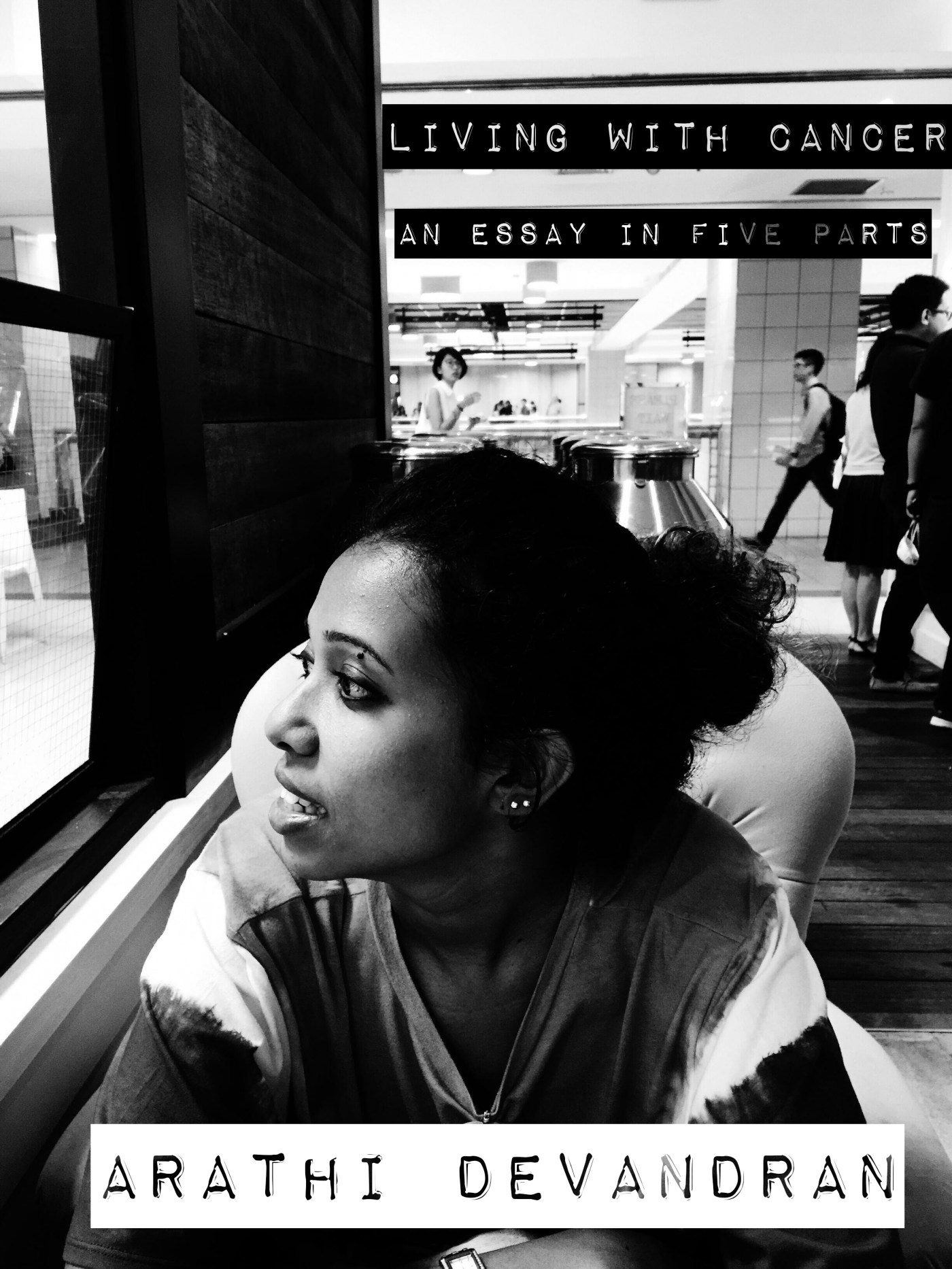
‘Living With Cancer’ – an essay in five parts by Arathi Devandran

Part 2: ‘The Treatment’


Note: This interview was written from a series of conversations between the author and her mother over several years. It has been put together to present this part of the series.

Me: Do you remember the day of your diagnosis?

My Mother: Yes. It is a day I will never forget. I remember the doctor telling me that I had a good chance of survival, that the lump they had discovered was small, that there was a fighting chance. The doctor spoke a language of hope. But all I could hear was death, disease, disaster. You know that saying about the world crashing down on you? Yes, that is what happened to me. The world as I knew it came crashing down on me. Continue reading “‘Living With Cancer’ – an essay in five parts by Arathi Devandran”

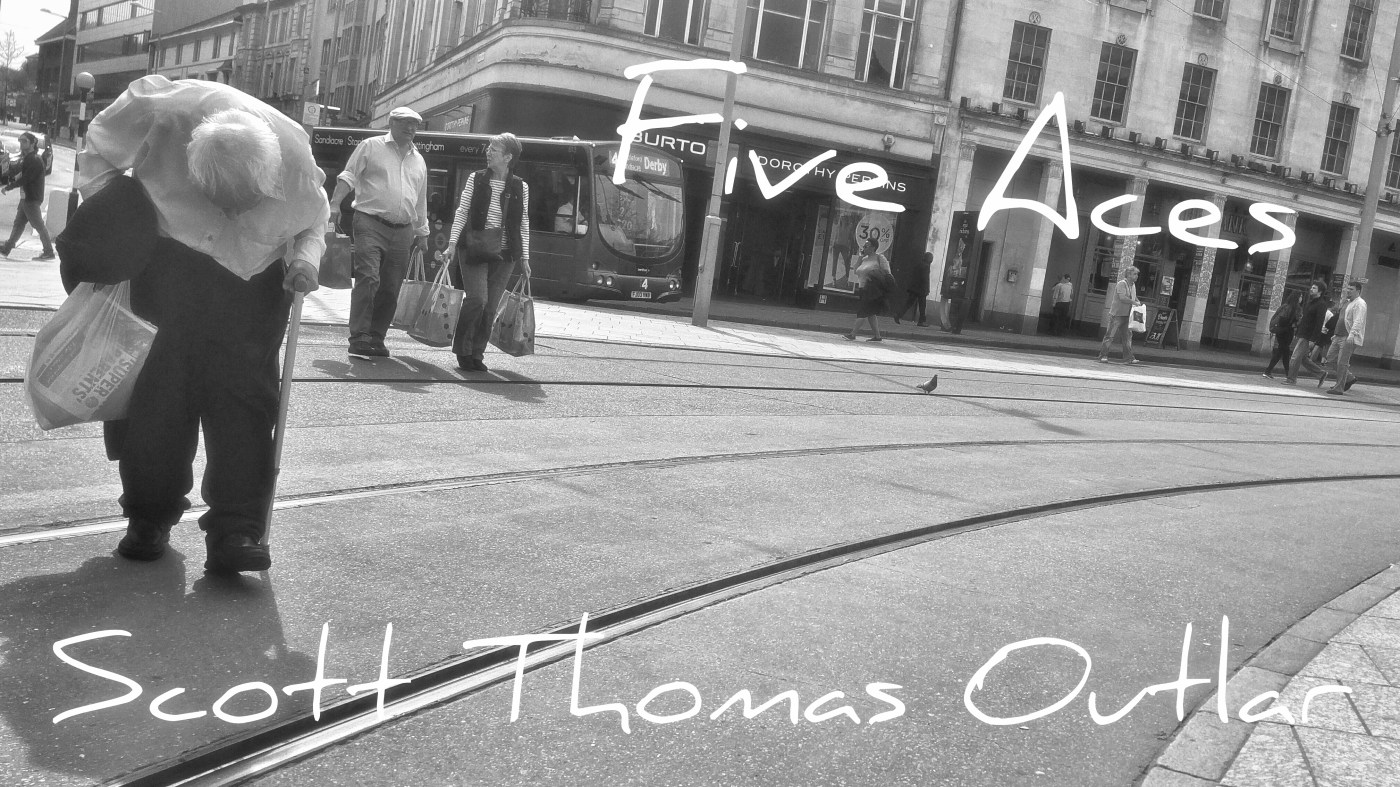
‘Five Aces’ – essay by Scott Thomas Outlar

If the Beast pushes you into a corner, do you come out swinging with haymakers? Or sit down cross-legged and meditate? Both could, conceivably, be actions that lead to salvation depending on what type of mood one might be in on any given day. Do you fight fire with fire? Or apply jiujitsu techniques in a way that wears down the aggressor striking out against you? Sometimes it is best to step out of the way and allow that which is evil to self-destruct from within. Sometimes, however, it is best to rear back and punch a bully square in the nose.
Continue reading “‘Five Aces’ – essay by Scott Thomas Outlar”

‘Living With Cancer’ – an essay in five parts by Arathi Devandran

Part 1: ‘When We Found Out’


Dear diary,

It seems silly that I am writing in my diary at this age, and yet –

Mother called earlier today. The biopsy results are in:

A malignant tumor. Breast Cancer. Continue reading “‘Living With Cancer’ – an essay in five parts by Arathi Devandran”

Blog at WordPress.com.

Up ↑