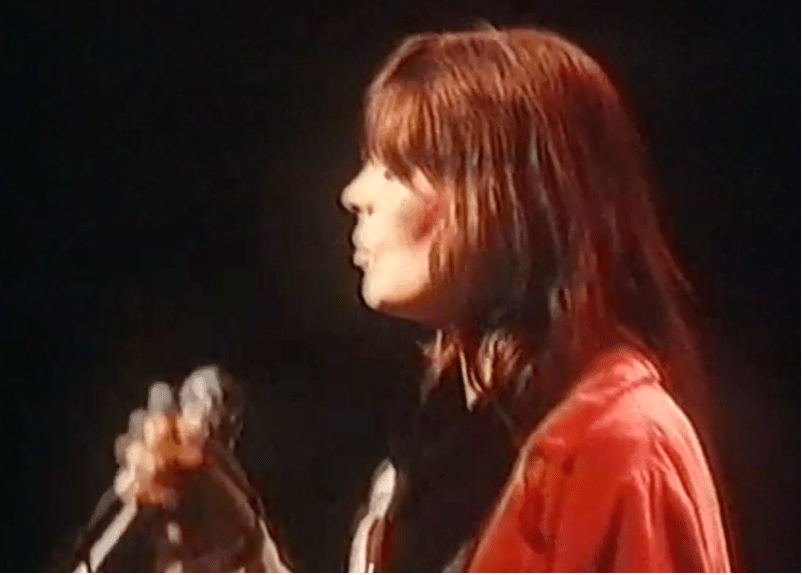
An interview from 1985, in Belgium, before or after a show where she performed My Funny Valentine with a drink in her hand, swaying and looking up into the lights.
The lines around her eyes and her easy smile. The lines around her mouth and her serious eyes. Her browned teeth.
It feels like every beautiful woman I know, whether in her twenties or her fifties, has recently tried to engage me in the talk about botox and fillers and surgery.
I don’t know what other women want from life, or why so many of us can be so easily fooled into hating time or pretending it away, but I end up saying the same thing over and over again, no matter where the talk goes:
I just can’t do it and there is really only one reason why:
I have never, ever, ever—never even once—looked at another woman and thought “she’d be beautiful if only she had no wrinkles, she’d be beautiful if only her eyes weren’t hooded, she’d be beautiful if only her acne scars were erased, she’d be beautiful if only her flesh were stretched tighter around her bones.”
And if I don’t trust my aesthetic intuition, what kind of an artist am I? If I let them convince me that someone other than me decides what I find beautiful, why bother ever writing another word again?
I know this is why artists are monsters. It’s why I have always been a little afraid of myself. But our lives are our works of art. We will eventually arrive at the moment when we can no longer deny it. For most it’s on the deathbed.
Just watch Nico talking and singing in 1985.
The 70s were a broken bridge, she says. She’s not excited by the fact that every band since the late 70s has listed The Velvet Underground as a significant influence. Why not? asks the interviewer. Because it gives me the feeling that I’m stuck in the 60s, she says. And the 60s and the 80s are too much alike already, she says. But why? asks the interviewer again. It’s the same paranoia, the same fear, she says. But the 70s were really different, she says. And they were a broken bridge. World-weariness overtakes her face, sorrow glimmers at the edge of her eyes.
She is otherworldly calm as she answers questions, as though she’s somehow had a long time to search her life and arrive at her responses, but this is no rehearsed interview. She can stop time with her presence, and so she doesn’t need to pretend that she’s not in time—aging—with her face or the rest of her body.
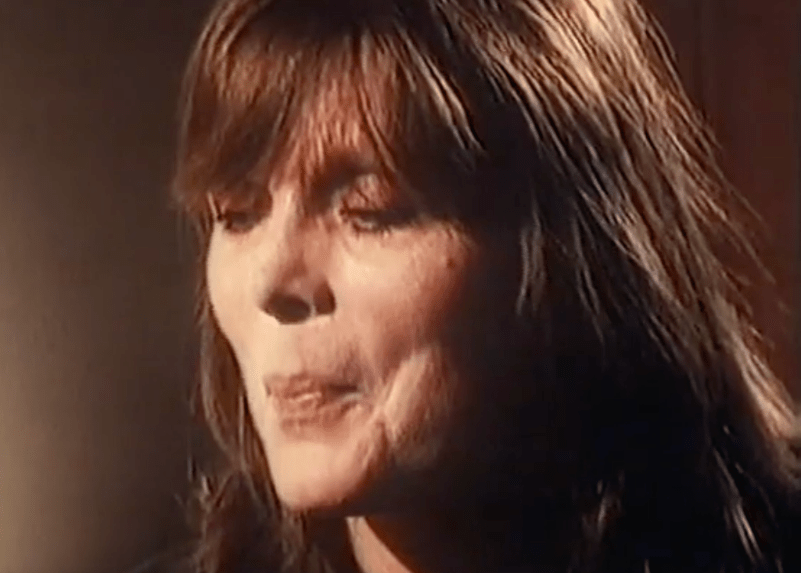
This interview has unnerved me. It’s what I can and cannot see in her eyes.
I’ve thought about it for days, feeling something emerge within and around me. Something distinct and real, like its own entity. I’ve let it exist as a kind of haze around me, until this morning, when it took shape. It’s this:
if there’s one thing I can do for my daughter (by which I mean all of life, the ‘future’ itself, the potential continuation of humanity) it’s that I can show her (us), with my life, that time is not to be feared. That life is not to be feared. That sorrow and joy are not to be feared. That moving through this mysterious game in which laws of time and gravity and space contain us is a wonder to behold. And to play. Simultaneously. In it and unafraid to also be of it.
A friend asked me, But what about her cruelty? The terrible things she might have said?
I don’t know why, or if, Nico has said the hateful things some say she said, but I know that we all know hatred in our own very personal ways, and we’ve all seen what it’s like when hatred has too firm a grip on someone who has usually been able to keep it in check. This is perhaps the lesson of now. Moving through time is not easy. It excuses nothing, but it’s true. This fact is on our faces and in our eyes and our necks and backs and hands and hips. And in every word we utter.
Maybe today I’ll visit her grave in the forest.
Lindsay Lerman is the author of two books, I’m From Nowhere (2020) and What Are You (2022). She is the translator of François Laruelle’s first book, Phenomenon and Difference. Her short stories, essays, and interviews have been published in The Los Angeles Review of Books, New York Tyrant, Archway Editions, The Creative Independent, and elsewhere. She has a PhD in Philosophy from the University of Guelph in Ontario, Canada. She lives in Berlin.
 BURNING HOUSE PRESS