Search

BURNING HOUSE PRESS

Not For Profit/For Prophecy

Tag

short story

Foils by Daisy Lyle

I

Millet’s spring mind soared red and skittish as an over-angled kite; in summer it entered the usual back-stall, and by August it had dived low enough for him to have another go at his wrists. This year he made an especial hash of it; fumbling with the false-economy razorblades until he ended up cutting his palms as much as anything else.

Afterwards the ambulance dumped him in the aisle of the A&E, where he lay on the hindmost of a metal spine of gurneys down the building’s centreline. Up on the ceiling, a loose panel exposed a pecking wedge of darkness. He turned on his side; the wall’s blank surface, gouged and spilling brown and fibrous shreds, was in worse nick than his skin.

After the stitching they left him in a side room, alone but for the slurping, whistling breaths of someone on the other side of a curtain. Wires snaked around its pleats to a bleeping machine in his own half of the room. His eyes tracked the glowing plots on the monitor; six months after his firing from Aventrix he still couldn’t stop himself subjecting the signals to confused analysis: window functions, discrete transforms, then breakdown into smaller sub-transforms. Radix two, four, sixteen … When the dragonfly lights on the screen began to sting his eyes he gave up his calculations and pulled the bedsheet over his head. Seeking distraction from the thin fabric’s vinegar-and-dead-skin scent, he tried to think its crumpled underside into the hills and valleys of that Stevenson poem. The Pleasant Land of CounterCounter

“… pain?”

The syllable repeated, a chain of islands in a sea of blurred speech, and he realized the nurse had arrived, with a prompt to rate his suffering out of ten. He thought the gurney was creaking, some part of the rails extending on either side of him.

“N over two,” he mumbled, and it seemed to do.

II

In the morning they had him shower the intact parts of his body. Two quivering shoots of something like watercress poked from the cubicle drain. He hoped they were real; he couldn’t bear the idea of hallucinating such lumpen symbolism. Then he was ferried to a psychiatric hospital on the county border, where his mind banked gently into the institutional mist. He spent much of the next few days contemplating more bedlinen, the troughs and peaks of mountain ranges hugged in soft shadow relief.

He wasn’t so keen on the topography of his outspread hands. In recent months they’d thinned out, the newly slackened skin across their backs trumpeting the onset of real ageing. When he turned them over, the mess of his healing palms troubled him. The scabs didn’t quite match the cuts he remembered making, though his memory was a joke. They kept him well-drugged. Quetiapine, lorazepam. Sometimes in the depths of the night a sister came to shine the round white beam of a pen torch on his eyelids. If they fluttered open, hands offered a pellet of zopiclone, the shadows of uniformed arms beating slowly on the walls. Sometimes, as sleep took hold, his throat felt like there was much more than one pill in it, a smooth, hard, comforting clutch.

III

They began to let him out. First just the grounds, the café and shop, in low outbuildings that reminded him of the old airfield Portakabins. He sat nursing weak coffee, watching the wings of the main building extend into milky light, until one day he and some others were put on a minibus and taken to the nearby riverside park.

On the drive one of their escorts enthused about the new fitness parcours along the banks, with special bodybuilding rigs, Ninja wheels, a machine for chest presses.

“Most of that junk’s already out of order,” his roommate Whitlock confided as they got off the bus. “The screws fail, and they’re a special kind. The council can’t be bothered to replace them.”

They quickly passed the old visitor centre, a silent cube of glass covered in crude paintings of leaf and feather that couldn’t hide the underlying curls of dustsheet. The trail head was marked by a pocked information sign. Lodged in one of its bulges, between a badly-drawn muskrat and a peeling heron, was a cluster of tiny pale green balls.

“They’ve got the map here,” said Whitlock.

“I can see that.”

“No, I mean the map butterfly. Araschnia levana, or prorsa, depending on the season. Invasive species, but I’d still like to spot the bleeder. Never set eyes on the black summer form.”

Millet murmured a vague answer to stem the flood of nature facts. The scabs on his palms were itching like hell, much worse than the ones on his arms.

IV

They walked on. After a while he ceased to notice the rise and fall of human voices. To his left was a dazzle of light on winding reed-lined water; foliage encroached on his right. Alder and beech, bramble hordes and white bells of bindweed, parted only by the green metal curves of the fitnessmachines. On each of their instruction diagrams, the silhouette figure looked less like a person.

Finally the path made a swan-neck double bend, and he found himself in front of the most preposterous contraption yet. The paint on this one had almost entirely flaked off, exposing a tall structure of rust-brown metal crisscrossed with streaks of faded cream. It was studded with appendages, and a maze of gears, flanges and blades, culminating in something like a giant upturned wishbone. The sight of the two symmetrical handles fanning out on either side of a discoid seat prompted a distant memory of gym adverts, and then he saw the instruction diagram, with its caption:

BUTTERFLY MACHINE

At the sight of the wonky grid pattern running across the underside of the depicted creature’s wings, the scabs on his palms raged until something in him hatched. When he sat down and grabbed the handles above his head, he felt the fire in his hands drain out into the cold metal. Warming it. Informing it. Loading the chart of his scars into its central navigation system. The antennae slewed and thrummed; great metal wings unfolded with a shivering clang and began to beat, then it bore him into the air.

V

Sounds rose up from the riverbank, individual screams convolved into a single wavering keen, but he couldn’t have looked down if he’d wanted to. When the machine broke through the clouds, it dropped its payload of eggs. As they whistled towards the earth he let go of the handles and the craft itself fell away from him. He hung for a second in the air, hands whipped aloft, before each palm burst apart, discretizing again and again into clouds of tiny flitting things; after a moment his mind followed suit, merry black thoughts whirling up to the sun.
Daisy Lyle is an engineering translator & dark fantasy writer based in Normandie, France. Bluesky http://@novembergrau.bsky.social

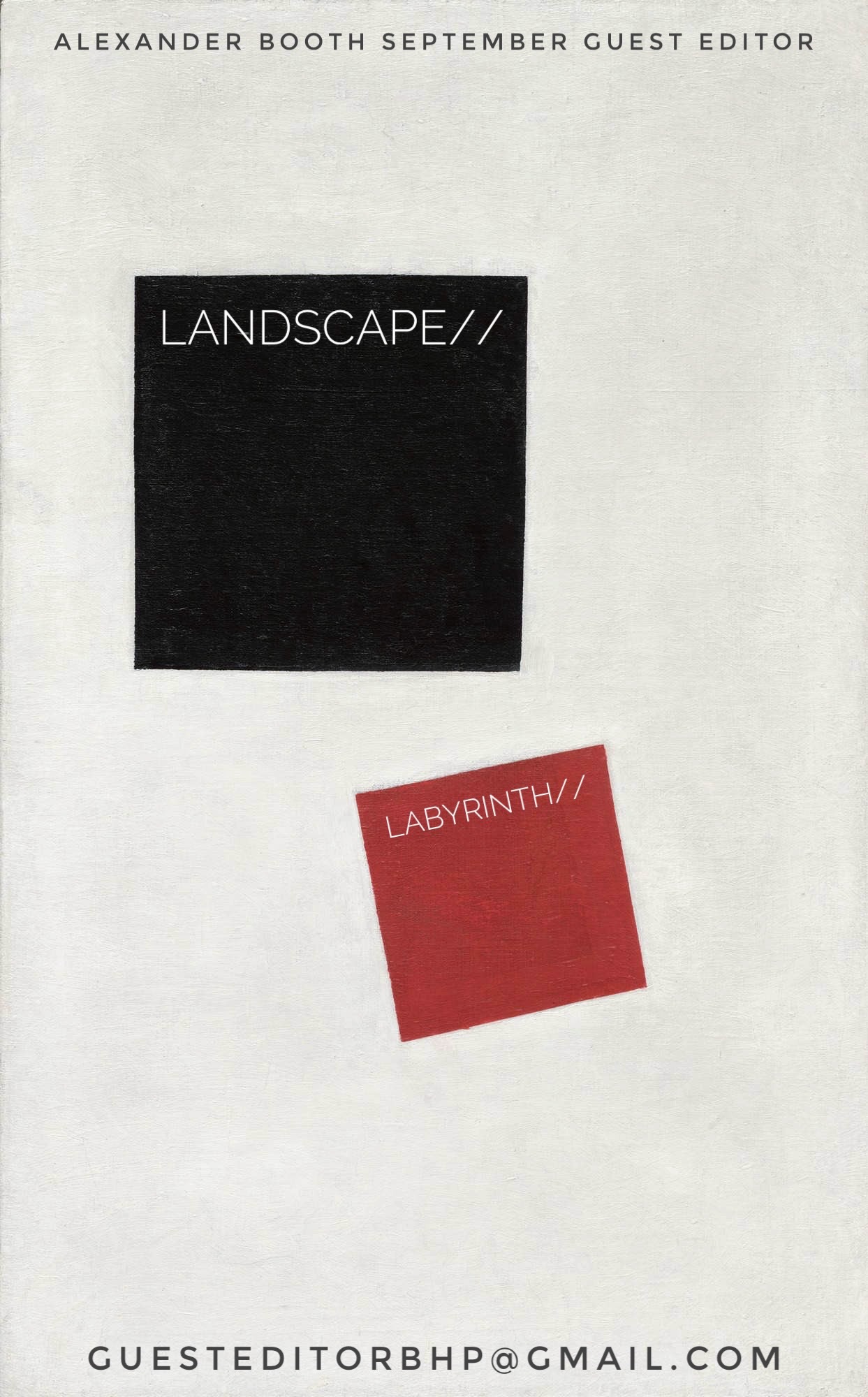
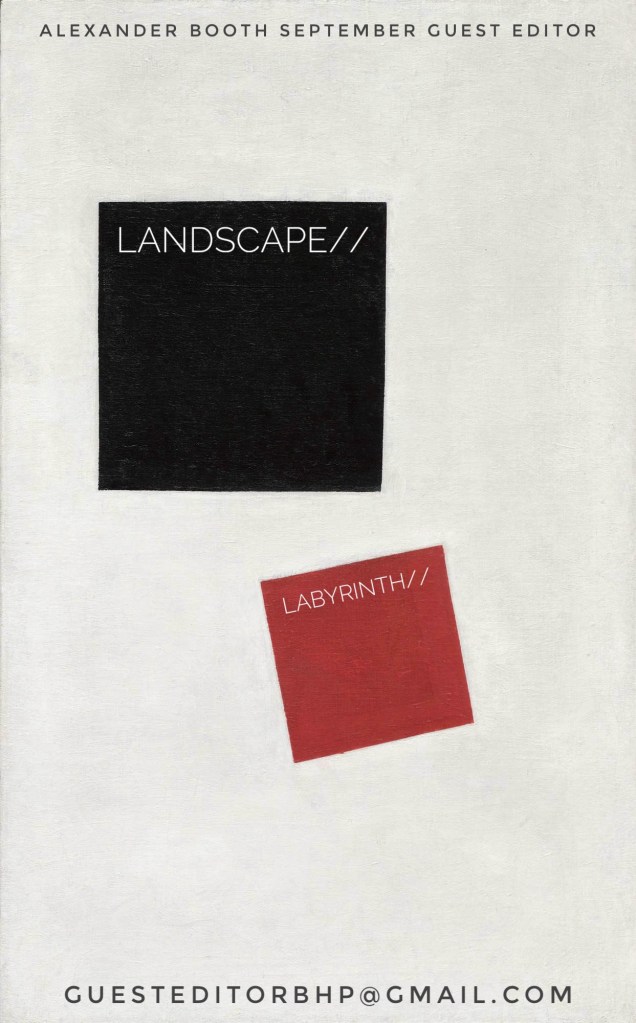
SEPTEMBER 2025 Guest Editor Is Alexander Booth!!! THEME/S: LANDSCAPE // LABYRINTH

Burning House Press are excited to welcome Alexander Booth as the fourth BHP guest editor of our return series of special editions! As of today Alexander will take over editorship of Burning House Press online for the month of September.

Submissions are open from today 1st September – and will remain open until 25TH SEPTEMBER.

Alexander’s theme/s for the month are as follows

—LANDSCAPE

LABYRINTH—

Black Square and Red Square by Kazmir Malevich

_____

LANDSCAPE // LABYRINTH

*

When the painter’s friends, however, looked around for the painter, they saw that he was gone—that he was in the picture. There, he followed the little path that led to the door, paused before it quite still, turned, smiled, and disappeared through the narrow opening. 

–        Walter Benjamin, Berlin Childhood around 1900 (trans. Howard Eiland)

*

Each one of us, then, should speak of his roads, his crossroads, his roadside benches; each one of us should make a surveyor’s map of his lost fields and meadows. 

           Gaston Bachelard (trans. Maria Jolas)

*

“Though Minos blocks escape by land or water,”

Daedalus said, “surely the sky is open,

And that’s the way we’ll go. Minos’ dominion

Does not include the air.”

–        Ovid, Metamorphosis (trans. Rolfe Humphries)

_____

Alexander Booth is a poet, translator, collage artist and printmaker who lives in Berlin. Recent translations include books by Friederike Mayröcker, Alexander Kluge, Gerhard Rühm, and a new translation of Ludwig Wittgenstein’s Tractatus Logico-Philosophicus. His collection of poems Triptych was published in 2021 and Kantor in 2023.

__________

Submission Guidelines

All submissions should be sent as attachments to guesteditorbhp@gmail.com

Please state the theme and form of your submission in the subject of the email. For example: LANDSCAPE/POETRY Or LABYRINTH/FICTION

Poetry and Fiction

For poetry submissions, submit no more than three of your best poems. Short stories should be limited to 1,500 words or (preferably) less. We encourage flash fiction submissions, no more than three at a time. Send these in as a .doc or .docx file, along with a short third-person bio, and (optional) photograph of yourself.

Art
Submit hi-res images of your works (drawings, paintings, illustrations, collages, photography, etc) with descriptions of the work (Title, Year, Medium, etc) in the body of the email. Files should be in .JPEG unless they are GIFs or videos, and should not exceed 2MB in size for each work. File names should correspond with the work titles. Video submissions can be uploaded onto Youtube or Vimeo for feature on our website. Send these submissions along with a short third-person bio, and (optional) photograph of yourself.

Virtual Reality/ 3D Artworks

For VR Submissions, please submit no more than three (3) individual artworks. For Tilt Brush works, please upload your artwork to Google Poly (https://poly.google.com/), and mark it as ‘public’ (‘remixable’ is at your own preference). A VR/3D artwork can also be submitted as a video export navigating through the artwork. If you prefer this method, please upload your finished video file to YouTube or Vimeo and provide a URL. With either format, please provide a 150 word artist’s statement.

Non-fiction
Non-fiction submissions (essays, reviews, commentary, interviews, etc) should be no more than 1, 500 words and sent as a .doc or .docx file along with your third-person bio/and optional photograph.

Submissions are open until 25th SEPTEMBER – and will reopen again on 1st OCTOBER 2025/for new theme/new editor/s.

BHP online is now in the capable hands of the amazing Alexander Booth – friends, arsonistas, send our SEPTEMBER 2025 guest editor your magic!

Womannotated – Dead Sea

Dead Sea 

Saunter through snapdragons, the cobblestone path

inside his house, into a bath prepared 

with Dead Sea salts by a sociopath— 

Continue reading “Womannotated – Dead Sea”

Short Story by Anna Walsh

daniel-von-appen-zNsOqOtKEik-unsplash

Photo by Daniel von Appen on Unsplash


short story: Ruined Things Are Only Gorgeous When They Are Not Yours 


Driving along the motorway, the radio crackled. She wanted to trace something on the window, but couldn’t think what. She fiddled with buttons, found an old song they both liked and turned it up. She imagined she was going to Berlin, to meet girls wearing orange lipstick and boots, tall and forward in the chaos of other people.  Continue reading “Short Story by Anna Walsh”

Short story by James Cato

jaunathan-gagnon-v5AG4QUfyx8-unsplash

Photo by Jaunathan Gagnon on Unsplash


short story: M80


I remember telling my parents that I was destined to get along with Bud Lykke, with that prosocial name of his, but I didn’t expect such a character. Each morning, he pours a bit of coffee into the hanging plants. After dinner he spends hours inside chunky headphones with “Binaural Beats” blaring, engineered to trigger dissociative states. He grew up in Appalachia, some obscure county in Ohio, and blames his ills on the heavy fracking around there, radioactivity in the drinking water. Continue reading “Short story by James Cato”

Short Story by Jennifer Brough

yuzki-wang-G4WL7mQuZ3w-unsplash

Photo by Yuzki Wang on Unsplash


story: The Somnambulist Party


The moon is full and bathing. Light laps each house in this quiet village, casting silver squares through windows with undrawn curtains.
In one such bedroom, a cat bathes too, pale fur illuminated against the floorboards. A clock chimes deep within the house and his eyes flash open. He stretches, unfurling his length, and leaps on the mistress’s bed, pawing at her cheek once, twice, waiting.  
                   
The mistress is between dreams. Within them, a dark ocean crashes into itself. She is expecting an arrival in the foam but is uncertain what form it will take. A vast scattering of shells and flint line the shore but she can’t move quickly enough to search through the piles. When she moves her hands, they leave ghostly echoes of themselves. The sound of waves melts into chiming. It is almost the hour, she knows, and she hasn’t found a thing.  Continue reading “Short Story by Jennifer Brough”

Short Story by Stephen Orr

cam-fattahi-9TWcgXlEDCs-unsplash

Photo by Cam Fattahi on Unsplash


short story: Point Nemo

He’s been on two journeys in his lifetime. Firstly, Antarctica. With his son, Mark. Arriving by air, setting out (despite all the warnings), saying to the seventeen year old boy, We must take our first reading from the coastline. Mark saying, How can we do that? It’s covered in a billion tonnes of ice. 

That doesn’t matter. Continue reading “Short Story by Stephen Orr”

“An Ethereal Tethering” by Stephen Wack

IMG_3145
Art by Moriah M. Mylod


. . . something about a man and his dog (in the grand, non-linear scheme of reincarnation) as being one in the same. Soul, that is. Ethereal transient dweller, is another. Here now, there they are: Situated between two distinct, bloody meat husks, between two separate states of existent being — at once, under one roof, simultaneously — with one foot in man, the other, a dachshund-terrier mix. 


. . . is comprised of both end and endless, singular and infinite, of omniscient oblivion, bright-dark heavy-light, of both shape and void, each with their own distinct name. As a man: Brandon. In dog form, she is Mocha, among countless others (i.e., Mochi, Mookie, Monkey, Chunky, Chubbers, Chunkmonster. . . ). As mutual entity, root identity, as timeless core incarnate, a loose translation: Daielaareux. 


. . . will spend seven months at the shelter, gone unadopted longer than any other dog, before rejoining herself again. Meanwhile, she cries her jaw off. Starves herself down to a coffee-boned silhouette. Even draws blood from the hand of a guileless child, to make clear the message: I will never be yours. She waits patiently for what she already knows will eventually be.


. . . remembers what, on pure impulse, will drive him to the shelter in this manic grasping for purpose, going on six days without medication. He will come upon himself, caged separate. His ovaries scooped clean. Groggy with shots to keep him quiet, stagnant, alive. Not even finding himself to be particularly cute, or unique, or enthralling, yet feeling instantly connected, just the same. Might he’ve recognized then, in those muted eyes, himself? She knows the next years ahead of them together will be nothing so glorious — that they are in no way ready or responsible enough to take adequate care of themselves. They will ingest things that will make them violently ill. They will be too poor, too careless, to seek medical help. Will endure vast chunks of boredom, chewing holes through themselves, incapable to leave the house. Will watch themselves from the foot of the bed sulk and rot away for days on end, treading the grey wash of their skull, directionless, besides down. Will be the only life force to keep them afloat, strong enough to pull themselves upwards, and eventually, out.  


. . . yanks on their leash in unruly directions, and, out of sheer spite, he tugs them back the opposite way. Each will struggle to tell themselves what to do. He instructs her to obey: Sit. Heel. Eat. Fetch. Up on the couch. Now, off. But she refuses to listen. Years later, their heart crushed by a lasting love, lost — the one who used to (she now learns) smack them in private, but still loves her, despite the abuse — two months out, having still not washed the pillows or sheets, incubated with the tortuous scent of their ex’s shampoo, she has no other choice than to piss on the bed. She instructs him to: Be calm. Go for a walk. Know your self-worth. Move on. But he refuses to listen. He tells himself: No. He calls herself: Bad girl. They scream as themselves: Shut up shut up shut up. 


. . . Daielaareux, in countless other forms: A bridge in New Zealand. A strip mall in Detroit. An unbuttered croissant. A great big pile of leaves. A spanned lineage of prehistoric, neon-colored crabs. A comfortable silence. An impossible dream. The 37th Annual Miss America pageant. A one-hit wonder. An impotent king. A fortuitous accident, recognized only in hindsight. The Divine Mouth taking the earth like a vitamin. A newborn horse’s first step. Another one biting the dust. 


. . . forever amounts to, returns back to, self-love. 


. . . just seconds before the New Year, 2018. Time hibernates. Thoughts shuffle like a deck of cards. Head loud. Skull turned inside out on psychedelics. A blubbery, sunken, self-contained mess of fleshy slop packed inside a transient shell. A dark stain on the carpet, on a mother’s pelvic floor. He rushes to the bathroom, convinced an empty bladder will cure him. It does, then doesn’t. Grime sits in every wrinkle. Gravity’s tandem held hand lets go. The universe’s veil pulled down like a shower curtain, their many forms spilling out over the linoleum floor. On their knees, hands, back, she perches on his chest and he catches it — a quick glimpse, the uncanny resemblance, atoms stacked like dodged shoved in a cage. He holds herself behind the ears, kisses himself on their wet, hot stinking teeth. Noticing it fully, this tethering between them — an ethereal cord, conjoined. He she they them are all was once will have had we become continuous as one day slips seamlessly into the next without a clock, as the crackling bursts of fireworks resound from outside, at last. They have made it, for now. 


. . . in the same windowed timeline, will cease just as abruptly as its start: The man, at the tender age of fifty-six, from an untreated pulmonary obstruction; as a dog, age nine, a pack of stale Oreos left accessible at the top of the trash. And yet, both still remain incapable of saving each other, themselves, from what must be in order to happen again.


Stephen Wack is an Atlanta-based writer. He earned an undergraduate degree in Neuroscience from the University of Georgia, where he briefly interned at the college’s literary magazine, The Georgia Review. His work has previously appeared in Five:2:One, Rougarou, and Cleaver Magazine, and is forthcoming in The Hunger and New Flash Fiction Review.

From where the birch takes the sun — A short story by Stephen Orr

From where the birch takes the sun

      Peter Maier waits in his back yard. He paces the patchy lawn, from where the birch takes the sun; from where he sits in summer to read. Or in the crook of the linden, further back, behind the vegetables. He follows the brick path, and remembers every time he’s helped his father turn the soil, plant the carrots, the potatoes. Just like this, wandering, unsure where to stand, where to go, what to think about what his mother calls the ending. He can hear the artillery a few kilometres away. They’ve been warned – later today, or tomorrow.

Continue reading “From where the birch takes the sun — A short story by Stephen Orr”

Watching The World Fly By by Melanie Davies

Watching the World Fly By

The clock chimed seven …ding…ding…ding… and so on, until it let out one final loud ding that woke Forbes with a start. He shuffled slightly and managed to stretch his front and back legs just enough to prevent the cramp from setting in. He meowed happily as he heard the familiar whirring sound. His morning feed came shooting through the food hatch and plopped into his dish in a brown lumpy mush.

Continue reading “Watching The World Fly By by Melanie Davies”

Blood Magic by Natasha C. Calder

Blood Magic

It was her first period for three months. Sitting on the lav with her knickers around her ankles and her knees falling apart, Mihaela saw the new slimness in her bare legs and grimaced. She thought of all the meals she’d missed since the promotion—the rushed breakfasts, the uneaten sandwiches, the insubstantial dinners—and how quickly it had become a matter of finding not the time but the inclination. Now she ate as irregularly and as little as she slept. No wonder her periods had stopped.

Continue reading “Blood Magic by Natasha C. Calder”

Dov Nelkin: 6 doors and One Slammed

129782555_5e4777344c_o

My brother’s childhood room and mine connect through paired doors, at three different points. Walk out my room and and ten paces would take you to my brother’s door, next to the AC control, across from the panic button. We also shared a bathroom, each room opening onto the sinks where we would brush our hair, or teeth, or forget to, side by side. With both doors open, you could have seen from pillow to pillow if you tried hard. Continue reading “Dov Nelkin: 6 doors and One Slammed”

Dustin Kennedy: Response Ability

When the dust mask is covered in soot I take it off and add it to the sack slung over my shoulder. The rubber straps have left imprints all across my face, sore to the touch. I take another one out of the box and put it on anyway, trying to change the angle enough so it doesn’t dig into the same grooves as the last one. The seal fits poorly over my beard but I already used my last razor and I haven’t made it to the store yet.

I’ve been making progress, though. For example, I’ve almost caught up to whoever is on the road in front of me. I haven’t actually seen them yet, just their sack. Judging from the size, I’m guessing whoever’s pulling it must be twenty, thirty years older than me. For every time I manage two or three steps, they’re lucky to move an inch.

Continue reading “Dustin Kennedy: Response Ability”

Maddison Stoff: Android Court Transcription

Official – Subject To Final Review

P R O C E E D I N G S

(9 :45 a.m.)

CHIEF JUSTICE GIBSON: We’ll hear argument f this morning in Case 84-2532, Android Rights Coalition verses The People’s Republic of America.

TX-38

ORAL ARGUMENT OF TX-38 Continue reading “Maddison Stoff: Android Court Transcription”

SPLIT – Elanacharan Gunasekaran

Continue reading “SPLIT – Elanacharan Gunasekaran”

Mayonnaise (at 3:00pm) by hiromi suzuki

An old man puts up a ladder on the face of the mountain of bedrock and cuts trees. To be precise, he is cutting ferns. Spring water is bleeding out through the gaps in the rocks. He throws away the leaves and vines entwining persistently to the roots of the trees. From 3:00pm until sunset. The mountain is small and flat, once a quarry. The rocks from which the leaves and vines of ferns were stripped became bare. Continue reading “Mayonnaise (at 3:00pm) by hiromi suzuki”

under there, somewhere by Andy Harrod

this is fragmenting.

He hears  the father’s voice first, a cracked whip across his senses, an involuntary flinch. He lifts the arm, the song begins again. It doesn’t stop the girl from appearing, flopping to the floor, crying. Pastel dust sticks. He remembers scurrying away from the aisle, he didn’t belong there. He’s not one of them, how could he intervene? Eyelids. Alone, alone. Five letters etched. Beat away these colours. Continue reading “under there, somewhere by Andy Harrod”

The House, Cogitatio Amphibolia by Matthew Turner

If shadows are the two-dimensional projections of three-dimensional objects, then does it mean that three-dimensional objects are shadows cast by things in the forth-dimension?     

My shoes made a tapping noise in the rain as I walked towards the house. Stepping inside the white noise of the downpour was unnaturally and quickly severed, along with the sound of my steps. At first, the house looked exactly the same as on my first visits, as a child, a long time ago. It was, however, dimmer than I remembered and it took my eyes some time to adjust to the darkness and find the light switch. Once they came slowly on they didn’t seem to make much difference, as all the lights had been diffused by various pieces of cloth shrouding them. Though it did allow me to begin seeing certain curious changes. At one time it had been immaculate, with every surface polished to a fine sheen, but now it looked tired and forgotten, a cover, as I later learnt, for a calculated and careful state of disrepair.    Continue reading “The House, Cogitatio Amphibolia by Matthew Turner”

The Watersteps by BR Williams

The Watersteps are ruins now, but you can still see what is left of them by walking through the dank forest on the edge of town, over the train lines and then down to the crease where two wave-like hills meet. The steps sit half-swallowed inside a wide clay gorge. A little further up the gorge, there’s a stream at least half as wide as the gorge itself. It drops down an accidental waterfall caused by the collapse of the Watersteps. A sheet of tarpaulin wafts, hit by the unravelling crystal carpet of water. For the most part, the stream disappears amongst the rubble and soft ground at the foot of the waterfall. Only further down does a meagre version of it reform, bypassing the steps entirely.

The Watersteps have haunted my imagination for a long time. The first poem I ever wrote was about the steps. I hated it, re-wrote it, destroyed it and started again. I have been repeating each step ever since.
Continue reading “The Watersteps by BR Williams”

The Green, Green Grass of Ceredigion by Laurence Mitchell

The final nine miles into Aberystwyth were a soothing amble through dappled green light – the disused railway track partially shaded by the overhanging branches of limes and oaks, the gravelly river close enough to be an audible murmur through the trees. Continue reading “The Green, Green Grass of Ceredigion by Laurence Mitchell”

Blog at WordPress.com.

Up ↑