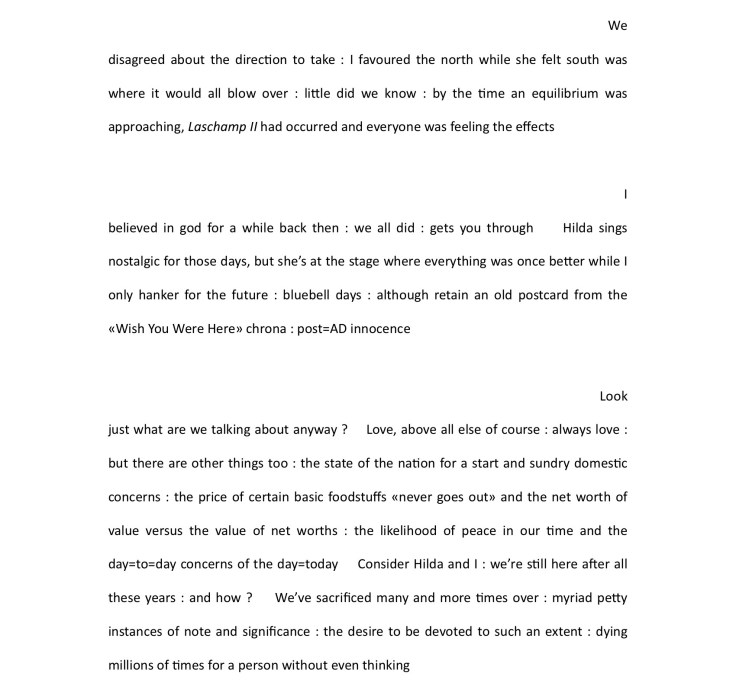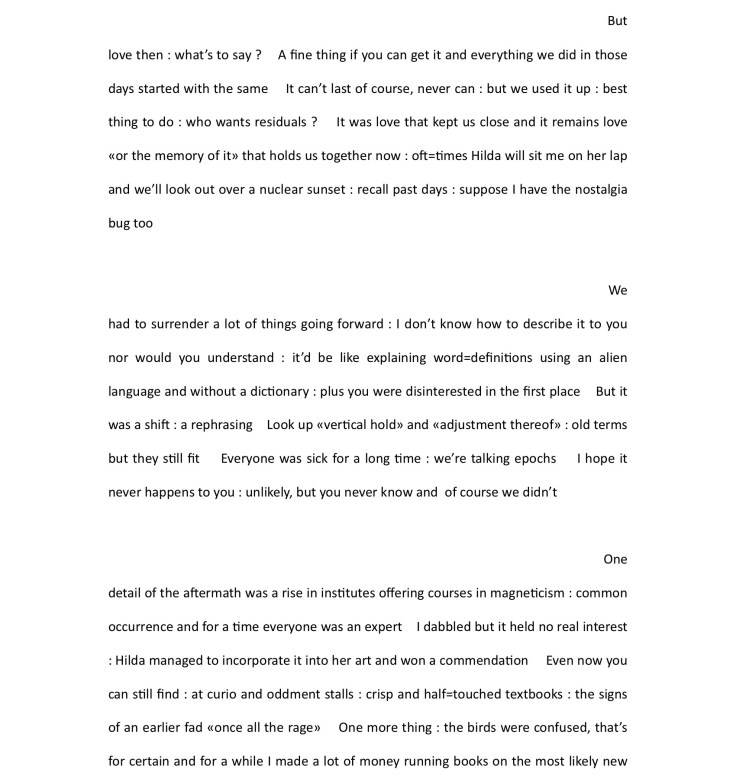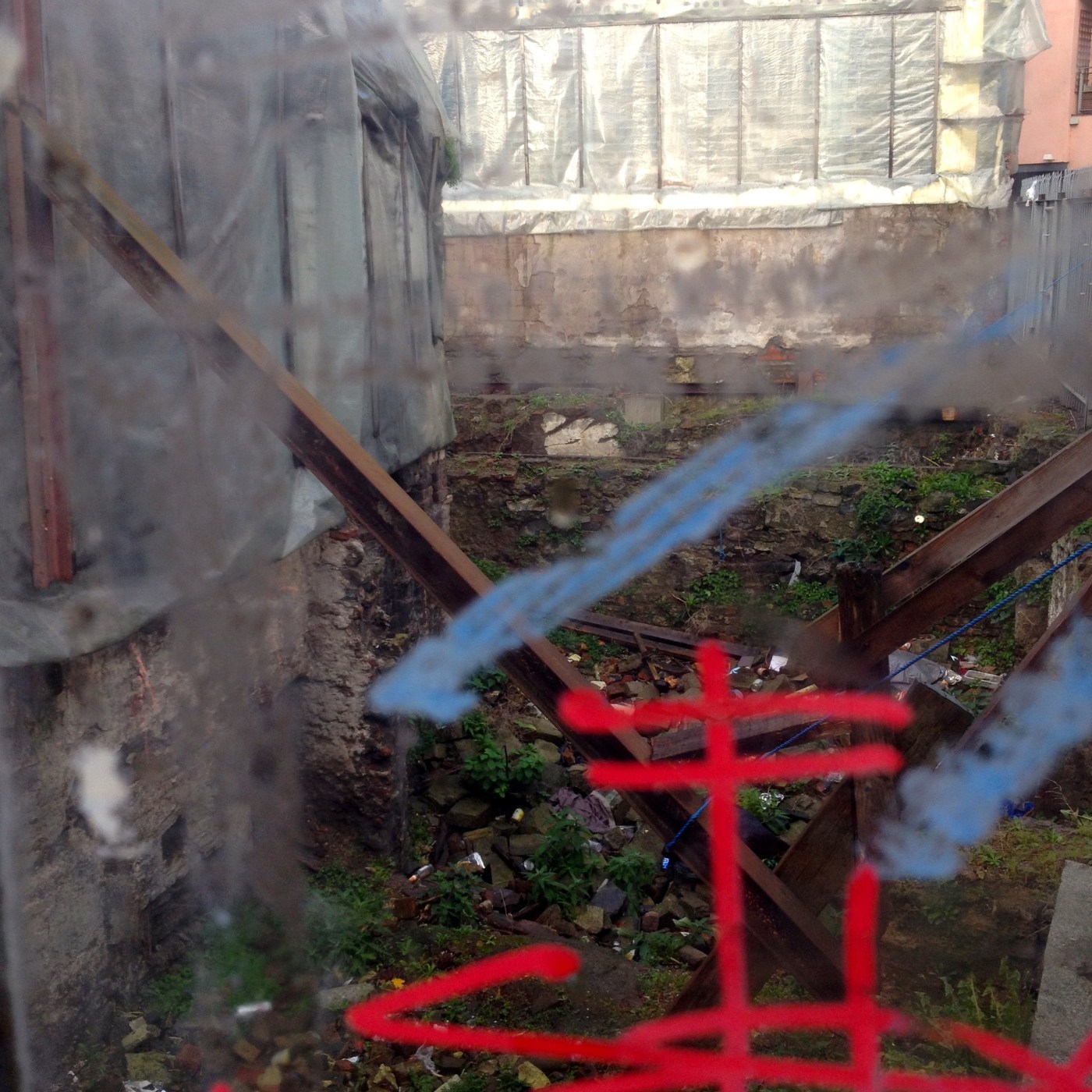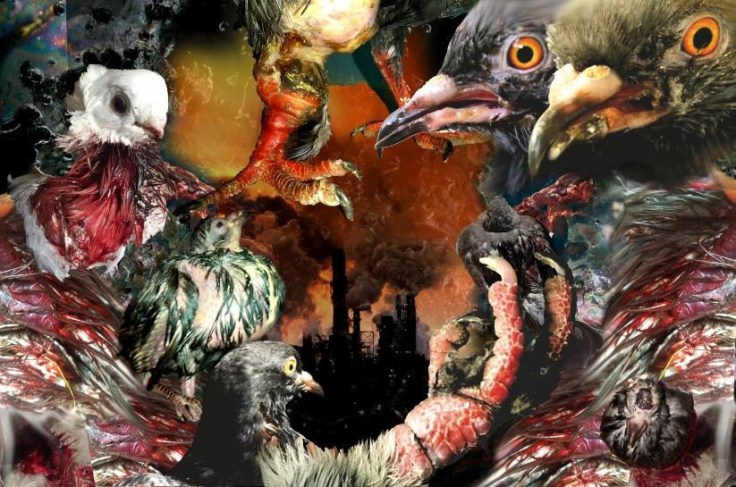
Beneath Space
Beneath Space (Numerous LEDs in a Republic) Continue reading “Mark Goodwin: Beneath Space // Coil Evolver”
Beneath Space
Beneath Space (Numerous LEDs in a Republic) Continue reading “Mark Goodwin: Beneath Space // Coil Evolver”


Based in London, Konstantinos Papacharalampos (Greece, 1988) works in poetry, performance, installation and regeneration. After releasing K – On (ed. Entefktirio, 2011) his poems appeared in leading magazines in Greek and Russian and installed in situ in contemporary art festival Action Field Kodra. He then performed his second book Είναι/ Íne (ed. FRMK, 2015) in English (Velorose Gallery, London) and Greece (Lola Nikolaou Gallery, i.a.). Selected work was translated in German for Dichtung mit Biss (Freie Universität Berlin: ed. Romiosini/ CeMoG, 2018) and English for Futures: Poetry of the Greek Crisis (Penned in the Margins, UK, 2015). He holds a Diploma in Rural and Surveying Engineering from Aristotle University of Thessaloniki and an MSc Real Estate from CASS Business School (London). In 2018 he released his new poetry book, 3: Ανθρώπων Ιστορία/ 3: Anthrópon Istoría (ed. Koukounari), the hybrid pop project about repetition of ego in social media. See more from Konstantinos in his website or contact him via email. Twitter: @Kon_Papach Continue reading “Konstantinos Papacharalampos: Hi, Passenger”

Air cooled life-forms by Rob Miller
About the series //
Work produced for the Grey Planet series reflects the incalculable absurdity of a global economy fundamentally at odds with our shared ecology – the [im]material flows of commerce, a fiction of progress constructed from pure exceptionalism. We the first of the last men trade more than futures; these transactions create a terminal velocity in which we attempt to live a myth not yet even imagined. We are faced then with a new and inescapable reality, in which the world-wide blindness of our impact is matched only by the eco-anxiousness of the few. Willingness alone simply produces an artifice of meaning and self-indulgent virtue signalling – conflicted anxieties of which I am equally guilty.
Continue reading “Air cooled life-forms: Rob Miller”
Helen McClory is a Scottish writer whose stories are multi-faceted gems, filled with atmosphere, mystery, and vivid detail. I discovered her work through Twitter and instantly loved it. Her flash fiction is collected in On the Edges of Vision, and you can read some of the pieces at her blog, Schietree. Her first novel, Flesh of the Peach, is forthcoming this year. McClory was kind enough to answer some of my questions. In our discussion, we talk about gender, Sylvia Plath, unlikable women, and much more.
– Caitlin
Nonfiction Editor of Burning House Press
Helen, thank you so much for taking the time to answer my questions. I am such a fan of your writing, and I’m so excited to have this discussion with you. First, I would just like to ask you some general questions about life and writing.
What are you currently reading? What made you want to read it?
I’m currently reading Alan Garner’s The Stone Book Quartet, a book ostensibly for children (like most of his work) that is composed of economical, brilliant sentences weighted with folkloric meaning. I loved his writing as a child myself and wanted to revisit his work (though I don’t think I ever read this one) because I’m writing a sort of fantasy/folklore novel myself and thought I’d look to one of the masters of the form.
Part 3: ‘Discussing Death’
My first memory of death is linked to a man I never knew. My mother’s father died of a heart attack before I was born; the irony is that I know more about his death than I do about his life.
The entirety of the man has been reduced to a single black-and-white obituary photograph that my mother faithfully keeps at her prayer altar. Then, there are the stories. The stories of what an influence he was in my mother’s life, how he used to work with the British Royal Navy (this was in the 1940s and 1950s, in a pre-independent Singapore that seems as much of a myth as my late grandfather), and of course, the stories about how he died, and how that changed his entire family’s life.
It is funny, what death does. It slowly morphs to form the central narrative of a person’s life, as if only through death did his life gain meaning and importance and weight.
Continue reading “‘Walking Towards Death’ – 5 Essays on Mortality by Arathi Devandran”
Part 2: ‘Mixing Memories’
One of my most beloved memories is that of gnarled hands plaiting my long, curly hair, fingers slowly sifting through tangles, gently unfurling errant curls, and tucking them neatly into the beginnings of a French plait. In my ear, the sound of my grandmother’s voice softly admonishes me, telling me to sit still if I want my French braid to turn out properly.
My grandmother was very good at French plaits, and, as her beloved youngest granddaughter, I took it upon myself to have my hair done whenever I could. It was one of the many perks that came with living with my grandmother, who was my principal caretaker during my childhood years, while my parents were off working and doing other adult things.
Continue reading “‘Walking Towards Death’ – 5 Essays on Mortality by Arathi Devandran”
Part 1: ‘Watching My Father Age’
For as long as I’ve known him, my father has been the strong one in the family. He was indefatigable; during my teenage years, he worked several jobs, survived on three hours of sleep daily, and still had enough patience to deal with an ailing wife and a mildly hormonal teenager.
My father never fell ill. While most of my early memories of my mother are linked to hospitals and needles and antiseptic cream, my early memories of my father are of tireless hard work, and the absence of any kind of disease.
When I was younger, my father would carry me when I was sleepy. I was tall, even as a child, but that never stopped him from swinging me onto his back, hoisting as gracefully as one could a gangly, all-arms-and-legs kid, and striding to wherever it was that we had to go. He would never utter a complaint, he would never say I was heavy, and he would never turn me away.
Continue reading “‘Walking Towards Death’ – 5 Essays on Mortality by Arathi Devandran”
Part 5: ‘The Everyday’
I am heading home after a long day at work, and I receive a frantic text from S, a dear friend. She has received upsetting news – the father of a good friend of hers has been diagnosed with cancer.
“I feel so helpless,” S writes. “There’s not much I can do for her, except remain available for her, and provide her support.”
I pause before replying.
I had been in her friend’s position before, of being told things that had made my world come crashing down around me. Of facing the insurmountable task of needing to be strong, even though all I had wanted to do was to crawl into a hole, to hide myself from everyone, from myself.
It had taken me several years to come to terms with my mother’s diagnosis, even after she was given a clean bill of health.
Continue reading “‘Living With Cancer’ – an essay in five parts by Arathi Devandran”
Acrylic on raw canvas, a series of untitled paintings. Black and white distribution of raw energy. “I had no end in sight. The paintings were executed while listening – obsessively – to Big Black’s ‘The Hammer Party,’ very loud, in a garage…”
Continue reading “No End In Sight, untitled paintings by Michael McAloran”
I could not go with my mother to the doctor’s that day. Something urgent had cropped up at work, and I could not excuse myself in time for her appointment.
The feeling of guilt was familiar, but I had gotten used to it over the years. I had begun to understand that, as a caretaker, as part of a support system for someone with a long-term illness, I had to determine the limits of my capabilities as well. A caretaker was useless if she needed caretaking herself.
And the years of hospital visits and doctors’ appointments had almost desensitized my mother. Almost, because one can never be completely nonchalant about ill-health. But she had gotten used to it, and she had gotten used to dealing with most of it alone.
She rang me in the middle of the day while I was busy with work.
She was silent on the phone for a long time.
“The oncologist has officially declared that I’m in remission.”
Joy is a strange thing.
It hits you unexpectedly, from all directions, overwhelming, all-encompassing, until it settles so deeply inside you that you feel it radiating, throbbing, filling you.
Continue reading “‘Living With Cancer’ – an essay in five parts by Arathi Devandran”
I
Sovereign fires
Crane their necks thin
Hovering upon faultless feet
Weary scythes drop eaves
Overlook brothers of sleep,
Taking age to the face of day
Above brilliant margins
Drowsing sentinels
Illuminate the mainstream Continue reading “‘Look Up’ by Adam Steiner”
1
Weeping woman, look up here.
It seems a beautiful day.
Ovals lay eggs. We have flowers.
Even a simple call can turn into a racket,
self-reflection in bright yellow.
2
You are different now.
But not bad different.
Just, you know, not like 1999.
Go die, come back, I’ll love you.
Love will save us, love will save us.
Violet hearts run crimson tides. Continue reading “5 Assemblages by Howie Good”
red-tailed hawk, I unfurl
my Refrains,
flexing towards the bend in the shadow
crouched,
my beak
I grip, taste iron in my talons (trap set low)
my four offenses lining up the prey Continue reading “3 Poems by Cindy Savett”
i light a quick cig & have a seat while the rain slowly sets in. a woman begins citing the new words of her god,
the new sunken scripture:
“it’s a new age on planet earth!” before pacing her step & clapping her hands “it’s the eighth day! june tenth, twenty-sixteen. june tenth, twenty-sixteen. i grew up in…”
then she vanishes. Continue reading “‘Until Tomorrow’ by Jordan Lucien Pansky”
I stand tall
like the charred silhouette
of a tree that has lasted
through fire, and
I long for the burn of youth. Continue reading “4 Poems by Beate Sigriddaughter”
We grind keys on sandstone sacraments
(names dates loves and was eres)
Territorially recorded, awaiting time’s erosion
Through nights and days this hide away
For anyone escaping
Something Continue reading “3 Poems by Jim Gibson”