Lucy Whitehead writes haiku and poetry. Her haiku have appeared in various international journals and anthologies and her poetry has been published or is forthcoming in Amethyst Review, Anti-Heroin Chic, Barren Magazine, Black Bough Poetry, Burning House Press, Collective Unrest, Electric Moon Magazine, Ghost City Review, Mookychick Magazine, Neon Mariposa Magazine, Pink Plastic House, Pussy Magic, Re-side, and Twist in Time Magazine. You can find her on Twitter @blueirispoetry.
Source text: Pike, Christopher. Falling Into Darkness. New York: Pocket Books, 1990.
Nick Quaglietta began writing poetry as a teenager, with his first work in print appearing in his 1985 college yearbook. More recently he has become affiliated with a few local writing groups, including Connect and Heal in Chandler, Arizona.
the rooms filled with ghosts performing an orchestra
of sorrow about all the broken glass
once, in high school, a girl i had never talked to
taught me how she held her breath until she passed out.
“after the light goes dim, you don’t remember anything.”
in the rooms of my body i wander, shuffling papers into
boxes made of songs i can’t always remember the words to
because i held my breath so many times
once a man held my balled-up fist in his own and
compared it to the size of the human heart. i noticed
how he held them both and i could breathe
in the cathedral of my body undulating rays of light
spell hope on the cracked facade and sometimes
i remember the words to every song
Mela Blust is a Pushcart Prize and three time Best of the Net nominee, and has appeared or is forthcoming in The Bitter Oleander, Rust+Moth, The Nassau Review, The Sierra Nevada Review, South Florida Poetry Journal, Collective Unrest, and many more.
Her debut poetry collection, Skeleton Parade, is available with Apep Publications.
This is a found poem. Source: Pike, Christopher. Hollow Skull. Hodder, 1998. Page 75
Her will
Transformation inevitable
She has grown great
now, difficult
with words
cooperate for
your ownsake
you’ll understand
everything soon
head slurped back
she saw starsgrin
demons
This is a found poem. Source: Pike, Christopher. Hollow Skull. Hoddler, 1998. Page 76.
Originally from the hilly corner of Ohio, Mark Allen Jenkins’s poetry has appeared in Memorious, minnesota review, South Dakota Review, Every River on Earth: Writing from Appalachian Ohio, and Gargoyle. He recently completed a PhD in Humanities from the University of Texas at Dallas and currently teaches in Houston.
The ghost of Guillaume Apollinaire writes on the walls of dilapidated buildings. His calligrams get lost amidst the strangest graffiti.
The ghost of Jane Austen wanders through the Roman baths at Bath. In the steam of time she glimpses people that fall in and out of love.
The ghost of J.G. Ballard watches airplanes coming in and out of Heathrow Airport. In the names of airlines he discerns a secret code.
The ghost of Roland Barthes writes love letters without recipient. He tears them into pieces in order to keep only certain fragments.
The ghost of Charles Baudelaire keeps on hiding from his creditors. He moves from loft to loft when he sees dust dancing in the sun.
The ghost of Felice Bauer likes to take long walks through empty streets. She wears a pair of small boots wet by the August rain.
The ghost of Samuel Beckett keeps looking for crossroads. In each one he sits down to wait for who knows what while he examines stones.
The ghost of Roberto Bolaño works at a closed down detective agency. He goes thoroughly through the files of all unsolved cases.
The ghost of Jorge Luis Borges walks up and down the corridors of enormous libraries. He looks for an encyclopaedia that describes the limbo he lives in.
The ghost of André Breton wanders slowly through flea markets. He searches for uneven objects to marry them in dreamy ceremonies.
The ghost of Max Brod rescues papers that are thrown into the fire. He reads them all trying to find the signs of a masterpiece.
The ghost of Italo Calvino hunts for old maps. With soft, deft fingers he draws new cities on top of beautiful ancient metropolis.
The ghost of Albert Camus goes to bars to watch soccer games. The screaming passion of the patrons makes him smile with nostalgia.
The ghost of Raymond Chandler takes advantage of the happy hour at melancholic bars. He orders gimlets even if they come in empty glasses.
The ghost of Agatha Christie specializes in tasting poisons. She writes down her opinions in a small notebook bound in the nineteenth century.
The ghost of Arthur Conan Doyle designs nets for hunting fairies. He tests them in ancient forests where silence is the one and only king.
The ghost of Julio Cortázar smokes blond tobacco by the side of the Seine. In the flow of the river he glimpses the hair of suicidal women.
The ghost of Simone de Beauvoir sits in her usual chair at the café Les Deux Magots. She flips through a book with only blank pages.
The ghost of Gérard de Nerval takes his lobster out for a walk when the day dies. Amidst the shadows the red pet keeps changing form.
The ghost of Giuseppe Tomasi di Lampedusa likes to go to seafood restaurants. He gets drunk on the different smells from the sea.
The ghost of Charles Dickens writes long love letters to the ghost of Ellen Ternan. He trusts in certain birds to deliver them.
The ghost of Marguerite Duras writes on a bench in a park covered with dry leaves. Her ideas materialize in Chinese characters.
The ghost of Sigmund Freud dusts his divan every afternoon. He sits on a chair in silent wait for a patient to knock gently at his door.
The ghost of Gabriel García Márquez stops beneath a storm of yellow butterflies. In the distance he sees the immortal glow of ice.
The ghost of Patricia Highsmith distrusts the calm of Switzerland. In the boats that cross the lakes she sees bloodstains.
The ghost of Christopher Hitchens argues against the existence of God. His audience are paintings of different divinities.
The ghost of Henry James explores vacant mansions. He calls dead children and servants by their names to keep him company.
The ghost of Milena Jesenská picks up letters from empty buildings. She looks for love stories hidden between the lines.
The ghost of James Joyce wanders lost through the streets of Dublin. He looks for guides that show the way to Molly Bloom.
The ghost of Franz Kafka hates insecticides. He tells himself that nobody knows which metamorphoses the night will bring.
The ghost of Pier Paolo Pasolini drives a silver convertible. He takes off his dark glasses to admire handsome young men smiling.
The ghost of Cesare Pavese haunts the house where Constance Dowling died. He keeps looking for the eyes of the actress.
■□●○•°■□●○•°
“The Dead Sailors”
[A ghost story in 20 tweets]
1. The old port groans at midday. Dead sailors come out to watch the sun strike the waves. Eyes full of longing salt and terrible dreams.
2. Dead sailors get drunk on air and stale beer. Hands following routes drawn on forgotten maps. Voices hoarse with nostalgia and foam.
3. Dead sailors wait for the swirling mist to rise. “Something’s coming,” they whisper among themselves. Skin crawling with anticipation.
4. Dead sailors stare at a broken moon. Hoping it would give them a subject to speak of. Mouths agape with a thousand words unsaid.
5. Dead sailors dream of being alone at night. Dark waters around them like cold blankets. Fireflies swimming through the enormous silence.
6. Dead sailors walk slightly hunched over. Carrying the weight of gigantic invisible ships. Feet leaving prints full of muddy water.
7. Dead sailors usually get moonburned. Skin crawling under the light of a million distant stars. Air full of stinging bees of freshness.
8. Dead sailors like to read bedtime stories to themselves. Childhood memories shimmering in the shadows. Words floating like dark pollen.
9. Dead sailors pray for rain. Looking for dark, heavy clouds inside themselves. Palms turned up in order to feel drops caressing them.
10. Dead sailors watch the sun rise over the sea. Old songs pouring from their parched lips. Eyes blinking against the first light of the world.
11. Dead sailors collect messages in bottles. Never reading them but just staring at them. Hoping their content will be revealed in dreams.
12. Dead sailors have nightmares scorched by thirst. Waking up coughing in the middle of the night. Tongues filled with the taste of sand.
13. Dead sailors keep waiting for the flood. Hearts beating slowly in their sunken chests. The smell of imminent disaster in the air.
14. Dead sailors grow tired of staring at the ocean. Hands clutching rusty compasses and torn maps. Wind howling around them like a madman.
15. Dead sailors sing to attract sirens. Voices full of iodine and foam, longing and regret. Lyrics talking about forgotten languages.
16. Dead sailors bathe in moonlight. Hands massaging tired arms and feet. Ancient beads of sweat glistening like perfect diamonds.
17. Dead sailors walk backwards. Hairs at the nape of their necks bristling with fear. Distant footsteps getting closer and closer.
18. Dead sailors listen to old radio tunes. Ears pricked up to catch trembling voices of ancestors lost at sea between bursts of static.
19. Go with the flow, dead sailors pray. May it take you far away from home. End of the air or end of the sea. Whatever comes first.
20. Who rules the deep blue sea? dead sailors sing. Amidst the waves, amidst the storms, amidst the rage. Who rides the chilled wide sea?
Mauricio Montiel Figueiras (Guadalajara, Mexico, 1968) is a writer of prose fiction and essays, as well as a poet, translator, editor and film and literary critic. His work has been published in magazines and newspapers in Argentina, Brazil, Canada, Chile, Colombia, Italy, Peru, Spain, the United Kingdom, and the United States. He has been Resident Writer for the Cheltenham Festival of Literature in England (2003) and The Bellagio Study and Conference Center in Italy (2008). In 2012 he was appointed Resident Writer for the prestigious Hawthornden Retreat for Writers in Scotland. Since 1995 he lives and works in Mexico City. Since 2011 he has been working on a Twitter novel, The Man in Tweed, in part through the account @LamujerdeM. Instagram: mauricio_montiel_figueiras.
There was a girl named Swan Elias. I don’t remember what grade she turned up in. She was overweight, nice and sweet, and had blue, cool blue eyes and light, wavy brown hair. I would watch her erase her paper. It seemed her hand and the eraser were made of the same textures, gummy soft. And warm. It seemed she could erase her paper or incorrect markings so effortlessly. Because there was, in my mind, this special oneness between her hand and the eraser. A certain chemical reaction which made the eraser really malleable.
Sometimes, when maybe I erased, I erased too hard and could leave a mark. A streak. But she could erase really cleanly. Leaving no tell-tale sign. Not that it mattered. We were allowed to erase. But it was a kind of magic she possessed and performed and for some mysterious reason it caught my attention. I would become transfixed and allured by her head turning toward me with what I now imagine to be a seductive and sweet smile while she worked her wonder. I wonder if she was doing something to my heart and mind in that moment. Hypnotizing me slowly, warmly, and softening my heart, relaxing my zaniness, and releasing my uncontrollable urge to please. It was like a you can be near me look she gave, and back off a little and watch. You can swim in my electrical, starspinning aura. All those things kids, we kids were attracted to. Sparkles, bangles, gold, magenta, azure, rainbow colors of glitter swirling in Swan Elias’ aura while she smiled at me. And I swirled with them. I was them for that moment and then would land in a pure stream of milky-colored happiness.
Blue eyes, plump, warm hand. Clean white paper. Pink eraser. Charcoal pencil shaped to a fine point. A cylindrical hive of possibility humming at the tip. A cylindrical hive of possibility humming into a fine point. Shavings and curls of shavings resting sweetly in a metal canister—future beehives. No, future bird nests. And I swear, I think Swan Elias wore a head band with birds and baby birds hatching from their nests. Her clothes are in my mind now brushed into a fine velvet. Everything was fine about her. Her sweat beads, her chewed lips. She was good enough to eat. I must have been in love with her, though I didn’t know it. Her big, strong marks of letters, cursive on her paper. Her wrong answers. All of it was acceptable to me. All of her. All of Swan Elias acceptable to me. Swan Elias and her golden heart.
Danielle Notaro grew up in Easton, Pennsylvania and has been writing, acting, & directing for a zillion years in the Lehigh Valley. She also taught acting & playwriting to kids in the Lehigh Valley as well in Boston where she studied acting with Reality Theater. She participated in several Les/Bi writing workshops. In NYC, she studied with Karen Malpede, Jean Claude Van Italie (Open Theater Playwrites) and at the Henry St. Settlement she studied with Crispin Larengeira. In Vermont she was in a longstanding writing workshop led by Cora Brooks. In 1982, she joined The Feminist Writer’s Guild and started a theater group, The Onsemble Theater. She has published poems in Women Spirit, Gaia, Womankind, Juxtaposition, Love Your Rebellion, Ovungue Siamo and written a few pieces for Healthy Living (a Rodale newsletter). She published her first book of poems and some prose in 2013 entitled, Limn the Mask. In 2019, she released a CD of pieces from her book w/ improv music entitled, Limn the Chord and won Outstanding Spoken Word Artist from the Lehigh Valley Music Awards.
Burning House Press are excited to welcome Mauve Perle Tahat as our NOVEMBER 2019 guest editor! As of today MAUVE will take over editorship of Burning House Press online for the full month of NOVEMBER.
Submissions are open from today – 1st NOVEMBER and will remain open until 23RD NOVEMBER.
Today is very long, with or without
a map, in its attempt at meaning. I didn’t dress up as a heroine or stop at
Hotel Eden. Nor did I disguise myself as a cyclist, or hail a taxi to the
revolution. Instead I buried myself like an object of adoration. (Befuddlement
sharpens intelligence.) There must be some way, I thought, to hear the canaries
of reality. Then, a reader walked by, and I went with him, simple as that, with
a zoom from the shaded area.
Hoy es un día larguísimo, con o sin mapa, en la intención del sentido. No me vestí de heroína ni visité el Hotel Edén. Tampoco me disfracé de ciclista ni fui a la revolución en taxi. En cambio, me dediqué a enterrarme como a un objeto adorable. (Desconcertada, la inteligencia aumenta.) Alguna forma ha de haber, pensé, de escuchar los canarios de la realidad. Después, pasó un lector a mi lado, y me fui con él, como si tal cosa, a un zoom de la zona oscura.
*
What a morning, this sadness! What a quiet cataclysm, this aspiration for a soul! Where are the living? No doubt, no worries, they weren’t sitting in the shadow of the laden journey and distinguished dust. I checked, but they weren’t there. Not even as they are not, extra clusters on the branches of time or nests too bare to notice in the room of the world. It’s me, I thought, the only intellectual object left. Nothing happened after that, except a light groan that blew and looked on.
Qué mañana esta tristeza! Qué cataclismo insonoro esta ambición de ser alma! ¿Dónde estarán los vivos? Sin duda y sin pena, no estaban en la sombra que hacían el distinguido polvo y el viaje con todo a cuestas. Me fijé bien y no estaban. Ni siquiera tal cual no son, racimos superfluos en las ramas del tiempo o nidos demasiado escuetos para notarse en la habitación del mundo. Soy yo, pensé, el único objeto intelectual que queda. Nada más pasó, salvo un leve quejido que sopló y veía.
*
Nervous, because I want but don’t, and on top of that, my weary heart. Taking three Aspirin won’t fix anything, won’t help me just be. It’s been so long since I’ve crossed that invisible lip between this place and the worldless. Like a caress that comes too late, writing is strung out and obsolete: correspondence to stake a place that at some point, maybe, will bear my name. Look in my empty hands. Tomorrow everything will start over: the disordered soul, the scandalous body stitched to lewd syllables, lunatic passions.
Nerviosa porque quiero pero no quiero, y además el corazón cansado. Tomar tres aspirinas no resuelve nada, no ayuda a simplemente ser. Hace tiempo que cruzo un labio invisible, entre aquí y ningún mundo. Como caricia que habrá llegado tarde, escribir es muy largo y obsoleto: una correspondencia para fijar un lugar que alguna vez, tal vez, tendrá mi nombre. Fíjense en mis manos vacías. Mañana empezará todo de nuevo, el desorden del alma, el escándalo del cuerpo cosido a sílabas profanas, a pasiones lunáticas.
*
A journey to where I’m awaited, at the very bottom of myself, by something I own. It’s not all that impossible. I only need to cling to my white box, the dead little house of language. Commencing, for once, moon expeditions around my room. Would a siege like that be any use? Chattels for walking in my own flesh and being reconnected? So many things can squeeze into the shadow: artist costumes, serial killers, the sheer duration of where. I feel more destitute than ever but anyway, this sky of skies where I play in silence, frail as I am, the lute of my music.
Un viaje a allí donde me espera, al fondo de mí misma, algo que poseo. No parece imposible. Debo insistir tan sólo en el casillero blanco, la pequeña casa muerta del lenguaje. Empezar, de una vez, la expedición de lunas alrededor de mi cuarto. ¿Asedio que me sea pródigo? ¿Enseres para andar carnal y ser reunida? Tantas cosas caben en la sombra: trajes de artista, asesinos seriales, la duración del adónde. Me siento más desprovista que nunca y aun así, este cielo de cielos donde resueno en silencio, cuan frágil soy, laúd de música mía.
*
It’s been many days, twenty years, that I’ve travelled north, and now I have insomnia that drags on from the day to the night of departure. Can some airplane ship me to consciousness? To this beast on the other side, locked in its four legs, between dozing institutions and the heart of the nation? Needles in the wind. Poetics split by fear. Abstract moon that asks for more more more.
Hace muchos días, veinte años, que viajo en dirección al norte y ahora tengo insomnio entre el día de partir y la noche de partir. ¿Qué avión podría llevarme a la conciencia? ¿A esta fiera del otro lado, encerrada a cuatro patas, entre instituciones que cansan y el corazón nacional? Agujas en el viento. Poética partida por el miedo. Abstracta luna que pide más y más y más.
*
Argentine poet and critic María Negroni is the author of twelve books of poetry, two novels and five collections of essays in Spanish. Works in English include Mouth of Hell, Dark Museum and The Annunciation (all translated by Michelle Gil-Montero, published by Action Books).
Michelle Gil-Montero is a poet, publisher and translator of contemporary avant-garde Latin American writing. She is the translator of Poetry After the Invention of America: Don’t Light the Flower by Andrés Ajens; Mouth of Hell, The Tango Lyrics, and The Annunciation by María Negroni; and This Blue Novel by Mexican poet Valerie Mejer Caso. She is the author of Attached Houses (Brooklyn Arts Press). She is the publisher of the translation press Eulalia Books.
Mommy Mommy Can I have a gun to shoot down the butchers of childhood I need my own cash to buy splooge grenades & lethal fireworks for rape holidays Mommy Why do you keep paying me bullets to the skull
*
THE ACID KWEEN
I’ve gone rancid In the boodlyjank At meat o’clock I expire My skin drags magnetic south My heart ulcers are full of poodles My scabbed scalp is a screamer My eyes buckle in the plop shop The whack of ages & I’m being chummed into a meat cloud Stank oceans roil Hell is a ripe daughter
*
A MAGYK TONIC FOR THE NERVES
So I drink the blood of virgins Who doesn’t That’s patriarchy for you Who am I to claim I’m on the outside So I’m a bottom-feeder So what Bottom’s up! only means one thing when there’s a boot on your neck
*
UNEXPECTED GUEST
I take my cream hard I like my bloods stiff with deathswoon But that one who just rolled up is An annihilation I’m eye-fucking a marvel of a bucking young Prince at the height of his clit-shaking powers
*
A TASTE OF VICTORY
Nom Nom Her swiney thumper on a platter tickles my brittle flank My rank veins flash freak sugars My skin pinks My clit perks How now Magik Mirror
*
Lara Glenum is the author of The Hounds of No, Maximum Gaga and Pop Corpse! These poems are from SW, a restaging of Snow White.
& reify the ashen body so I might
piss on it in its entirety.
Dead dad died & all I got was
this lousy imaginary eulogy.
Dead dad died from diner food &
damnit
I want the heart heredity that
doesn’t risk giving out
in the heat of the night
jammed past the hilt.
Hearts should be bloody
& hearts should
beat
& hearts should explode
& when incapable of taking in
the birdsong of ambient affections
blockages become prevailing wind.
Blowback unlimited
& I like to sunbathe in the puddles
formed.
Sewerage is my favorite suntan
lotion.
Daddy slathered hatred hightails it
for the heavens when I try to attract it.
Daddy escapes atonement & speaking
of skeletons
I can’t find a speck of soul to
interrogate
nor an inkling of remorse to extend
to projector
when he’s all ground to powder
& it doesn’t even taste good
enough to season steak with.
I’m so hungry I could eat
disparagement
& call it enough calories to get
through the day.
In my moment of duress at the news of
Dad’s eternal rest
I had nothing to do but laugh &
get undressed.
Philharmonic harmonizing & the
invisible din thud squeal
& the imaginings of mourning that
must’ve been farcical
with snotty tissues balled up &
volleyed
off a coffin I’m disinvited from
viewing
despite my disinterest
& my morbid commitment to
dignity.
I want dick for breakfast & dick
for lunch & dick for dinner.
So much dick that clouds part
& on my knees blessings
resounding & Gabriel’s horns screeching
Levi’s unzipping appear as fortuitous
angels in the sky.
I look up & Dad’s whinging
Never forget. The heathen bull
does not fuck other bulls. Balls
shouldn’t smack balls.
The earth trips off its axis in the presence of filth.
*
CJ Waterman is a writer living in Providence, RI. He holds a degree in literary arts from Brown University and an MFA in Poetry from Notre Dame. Other poems appear in Smoking Gluegun, Tarpaulin Sky, Similar Peaks and elsewhere. He is currently at work on a novel.
and I am a budding rose whose
friends are serpents.
Have you
ever seen so much sickness
the rest of the world appears as an oil
painting?
Have you
ever watched the summer
meet a mother at her place of
grief —
alight
in the hum of vein-songs and apologies? I know what it means
to watch someone ask of a human what
they ask of god.
It is a wretchedness that happens in
children’s
hands.
I am
still half-child. I am a half. I am the blood of the moon.
I am I love
you, I forgive you
but I will choke you. I am
the earth
and its
forests fucked and fired.
How I
was lush once, too, as the earth. And then the embers.
My
mother will remain small when this is all over.
And I will remain small too. Our
gardens undead.
I am an
orphan under the table shaped as a dog. Loss is a child
whose house has been swallowed by
vines,
who has
become the vine, whose heart is buried
within rooms in rooms in rooms where
flowers grow upside down so they are
beautiful only where no one sees.
We are
always in houses, in churches, in gardens
waiting. For eviction. For custody. For
the seed.
Orphans
at night, my body and me, we dial mother, are you there?
We build a fort of prayer. We grow wings in the soil.
ii
I will tell you the shadow. Its sound. Its plumage, and all the rest. I will only make a home my own when I have collapsed into it of utter need, that’s my glitch. I am addicted to houses that aren’t my own. I am pissing in the floor boards to stay somewhere forever. In its wreckage is a salvation in the shape of — what is it? The shape is me. I am my own territory. I miss the way the sky looked when I held food stamps in my hand. I know that sky, as a sister, though she is no longer mine. This is a poem that has done a badness to its twin. The other poem tries to say it all without saying it. Not now. This poem means the sky and says it. This poem means poverty and sings it. Can you feel the way I move through time? Can you feel my secret soiling you? That my body is perpetually there and now and now. I keep my rot hidden the way young things do, with that spectacular shame which becomes organ. I am a summer full of orphans, and then summer ended. All I know is in a dream my mother stood at the window and looked happy. It was long ago, but that is what I know.
iii
This
shelter is built of secrets. Four floors in an ancient church where angels
hover within the walls. The windows speak ivy. Sometimes we think we see the
angel. We’re not wrong. I am 11 and I cut my ankles in the fourth floor
bathtub. I am shaving my darkness away while everyone else sleeps. A woman
excretes her addictions in ritual. Through the bottom of her door, sweat and
pale blood; my mother is somewhere in there holding white linen to her
forehead. Her kids will be too young to ever remember, but I will. I do. It’s
not about god here. It’s about something bigger. My blood smells of iron,
crying outward until it is almost pink, and then gone. I imagine this is what
everyone in every room feels. I weep so often in the communal spaces that other
women mother me. I am at church in their arms. Each woman a pariah; each
pariah, my chapel. My mother the pariah, my patron saint of vice. They braid my
hair in rooms of death. They make me pretty in kitchens of folk prayer and
yuca. My lipstick, donated. My clothes, donated. My body the ivy now, the ivy
handcuffed and medicated. The whole garden an in-patient waiting for light.
Sudden divinity sudden blood. Some of the angels die on route. Why don’t they
know this themselves, that we feed the earth with our pain? Today I avoid
too-small rooms. I like beds to be my own. I like to pretend I am another body
with the memories of a beautiful thing. But I am not a beautiful thing. I am
the daughter of the forgotten. I am the keeper of stories. I am the disciple of
rot and savior in a garden without a name.
*
Lisa Marie Basile is the founding creative director of Luna Luna Magazine, and is the author of a few poetry collections, including th recent Nympholepsy (Inside the Castle, 2018). Work has appeared in Spork Press, Atlas RevIew, New York Times, Narratively, Entropy, Catapult, Best American Experimental Writing, PANK, Best American Poetry, and more.
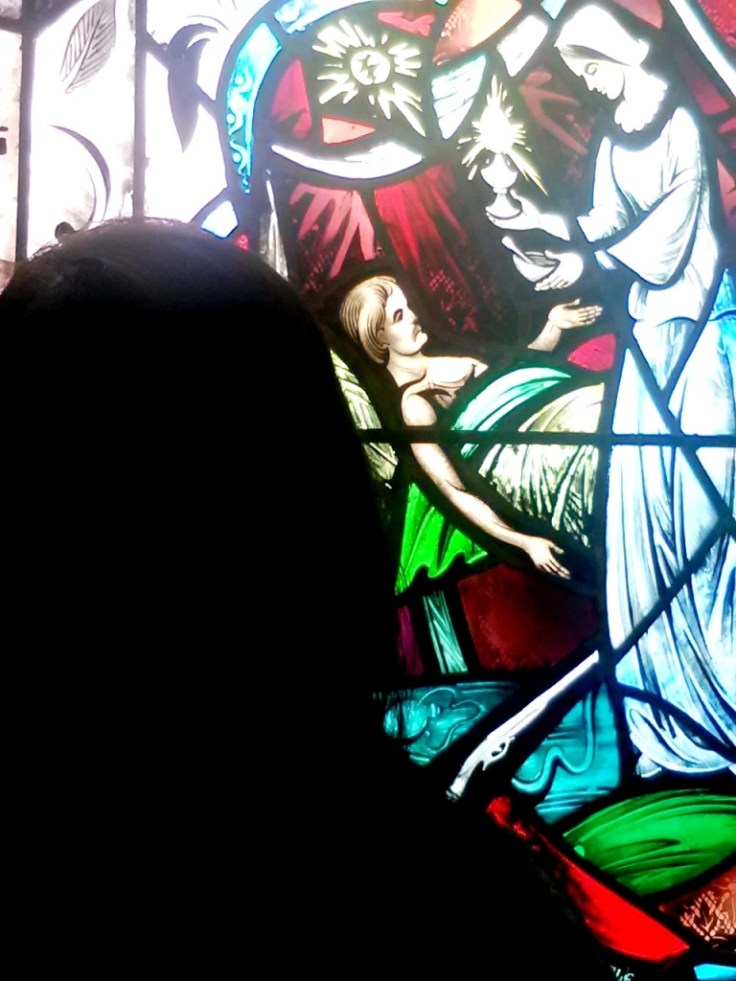
Artwork is from Leif Holmstrand’s series “Holy Helpers.”
You read Jill Magi, Bhanu Kapil, like visionary literature. Like something hermetic, harnessing weird psychic energy. The work of ghosts. Emily Dickinson. OKAY BUT I DON’T BELIEVE IN ANYTHING! I AM IN A CAVE IN THE DESERT, RENDING MY CLOTHES!
In my notebook is written in a descending column:
somatic → visible soul → insubstantial
essence mirroring the haunted body → contaminated by art → radical embodiment, hyper-corporeal→ DOG DIRT
REPEATED:
EAT THE DIRT.
In my notebook, reeking:
I am desperate to be like you. I have
your photograph taped inside my dictionary. Do you have a favorite book? What
color is your pen? How do I receive a prism on my head? Are you pleased to read
my note? Wait— I haven’t sent it yet. Where’s my book? May I please have your
address?
In my notebook, unsent:
Dear X,
Scorpions are leaking out of my blood. They are eating me alive. I am chained to the radiator.
*
m. forajter is a MFA graduate from Columbia College Chicago. Her work has been published in several magazines, including Tarpaulin Sky, Court Green, Queen Mob’s Tea House, Luna Luna, Petra and Witch Craft Magazine. Her chapbooks, WHITE DEER and Marmalade Girl, are available from dancing girl press. She really likes Nirvana, werewolves, and medieval art.
Deviating from the Bibliothèque Nationale’s original record, our newly transubstantiated Joan is lying on flagstones in the shape of a cross. Her body is too many voices. It’s amassed too many jeers from too many tormentors. It’s caught in the middle of a slow dissolve and she is kneeling before herself. Her soul is one divine intervention too many. I watch her lapping from a small stoup on all fours. I watch her brandish her perspiring head like an aspergillum. And when a surgeon enters the cell dressed like a blacksmith, I watch that too. I watch him operate with hammers. I see her body collapse. I see three soldiers insert a long straw between her legs and take turns to inflate her. Hear how they consider her equivocally gendered. How in reply she says how God has stood before her, and how the God she saw was trans, and how her sky is full of thirteen moons. She says, ‘At home I am called all the imagined saints.’ She says, ‘Here I am called possessed by the Devil.’ And the perceived blasphemy of her surgically reassigned Almighty upends the incels. And they turn green. And they turn greener. And they cover their ears. And she says, ‘I was born this child of nineteen, with short hair, dressed in boys’ clothes. I was born versed in the art of indecency. I was born martyred and full of tears. I was born inaudible to myself. My head crowned in thorns, in straw, in men made of straw. And I feel your odium but I bring you pity, for nobody loves the English, not even God, not even the English. Oh and tell me,’ she says, ‘do I have hair on my head? Did God shave me a tonsure right through to the brain? Do I have wings?’ And she curtsies for the court, bends over, offers the judges her judas. And they cannot help themselves as they cross-examine her colon. And a prelate in the prolapse is witness to a vision—of the crowning head of our Father so ignominiously reborn. And all the mendicant friars cannot force her into a gown. For she will not obscure the shameful costume of her body until the shame itself has gone. Until her being is no longer cosmetic, no longer insincere, no longer heresy. And to me? Me: sat genuflecting before all transfigured daughters of God. When I can’t even decide what socks to wear. When I’m in this heavenly light pulling worms out my ears. When I’m standing on tiptoe getting closer to God. And they feed her wafer to a dog. Until out the other end… and still all she can taste is the Eucharist. And she’ll cross herself, she says, until it draws blood. Until the judges warn her: ‘Raise your eyes to heaven again and we’ll cut them out.’ That if she doesn’t hold her tongue they’ll stick it with a fork. For how dare you be pretty and childlike and illiterate and destined for paradise. How dare you hum the absolution. How dare you eavesdrop on the salvation of your soul. Wherever her visions come from the torture chamber will cure them. And so she counts her broken fingers and they are as many as the days since her last confession. And she takes the Sacrament in increments, in punches to the face, in threats to drown her in the Seine. She dreams she drinks the eyes of God from every chalice, that her vanity is less tear-stained than her soul, her prayers less divine than her madness. She refuses again to foam at the mouth. O sancta simplicitas! And then they bleed her and the Y is upside down, like a middle finger. And they watch her sob in her sleep. But the witch is gone! Because she’s sharpening her nails on the flat stones of graves. Because she’s caking her face in consecrated mud. She’s blood-letting poisoned toads, and binding missals with their backs. She’s advancing on Rouen in Guerlain nails and glitter mesh Louboutin spikes. And so giddy is she in her expiated skin that she does not hear the inquisitor’s peroration: how this apostate is dancing with dancing bears, how she’s contorting with contortionists, and singing litanies with infidels, this idolatress, this monster, this agent of perverted Mass. And yet is man not too small a morsel to cover with so many kisses? And are our death beds not water beds? And do we not fill them from a holy spring? As our ascetics get fat. As our delusions become real. As our states of grace become ever more inelegant. Our glory infirm. And because all interrogations must conclude, it concludes. Albeit with some apophatic biology for a coda. Albeit inconclusively. And what foul irony to arrive at the stake for the abjuration of a phallus. And to burn there an exemplar for the intricacies of man. What ignominy! What comedy! What a voice thereafter calling for Jesus and screaming like a kettle whistle. The flames sounding like a prayer. Like the twelve articles of the Creed. Like a billion bifurcated tongues stuck to a hot plate. And the screen now her face, pressed flat against the window of heaven, struggling to breathe. And so she dies again. And so her body burns again. And so the executioner rakes the ashes and does not find her again. When even the heart is gone. Because it never came back. Because it remains in the river where it lives like a fish. Where it cannot be incinerated. Where God cannot see it. Where the hyenas cannot eat it. Where its chambers shun the light from any sky of any number of different moons.
*
Gary J. Shipley is the author of ten or so books, most recently 30 Fake Beheadings (Spork), Warewolff! (Hexus), and The Unyielding (Eraserhead). He has published in numerous magazines, journals, anthologies and academic journals. His monograph on Baudrillard is forthcoming from Anthem Press. More information can be found at Thek Prosthetics.
Dog skeleton//leashed to tree//bullet hole in head//I still hear the suffer// brambles sharp// trees red//dog blood//dog chained to tree or person bullet hole in head round as cigarette burn//dog or person chained to tree//bones scarred by beaks and teethings// body tightening //muscles drawing up// //coiled like copperheads//eastern land is filled with them//brutalized corpse// a person crippled to death//I still hear the suffer//agony is the pain before dying// the fear of burial is real//darkness is dark//in terror of night// animal blood sticky//animal blood all sticky//I woke up to blood// what graves were dug in sleeping?// I woke up to blood// Did I bleed?//I bled//I think I bled//A different smell than my own making// where did my hands go to thrum the edges of the earth?// a corpse I dream// the brutality of grieving//I dream a corpse I dream//corpses grow as if breeding//filling dream fully//skin chafes for love or hunger//skin grafted onto bark//spirt dead or charging higher//I woke up to blood// covered in loamy soil// smelling of alien earth//what graves were dug in sleeping?//rope on neck of dead//gutshot//crippled fluid//seeping grime//torsos purged// the cunt of a family//mother battered each baby head with ball peen hammer//curve of skull//shattered moon//maw of sun//childs skull//breach birthed to death//imagine the dead in your mind//burn victim is a victim//gauzed wrapped// like wedding veil//maggots dancing in the wound//burn victim is a victim//chained to tree//dog or person chained to tree//splinted to fear//I still hear the suffer//the world is wicked//the blood is hot//vermin cannibalize//vermin cannibalize my dreaming//I woke up to blood//smelled the ore of mining bodies//penetrated iron inside the skin//teeth cured in the red of it//I see faces//I see faces in all things//jawing scream in pocked stone//dense black of waves// jawing to hold hammer high//to bring it down between marbled eyes//of someone loved// picture wavers// blood moves//eyes cross//blood vibrates//picture wavers//embalmed// aura blooded//pollinating gore//fire will cleanse the terror clean//burnt duff of body//smoking like an ember//imagine the dead in your mind//I woke up to blood//I see the faces calling//to burn the tools// of what trade//I am not sure//The world is wicked//the blood hot// my eyes crossed//cataract in pain//imagine the dead inside your mind
* S.M.H is a writer. They have two books and two chapbooks out through VoidFront Press and a chapbook currently out from SelfFuck press. They live in the mid-atlantic.
All words sank
into space: gaps between sound where silence draws its first and slow breath
like closing portcullis—a blue-faced babe smothered with a blanket. From a
watchtower at the end of the desert, a clown lifted into fire. Satan licks the
blood of bees.
.
I do not believe
in human death, only the shattering of teeth: a pink skull exploded at noon—its
vertex reversed into red shards glowing with an inversion of heat sank back into
cold thought (blind and silver eels). Coldness
is my only religion.
.
I stole a
handkerchief of marbles from the marketplace and studied the wrinkles of
colour: yellow, blue and green suspended in glass. I counted ten eyeballs extracted
from the head of a poet tied to a billiard table—nerves torn like lightning
from his cloudless back.
This poem contains excerpts from “The Hollow Men” by TS Eliot , “Pour le (se ge te) CGT” by Rod Smith, and Kanye West referencing “Strange Fruit,” a poem by Abel Meeropol, which was also sang by by Billie Holiday and Nina Simone, and lastly, “paper plane” by M.I.A. Thank for listening.
ALL OUT
WITH BANG BANG
This is
the way the world ends
This is
the way the world ends
This is
the way the world ends
Not with
a bang but a whimper.
But I wanna go out
ALL OUT with BANG BANG
My love,
All I want is your body part
in my fucking body part
But I’m told planned parenthoods are selling
fetus parts now a days
SOLDÉ
The Summer Sale is here
and the town square is covered in body parts
SOLDÉ
Another town square is shot up & Forever
21
is the victims’ forever-age
SOLDÉ
My life is sold to the capitalism, exchanged
with paper currency
& I exchange my paper life
with the made-in-sweat-shop dresses
SOLDÉ
I am SOLD on the idea
that capitalism will always prevail
We work
too hard
We’re
too tired
to fall
in love.
Therefore
we must
overthrow
the government.
We work
too hard
We’re
too tired
to
overthrow the government.
Therefore
we must
fall in
love.
We are too tired…
My love,
My tired soul requires instant rejuvenation
My tired soul needs anti-aging cream
My tired soul needs a lipstick to brighten up
my ashy face
I just need a pick-me-up,
But I’m told I need to wait for the next SALE
season
***
BREAKING NEWS
the camera zooms into a man walking down the
street
in a suspicious manner
off-camera, the robot bomb goes BANG
& the concrete wall is spattered in
Orgasm
Red
My love,
I see the blood on the leaves
I see the blood on the street
I see the blood on concrete
But the reality is too low resolution
& it’s buffering for like, forever
I see the blood on my hands…
I wanted to be part of the historical movement
But all I see is hashtag AVERAGE OUTRAGE
I wanted to change the world
But I’m told Lululemon changed the world
with their yoga pants
From the rooftops of the iphone factories
the workers fall like confetti
SOLDÉ
I wanted to be the salt of the earth
but all I’ve been doing is not going to the
cinema
during national holidays to avoid mass
shooting
SOLDÉ
I wanted to find a belief system I could
devote my life to
But all I see is collection baskets and BANG
BANG
SOLDÉ
I wanted to be at the pivotal moment of my
generation
But all I see is
Bridal expos & I do I do
& All I want to do
BANG BANG BANG BANG
is to take your money.
My love,
I don’t want my death certificate to say
“death by consumption.”
Zan de Parry has been published variously in print and online, most recently Dostoevsky Wannabe’s Dundee, West Branch and BathHouse, and is forthcoming in Unsaid 8, TABLOID 13 and the chapbook HENNIE from Berlin-based Tabloid Press. He teaches poetry workshops in Lansdale public schools, is co-founder of KEITH LLC, and is at work translating Anatol Prasicky from the Ukrainian with Demyan Hryciw.
The photograph is from Leif Holmstrand’s “Holy Helpers” series.
in chillingly foggy swales of houseless brown liminexurban plains are rolling down over immediate horizons in every direction Nadia and I are meandering less toward a streetaddress than following a sensation in the air over the crumbling streets of Sannikov—virgin asphalt at the frontier of the navmesh servicearea—are turning in on themselves with involuting axes are shutting down vistas of unfurling asphalt with filterfabric of home facades, a person is standing inside the clumpiness of a nettle bosk dropping into hiding on their knees, although the most opportune packing of streets is simple arithmetic spiraling an additional consideration of the Sannikov masterplan is encouraging recursively unfolding sensations of discovery and possibility with forking recursions branching and branching into smaller and smaller deadend feeders—our missteps, although we perhaps are adjacent to our destination—the <<Payrite>> home, surprisingly few windows—we are kilometers of coiling roadsurface away from even the errant axillary axiom—initiator fork—, the Sannikov masterplan is not even topologically a spiral but is a labyrinthine vermicular meandering, a branching <<Lindenmayer system>> is producing cognitive disorientation & isolation & hopelessness, the persistence of terminality at empty homes, possibly, determination as to the actual emptiness of homes is difficult, the windows shining with the whiteness of the sky, a pouch of pottery smashing against the pavement, stalks of grass and nettles in muddy gardens grow the height of 2m, Nadia’s legs are wracking and bowing her feet turning over onto the ankles pulling me over with my arm under her armpit and attempting equilibrium with her travelcase swinging around in my other hand, fashioning a method of binding her arms together with my thin jacket and looping them around my neck with her chest bearing on my shoulder, we are going the wrong way, I’ve an acute awareness of this, the circuit is opening onto another recursion is branching toward the quality of light in the distant sky is opening and optimistic, the sensation of the sea lying just over the horizon, in each sideyard division between homes is the vista of more homes and







 BURNING HOUSE PRESS