Search

BURNING HOUSE PRESS

Not For Profit/For Prophecy

Tag

memoir

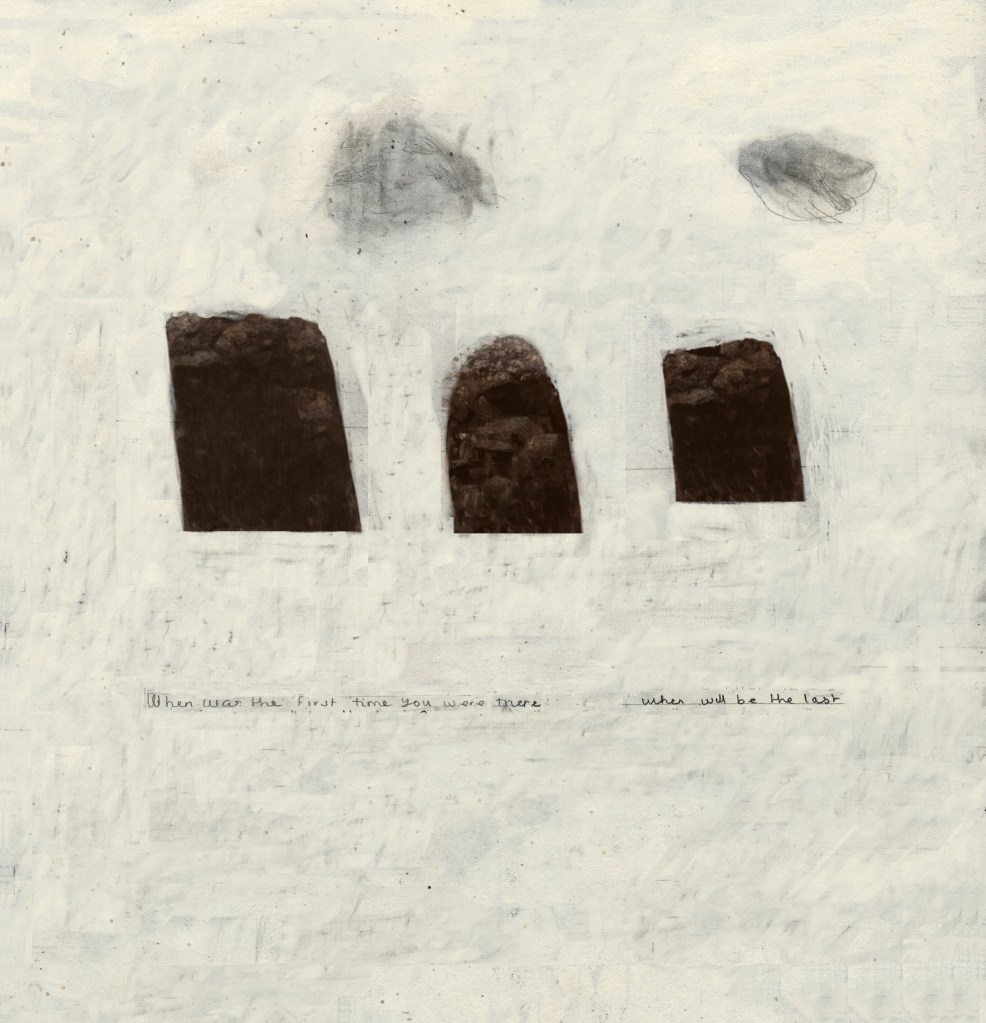
Sketching Clouds by Bo Mandeville

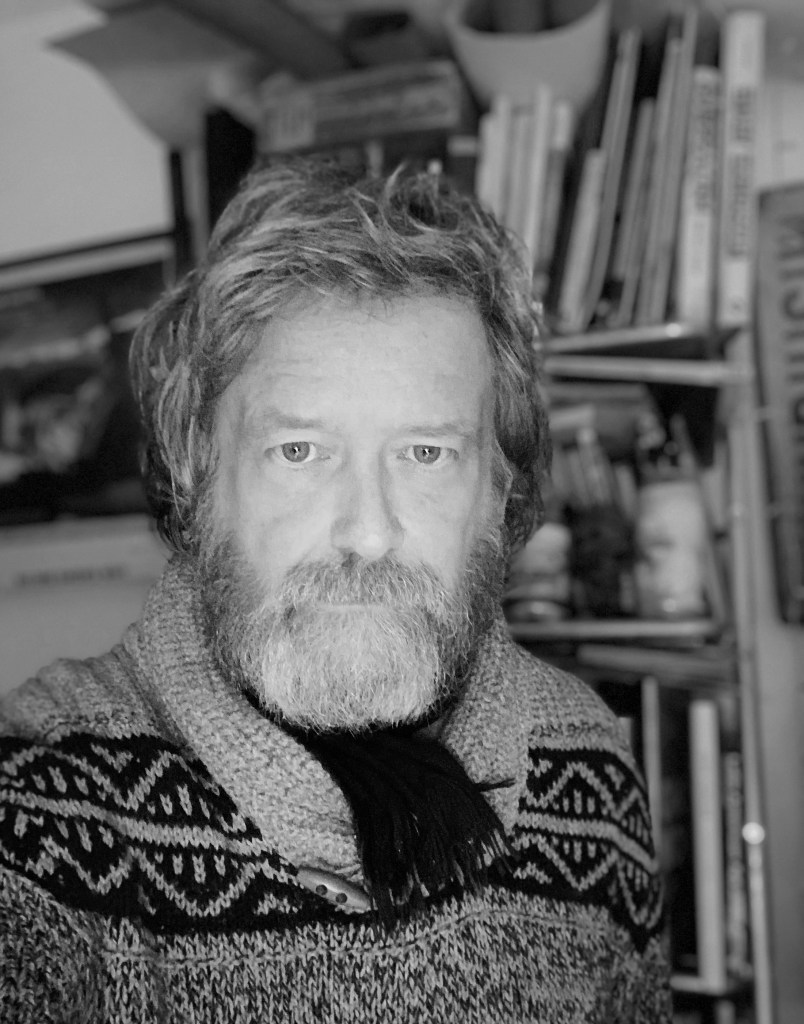
Photo by Bo Mandeville

Driving from Edinburgh to Cairnryan, still in a state of dulled lucidity, unable to fully grasp the enormity of the journey. Once boarded, sounds, smells and motion wake me. I notice the dissipating sleep inertia while cruising. I observe how coastlines move along the ferry. Waves delineate the present, allude to the past and possibly a future. In my mind, I draw the shores with cliffs and hills, inlets and rivers flowing. Sketch the clouds too.

Some ancestors endeavoured the same voyage. Probably many times. Perilous on occasion. From Argyle to Antrim. Settling. My family’s history, a fragmented genealogy, has recently become more important to me. I’ve managed to connect dots, milestones and major events.

Forefathers joined rebellions and fought for hope. Romantically perhaps, I wish valorous and chivalrous men engaged in battles to protect the vulnerable and those who couldn’t stand up for themselves. But I know these forefathers — particularly the first ones who crossed from Normandy to lead the charge at Hastings — were mercenaries. Medieval warriors for coin who later became part of more rewarding and legitimate causes. Fights for freedom. Something I like to mention with pride.

Thinking of those many descendants and generations through centuries of being and remaining unsettled. Stories to make sense of my own existence.

The crossing is smooth. Too short for elaborate meanderings. As I never used this ferry crossing before, ruminating through history appeals, is pertinent. Locations as markers of my mariner heritage: Loch Ryan, Carrickfergus and Whiteabbey. An ancient maritime route. Connecting Scotland and Ireland, trading and exchanging stories, for centuries.

Docking in Belfast comes as an interruption. Like the ancestors, who feel so discernible now, this is a brief stay. Layover, a pause. I walk and my antecedents walk with me. Unsteady and slow, vague and opaque. But they are there. Here.

. . .

Reaching Ireland feels like an achievement, culmination of many attempts and struggles. There’s a sense of accomplishment. Finality or not. So…I tell myself this won’t be the last time. Self-reassurance feels like cheating life. And death. Perhaps I have always been a cheat, an imposter — a syndrome that has plagued me since early teens.

I see opportunity for new experiences, even repeats, as a welcome sign, a bonus, a rewarding gift for my own persistence and perseverance. An inherited determination that has possibly prolonged my life, or slightly plateaued the progression of symptoms and appears to have altered the course of expectations, both from the clinicians perspective and our (family and me) own.

“Life expectancy is six to nine years for most. Some get twelve.” It says so on the website, in the leaflets. Nine years in, I sincerely believe I have more than three years left in me. A calculation I have never expressed, never shared. An aspirational awareness.

When the new neurologist affirms the diagnosis — Corticobasal Degenerative Syndrome — he immediately adds ‘atypical’ with a gentle smile, referring to an uncharacteristically slower decline than expected. I return his smile. As if we bond in a complicity to deceive the expected. Gratitude, an element of self deprecation and a desire to cheat the norm. He tells me there’s no certitude, no predictability or any clinical factors to provide a reliable prognosis. But he knows the numbers as well as I do. He too, understands time. And he knows it’s irreversible and incurable, degenerative. Curtains are closing, slowly yet very surely. He knows, he alludes to it and he gives me another, now even more compassionate smile. I like his manner, his tone and expressions, his clarity, his twinkle. A shimmer like tiny stars on dark curtains.

Some use the word gift, as if a benevolent creature rewards me. I accept it all: my condition, the illness, the lack of clarity and certainty of prognosis, the inability to obtain assurance. There’s defiance and acceptance. I resist limitations while embracing an increasingly disabled life.

I no longer drive myself. I miss it. The car, the independence, possibilities and destinations. Actually, I no longer have the ability to do much myself. Beyond some thinking. And even that is difficult. For more than three quarters of the hours of the day, I struggle with everything. 75 per cent of the time I exist in near to full obscurity. I live in the vicinity of perpetual fog, my life floating around mist banks. Fog formations over bodies of water with me on a boat without mast or sail, no oars nor anchors. To me this mist, the fog, appears monochrome, as rudimentary woven linen and lace. Écru. Raw and untreated. Weirdly tangible. Veils, retaining some elegance and delicacy, rather than heavy ruby theatrical curtains. They open a few hours each day when I feel freed, am allowed to wonder and be lucid.

Definitely happy. Really happy. Childishly happy.

Despite that, some hours later, I am always ushered back to my veiled sense. An uncertain existence, where all true consciousness evaporates, just leaving some cloud-like space I fill with unknown. Unknowns. Plural.

Repetitive oscillatory motions, erratic pendulum patterns. Yet, I am truly happy.

Embarking on this road trip, I emphatically exclaimed it — “I am the happiest I have ever been.” — unsure if anyone would believe me. And maybe it did sound unreal, not credible, callous even. Surely, key events in my life Have rendered me happier. No! Maybe this is a different connotation of happiness, or as I see it, another realm, a new dimension.

An end-of-life prolepsis, ahead of time. An early fictionalised version, or view, with sea horizon clarity on a bright day. Translucent and floating above aquamarine, turquoise, cyan and seafoam. Tangible glee, near-delirious high spirits I can hold in my hand as tanzanite, reminding me of trichroic properties. Appearances of sea blues, sunset violet, with lavender tones, hints of tangerine, blood orange and burgundy.

It is not contentment, not merely gratification, neither fulfilment nor a feeling of comfort. It is an elevated joy, elation and the discovery of tingling delight. Even a somewhat tantalising notion of new found jouissance, discovery of late life ecstasy. Rather apt, timely. My own renaissance.

As physical excruciating pain has a hold over me, like a threatening hang-man standing on a scaffold not too far away, smiling. Agony always is an ugly face.

When I mention joy and happiness, others often find it impossible to imagine. Maybe because of my facial expression, at times anguished, when muscles jerk and spasm and my entire body is assaulted by torrents of aches.

Or maybe because of the finality. What appears contradictory makes it even more special for me.

The north to south drive crisscrossing counties and sceneries is not so much a reminder of previous returns home, but a refreshing perspective of an amazing varied tapestry of places and meanings. New, old, new, old. Non-linear meaning, circular mapping, a cartographer’s wild dance and rites of spring. Around a fire with flames reaching up as if to colour the night sky yellow to amber. Past autumn, in a brightness of winter. Anticipation of renewal.

Closer to home, it is more recognisable.

Memory-lane is flanked by old copper beach trees whose drooping branches appear to prepare for weeping. Nature’s anticipation of sadness and a reminder of cycles. Limbs surrender. This is not my dolorous time. Not yet. Desolation emerges in shapes from crystalline and fluid to sharply outlined and clear. Coloured or black. Sorrow hangs on branches as a substitute for once vibrant leaves. They all fell and are heaped along the path to form floating ephemeral dams and ditches, they’re soft-walling the roadside but it’ll only take the lightest breeze to displace them. I like the lightheartedness of that thought. Any glumness I might have carried on my shoulders floats away. Anticipatory melancholy instead of deepest darkest grief, is what I note about this lane.

Sweetest melancholy. Pensive and pending in this moment. Slow yet still rhythmic. Poetic and impressionistic vibrant.

While I look at the sky, we’re driving slowly towards the river, swollen as if the banks are no longer able to contain the landscape, flooding the cartographers precision with new impressions. I settle for seeing clouds simply move. Different boundaries. New horizons. Not for me. Or not for long for me. Again, I wonder if cloudscapes, seascapes and landscapes, those I happily contoured or traveled through for decades, are as inviting to generations following the imprints. In sand or dust or ash.

This visit is about letting go. Like clouds. Or feathers of smoke from the wood and peat fire that invites me to sit down. Perhaps have a drink. Smile. Or not. Yes, smile.

Smile…

. . .

In 2013, Bo Mandeville moved from Ireland to North Wales to run the National Writers’ Centre. After less than two years in the post, he had to retire due to a neurodegenerative disorder. Over the years, his multidisciplinary practice has taken him from Ireland and Belgium to France, Netherlands, Germany and the United States. His work spans cultural anthropology, film-making, writing and creating (mainly) anonymous, ephemeral land art. He set up and directed several multidisciplinary arts projects and festivals, curated film events and was a board member of an EU Film Festival organisation. Bo has scripted several film projects, produced and co-directed documentary films and gave talks about film at events and colleges.
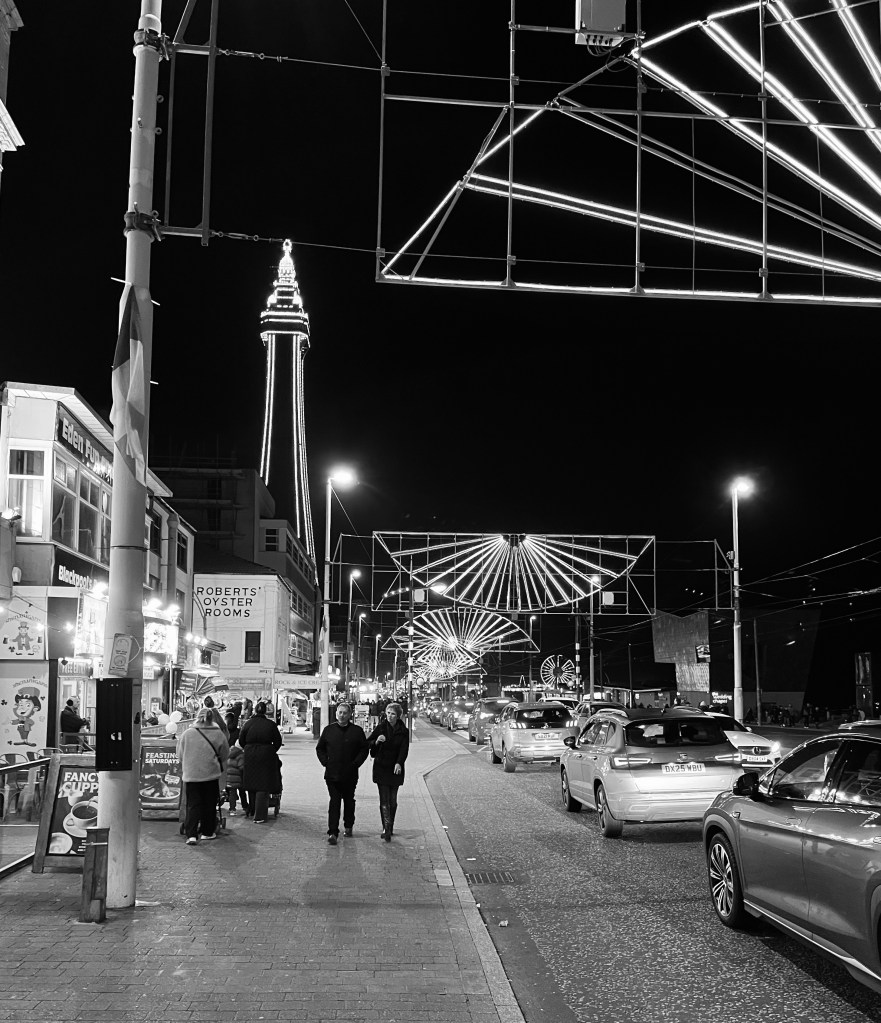
Tangerine Coast by A.J. Lees

The North Shore, Blackpool. All photos by Stefan Svennson.

Every year, in the last week of June, the mills, engine rooms, and coal mines in Oldham closed down, and an exodus followed. My great-grandparents, George and Alice (both born in 1867), dressed to the nines, would board the ‘Wakes Week Special’ at the station and head for Shangri-La. The railway served as a steam-powered conveyor belt that shifted human assemblies from the factory floor to a manufactured seaside resort I had the best of reasons to return to Blackpool. It was a joke of a place where you could let rip, lose yourself and fall in love. It was my seaside heritage and had become synonymous with northern soul.

The West Coast express from Euston was packed with jovial passengers, many bursting with stories, but even before Watford Junction, I was in the zone, oblivious to my surroundings, absorbed totally in forcing sonic madeleines up to the surface. The first to return was the voice of my father, “Look, son, can you see it, there, faraway beyond Crow Wood?” From the same vantage spot on Billinge Marilyn looking out to where the skyline met the Irish Sea we had seen an island of unearthly beauty covered with trees. Once he was certain I had spotted the thin vertical silhouette that he said was the Eiffel Tower, he started to parrot, “There’s a famous seaside town called Blackpool, that’s noted for fresh air and fun, and Mr and Mrs Ramsbottom went there with young Albert, their son. “

I eventually arrived with my bucket and spade at the advanced age of eight and a half. Outside the Fun House on the South Shore, an automaton with large, round eyes, bright red lips, and a disconcerting gaze sat inside a glass cabinet. A crown was resting on its frizzy hair and a sad Pierrot sat on its lap. As it rocked on its throne, it emitted a deranged cackle that I felt compelled to imitate and which, like a nursery rhyme, would become indelible. At the Winter Gardens, I had been mesmerised by a magician in his tailcoat and white bow tie called the Amazing Yoxani who was bound, placed in a bag, and then locked in a large trunk by a female assistant. The heavy curtain fell, and when it rose moments later, there he was, bowing and smiling at the audience. He then bounded over to the trunk, unlocked it, and liberated his female assistant. I knew it was a trick, but it didn’t matter but it felt very real. Cinematic flashbacks of the wooden hut for lost children at the entrance of Pleasure Beach, the pennies that never fell from the shelves in the amusement arcade, sheets of spray spilling onto the promenade and the drawn curtains of the fortune tellers’ kiosks flooded in as the train approached Warrington. In the menagerie at the Tower, I listened to a recording of Stanley Holloway reciting his monologue of Albert and the Lion. Dressed in his Sunday best, young Ramsbottom had stuck a stick with a horse’s head handle into Wallace, the lion’s ear and paid for it with his life. My father had frightened me by telling me it was a true story.

My paternal grandparents, Ben (born 1892), a machine fitter and Doris (born 1899), had also gone to Blackpool by train from Oldham during wakes week. Granny once told me that when the Tower and the gleaming sands came into view through the carriage window , the atmosphere changed. The starchiness vanished, and the excited holidaymakers burst out singing, passing round bags of sweets. She also told me of a rainy day on the promenade when she had watched with astonishment as a group of miners she recognised from Wood Park Colliery had passed her jigging with joy.

I changed trains at Preston and on the last short leg through the flat and characterless Fylde plain a man sitting opposite me asked me if I was off to see the ‘Lights’. When I told him I was going dancing, he replied, “You’ve got the right place, pal, they even dance in the street.” Blackpool North had an end-of-the-line feel. Its platforms were deserted, and its surroundings resembled a sanitary landfill. Inside the station, there was a large concourse with no seats that served as a holding area beyond the automatic ticket barriers. Two long queues of passengers snaked round its perimeter. A gaggle of officious station foremen guarded the platforms to ensure orderly boarding for the trains to Lime Street and Manchester Airport. Outside the station, there was a connecting underpass to the tram interchange. Head down, I hurried past a group of inert heroin addicts and a man wrapped in a layer of homemade lard, clutching a can of ale. Behind me, I heard the low hum of a modern tram gliding towards the shore. Talbot Road felt edgy, cut off and run down with swathes of arrested brownfield development. Even in the town centre, there was a moribund low season feel. The many multi-storey car parks and spacious lots were almost empty and the few people in the street seemed in a hurry to get home

In a few minutes, I reached the Golden Mile . The priapic Tower was lit in indium blue, and the Prom bathed in electric sunshine. There were many live shows and music venues on the strip. At the entrance to the North Pier a middle-aged woman where I bought some sticks of rock called me ‘sweetheart’ in a cheery Lancashire brogue. The illumination and movement had lifted my spirit. Someone had written in chalk on the pavement, Yesterday is history, tomorrow is a mystery, today is a gift of God, which is why we call it the present. It was a sin to be unhappy in Blackpool. The Scots and Scouse hordes were walking the walk, and there was a hen party from Yorkshire. I could hear the sea booming in the dark dusk. Ocean Boulevard, The Esplanade and the Atlantic were the set for our shared illusion. Dray horses with jingling bells were clip-clopping towards Central Pier pulling pink Cinderella carriages sprinkled with tinsel

There was already a line of old souls outside the Tower Ballroom, intent on securing tables close to the dance floor. I walked towards Pleasure Beach, hoping to hear the bellowing mechanical laugh of the ‘King of Fun’, but all I could reconnect with was uptown Motown and Stax music coming from the crowded bars. The scaffolding of the roller coasters resembled glittering lattices in the darkness. Their cars, full of screaming late-night riders crawled up the steep inclines before shooting comet-like through a starless sky. The Blue Waves, The Windmill and The Sands were derelict, but there were still plenty of pet-welcoming boarding houses advertising Free Showers. The Sea Front Camelot Tea Rooms, which I felt I remembered from seventy years ago, was offering every permutation of the Full English breakfast.

When I returned to the Tower, the queue had been replaced by a strong smell of vinegar and fried onions. I looked up at its archways, stained glass windows and the vertiginous criss-cross lattice of iron and steel. I showed my ‘Togetherness’ wristband to the smiling doorman and climbed the stairs to Circus Walkway. As I rounded the first corner, I was hit by the sound of Frankie Beverly belting out If That’s What You Wanted. I started to mouth the lyrics with the same autonomic reflexes that compelled me to mimic heading a ball every time I watched a corner kick:

Ha! Since I’ve been left here, darling,
I’ve been walking into closed doors, call yeah!
I needn’t tell you how much I love you, but I just can’t take it no more
, ah yeah!

The final three in the Dance Championship, Tower Ballroom, Blackpool.

The ballroom on Level 3 was rococo with Victorian knobs on. It was adorned with columns, arches, cherubs, friezes and balconies. A large crystal chandelier hung from the sliding roof. An invocation to the dance written by William Shakespeare, “Bid me discourse; I will enchant thine ear”, written for Venus in her seduction of Adonis, was emblazoned on the top of the proscenium arch. Below the stage, the Mighty Wurlitzer used to orchestrate the quickstep, tango and waltzes lay dormant for the weekend. The disc jockey, Richard Searling was tucked unobtrusively between two large LED video screens whose purpose was to magnify and project the spinning discs. The music was rawer and looser than Motown but had the same mono, four on the floor backbeat. Every record had a hook line that was repeated over and over and the beat was kept heavy. I imagined the clanking and grinding of engines, the honking of forklifts and the rhythmical high-pitched clatter of looms on the mill floor. A fervent, supercharged excitement rose from the ballroom’s sprung wooden dancefloor. The dancers’ intricate backward swerves, dervish spins, Soul Train turns, backdrops, swallow dives, and somersaults of the dancers reminded me of the amphetamine-driven rats I had studied in the speed laboratory. The music seemed timeless. Soon I was floating out on the floor, feeling the syncopated horns and strings, galvanising my thinning muscles. I was still the old modernist, making moves I didn’t know I still had in me. I owned the music, kept the faith and was not too old to dream.

The stars of the northern soul scene were black American artists, almost unknown to the general public and a handful of blue-eyed white singers like Frankie Valli, Timi Yuro and Dean Paris. The disc jockeys were unfussy magicians who constructed an illuminated reality from pieces of plastic and were able to create an illusory willing suspension of belief . Most of the favourite tracks were obscure flops from the sixties and seventies with furious melodies, heavy syncopation and powerful vocals. Years of communal connoisseurship had led to an impeccable quality control. As the hours passed, listening to the music, I fell into a trance. There were moments when I was carried back to the Abracadabra magic show with a white rabbit materialising from an empty top hat and a bunch of scarves rising in defiance of gravity. The music became a healing force that loved me back.

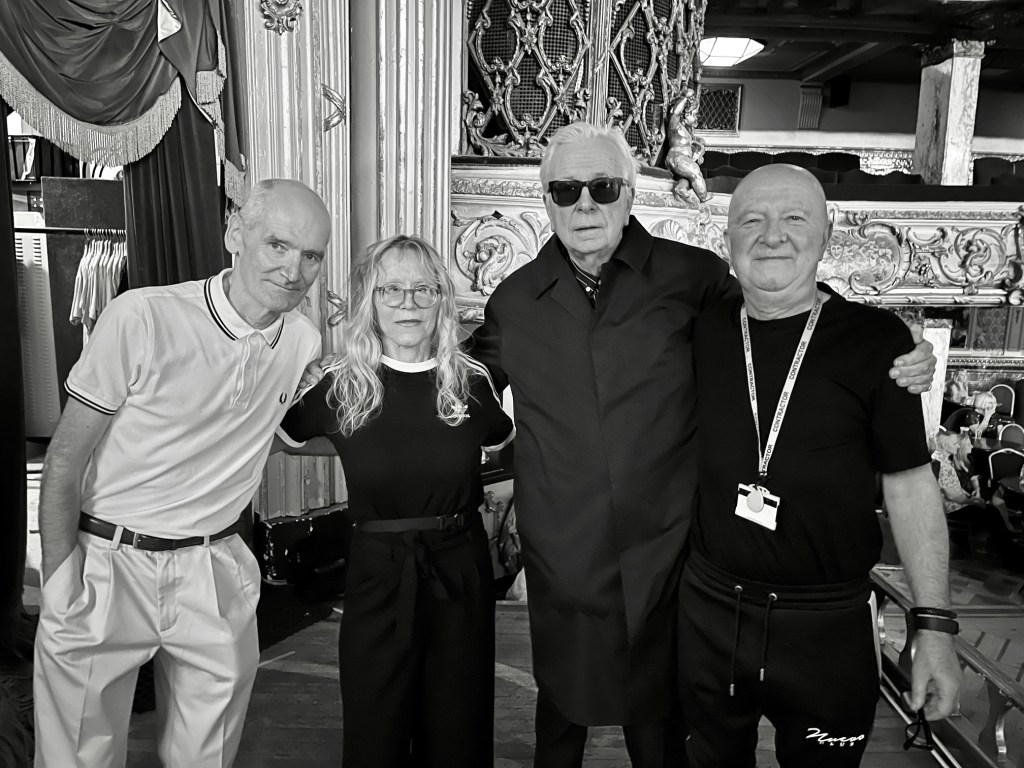
Around midnight on the second day, I climbed up to the sweeping upper balcony and looked down, scouring the floor for the Dopamine Dancer and for David, the Boy Miracle from Stirling, who had been brought back to life after a brainstorm by a northern soul tape. The stomping was spontaneous, improvised and high energy. There was no leader, everyone was free to express themselves in their own way but a strong sense of etiquette existed on the floor. Each dancer reacted to those in closest proximity and avoided getting too close by steering an instinctive course, which returned them to their own spot sometimes marked by a pool of sweat. Everyone was committed to having the best night ever. Fifty five years after it began northern soul was now being kept alive by the children and grandchildren of the pioneers from the iconic venues like the Torch, the Highland Room, The Casino, The Catacombs, the Pier, the Ritz and the 100 Club, Some renegades from the funk and disco scene who had belatedly found the holy grail and a few visitors from the Japanese, Australian and Canadian scenes injected new blood. Some of the old soulies were now too unwell to dance but still got high on the music, and there was still plenty of fast footwork in evidence from bald elderly men in Fred Perry shirts, vests and baggy trousers and glowing women of a certain age with long circle skirts and lightweight tops. The motion was soulful, passionate and beautiful to watch. First, I spotted David in a white shirt sitting with friends in ‘ Scotch Corner’ close to the stage on the left in front of the record stalls. Then I picked out Anne, the Dopamine Dancer freed from the shackles of Parkinson’s disease, dancing in the middle of the ballroom. Music had released her handbrake and she could dance all night

From Left to Right: David, Anne, A. J. Lees and Richard Searling, on the stage at the Tower Ballroom, Blackpool, November 8, 2025.

On Sunday afternoon, I took a tram back to the station with my heartbeat still turned up and wreathed in a glow of animation. A burly man with a loud voice told me it was a free ride then warned me to transfer my wallet to my back pocket. As my train pulled out of Blackpool North. I felt that I had become truer to myself. The invigorating make-believe world of northern soul was a portal to authenticity. It brought home that the high bogus of scientific fraud, doctored clinical trials and the sale of counterfeit medicine had dragged me down. Some technological titans who believed in the infallibility of machines were trying to reduce medicine to a measurement and I had read about unaccountable customer-friendly chatbots that encouraged the suicidal to kill themselves. Moving to the music had helped me rebuild and resynchronise. The trip to Soul Town told me I needed to take more time out to dance on the edge of volcanoes and spend time watching the sunbeams flirt with the shadows. I would continue to respect data, but I must never lose my delight in magic and faith in God

Footnote:
In 1923 Blackpool football club founded in 1887 adopted a distinctive tangerine shirt with its team wearing it for the first time in a 2-2 draw against Oldham Athletic. I associate tangerine with warmth, high energy, adventure and cheerfulness.

. . .

A.J. Lees is a Professor of Neurology at the National Hospital, Queen Square and University College London. , He pioneered the use of apomorphine for the treatment of Parkinson’s disease and has received international acclaim for his expertise in the treatment of abnormal movement disorders. He is also an original member of the Highly Cited Researchers ISI database. Born in St Helens Merseyside, he qualified in medicine at the Royal London Hospital Medical College, Whitechapel in 1970 and received his training in neurology at L’Hôpital de la Salpêtrière, Paris and University College London Hospitals. His book Mentored by a Madman, The William Burroughs Experiment (Notting Hill and New York Review of Books) published in 2016 explains the unlikely association between his neurological career and the author of Naked Lunch. His latest book Open the Door to your Heart describes the importance of dance music in his own life and in the restoration of function in some of his patients.

this by anna f.

Photos/artwork by anna f.

All this started on a lonely bench at Frustration Station.

There I was, sitting, with a crushing sense of defeat, of failure, and a nagging urge to engage in some kind of creative process again. My life had unravelled slowly but predictably so, over the past few years. 2020 was the last straw.

I used to dream up shows, and stage them at festivals, fringe theaters, and clubs.

Exit – Irreverent Sideshows.
Enter – Irrelevant Slideshows.

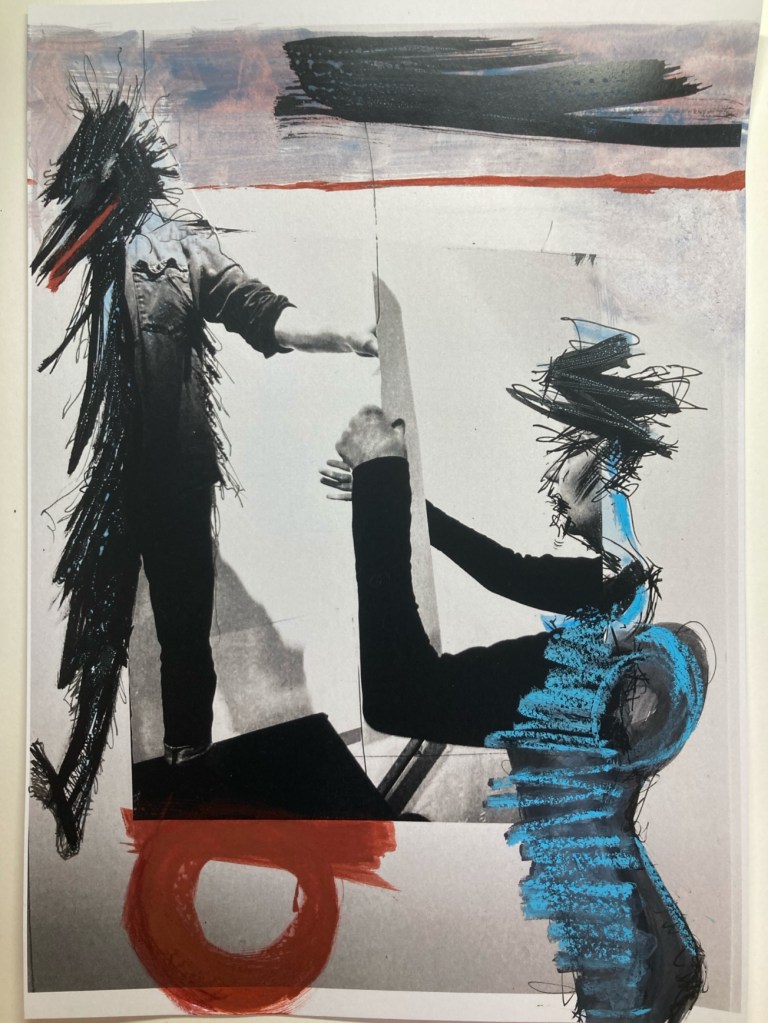
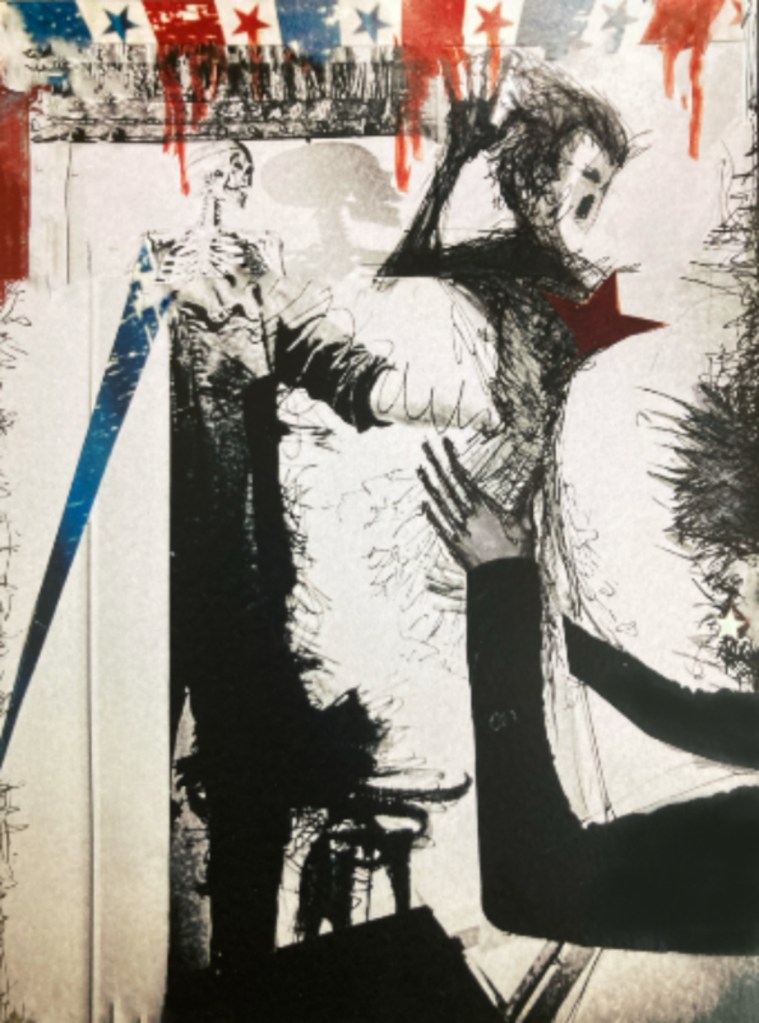
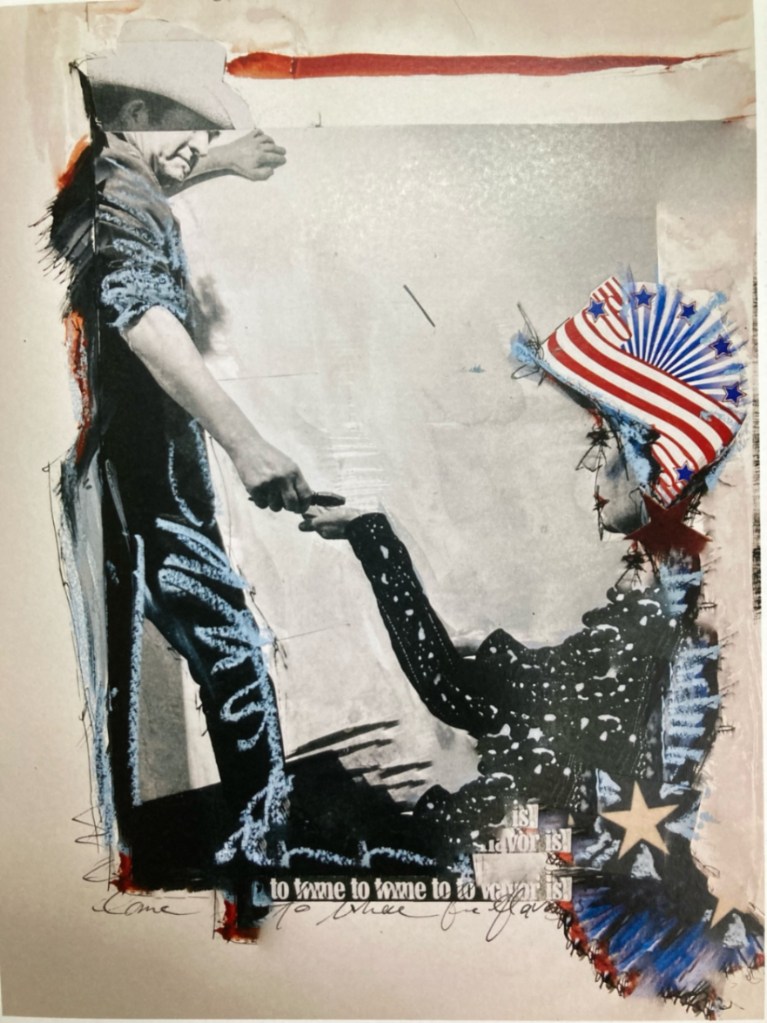
Working in 2D was not my thing but I was left with no better options. I started playing around with a series of photographs I had taken of two friends taking down an exhibition. I had documented their ‘performance’ — their gestures, interactions, and movements — against the white walls of the gallery.

I don’t usually print the photos I shoot but this time I did. All of them, and more than one copy of each. I propped them up against the wall at the edge of my chaotic desk.

Waiting? Maybe.

I wandered down a path without any sense (nor care) of where I was going. No purpose, no intention, no destination — a random walk in the dark. I let my pen run over the images, then added brush strokes to some, before reprinting them, then more of the same. Over and over.

After a couple of months, I was on a roll, reworking the same photographs again and again, experimenting with collage, color, different inks and paints, re-photographing, and re-printing, adding more ink and paint. I was like a child throwing toys around a sandbox and loving it.

In spring 2025, almost a year after I had shot the original photographs, I stopped for a moment and looked. I said ‘Hi’ to my new friends. I was ready to dance, to transform the photographs more purposefully, and bend them gently along a curve of intention.

I’m not planning to leave this dance floor any time soon. I might even change the music, learn some new moves.

. . .

anna f.’s background is in architecture and predominantly in theatre. She’s the founder and director of the performance group Irreverent Sideshows and recently started the visual arts project Irrelevant Slideshows. She lives in London.

Glittering Metals by Lake Sleep

Sailing in the Caribbean changed me, it’s true.

I hold the memories delicately in my fingers wherever I go.

. . .

March 29, 2024, in New Orleans, Louisiana: things at the tattoo shop hadn’t panned out. Business was mind-numbingly slow, and the owner of the shop I was working at decided to let everyone go and use the shop as his own private studio.

I felt relieved, more than anything. I have a deep love for tattooing, but I didn’t feel that working at a shop was what I needed at that moment in time. It was a time in which I was deeply avoidant of anything that could lock me down. I had a gnawing need to move with agility. Any direction, any time. I was shirking structure, seeking something beyond it. I knew I was looking for something, but I didn’t know what it was. I was only sure that I hadn’t found it, yet. In the meantime: my world was wide open.

That day, I collected the last of my things from the tattoo shop. I finished the illustrations I had been working on for some friends’ puppet show. I cut my hair. I drew on long-winged eyeliner, stood in front of the mirror in my room, and looked myself in the eyes. I said: “I want something to happen.”

I had alcoholic Monster energy in my fridge that I’d been keeping for an auspicious moment. The Beast Unleashed – Mean Green. I took it.

I went out.

Someone who was just a distant friend at the time was organizing a punk show in a local liquor store parking lot. It was my understanding that the store loved it when punks put on shows there: it was great for business. I love a punk show, I especially love a punk show in a weird location, so I have to go. The friend I’d made plans to go with canceled last minute. Her ex was there, staring daggers into my back. Talking to my friend Vex, they said, “It seems you’re doing a lot of Closure Things.” I agreed.

Some friends I knew to varying degrees, including my roommates at the time, were putting on a renegade show afterwards. Freak rave with noise interludes. The location, given by hotline, was in a large abandoned lot in a weird part of town- this dead nowhere zone nestled between an overpass and a mostly-abandoned residential neighborhood that had been plagued by strings of misfortune.

I pulled up a dark dirt road in my silver Subaru Legacy and parked. A brightly-painted Ford Ranger pulled up nearby. Two figures hopped out. One, Guinevere, a friend, the writer of the puppet show I had been making illustrations for. Two, Lucian, someone from out of town, who I had met briefly a few days before.

“Oh hey, we were just talking about you,” Guinevere called out.

I was surprised: “Talking shit, I hope!”

We wandered into the weeds, then deeper down a scraggly tunnel of bushes and small trees, the path lined with occasional glow sticks. On the other side of the tunnel: a decaying corrugated metal warehouse.

The spot and surrounding neighborhood had been scoped out long before the event, but the day of the show a huge overturned bus had suddenly appeared in the middle of the building. It seemed like the abandoned warehouse was also someone’s chop shop for scrapping stolen vehicles. Music and visual gear was set up atop the engineless bus. We all climbed on and around the looted vehicle, spun on a freely rotating wheel aloft, jumped through windows above to windows below.

After a while, the novelty wore off, and the undertone of conflict between various coupled friends was becoming ever-more perceptible, so I made my escape to a fire pit outside.

Monster finally cracked open, I found myself talking to Lucian from out of town. We talked a long time about travel, brutalist architecture, and other things that slip my mind now. He said he’d just bought a boat in Martinique, an island in the Caribbean I had never heard of. He didn’t live anywhere. New Orleans was only a stopover on the way to his new boat, bought sight unseen with a broken motor. He seemed confident he could fix it. I believed him. I thought, how cool, I’m sure he’ll have a great time.

Just then, a strange man with a can of beer swayed over to the fire. He was wearing black and white vertically striped pants and looked like oogle beetlejuice. I had never seen this man before in my life. He interrupted the conversation I was having with L. “Excuse me…excuse me, can I just ask you something?” He was looking at me.

“Can I just ask you… what do you see in this guy?” He pointed at Lucian.

He must think I’m dating him or something, I thought. He had no idea this was the first time I’d ever had a real conversation with Lucian, who was pretty much a stranger to me. I thought, the only way to get out of this is to say something funny.

I said, “It’s because he has a boat.”

Oogle beetlejuice laughed. “Oh, so you’re a boat digger, huh?” He thought for a moment. “I guess being a boat digger is more honorable than being a gold digger, since you still have to be on the boat.” We laughed.

At some point oogle beetlejuice made his exit, and it was then that Lucian invited me to sail with him on his boat as crew. He was going to sail in the Caribbean — indeterminate end.

For a long time, I felt like I’d been doing nothing but closing doors. I was unemployed, my life before me was virtually vacant. No plans. I had been waiting for something to happen. I wanted something to happen. Was this it?
I didn’t know anything about sailing. I’d never been on a sailboat before, never had an opportunity. But I’d wanted to. I’d wanted it the way one wants an improbable dream: You just want. Your wanting creates a shape. And you think, it’s impossible, and it sinks down. The dream was so deep in my subconscious I could barely feel it rising to the surface.

I said, “Maybe.”

I remember him walking away from the fire, into the darkness, waving noncommittally. I wondered if I’d ever see him again.

I would.

I went to sea with him and it changed me. Four months later, I returned to New Orleans.

. . .

The strangest thing about traveling for a long time is the return. Your descent back into your old life and old patterns feels like a direct confrontation with your past self. All of the choices you’ve made in your life up until your departure seem tinged with sharper edges, yet you feel removed from it. Strangely objective, an outsider in your own life.

You find yourself in your own room — but it feels like it belongs to a person that no longer exists. It is jarring, suddenly to feel a vast gap between you and your older self, a gap you didn’t expect to exist. Around you, people and places loosely gather in similar structure. Most act like everything is the same. You have an urge to explain, to properly convey your experience but words fall flat. How can you explain that you feel your insides have re-arranged themselves? Inside of you is filled with glittering metals that you will walk around with, always now.

. . .

Lake Sleep is an artist living in New Orleans, Louisiana. Her art finds form in ink and watercolor illustration, printmaking, tattoo, and digital fragments scattered around the web. Through her work, she pulls at the fragile seams between technology and nature, the tame and the untame, the real and the unreal.

She can be found on instagram: @lake___sleep

Mizmaze by Sylvia Warren

The first time I walked a city without direction was in Florence. Before that trip each day was regimented by parents—a designated set of sites to visit, walking through the streets was a chore between destinations rather than a reason to travel. This time I was fifteen; I made my case that I wanted to go back to a gallery to draw some of the statues, and on the way there I got deliberately lost. It is an intentional form of being lost, formed by noticing buildings or landmarks or quirks of the way two streets intersect into an impossibly narrow corner of a house that begin to build up a map of a place in your head. Medieval cities, souk cities, old towns are all particularly good for this. Ideally this is an act that should be done alone without headphones or distractions, but there is pleasure in doing it with someone you love to share in the ornamentation given to houses, the peculiar shape of that window, the way this street links two parts of the city you might have visited via a different route and then the contours of the place become connected. It is also worth doing the same path at night, but that is not always possible, it depends on who you are. I am very envious of those who feel safe to do so alone.

In Bolivia, high up in the Andean mountain town of Cochabamba, the Spanish phonetic translation of its Quechua name, Quchapampa, or ‘lake plain’, my friend and I were told explicitly not to walk around the city alone. Another person, a man no less, had been beaten up when out for a morning run. To escape being chaperoned was a release, and my habit of wandering down side streets only got me into minor trouble with our host mother, but without this I would never have seen the southern cross from the top of a children’s slide in a playground at night or stumbled upon the embassy quarter with the manicured lawns that were so different from the rest of the city. I looked up the Quechua name for the correct spelling and the city looks different now, with sleek light rail services instead of the converted minibuses decorated with rugs and tinsel that I remember. My memories of the route from where we stayed to the outskirts to the orphanage might be only a shadow now, confined to my memory of walking and recognising the advertisement that was put up that indicated where we would have to ask the minibus driver to stop so we could run across a four-lane road to get to work.

I have repeated these walks in almost every place I have visited, from Hà Nội to Lisbon. London is a special case, a set of villages of sorts that I can navigate around like fruiting mushrooms emerging from the myceliae of the underground system, distinct but not truly linked in my mind. Something strange happens when I live in a place: the urge to wander is all but lost. During lockdown I found an area of the city in which I had lived for over a decade for the first time, as though being forced to stay in place gave me the permission to deviate from the boring routes that I stuck to so rigidly. It was an island, formed over a reclaimed rubbish dump. In autumn the trees are heavy with apples, in winter you can see muntjac deer through the bare branches, breath steaming into the mist. 18th century pottery and old scientific glassware can be picked up when the ground is soft, and in summer there are trees to climb and one spot where you can slip into the river to swim. Take another route, another turn, and you are in a metal processing plant, all noise and smells of oil and burning. This is not an essay about psychogeography or being a flâneur, it is a question of what about settling somewhere is it that resists what is otherwise one of life’s great pleasures.

One of my earliest memories is of walking the mizmaze at the top of a local hill. You pass the plague pits and beech trees before ascending the chalk-based soil that produces scrubby grass and strange orchids. In front of a copse of copper beeches is an old turf maze, but that name is wrong. There are no wanderings and wrong turnings here, the route curls around itself from the entrance to the centre and back out, all it requires is patience and to put one foot in front of the other. I have walked it in winter so thick with frost that the grass appears as a ghost and drunk in summer when the scents of rock rose and thyme mix with bonfire smoke. The turf is cut so as when you begin you put one step in the narrow furrow and the next pace just ahead, it is too small for you not to move forward with each footstep unless you run out of path to tread. There is a peace in walking this mizmaze, an hypnotic action in the movement that compels you to complete the circuit until you walk out of the parallel exit to the entrance and the spell breaks. I have never dared to step through or across the turf to exit more quickly, to do so would feel wrong on a level I cannot articulate.

Perhaps we build our own mizmazes for our hometowns? This journey, this shop, this route between places we need to go, this side of the street to walk down? This does not feel like a spell, however, more as though one is placed on a track that is so practiced that looking around ceases to be of any interest. Yet to deviate from the known routes feels stupid, almost embarrassing. This is not to say that routine is uniformly bad; it is a requirement of becoming a local in a pub or café, which can open up a place where you reside into a place where you live and are known.

After the pandemic I moved to a different town and I despised it. I found it cramped and ugly, and my walks were restricted to going into the town (through an unlit alley, down a residential street that floods when it rains, turn right past the fish shop and across the bridge), to the station (turn right just after the bridge), and around the small park behind my block of flats (enter across a wooden bridge past the teenagers and their dog, walk eight times around the circular loop of tarmac past the unused outdoor exercise machines and the playground with men drinking from plastic two litre cider bottles on a bench, go back via the teenagers). The more I repeated these routes the more I hated the place I had moved. The stench of the canal, the soggy leaves underfoot in winter slippery and hateful, the dark passages I had to navigate to leave my flat.

Eight months after I had moved in I felt furious with everything, most of all with myself. I set out in the opposite direction from the unlit alley and walked aimlessly. An underpass called to me, so I took my time seeing the graffiti, some illustrating a cartoon of the history of the area, half covered up with tags and original art. A manor house that had been converted into a school, then a railway bridge that opened up onto fields with grazing cows and horses, a rock processing plant with large lorries ferrying gravel out, and then a reservoir that fed a river with a set of invitingly large stepping stones. The sound of the water led me to the wrong side of an underpass that opened up into a park that I hadn’t known linked up to the main canal that runs through the town. Walking through the woodland and spiralling back, the single route took me back home.

This will never be my final hometown, but I feel an affection for it in the way I do towards the city where I was born; its ugliness and architectural surprises. Down the residential street one house has a Victorian door and beautifully moulded brickwork that gives texture and beauty to an otherwise uninteresting house. One of the houses by the river is a palimpsest of workhouse and glass conservatories jutting over the water, and just off the main square a bust of Shakespeare stares, weather beaten and softened with pigeon shit, over a town that once was cared for enough to have people decorate it.

. . .

Sylvia Warren is a writer and academic editor. Their work has been featured in Open Pen, Minor Literature[s], the Brick Lane Short Story Anthology, and more. They consider AI an affront to the joyous act of creation but refuse to stop using em-dashes. They enjoy writing, the sea, and sketching the architecture of pubs over a pint.

Everything Is Far Away by Brian McHenry

Drawings by Brian McHenry

I have a favourite road.

There is a moment in the film version of Gavin Maxwell’s Ring of Bright Water when the main character, Graham, gets off the MacBraynes’ bus and for the first time looks across the Firth of Lorne towards Mull in the distance.

Ben Buie, Sgùrr Dearg, Dùn da Ghaoithe are all there in front of him, each a distant grace note to something that isn’t there anymore. Of course the movie takes vast liberties with both the book and indeed the story of Gavin Maxwell himself but somehow for me, with that scene, it all gets forgotten.

And so I watch the grass as it gets moved by the wind

and the sound of it

And I think of us there in Fishnish all those years later

The sweetness of that sound on Aird a’Mhorain.

Traigh Iar

and I think of those landscapes now that we’re not there,

the spaces where we used to be.

Your presence as it shifts into abstraction

and distant thought now

the space between you and me and the lines that I draw.

. . .

Born in Belfast, Northern Ireland, Brian McHenry is an artist and illustrator whose work has appeared in various publications — including The New Yorker — and featured on record covers, books, and even the odd beer can. He currently lives on the north-east coast of Ireland with his two children. His recent combines elements of portraiture, symbolism, and abstraction to explore the physical and emotional landscape of remembering.

https://brianmchenry.bigcartel.com/

Walking In Circles by Paul Tritschler

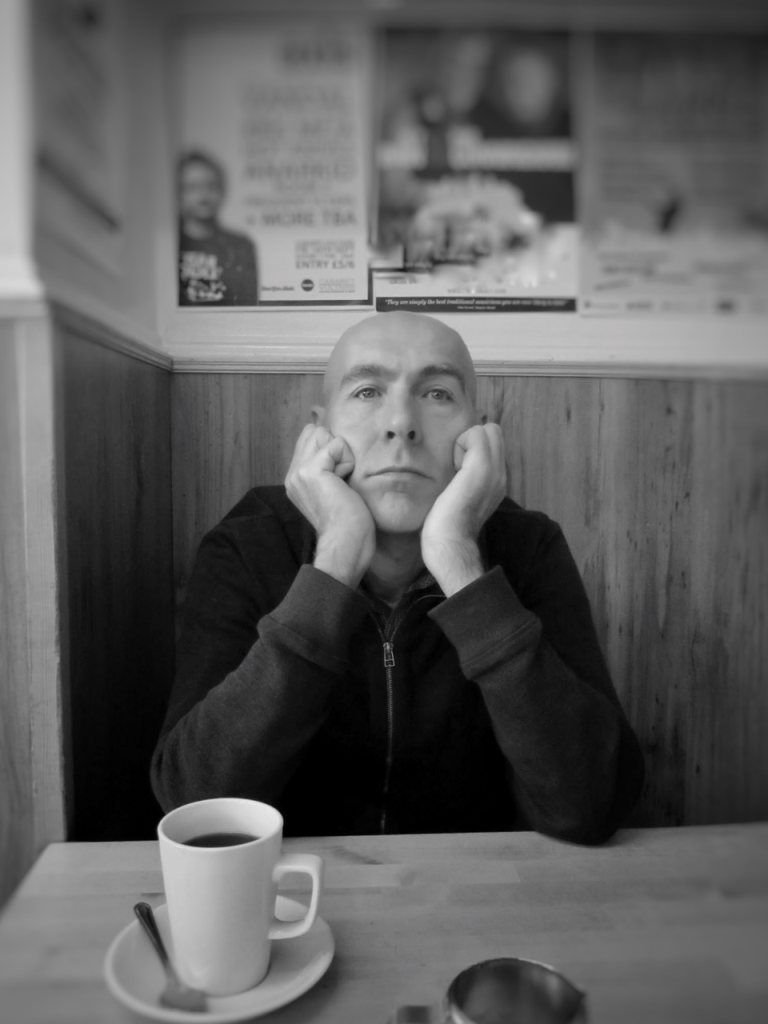
Photo by Paul Tritschler

Midway through the event, a woman seated in the front row of the audience asked the panel of four authors, all of whom had made an appearance for the purpose of promoting their recently published travelogues, if they could explain in simple terms how their notion of travel differed from what most ordinary folk called holidays. Nothing is more difficult than to be simple, but the elitist charge implicit in her question, one that was somehow rendered more pointed by her affected pleasantness, laid another layer of complexity. The moment demanded deflection by way of a pithy response — l’espirit de l’escalier might have suggested a poignant quote from Ibn Battuta or something whimsical from Rabelais. Instead the panel, with a tad too much haste, dug themselves into a defensive trench, and in the process shovelled dirt on what they ill-advisedly and repeatedly referred to as common tourism. And they wouldn’t stop digging.

Conversations erupted throughout the room but eventually settled into silence, and no indication was given that the audience would assist her in pushing the panel off its platform, if indeed that was her intention. That being said, it most likely nudged it a little; peering through the newly created cracks in the edifice, the panel’s itinerant forays and desultory wanderings would have appeared to some people as lofty peregrinations wrapped in pompous superiority…or thoughts to that effect. Their somewhat clumsy efforts to enumerate the differences between what they get up to and what everyone else does would not have helped in that determination. On the other hand, some would have interpreted her question as self-aggrandising, one motivated by conceit, point-scoring and the desire for audience adulation. Either way, the nourishing conversations that were until that moment shared between the panel of authors and what felt like a roomful of friends, now a breathing mass of strangers, failed to revive.

Possessing an air of originality, mystery and spirited adventure, the mention of travel arouses more curiosity than that of the humble holiday, and there can be little doubt that by describing oneself as a travel writer rather than a holiday writer one gathers greater cachet. Yet it often seems that, at core, there is no difference between them. Indeed, the travel writers sharing the podium might easily have described their journeys as holidays. After all, three were promoting books about relatively short stays in what many would deem holiday destinations, including a fortnight in Paris, three weeks in a wine-growing region of France, and a month in Tuscany. Only one took a longer and more varied route, that resulting from an unplanned year of backpacking.

Putting it this way perhaps challenges their street cred, yet many philosophers, among them Seneca and Thoreau, were greatly inspired by the odd holiday, during which they created notable works of reflection on nature, on the human condition, and on life’s meaning or purpose. The same is true of literature. Agatha Christie developed the idea for a well-known detective mystery whilst on a leisure cruise down the Nile. Virginia Woolf wrote To the Lighthouse whilst on vacation on the Isle of Skye, and Elizabeth von Arnim’s The Enchanted April was inspired by a month-long holiday to the Italian Riviera. The list goes on. In the end what matters most are the stories, and to this one might add a degree of self-discovery.

. . .

Old Cathy used to come into our house to wash her money. Though she scrubbed the stairs of every last one of them, and had done so for years, ours was the only flat in a long street of tall black-sooted tenements where she could come and go as she pleased. She even had a key. Some people would rinse out and refill her bucket, but she would have to remain at the doorstep, door closed. To be fair, Old Cathy wasn’t one for conversation, and in fact blanked most people, but that wasn’t the only reason people covered their doors. For much of her life she lived between the mental asylum, as it was then known, and the street, and when that information got around the neighbourhood by the usual whispering campaign people kept a watchful eye. During the time our family knew Old Cathy she had secured permanent residency in a Salvation Army hostel not far from where we lived: a small room with an iron-framed bed, a chair, a cabinet, and a cross on an otherwise bare white wall. Visitors were not allowed, but we visited anyway, my sister and me, and whilst some residents occasionally looked at us with suspicion, neither the warden nor anyone else ever refused entry.

My sister always firmly insisted that if anyone were to question us I should stay silent and let her do the talking. When neighbours or anyone else asked questions she generally cut in to finish my sentences in ways I could never anticipate. Three years my senior but in reality much older, I guess my sister would have been around eleven or twelve when we visited Old Cathy. She doted on us, and was always steady and sunny, but I doubt if many people saw that side. She just kept her head down as she scrubbed the stairs, her metal bucket echoing in the close as it clanked down each step, then reached back up to draw intricate floral patterns with white chalk on the margins of every step. This was a common custom in our neighbourhood, an area that outsiders called slums, but unlike Old Cathy most women just chalked a quick zig-zag or squiggle. Either way they only lasted a day at best.

A woman notorious for malicious gossip once stopped us to ask if our dad knew that our mother allowed a pauper lunatic to wander in and out of our house when he was at work (he worked almost all the time). We of course knew who she meant, but as instructed I buttoned up. I would have liked to have said that we loved Old Cathy, who was one of the kindest people on Earth, and that not only did she visit us, we visited her; but as my sister later reminded me she would most likely have called the police and had her thrown out of her residence and into the street. Adults were a different breed, and I dreaded the thought of mingling with them. Even at the early stages of adulthood most people showed signs of becoming distinctly unpleasant. I think Old Cathy felt the same way.

This was a time when mothers who took to their bed for days or weeks or maybe even months were generally considered to be indolent rather than depressed, a time when postpartum depression was for the most part unknown, and a time when having a stillbirth — regardless of the sadness, guilt and anxiety that were at heart a cry for help — was hushed up as a shameful failure. Mrs Bogus, a pathologically nosey upstairs neighbour of ours — listening at the letterbox, she fell into our hall one time when my dad opened the door on his way to work — stopped me and my sister on the stair to ask if my mother was still lying in her bed. She called her a lazy article, jolting her miserable mongrel on a choke chain before briskly walking on. No one ever explained to me the meaning of article, but I got the gist. Just ignore her, my sister said, and don’t repeat what she said to anyone. I didn’t have to: everyone seemed to know that my mum had sunk under the covers and let the house go to hell. It even got around the school.

For the best part my sister looked after things at home, organising clothes, tidying up, making meals, but after a while things began to slip there too, and the mess just piled up. We made a space on the sofa between heaps of clothes and coat hangers and ate cereal from the box. On one occasion we heard our mum mumble to herself that she wanted to cut her throat, and I was told never to repeat that either, not to anyone, not even to dad — especially dad! She didn’t mean it, my sister insisted, but I couldn’t quite dismiss the possibility. For all their promises to the contrary, adults were notoriously unpredictable. My friend’s sister killed herself over a stupid fiancé, the mother of a boy at my school was murdered by his dad — just one punch, they said, whilst she was doing the ironing — someone sunk an axe into someone’s front door, another put a petrol bomb through a letterbox, men filled with rage and hearts of hate fought to the death outside pubs, and psychopathic razor gangs roamed the streets and alleyways. No adult could be trusted entirely.

We came home from school one day to find all the mirrors in the house had been smashed — why mirrors? — and immediately I wondered if my mum had taken a shard of glass to her throat. I envisaged it. My sister made me wait in the hall until she checked out the bedroom. Mum was sobbing under the blankets, but otherwise okay. Old Cathy was there, calm and calming, picking up the pieces. She would have known worse, and most likely understood the situation better than anyone. For several weeks no stairs were washed as Old Cathy stepped in as our femme de ménage, arriving before we went to school, and leaving in the evening. Between those hours she did the shopping, made breakfast and prepared dinner, looked after my mum, washed clothes, tidied the house, and even found time to play board games with us — she was a master at draughts. In time, when my mother got back into harness, Old Cathy got back down on her kneeling mat to scrub and chalk the tenement stair, the distinctive sound of her metal bucket once more echoing in the close as it clanked on each step. Thereafter she would rinse out her bucket, brushes and money in our small scullery whilst the kettle boiled before settling down to sit with my mum, gazing into the embers in silence.

. . .

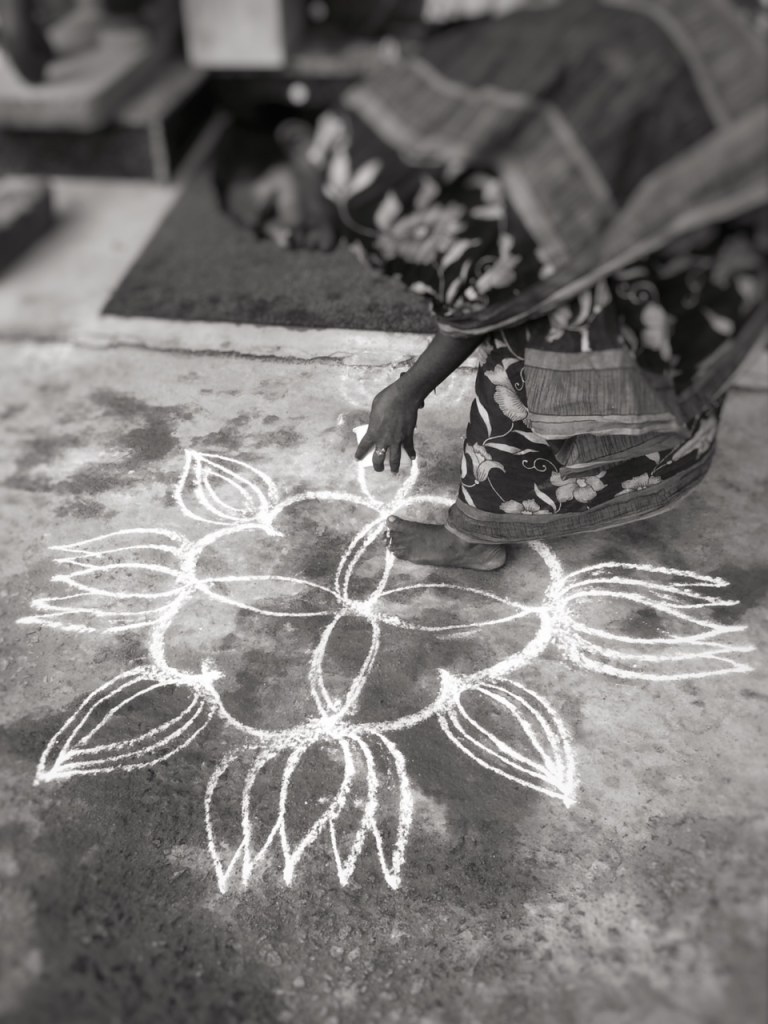
For some people, travel writers are escape artists sharing their secrets on how to break loose from sameness. Others live to wander, to find stillness in motion, and perhaps by chance to find missing parts of the story that made them who they are. It was whilst perched on a doorstep under a hot sun in Tamil Nadu that Old Cathy, for the first time since childhood, wandered into my thoughts. I was watching a woman take great care to create a kolam at the entrance to her home, a decorative chalk circle with floral designs that is said to bring good luck and prosperity to the occupants. The drawings are walked on, scuffed and washed out every day, and whilst illustrations and meanings vary, each in their own way presage the transience of our existence and the impermanence of all things. The process was hypnotic. With eyes squeezed shut I remembered Old Cathy with head bowed drawing similar floral patterns with her piece of chalk on the steps to our door, and for a moment that door opened. The long journey to India had led me back to the start, and perhaps, after all, that was the point.

. . .

In addition to teaching psychology in universities, adult education and colleges across the UK, Paul Tritschler has managed organisations within the fields of brain injury, sensory impairment, mental health and community activism. He has written for a variety of magazines, including Aeon, Psychology Review, Bella Caledonia, Counterpunch and Open Democracy.

Original Sin by Liz Cullinane

Sculpture by Liz Cullinane

Watercress abundant, pooled, fed by a freshwater stream that leaks a channel, a winding furrow  carving an arc across the sands. Joining the Atlantic salt waters. Diluted. 

Conas ta tu a stor? How’re you love? Bhfuil tusa ann?  Are you here? Where are you? 

                Under the rocks……..caught in the weed………….? A remnant of yourself…. a fragment, flotsam, tiny bones  bleached out over time. 

                First child, the one and only first, spent in the sands and carried away unseen.

Pause, sigh, and breathe. Slow. Clearing. In and out breaths. Fuck it …

The stream’s absorbed when it reaches the sea. Red standing stones guard the shoreline. Dug in, bulk undiminished through the years. Smooth blank faces peppered with tiny lives. Living creatures  in spiraling whorls, paint-box colours distinct from the rest with their blend of muddy greys, blacks and browns. The discreet, minding their own business ones.

Keeping to the low formation, leaning into these sentinels, pushing up hard. Limpets impress their determination into my back, encouraging them to leave their marks on my skin, through the layers of time and guilt. Tiny bruises, kissed into my shell.

Cá bhfuil tu mo stor,  where are you my love? Still here? Shape shifting your small self, half formed baba deas, lovely baba? Or have you vanished into mists of salt water and weed? Níl fhios agam, I don’t know, may never know.

Sins for which I alone hold no charge, spoken in my head. Not then, had no clue back then. 

Busy in the kiddish world of long summers, heat hazed early mornings blended into same grey days. School and holidays, home and here, the Red Strand. First beach out of Clonakilty, Cloich na Coillte, stone castle of the woods.

The brother, older but no wiser through the passage of summers, collects the tiny vivid shells under instruction from his know it all little sister. All through our early rising summers for as long as it pleases him. Mostly in the absence of anyone else. (He’d prefer the other boys, tardy, sleeping-in boys, almost always with a ball). 

We sort  the shells into currency for our long playing games, oblivious to any lives inside the whirly chambers. Red, yellow and green defining value, same as fruit pastilles or wine gums;sticky pleasures.  Flavours imparted by the power of suggestion. 

In truth  they all tasted much the same, the richer the colour the more they’re desired, sweeties and shells. No truth to either.

He is obliging, patient and generous, prepared to share a vision of the day, playing shop? Or being rich for our new life ahead. Content til he gets a better offer……at least til then. 

A big brother like no other, he is dark to my fair, tall where I am slight, brave while I am cautious. Protective and free running altogether in one certain self. His infectious self-belief sweeps us into his limitless foolhardy world and we’re away. Climbing rock faces, out of windows and trees, into danger without looking back. Running for miles with no sense of the dinner time clock. It chimes without our ears to mind it. Into trouble over and over he brought me, with no regrets. 

                                        Not true, baba deas. My one regret. The original sin.

Hours we spend under the towering protection of this headland. Obscured from view by the remains of an over-ground tunnel. Giant concrete slabs scattered about, fallen, impotent, discarded. Marooned in the sands. 

A hidey hole, a place of travel from one gloomy tunnel end to the other, between the stream and the sea. 

Fresh water and salt, fishing in both, crazy laughter and messing, all the way to tears and squabbles on rare days, high days and holidays, tense sort of days.

Status Quo, the quo, ruled the roost for his whole gang, while we, the girls, follow the Bay City Rollers. Uniform in our tartan trousers, Baby love, oh baby love, skimming our thighs cutting into our vain attempt to hold the boys attention. All the while loving our idols, the special one, he who holds our gaze on the telly. A band member for all the seasons of our pre-teen crushes.

Teenage years we return to the Red Strand with beer and tents. The sea is the place to be rather than the shore. Trailing friends, boyfriends, girlfriends, cousins once from overseas, to share the magic that no longer exists. Red Strand’s too full of childhood and original sin. Better beaches round the corner, further along the coast, closer to the shore life of pubs, craic and caravan parks. 

All these places we never saw as children, never knew were there, so determined was this family not to mix with the noisy ones, the drunken ones. The families that might know us from life at home ones. The sleeping in, lying in their beds half the day ones. 

Mothers and fathers equally corrupt longside their offspring, in the gospel of our English origins. They lined up daily at the chip van for their tea. We ate freshly caught mackerel with bread and butter, the food of the Gods, and so it was. Free, from the sea.

We ate mussels plucked from the rocks. Sometimes lobsters, captured in pots thrown off the shore. Squealing their way from blue black to bright scarlet in a pot alive with boiling water, delicious, with butter dripping from our chins, stinking of garlic. No one ate that stuff, famine food still reeking of the sea but we did. Set apart, positioned above, looking down, while trying to squeeze in.

We were blessed, apparently.

The beach welcomed us back annually, sharing its curves, a safe return into the familiar crook of embracing rocks. The concrete tunnel sheltering our comings and goings from year to year, constant,  never-changing. The strand,, our part in it, had a rhythm, a ritual of its own making.  It bent slightly each year as we grew up, new faces appeared, alongside the familiar caravans. 

Softly whispered voices, rememberings from the sea, in the sand dunes, where courting couples played out their pleasure. Mostly undiscovered, known by all and avoided, quietly sidelined. Not allowed, and still they were always there. Bless me father for I have sinned. Curled up in warm grasses on heated sand that threatened collapse without the tough spines that held it altogether.

All through the early Summers a man ploughed his way, twice a day from the dizzy height of the headland, traveling from his smallholding, along a narrow sunken track. He trailed a donkey and a jennet down onto the strand, on a single rope. Their arrival a Mr Whippy of excitement in the day trippers, our prior knowledge fattening our superior position. Privileged with familiarity, without names, we are known to each other. The donkey man and us, the regulars.

Some days I follow them on their return pilgrimage through the steep channel, the sharp, dry grass nicking my bare shoulders, a minor penance, a small offering. I daydream a change of identity, assuming a place in their holy family on the homeward climb. Shifting from child to blessed mother, to partner and devoted animal whisperer. The donkey man never seems to notice my presence or acknowledge it at any rate.

Codladh samh, sleep safe, a stor, love, where ever you are, under the deep sand or washed clean among the creatures that flow back and forth, in and out of the tides. Three hail Marys and one our father the regular gift for telling lies. How could you not tell lies when caught between the father and the son. I have no idea, only one idea possesses my mind, escape and protection. 

First love learned at the foot of the should be protector and  corrupt for ever after while nuns whispering lies and responsibility into the shell like of every girl child and what would they know about it anyway? Brides of Christ, be lady-like, be Marylike the impossible mantra, the ideal that will never be matched.

They can’t control themselves, they confide,  it’s up to ye to take control, female pleasure, unknown, unspoken.

Is it any wonder a stór beag, my small love, my tiny not fully hatched firstborn that you were conceived and lost on the shore of my innocence. Bless me father, I don’t fucking think so, thank you very much and goodnight.

Transformation, a daily event as the sea wipes out the story of the sand and shore. Washing and rinsing rocks and strand in a matter of hours, filling and emptying the pools closest to the rushing waters.

Anemones, the most tantalising transubstantiation of all. Still to this day, a miracle. Brown jelly mounds stranded in the air of low tide become flowering tendrils of soft pinks submerged in the salt water. Waving gently, they invite  touch, dipping a finger into a shallow pool and softly, softly stroking the water closest to the fleshy petals. Too close, they fold themselves in, abruptly resuming their impenetrable personae. Still here, always here, since the beginning of time. Stuck fast to their ways. 

Echoing through the years, on every return I pay homage to their beauty hidden in the dark  brownness of the rock pools, discomfited in the air heavy world.

Tabhair aire, take care, precious one, watch out for the sidewards crabs lurking out of sight among the weed. Sharp little nipping pincers, painful beyond belief to the unwary, bi curamach, be careful, mind your little fingers and toes. 

A fully grown woman this visit, kneeling in a hollow scraped out of the sand. Lost but keeping watch on the tide, inching closer and closer, washing clean its own. Soothing the grains with the patterns of waves, licking into the holes dug out with plastic reds and yellows. Further out to sea, waves churn up the red sandstone rocks  lining the basin of the strand. Fractured thoughts coming and going rolling back and forth, testing the present with the past, seeking out long gone shapes amongst the weed, carried and tossed, lifted along the breadth of the curve. 

Nothing clear, no single sound, a rag bag of rattling stones to hang from my feet. Uneasy flickerings in the corner of an eye. Glimpses of the jennet’s flashing whites and straining head. His unpredictable nature printed in my memory, a familiar refrain, a chord that echoes in my pulse. He was half donkey and half horse, we said, the mixture of breeding, his magic. Also his devilish power, tempting fate with its unnaturalness. 

The water, freezing, has reached me, frothing at my knees and trickles begin to fill the spaces around and between my legs, my feet folded into the dugout. How long could I last? The cold drove me out half way between head and toes, intimate with my belly. Enough already. This time.

. . .

Inter-disciplinary artist Liz Cullinane is a storyteller in words and pictures. Her Belfast based practice is rooted in community activism, theatre design and film collaborations with poets and musicians. Liz’s academic research on early 20th century Irish women artists focusses on Mary Swanzy (1882-1978). Published by the Irish Museum of Modern Art (IMMA), she has innovated a digital opera on Swanzy. Recent exhibitions & writing reflect her engagement with the Achill Island landscape in Mayo.

https://lizcullinane.com

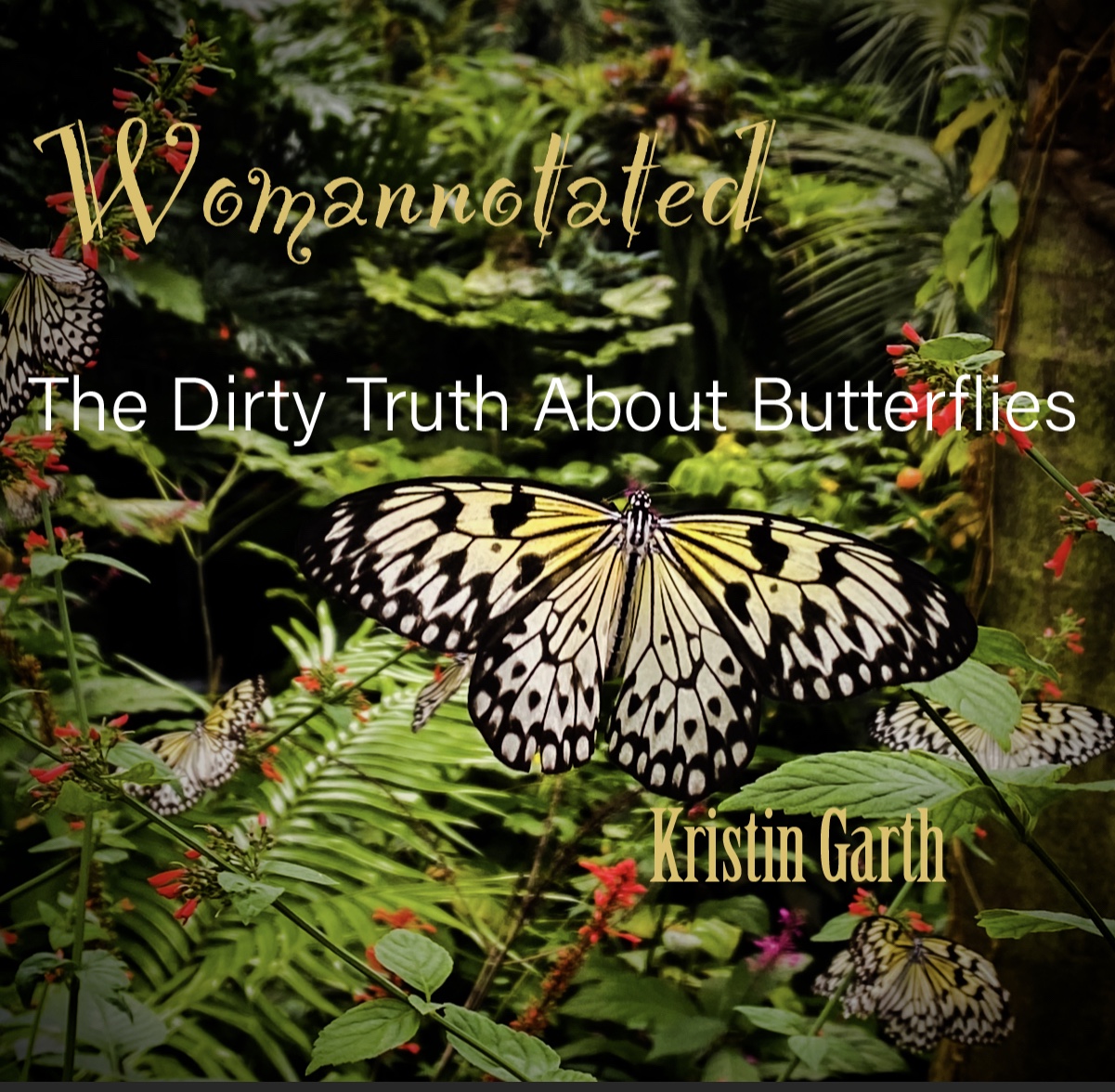
Womannotated – The Dirty Truth About Butterflies

November 29th, 2020

The Dirty Truth About Butterflies

It’s easy for a religiously bred

(misled) girl to make an Eden of

a garden, angels of winged soon dead,

repopulating in three weeks. But love’s

amino acids butterflies won’t find

in agapanthus nectar, waterfalls —

Continue reading “Womannotated – The Dirty Truth About Butterflies”

Womannotated – Underneath


The following is a brand new poem written for The Meadow, my bdsm themed poetry collection about my time in the world of bdsm as a young woman.  I wrote this piece as well as the Reader’s Guide I published below to enhance your pleasure and understanding of the text.  Order your own Meadow at apeppublications.com.

Underneath 

Before you call yourself a womanchild,

you fly to New York City, college girl 

costumed to be defiled, pigtailed, beguiled 

before a bedtime story, too.  A whirl-

wind trip in which he will present to you 

Red, topsy-turvy, Riding Hood one night, Continue reading “Womannotated – Underneath”

Big Moves/Changes/ Feelings by Lauren Weik

When I first decided to move from Austin, TX to Los Angeles, I was leaving behind my friends, family, two jobs, and cat all in Texas to go finish school in a big, new city. I was freshly single after a relationship of two years, and I felt isolated, alone, but empowered to say the least.

The week before I moved from Austin, I said several goodbyes. To the job I worked for 3 years, to my students who I worked with in an after-school program. I moved everything out of my apartment and picked myself up after long sad nights.

During this transition period, talking about all the swift changes and new rules of the adult world proved difficult. I was only beginning to learn how to navigate my own mental health, and I went through my days carrying the weight of the breakup pain plus the grief of moving while others appeared to function and lead happy, perfect lives. I watched my 4 year old cousin turn 5, and we painted his hair pink. I went to Chicago by myself to visit an old friend. I packed up my belongings and dealt with the process of moving like a grown woman. Continue reading “Big Moves/Changes/ Feelings by Lauren Weik”

Redoubt by John Trefry

Your consciousness is homeless and itinerant for quite some time in a significant physical journey. And you must build it its home, or its redoubt. That redoubt is specific to the journey. And like a tortoise’s shell the redoubt accompanies you on the journey even as it grows. Its construction is excruciatingly frustrating and failure-ridden. Accept this. Construction of the redoubt is the journey.

01.jpg
Skjerdal, Norway, 9:00 PM, June 9, 2015

Arrival takes place much later cognitively.
Accept this.
Continue reading “Redoubt by John Trefry”

The Watersteps by BR Williams

The Watersteps are ruins now, but you can still see what is left of them by walking through the dank forest on the edge of town, over the train lines and then down to the crease where two wave-like hills meet. The steps sit half-swallowed inside a wide clay gorge. A little further up the gorge, there’s a stream at least half as wide as the gorge itself. It drops down an accidental waterfall caused by the collapse of the Watersteps. A sheet of tarpaulin wafts, hit by the unravelling crystal carpet of water. For the most part, the stream disappears amongst the rubble and soft ground at the foot of the waterfall. Only further down does a meagre version of it reform, bypassing the steps entirely.

The Watersteps have haunted my imagination for a long time. The first poem I ever wrote was about the steps. I hated it, re-wrote it, destroyed it and started again. I have been repeating each step ever since.
Continue reading “The Watersteps by BR Williams”

Exile, intensive care by Christina Tudor-Sideri

I am not from here. I am from somewhere in between push and pull. I am a thrust not yet experienced by what people usually call ‘home’. I am exiled. I am exile. I reside not in my consciousness, but in the lingering smell of last night’s cigarettes and rain drops. In the burning of pages. In the hunger for belonging, which I feed with matches, flames, and the ashes of what were once my journals, my essays on the flesh of the world, my notebooks, my manuscripts, my resolutions, my shopping lists, my thoughts on the nightstand. Exile. Soft, felt in my hands. Felt in yours. Grasping its shape, fingering its texture, sensing its temperature. Exile, mingled with memorabilia and all the angers of the world. I live with it as one lives with a strong sense of physical presence, something to cling to until I get better. Something to keep me going. Being a gesture, becoming an extension of its flesh. That’s what exile is to me. A grave. Luscious. Infinite. Sarcophagus of blessed souls. I am pulling you into the depths of it. Exile, exceptional euphemism. Continue reading “Exile, intensive care by Christina Tudor-Sideri”

Spanish Moss by Eric Edwards

Despite the distance we crash into each other repeatedly.

We spend a lot of our time typing messages. Talking over poor quality internet calls, across time zones that leave me exhausted, both of us wanting. A yearning that brings us closer but at a cost. Long nights of feeling alone while being together.

We hit and smash and spin out of control; never enough days and nights to find the balance that is there, tantalizingly out of reach, never out of sight. The wheels run straight for a while, but veer. We make it to the swamp. Though not the cemetery or the convent. Not this time. What we want is to run away into the woods. Continue reading “Spanish Moss by Eric Edwards”
L.A. Lust by Yanina Spizzirri

This city, this big sprawling dream of a city, mighty and misunderstood Los Angeles, is often defined in terms of tired cliches and sweeping generalizations. Soul-less and a-historical L.A., they say. A city where nobody walks, they lie. A far-reaching enigma going on for miles and miles, they all nod and agree, baffled. Continue reading “L.A. Lust by Yanina Spizzirri”

On Becoming A Storyteller: A Berlin Memoir by Jessica Ciccarelli

There’s a five-mile block in the northernmost part of Prenzlauer Berg that I haunted during my last weeks in Berlin. Within this five-mile block, I allowed myself to fade in and out of memories – I let past and present mingle surreptitiously. I chose it in the exact breath it chose me. Even knowing what writing my memoirs would mean, I had no idea the gravity, but each time I got too lost or too overwhelmed, one man was there to encourage me forward. Continue reading “On Becoming A Storyteller: A Berlin Memoir by Jessica Ciccarelli”

Meeting Robert Graves by Larry Buttrose

In 1976, Larry Buttrose, an Australian playwright and poet, journeyed to Deya, on the Spanish island of Majorca, to seek out the then 81-year-old British poet, author and classicist, Robert Graves, renowned for his historical novels, notably I, Claudius and Claudius The God, a memoir, Goodbye To All That, and a ‘speculative study of poetic inspiration’, The White Goddess.

I stepped out onto the steep cobbled street outside the Villa Verde. I had arrived at the hostel’s door in the wilting afternoon heat of the day before, after having taken the overnight ferry from Barcelona, and the bus up from Palma, along with the locals in breeches and headscarves carrying bound, clucking chickens on their laps. Continue reading “Meeting Robert Graves by Larry Buttrose”

Nothing Dries Sooner Than A Tear* by Joanna Pickering

Marrakesh, Old Town

Everyone seemed to have rotten, black, and missing front teeth. They were friendly and kept smiling and that’s how I saw they mostly had rotten, black and missing front teeth.

I couldn’t see a lot of the women’s teeth, only their eyes, and often not even. There were many women dressed from head to ankle, in long black fabrics, with layer upon layer covering skin, hands, hair, and some that covered the eyes, and with only a marginally thinner veil, so that everything was hidden, nothing to determine soul, being, nor Continue reading “Nothing Dries Sooner Than A Tear* by Joanna Pickering”

Ash and Stardust i: Here We Are

This is the first instalment of Ash and Stardust, a monthly column exploring how my tarot practice intersects with self-care, healing, and creativity. Note: I don’t claim to be a tarot expert! This is me learning as I go, overcoming creative blocks along the way.

“Everyone deserves an outlet; a reservoir of safety – a comforting warmth in the ribcage – the space surrounding the heart.”
– from the guidebook of The Next World Tarot by Cristy C. Road

I can’t say exactly when I was introduced to tarot. It would appear or get mentioned in passing here and there during my teenage years. I remember once-upon-a-time friends spreading cards on bedroom floors to articulate desires and what-ifs. They’d ask if I wanted a reading done and I had always said no. It didn’t feel right. I don’t mean that I had trouble with the idea of cartomancy – the mystical world fascinated me. I was, however, having trouble seeing myself as someone who could hold these archetypes in my hands, to shuffle and create a narrative out of them that can serve not as divination, but as guidance – or even to satisfy curiosity.

In those earlier years, I was nowhere near okay enough to claim my own story, let alone see it as part of something bigger.

Continue reading “Ash and Stardust i: Here We Are”

Blog at WordPress.com.

Up ↑