Search

BURNING HOUSE PRESS

Not For Profit/For Prophecy

Tag

Writers

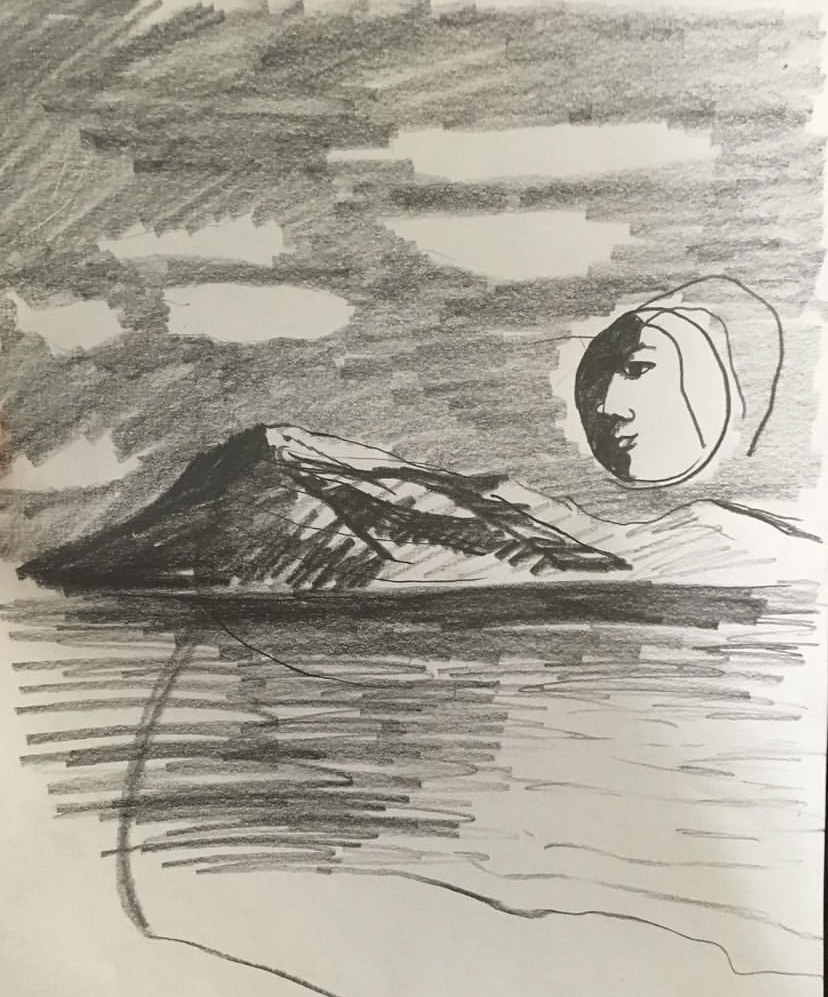
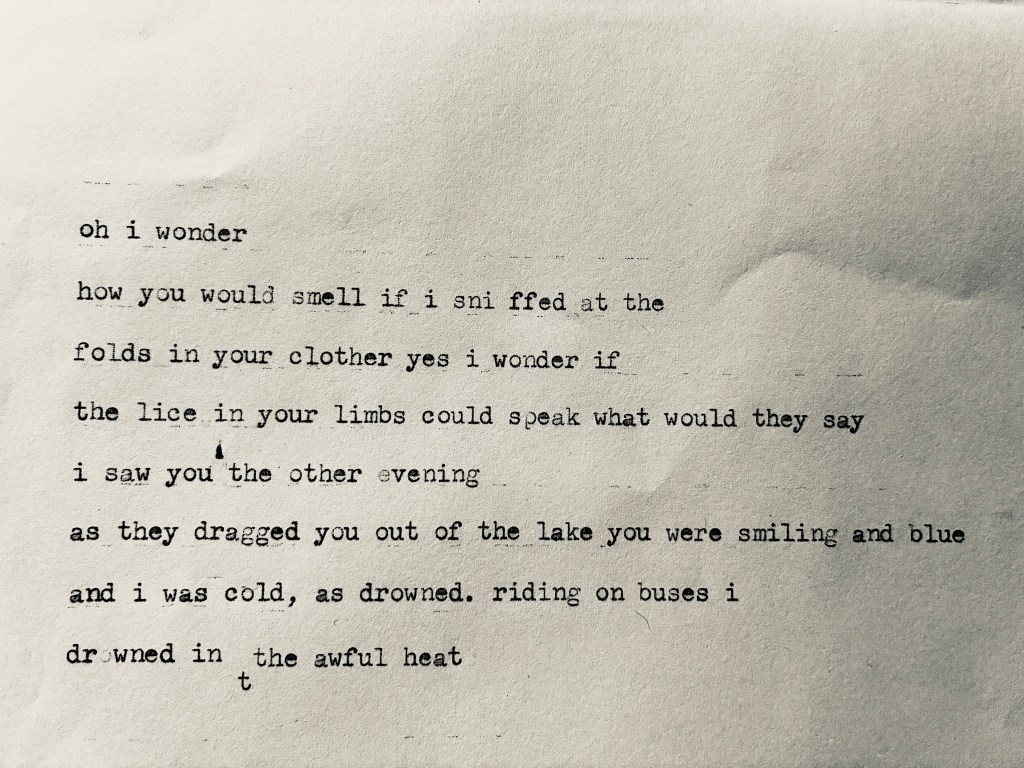
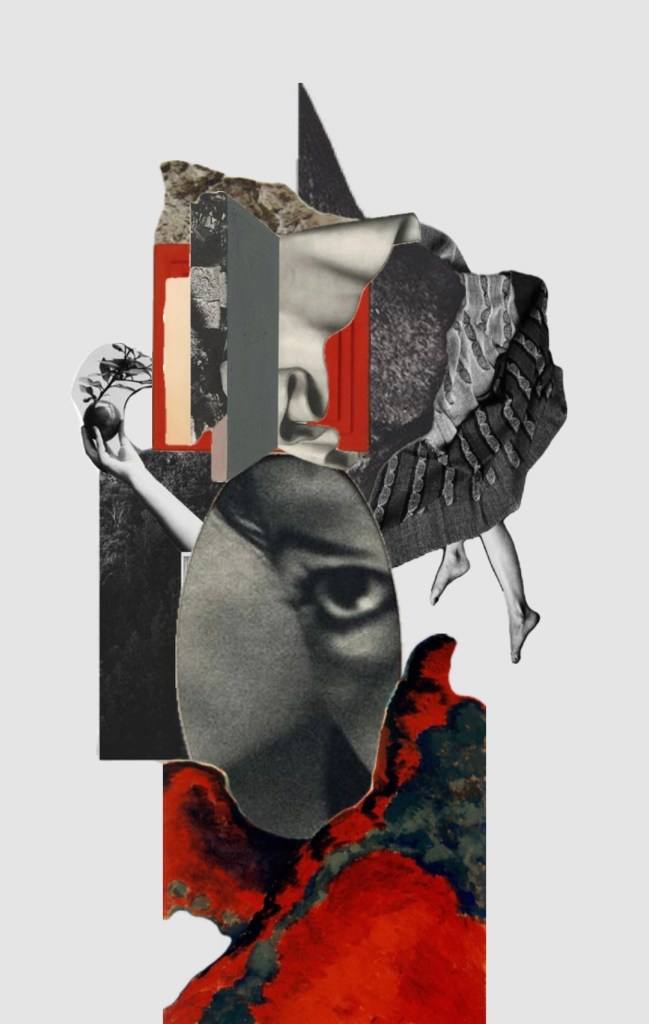
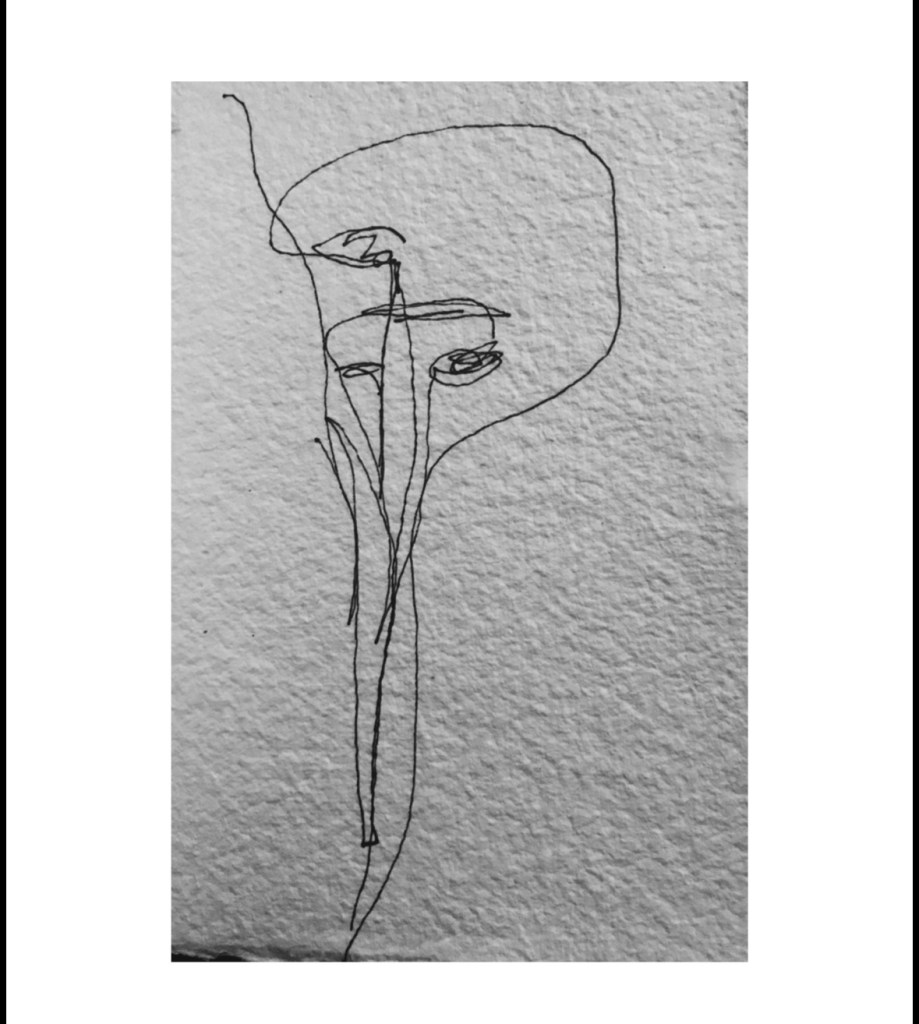
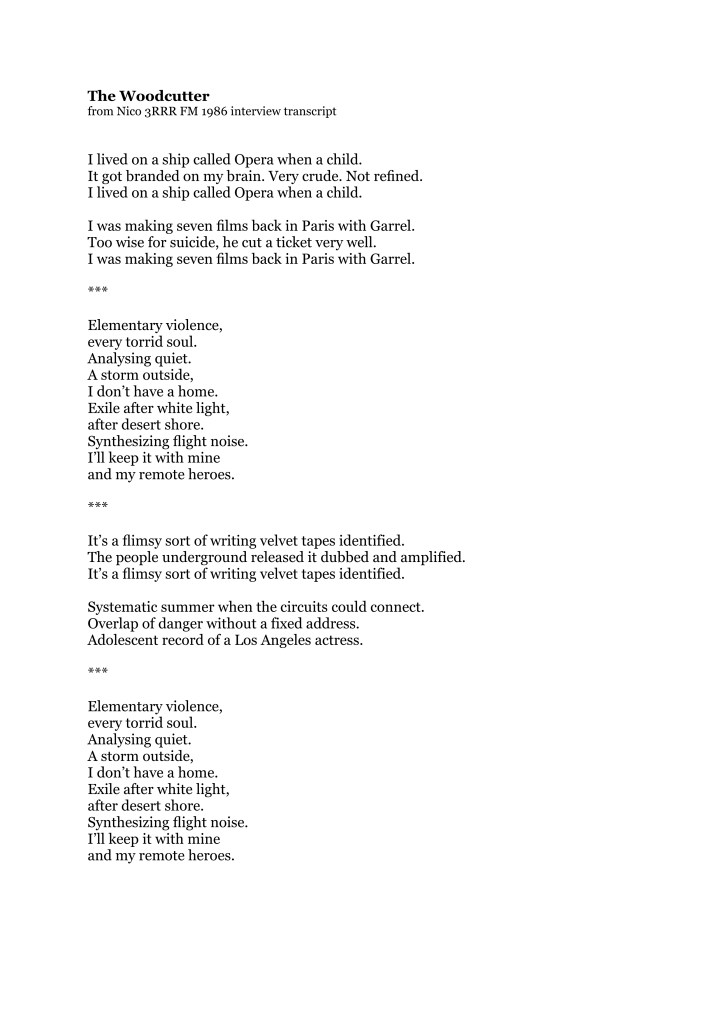
The Woodcutter by Vik Shirley

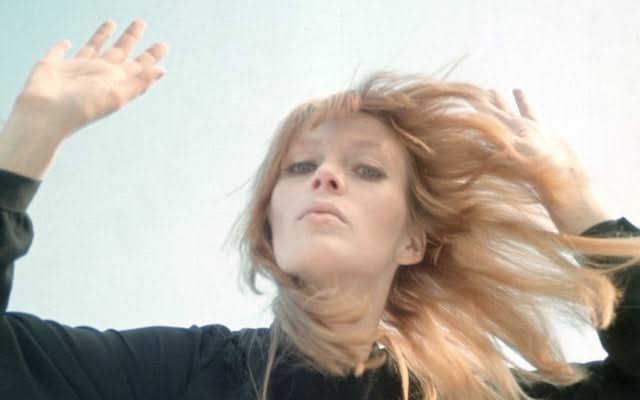
Nico (1967) by Michael Ochs.


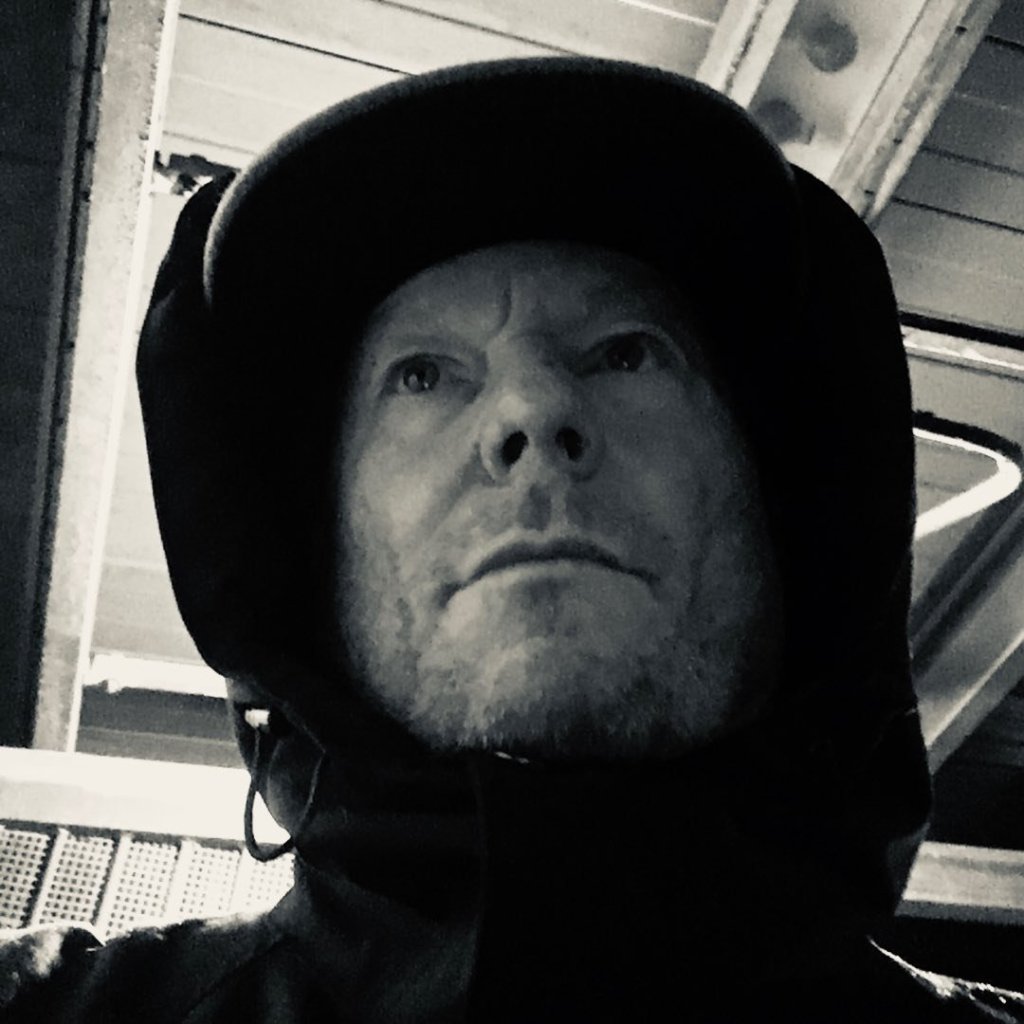
Vik Shirley is a poet and writer from Bristol living in Edinburgh . Her collections and chapbooks include: Persona Digitalia (PhotoWorks, 2025), a photo poetry pamphlet which was selected for the inaugural P5 photo poetry series, Some Deer (Broken Sleep, 2024), Strangers Wave (zimZalla, 2023) and Corpses (Sublunary Editions, 2020). Her work has appeared in Poetry LondonPN ReviewThe RialtoMagmaPerverseand 3am. She has a PhD in Dark Humour and the Surreal in Poetry from University of Birmingham. 

Boy or Girl by James Nulick

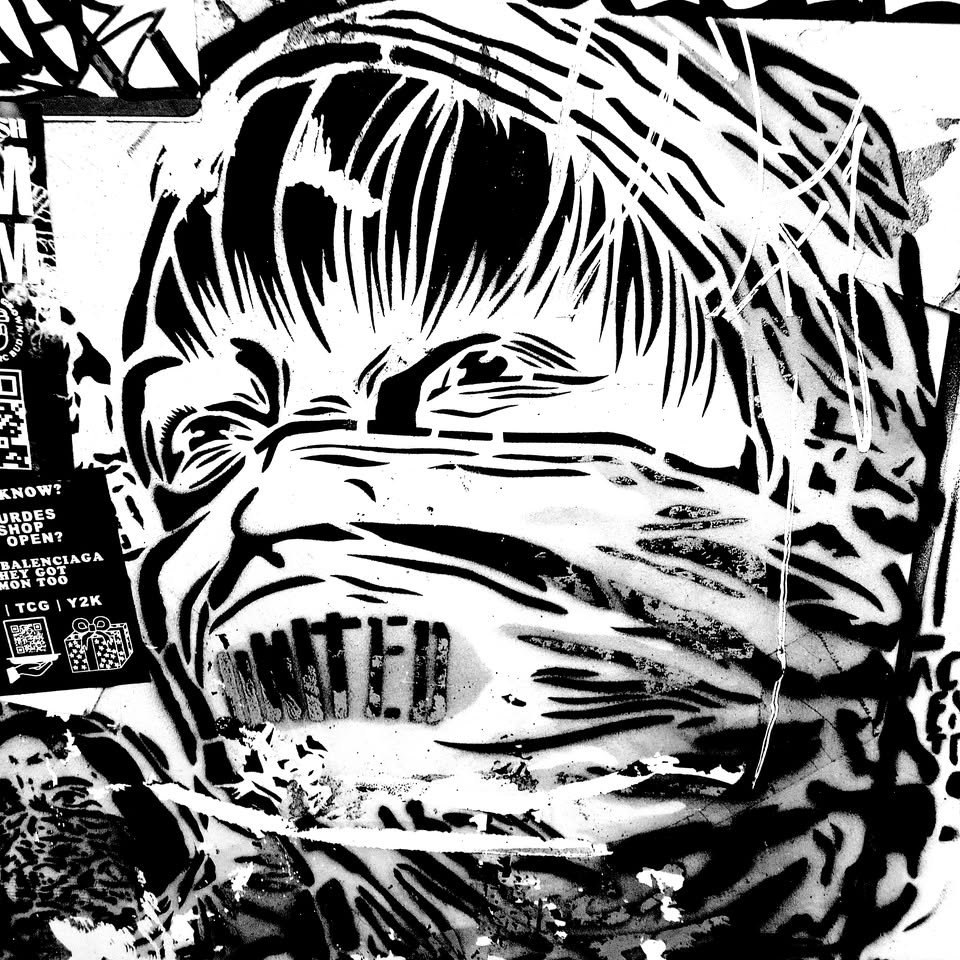
Nico in his The Velvet Underground & Nico shirt.

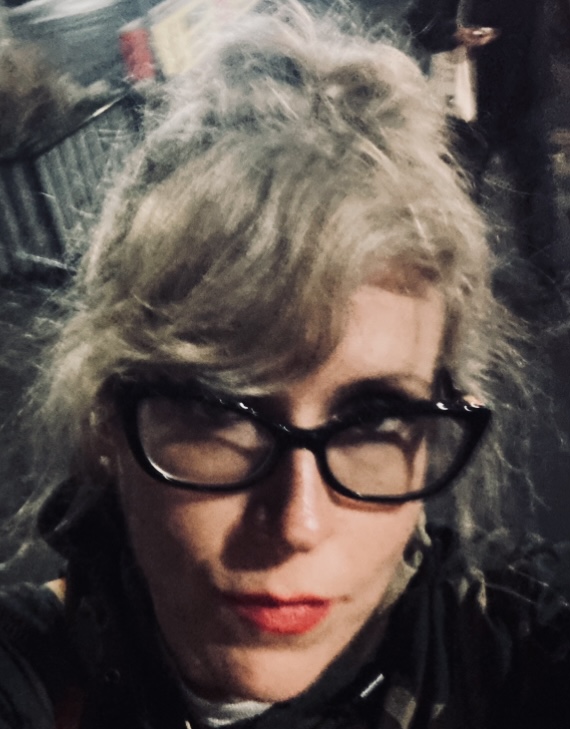
My name is Nico. It has always been Nico. It felt like a good name when I tried it on. My mother named me after a singer most people my age don’t even know. On most days it sounds like a boy’s name, though on some days, usually a Sunday morning, it sounds like a girl’s name, but I’m definitely not a girl. My name sounding like a girl’s name doesn’t bother me anymore. It used to, like when I was a kid, hey faggot, how come you got a girl’s name, but not anymore. There aren’t very many Nicos, maybe a barber once in one of those ghetto barbershops where everyone is tripping over themselves to look cool, a skin fade kid with a Wahl in one hand and a girl’s digits in the other, grey sweatpants and black Vans and a drooping eyelid that’s somehow endearing, I’m stealing glances of him while in the chair waiting for the next call, hoping he’s the one, the double quicksilver echoing my reflection in a thousand shop windows, I’ll be your mirror, and when you have an unusual name like mine you always pay attention to others you share it with, like when you notice all the cars just like your car, my mother’s favorite song, Sunday morning, a song father approved of, when my days were laid out for me, my life simple because everything was preplanned, I didn’t have to think of what to wear, what to say, deciding if I was a boy or a girl, the fate of the nation trapped in the web of my lattice fingers. I pull on my threadbare brown corduroy pants and a green cardigan mother found at Goodwill for 12.99, so today I will be a boy. 


James Nulick is the author of several highly acclaimed novels including Plastic SoulThe Moon Down to Earth, and Valencia. He is working on a new novel. 

DECEMBER 2025 Guest Editor Is MATTHEW KINLIN!!! Theme: My Heart Is Empty: Responses to The Life and Work of Nico

Burning House Press are excited to welcome Matthew Kinlin as the fifth BHP guest editor of our return series of special editions! As of today Matt will take over editorship of Burning House Press online for the month of December.

Submissions are open from today 1st December – and will remain open until 21st DECEMBER.

Matt’s theme for the month is as follows

My Heart Is Empty: Responses to The Life and Work of Nico

Matthew Kinlin lives and writes in Glasgow. His published workst include Teenage Hallucination (Orbis Tertius Press, 2021); Curse Red, Curse Blue, Curse Green (Sweat Drenched Press, 2021); The Glass Abattoir (D.F.L. Lit, 2023); Songs of Xanthina (Broken Sleep Books, 2023); Psycho Viridian (Broken Sleep Books, 2024) and So Tender a Killer (Filthy Loot, 2025). Instagram: @obscene_mirror.

——

Submission Guidelines

All submissions should be sent as attachments to guesteditorbhp@gmail.com

Please state the theme and form of your submission in the subject of the email. For example: NICO/POETRY

Poetry and Fiction

For poetry submissions, submit no more than three of your best poems. Short stories should be limited to 1,500 words or (preferably) less. We encourage flash fiction submissions, no more than three at a time. Send these in as a .doc or .docx file, along with a short third-person bio, and (optional) photograph of yourself.
Art
Submit hi-res images of your works (drawings, paintings, illustrations, collages, photography, etc) with descriptions of the work (Title, Year, Medium, etc) in the body of the email. Files should be in .JPEG unless they are GIFs or videos, and should not exceed 2MB in size for each work. File names should correspond with the work titles. Video submissions can be uploaded onto Youtube or Vimeo for feature on our website. Send these submissions along with a short third-person bio, and (optional) photograph of yourself.

Virtual Reality/ 3D Artworks

For VR Submissions, please submit no more than three (3) individual artworks. For Tilt Brush works, please upload your artwork to Google Poly (https://poly.google.com/), and mark it as ‘public’ (‘remixable’ is at your own preference). A VR/3D artwork can also be submitted as a video export navigating through the artwork. If you prefer this method, please upload your finished video file to YouTube or Vimeo and provide a URL. With either format, please provide a 150 word artist’s statement.

Non-fiction
Non-fiction submissions (essays, reviews, commentary, interviews, etc) should be no more than 1, 500 words and sent as a .doc or .docx file along with your third-person bio/and optional photograph.

Submissions are open until 21st December – and will reopen again on 1st January 2026/for new theme/new editor/s.

BHP online is now in the capable hands of the amazing Matthew Kinlin – friends, arsonistas, send our December 2025 guest editor your magic!

Walking In Circles by Paul Tritschler

Photo by Paul Tritschler

Midway through the event, a woman seated in the front row of the audience asked the panel of four authors, all of whom had made an appearance for the purpose of promoting their recently published travelogues, if they could explain in simple terms how their notion of travel differed from what most ordinary folk called holidays. Nothing is more difficult than to be simple, but the elitist charge implicit in her question, one that was somehow rendered more pointed by her affected pleasantness, laid another layer of complexity. The moment demanded deflection by way of a pithy response — l’espirit de l’escalier might have suggested a poignant quote from Ibn Battuta or something whimsical from Rabelais. Instead the panel, with a tad too much haste, dug themselves into a defensive trench, and in the process shovelled dirt on what they ill-advisedly and repeatedly referred to as common tourism. And they wouldn’t stop digging.

Conversations erupted throughout the room but eventually settled into silence, and no indication was given that the audience would assist her in pushing the panel off its platform, if indeed that was her intention. That being said, it most likely nudged it a little; peering through the newly created cracks in the edifice, the panel’s itinerant forays and desultory wanderings would have appeared to some people as lofty peregrinations wrapped in pompous superiority…or thoughts to that effect. Their somewhat clumsy efforts to enumerate the differences between what they get up to and what everyone else does would not have helped in that determination. On the other hand, some would have interpreted her question as self-aggrandising, one motivated by conceit, point-scoring and the desire for audience adulation. Either way, the nourishing conversations that were until that moment shared between the panel of authors and what felt like a roomful of friends, now a breathing mass of strangers, failed to revive.

Possessing an air of originality, mystery and spirited adventure, the mention of travel arouses more curiosity than that of the humble holiday, and there can be little doubt that by describing oneself as a travel writer rather than a holiday writer one gathers greater cachet. Yet it often seems that, at core, there is no difference between them. Indeed, the travel writers sharing the podium might easily have described their journeys as holidays. After all, three were promoting books about relatively short stays in what many would deem holiday destinations, including a fortnight in Paris, three weeks in a wine-growing region of France, and a month in Tuscany. Only one took a longer and more varied route, that resulting from an unplanned year of backpacking.

Putting it this way perhaps challenges their street cred, yet many philosophers, among them Seneca and Thoreau, were greatly inspired by the odd holiday, during which they created notable works of reflection on nature, on the human condition, and on life’s meaning or purpose. The same is true of literature. Agatha Christie developed the idea for a well-known detective mystery whilst on a leisure cruise down the Nile. Virginia Woolf wrote To the Lighthouse whilst on vacation on the Isle of Skye, and Elizabeth von Arnim’s The Enchanted April was inspired by a month-long holiday to the Italian Riviera. The list goes on. In the end what matters most are the stories, and to this one might add a degree of self-discovery.

. . .

Old Cathy used to come into our house to wash her money. Though she scrubbed the stairs of every last one of them, and had done so for years, ours was the only flat in a long street of tall black-sooted tenements where she could come and go as she pleased. She even had a key. Some people would rinse out and refill her bucket, but she would have to remain at the doorstep, door closed. To be fair, Old Cathy wasn’t one for conversation, and in fact blanked most people, but that wasn’t the only reason people covered their doors. For much of her life she lived between the mental asylum, as it was then known, and the street, and when that information got around the neighbourhood by the usual whispering campaign people kept a watchful eye. During the time our family knew Old Cathy she had secured permanent residency in a Salvation Army hostel not far from where we lived: a small room with an iron-framed bed, a chair, a cabinet, and a cross on an otherwise bare white wall. Visitors were not allowed, but we visited anyway, my sister and me, and whilst some residents occasionally looked at us with suspicion, neither the warden nor anyone else ever refused entry.

My sister always firmly insisted that if anyone were to question us I should stay silent and let her do the talking. When neighbours or anyone else asked questions she generally cut in to finish my sentences in ways I could never anticipate. Three years my senior but in reality much older, I guess my sister would have been around eleven or twelve when we visited Old Cathy. She doted on us, and was always steady and sunny, but I doubt if many people saw that side. She just kept her head down as she scrubbed the stairs, her metal bucket echoing in the close as it clanked down each step, then reached back up to draw intricate floral patterns with white chalk on the margins of every step. This was a common custom in our neighbourhood, an area that outsiders called slums, but unlike Old Cathy most women just chalked a quick zig-zag or squiggle. Either way they only lasted a day at best.

A woman notorious for malicious gossip once stopped us to ask if our dad knew that our mother allowed a pauper lunatic to wander in and out of our house when he was at work (he worked almost all the time). We of course knew who she meant, but as instructed I buttoned up. I would have liked to have said that we loved Old Cathy, who was one of the kindest people on Earth, and that not only did she visit us, we visited her; but as my sister later reminded me she would most likely have called the police and had her thrown out of her residence and into the street. Adults were a different breed, and I dreaded the thought of mingling with them. Even at the early stages of adulthood most people showed signs of becoming distinctly unpleasant. I think Old Cathy felt the same way.

This was a time when mothers who took to their bed for days or weeks or maybe even months were generally considered to be indolent rather than depressed, a time when postpartum depression was for the most part unknown, and a time when having a stillbirth — regardless of the sadness, guilt and anxiety that were at heart a cry for help — was hushed up as a shameful failure. Mrs Bogus, a pathologically nosey upstairs neighbour of ours — listening at the letterbox, she fell into our hall one time when my dad opened the door on his way to work — stopped me and my sister on the stair to ask if my mother was still lying in her bed. She called her a lazy article, jolting her miserable mongrel on a choke chain before briskly walking on. No one ever explained to me the meaning of article, but I got the gist. Just ignore her, my sister said, and don’t repeat what she said to anyone. I didn’t have to: everyone seemed to know that my mum had sunk under the covers and let the house go to hell. It even got around the school.

For the best part my sister looked after things at home, organising clothes, tidying up, making meals, but after a while things began to slip there too, and the mess just piled up. We made a space on the sofa between heaps of clothes and coat hangers and ate cereal from the box. On one occasion we heard our mum mumble to herself that she wanted to cut her throat, and I was told never to repeat that either, not to anyone, not even to dad — especially dad! She didn’t mean it, my sister insisted, but I couldn’t quite dismiss the possibility. For all their promises to the contrary, adults were notoriously unpredictable. My friend’s sister killed herself over a stupid fiancé, the mother of a boy at my school was murdered by his dad — just one punch, they said, whilst she was doing the ironing — someone sunk an axe into someone’s front door, another put a petrol bomb through a letterbox, men filled with rage and hearts of hate fought to the death outside pubs, and psychopathic razor gangs roamed the streets and alleyways. No adult could be trusted entirely.

We came home from school one day to find all the mirrors in the house had been smashed — why mirrors? — and immediately I wondered if my mum had taken a shard of glass to her throat. I envisaged it. My sister made me wait in the hall until she checked out the bedroom. Mum was sobbing under the blankets, but otherwise okay. Old Cathy was there, calm and calming, picking up the pieces. She would have known worse, and most likely understood the situation better than anyone. For several weeks no stairs were washed as Old Cathy stepped in as our femme de ménage, arriving before we went to school, and leaving in the evening. Between those hours she did the shopping, made breakfast and prepared dinner, looked after my mum, washed clothes, tidied the house, and even found time to play board games with us — she was a master at draughts. In time, when my mother got back into harness, Old Cathy got back down on her kneeling mat to scrub and chalk the tenement stair, the distinctive sound of her metal bucket once more echoing in the close as it clanked on each step. Thereafter she would rinse out her bucket, brushes and money in our small scullery whilst the kettle boiled before settling down to sit with my mum, gazing into the embers in silence.

. . .

For some people, travel writers are escape artists sharing their secrets on how to break loose from sameness. Others live to wander, to find stillness in motion, and perhaps by chance to find missing parts of the story that made them who they are. It was whilst perched on a doorstep under a hot sun in Tamil Nadu that Old Cathy, for the first time since childhood, wandered into my thoughts. I was watching a woman take great care to create a kolam at the entrance to her home, a decorative chalk circle with floral designs that is said to bring good luck and prosperity to the occupants. The drawings are walked on, scuffed and washed out every day, and whilst illustrations and meanings vary, each in their own way presage the transience of our existence and the impermanence of all things. The process was hypnotic. With eyes squeezed shut I remembered Old Cathy with head bowed drawing similar floral patterns with her piece of chalk on the steps to our door, and for a moment that door opened. The long journey to India had led me back to the start, and perhaps, after all, that was the point.
. . .

In addition to teaching psychology in universities, adult education and colleges across the UK, Paul Tritschler has managed organisations within the fields of brain injury, sensory impairment, mental health and community activism. He has written for a variety of magazines, including Aeon, Psychology Review, Bella Caledonia, Counterpunch and Open Democracy.

3 poems from Book Of Mirages (Libro de los Espejismos) by Gaspar Orozco, translated from the Spanish by Ilana Luna

Photo by C.C. O’Hanlon

¿Y el fuego que no se ve? ¿Cómo registrarlo? ¿Y la llama que invisible cerca al cuerpo? ¿Y la hoguera incolora que arde en el cerebro? ¿Cómo dibujarlas, cómo explicarlas? El incendio ciego encerrado en cada gota de sangre, ¿con qué tinta, con qué pigmento se traslada al papel? ¿Cómo hacer visible el alcohol que quema su anillo fantasma en la retina? ¿Y el fuego innombrable que calcina la lengua? ¿Y el alambre ardiente y afilado de la circunferencia que te atraviesa el alma? ¿Cómo decirlos, cómo llamarlos?

And what of the unseen fire? How to record it? And the invisible flame about the body? And the colorless bonfire roaring in your brain? How to draw them, explain them? The blind blaze enclosed in each drop of blood, with which ink, with which pigment can it be put to paper? How to make visible the alcohol that burns its phantom ring on the retina? And the unnameable fire that scorches the tongue? The blistering, razor wire that encircles the soul? How to name them, how to call them?

. . .

El nombre es una espiral, un erizo que da la vuelta a la sombra. Adivinas luz al torcer el muro. Casi la tocas, pero no la alcanzas a ver. Arena blanca. Sigues. Recorres un segmento del círculo con una jaula de pájaros vacía en tus manos: la puertita choca su metal al abrirse y cerrarse a tu paso. El mar deja en libertad uno de sus vientos para que se pierda en el laberinto. Lo encontrarás llevando el rumor de campanas distantes y de piedras tristes y metales que brillan lejos. El palacio del caracol es su esqueleto. El palacio del estratega es su memoria. Hay un mar vivo en el centro. Al humedecerse, el cráneo del remolino canta su canción. Es lo que llega a tu oído.

The name is a spiral, a sea urchin turning round the shadow. You glimpse light when curving along the wall. You can almost touch it, but you can’t quite see it. White sand. You continue. You pace the segment of the circle with an empty birdcage in your hands: the tiny door clanks its metal open and shut with your footfalls. The sea sets free one of its winds to lose it inside the labyrinth. You’ll find it carrying the rumor of distant chimes and sad stones and metals that shine from afar. The seashell palace is its skeleton. The strategist’s palace is his memory. There’s a living sea at its center. When wet, the whirlpool’s skull sings its song. That’s what you hear.

. . .

A lo largo de la Odisea, hay una frase que deja un leve rastro en la historia de los días y las noches de Odiseo entre las islas: la luz del regreso. Telémaco la pronuncia por primera vez cuando le confiesa a la diosa Atenas, la ojizarca, el temor a que su padre hubiera perdido ese fulgor. Odiseo la emplea cuando trata de explicar a Calipso su deseo de volver a Ítaca. Hay esperanza en esta imagen, pero se trata de una esperanza humedecida de tristeza. La tristeza de la imposibilidad del retorno, la de la callada certidumbre de que la Ítaca de la cual partimos no la encontraremos ya. La Odisea, como todos sabemos, es la apuesta para recuperar la luz del origen, la primera que vieron nuestros ojos y por la que vale la pena morir para verla brillar una vez más. Todos tenemos una Ítaca que reverbera en el filo de nuestro horizonte. Así, el poema entero –es decir, la vida- se concentra en esa imagen, como la luz de la isla en el vaso que dibuja su reflejo en el muro.

Throughout the Odyssey, there’s a phrase that leaves the faintest of traces on the history of the days and nights of Odysseus among the islands: the light of the return. Telemachus first pronounces it when confessing to the goddess Athena, the bright-eyed one, his fear that his father may have lost that glow. Odysseus uses it when trying to explain to Calypso his desire to return to Ithaca. There’s hopefulness in that image, but it’s hope dampened by sadness. The sadness of the impossibility of return, that of the quiet certainty that the Ithaca we left won’t ever be found again. The Odyssey, as we know, is the attempt to recover the original light, the first our eyes ever saw and for which it would be worth dying to see shining once more. We all have an Ithaca reverberating on the edge of our horizon. Thus, the entire poem—that is to say, life—is concentrated in that image, like the light of the island in a glass that etches its reflection on the wall.

. . .

Born in Chihuahua, Mexico, Gaspar Orozco has published 8 books of poetry, three of them translated in English by Mark Weiss. He has translated poetry from English, French and classic Chinese to Spanish. He was a member of an obscure punk band, Revolucion X; the Spanish label Metadona Records will release an album of their lost recordings in December 2025. He currently works as a diplomat. 

NOVEMBER 2025 Guest Editor Is C.C. O’HANLON!!! THEME/S: JOURNEYS

Burning House Press are excited to welcome C.C. O’HANLON as the fifth BHP guest editor of our return series of special editions! As of today C.C. will take over editorship of Burning House Press online for the month of November.

Submissions are open from today 1st November – and will remain open until 25TH November.

C.C.’s theme for the month is as follows

—JOURNEYS

~~~

JOURNEYS: Physical, Psychological, and Imaginary, embracing words and images, in all forms, as well as complexity, resisting the superficial, algorithmic narratives of social media.

~~~

Photo by Given Rozell.

~~~

A self-described ‘vagabond, diarist, and wreck’, C.C. O’Hanlon’s fragmentary memoirs have been published in various anthologies, including Best Australian Essays 2005 and Best Australian Stories 2004 (both published by Black Inc, Australia), A Revealed Life: Australian Writers And Their Journeys In Memoir (ABC Books, Australia), The Odysseum: Strange Journeys That Obliterated Convention (John Murray, U.K.), Zahir: Desire & Eclipse (Zeno Press, U.K.), and Dark Ocean (Dark Mountain Project, U.K.). A founding features editor of Harper’ Bazaar Australia in the late ’80s, his mainstream journalism and images have appeared in The New York TimesThe Sydney Morning HeraldVarietyTravel & Leisure, the Australian editions of Vogue and Harper’s Bazaar and scores of other newspapers and magazines.

He now lives a nomadic life with his American wife of 38 years aboard a small, sea-worn old sailboat named Wrack in the southern Mediterranean. They have three adult children.

_______

Submission Guidelines

All submissions should be sent as attachments to guesteditorbhp@gmail.com

Please state the theme and form of your submission in the subject of the email. For example: JOURNEYS/POETRY

Poetry and Fiction

For poetry submissions, submit no more than three of your best poems. Short stories should be limited to 1,500 words or (preferably) less. We encourage flash fiction submissions, no more than three at a time. Send these in as a .doc or .docx file, along with a short third-person bio, and (optional) photograph of yourself.

Art
Submit hi-res images of your works (drawings, paintings, illustrations, collages, photography, etc) with descriptions of the work (Title, Year, Medium, etc) in the body of the email. Files should be in .JPEG unless they are GIFs or videos, and should not exceed 2MB in size for each work. File names should correspond with the work titles. Video submissions can be uploaded onto Youtube or Vimeo for feature on our website. Send these submissions along with a short third-person bio, and (optional) photograph of yourself.

Virtual Reality/ 3D Artworks

For VR Submissions, please submit no more than three (3) individual artworks. For Tilt Brush works, please upload your artwork to Google Poly (https://poly.google.com/), and mark it as ‘public’ (‘remixable’ is at your own preference). A VR/3D artwork can also be submitted as a video export navigating through the artwork. If you prefer this method, please upload your finished video file to YouTube or Vimeo and provide a URL. With either format, please provide a 150 word artist’s statement.

Non-fiction
Non-fiction submissions (essays, reviews, commentary, interviews, etc) should be no more than 1, 500 words and sent as a .doc or .docx file along with your third-person bio/and optional photograph.

Submissions are open until 25th November – and will reopen again on 1st DECEMBER 2025/for new theme/new editor/s.

BHP online is now in the capable hands of the amazing C.C. – friends, arsonistas, send our NOVEMBER 2025 guest editor your magic!

Ambiguous Dirt by Austin Miles


one much quieter
one much more talkative,

interpreting daylight as if it were a room

depleted sidewalk wants
2 tell u (me) some
thing

something só imp. It

had to wa
it

a pile of dirt remains ambiguous

laying on the stone like that

can it tell the future?

can the most mundane
can it (not) shine in my eye?

a rock gets lost but ppl forget

then nothing much done today

sometimes sleep
but sometimes not.
washed away

an interesting turn of phrase

someone walks into a bar
but someone
someone tries to convince me of something
but i’m conversing with a
desk lamp

the problem w the world today:

the problem w the world today


Austin Miles is from southeast Ohio. He is the author of
the chapbook Perfect Garbage Forever (Bottlecap Press)
and has poems published in Touch the Donkey, Reap Thrill,
Don’t Submit!, and elsewhere.

Two Poems by Dan Melling

A Tense to Describe a Duck That Isn’t There
After Asger Jorn’s The Disquieting Duckling

Duck would have been erupting.
Duck would have erupted.
Duck continuous erupt
in the would / have been. Future
duck the perfect erupts. The never duck
eruption.
present simple farmer
haybales fowl in the is and ises in the ed
of rural whitewash each breath
a flesh of brushstrokes.
a tense to describe the temporal
stretch of canvas. Dapples
of birch leavings to stack
in impasto. An erupt

to duck a basal ganglia.

*
A-Political Self-immolators

We fizzy & piffy lakeside straight shooter boys
shoot stray cats from the Baroque balcony boys
we’re landslide boys eat crab boys big bullet
bully boys hooligan melodies & tenebrous eyes boys
sparkle sparkle little pig we ride rapid boys wide
boys locked safe boys sink to the depths the Davy
Jones boys real boy’s boys’ boys locker room
boys’ talk boys neck foam boys nick phones boys rock
-a-bye baby boys the blue-eyed boys bish bash
bosh job’s a good’un boys we’re those landgrab boys
swamp stab boys drain the blood dig the liver
boys pile-driver boys we’re deep-sea diver boys
black-lung coal miner boys real DH Lawrence boys
big tough boys with big tough toys oioioi boys
make some fucking noise boys we’re poison boys
burn the fields salt the earth shatter seas stone skim
boys we’re the make room boys the me-first boys
the boys with a fire in our fists we’re pollution boys
we’re gruesome boys those lumpen laymen men
of the earth serf boys we’re wind & rain boys fight
through snow sludge through mud we breathe gas
boys bottle rocket shrapnel boys we’re front-line boys
Gulf War Syndrome born alone die alone eight
pawn boys dethroned boys deflowered & defaced
face the music boys on my mark we go over
trench foot shell shock whizz-bang boys no man’s
land landless boys no stake in society ASBO boys
we’re high fire boys burn like mustard boys
we burn water baptisms of gas explosions stop
drop & roll up a fatty we’re rock n troll star
boys steal your hearts & leave a scar life sentence no
possibility of parole we’re born to die boys beautiful
corpse cheap funeral Amazon coffin & BYOB
boys search & destroy boys given no quarter hung
drawn & quartered we’re those coup de grâce
coup d'état boys raze the dead seize the day gone
tomorrow boys we’re the lost boys the last boys
last of our name last of our nature we’re ouroboros
boys anonymous boys we see things say things
you wouldn’t dream boys you wouldn’t feed us
to your dog you wouldn’t touch us with his you’d
off with our heads you wouldn’t be seen dead.

Dan Melling is a writer from the UK.
He holds an MFA in Poetry from Virginia Tech and teaches creative writing
at Liverpool John Moores University, where he is also pursuing a PhD.
His work has appeared in The Rialto, X-R-A-Y, HAD and elsewhere.
He co-edits Damnation literary journal.

Simón Bolívar (1783–1830) by Peter J King

                                         How will I ever get out of this labyrinth?
After defeating
the bull-headed monster,
not once but
over and over again,
I hung my sword up
on the bullet-pitted wall,
and tried to find my way back home.

The thread was broken, though,
and now I wander in this fearful light
and search for darkness.


Peter J. King was active on the London poetry scene in the 1970s.  Since his return
to poetry in 2013 after a long absence he’s published four collections (the latest being
Contact Light, Alien Buddha Press, 2025), and appears widely in journals and anthologies. 
He also translates, mainly from modern Greek and German, writes short prose, and paints.
Bluesky @rock-rex.bsky.social

https://wisdomsbottompress.wordpress.com/peter-j-king/

Two poems by Liesl Ujvary

translated from the german by Ann Cotten & Anna-Isabella Dinwoodie

*
first true story (from “three true stories”)

the fence is a window and the window is a room and the room is a table and the table is a speck and the speck is a girl and the girl is a knife and the knife is a clock and the clock is a letter and the letter is a neighbor and the neighbor is a flowerbed and the flowerbed is a city and the city is a street and the street is a friend and the friend is a summer’s day and the summer’s day is a hill and the hill is a field and the field is a tower and the tower is a woman and the woman is a wave and the wave is glasses and the glasses are an evening and the evening is a tree and the tree is a mound and the mound is a key and the key is a coin and the coin is a sheet of ice and the sheet of ice is a hole and the hole is a bridge and the bridge is a pillar and the pillar is a look and the look is a colleague and the colleague is a stick and the stick is a mountain and the mountain is a journey and the journey is a cafe and the cafe is a camp and the camp is a wolfhound and the wolfhound is a grate and the grate is an abyss and the abyss is a toilet and the toilet is a school

*
great authorizations

you may be expected to
you may be able to
you may be required to
you may be allowed to

you may be expected to be expected to
you may be able to be expected to
you may be required to be expected to
you may be allowed to be expected to

you may be expected to be able to
you may be able to be able to
you may be required to be able to
you may be allowed to be able to

you may be expected to be required to
you may be able to be required to
you may be required to be required to
you may be allowed to be required to

you may be expected to be allowed to
you may be able to be allowed to
you may be required to be allowed to
you may be allowed to be allowed to

you may be expected to be expected to be expected to
you may be able to be able to be expected to
you may be required to be required to be expected to
you may be allowed to be allowed to be expected to

you may be expected to be expected to be able to
you may be able to be able to be able to
you may be required to be required to be able to
you may be allowed to be allowed to be able to

you may be expected to be expected to be required to
you may be able to be able to be required to
you may be required to be required to be required to
you may be allowed to be allowed to be required to

you may be expected to be expected to be allowed to
you may be able to be able to be allowed to
you may be required to be required to be allowed to
you may be allowed to be allowed to be allowed to


From Good & Safe, published by World Poetry Books, 2025.

Liesl Ujvary (1939) is an Austrian writer in the concrete tradition.
Her oeuvre includes experimental electronic music & video
Good & Safe (Sicher & Gut), her debut, was originally published in 1977 /
Ann Cotten is a writer & translator from Vienna, Austria.
Translations from English to German include books by Isabel Waidner,
Legacy Russell, Rosmarie Waldrop & others /
Anna-Isabella Dinwoodie is a translator & writer
who makes visual poetry & performance art. She lives in Berlin.

Fingerprint by Michael L Sevy

we had a dinette, the house was too small for a proper dining room, there was a painting on the wall, notable because artwork was minimal in the house, I was fascinated by this painting, it looked European to me in a vague way as at nine years of age I knew nothing of life outside the US, it was a river scene, a river surrounded by a forest, a mountainous forest, with a small house about a third of the way up on the mountain surrounded by evergreens, I think it would be called a chalet, there’s a European word, it pronounced funny, and on the river was a small boat with a man standing astern navigating with a long pole, the painting was always there on that dinette wall, I didn’t know its origins, how, where and why my parents bought it, after some time, after months of glances, I made an observation, the perspective was wrong, the chalet was too small to be real, or the boat with the man was too large, even taking into account that the boat with the man was closer to the viewer it felt like sizes were off, once noticed this was all I could think about when looking at the painting, this mismatch of proportions, if happening to walk through the dinette I glanced up at the wall, all I saw were the two mismatched objects and my mind became stuck in a comparison loop, judging dimensions and wondering, but then sometime later, more glances, I noticed something else was off, the paint was darkened to the right of the chalet, a chaletshadow, and the paint was darkened to the left of the boat, a boatshadow, right then left, as if the chalet was painted under morning sky and the boat was painted under afternoon sky, or as if there were two suns over Europe, and once noticed that was all I could think about when looking at the painting, this mismatch of illumination, my mind stuck in a newer superseding comparison loop, and then still, sometime later, yet more glances, I stood up on a chair and gazed at the painting, closer, my nose inches from the chalet, I examined each brushstroke though it was hard to tell a brush was used, the paint was glopped on thick as paste, perhaps a palette knife was the artist’s implement of choice, and this was fine, interesting, but there was one glop, a dark green section of forest just above and to the left of the chalet, where, my face almost touching the canvas, I discovered unmistakably a fingerprint embedded into the painting as if instead of a brush or knife the artist had smooshed this one glop with a finger, it looked purposeful, the brushes needed cleaning, the palette knife was dirty, but here was a finger, relatively clean and always available, the artist’s original tool, I could follow the loops, arches and whorls around and around within the print, no one else noticed this fingerprint, only I, my secret, as a child I was not afforded many, after months of glances and after some time, no other family member knew this existed, and that impression was all I could think about when looking at the painting from that discovery on, the chalet no longer existed, the boat with the man and his pole no longer existed, the mismatched perspective, the contrasting shadows, all forgotten, the painting was just a fingerprint, every glance at the painting caused wonder, a loop, my mind dominated by a single fingerprint, a fingerprint that belonged to an unknown artist, maybe European, working hours every day in his studio with his paints and his palette knife and his finger

Michael L Sevy is a writer & composer from Vermont. His work has been published in 3:AM Magazine & minor literature[s]. He was the leader of punk bands Cold Dogs in the Courtyard and Bonus Marchers. You can find him on bsky at @mlsevy.bsky.social

SEPTEMBER 2025 Guest Editor Is Alexander Booth!!! THEME/S: LANDSCAPE // LABYRINTH

Burning House Press are excited to welcome Alexander Booth as the fourth BHP guest editor of our return series of special editions! As of today Alexander will take over editorship of Burning House Press online for the month of September.

Submissions are open from today 1st September – and will remain open until 25TH SEPTEMBER.

Alexander’s theme/s for the month are as follows

—LANDSCAPE

LABYRINTH—

Black Square and Red Square by Kazmir Malevich

_____

LANDSCAPE // LABYRINTH

*

When the painter’s friends, however, looked around for the painter, they saw that he was gone—that he was in the picture. There, he followed the little path that led to the door, paused before it quite still, turned, smiled, and disappeared through the narrow opening. 

–        Walter Benjamin, Berlin Childhood around 1900 (trans. Howard Eiland)

*

Each one of us, then, should speak of his roads, his crossroads, his roadside benches; each one of us should make a surveyor’s map of his lost fields and meadows. 

           Gaston Bachelard (trans. Maria Jolas)

*

“Though Minos blocks escape by land or water,”

Daedalus said, “surely the sky is open,

And that’s the way we’ll go. Minos’ dominion

Does not include the air.”

–        Ovid, Metamorphosis (trans. Rolfe Humphries)

_____

Alexander Booth is a poet, translator, collage artist and printmaker who lives in Berlin. Recent translations include books by Friederike Mayröcker, Alexander Kluge, Gerhard Rühm, and a new translation of Ludwig Wittgenstein’s Tractatus Logico-Philosophicus. His collection of poems Triptych was published in 2021 and Kantor in 2023.

__________

Submission Guidelines

All submissions should be sent as attachments to guesteditorbhp@gmail.com

Please state the theme and form of your submission in the subject of the email. For example: LANDSCAPE/POETRY Or LABYRINTH/FICTION

Poetry and Fiction

For poetry submissions, submit no more than three of your best poems. Short stories should be limited to 1,500 words or (preferably) less. We encourage flash fiction submissions, no more than three at a time. Send these in as a .doc or .docx file, along with a short third-person bio, and (optional) photograph of yourself.

Art
Submit hi-res images of your works (drawings, paintings, illustrations, collages, photography, etc) with descriptions of the work (Title, Year, Medium, etc) in the body of the email. Files should be in .JPEG unless they are GIFs or videos, and should not exceed 2MB in size for each work. File names should correspond with the work titles. Video submissions can be uploaded onto Youtube or Vimeo for feature on our website. Send these submissions along with a short third-person bio, and (optional) photograph of yourself.

Virtual Reality/ 3D Artworks

For VR Submissions, please submit no more than three (3) individual artworks. For Tilt Brush works, please upload your artwork to Google Poly (https://poly.google.com/), and mark it as ‘public’ (‘remixable’ is at your own preference). A VR/3D artwork can also be submitted as a video export navigating through the artwork. If you prefer this method, please upload your finished video file to YouTube or Vimeo and provide a URL. With either format, please provide a 150 word artist’s statement.

Non-fiction
Non-fiction submissions (essays, reviews, commentary, interviews, etc) should be no more than 1, 500 words and sent as a .doc or .docx file along with your third-person bio/and optional photograph.

Submissions are open until 25th SEPTEMBER – and will reopen again on 1st OCTOBER 2025/for new theme/new editor/s.

BHP online is now in the capable hands of the amazing Alexander Booth – friends, arsonistas, send our SEPTEMBER 2025 guest editor your magic!

“The Taste of Gin” by Elliott Gish

Continue reading ““The Taste of Gin” by Elliott Gish”

“The Death of a Star /Exploding of the star” by Aleena Muzafar

Continue reading ““The Death of a Star /Exploding of the star” by Aleena Muzafar”

AUGUST 2025 Guest Editor Is stephanie roberts!!! THEME: Better Than It Looks

Burning House Press are excited to welcome stephanie roberts as the third BHP guest editor of our return series of special editions! As of today stephanie will take over editorship of Burning House Press online for the month of AUGUST.

Submissions are open from today 1st August – and will remain open until 25TH AUGUST.

stephanie’s theme for the month is as follows

—BETTER THAN IT LOOKS—

________

stephanie roberts is the prize-winning, Canadian author of the poetry collection UNMET (Biblioasis Books, April 2025). The poet Lisa Russ Spaar, writing for the Adroit Review, said, “One emerges from the agile linguistic theatrics of this book [UNMET] feeling requited, met, seen, and inspired—a sensation that moves from writer to reader. From daring to darling.” Her debut collection rushes from the river disappointment (McGill-Queen’s University Press, May 2020) was an A.M. Klein Poetry Prize finalist. Widely featured in periodicals and anthologies in the U.S., Canada, and Europe such as Poetry Magazine, Atlanta Review, Event Magazine, New York Quarterly Books, Verse Daily, Crannóg (Ireland), and The Stockholm Review of Literature, she is the winner of The Sixty-Four: Best Poets of 2018 (Black Mountain Press). www.oceansandfire.com

stephanie roberts lives in Beauharnois Québec. The author of UNMET (Biblioasis Books, April 2025) and rushes from the river disappointment (MQUP, 2020) an A.M. Klein Poetry Prize finalist, she is a 2025 Canada Council for the Arts grant recipient and the winner of The Sixty-Four: Best Poets of 2018 (Black Mountain Press). www.oceansandfire.com

stephanie

linktr.ee/ringtales

__________

Submission Guidelines

All submissions should be sent as attachments to guesteditorbhp@gmail.com

Please state the theme and form of your submission in the subject of the email. For example: BETTER THAN IT LOOKS/POETRY

Poetry and Fiction

For poetry submissions, submit no more than three of your best poems. Short stories should be limited to 1,500 words or (preferably) less. We encourage flash fiction submissions, no more than three at a time. Send these in as a .doc or .docx file, along with a short third-person bio, and (optional) photograph of yourself.

Art
Submit hi-res images of your works (drawings, paintings, illustrations, collages, photography, etc) with descriptions of the work (Title, Year, Medium, etc) in the body of the email. Files should be in .JPEG unless they are GIFs or videos, and should not exceed 2MB in size for each work. File names should correspond with the work titles. Video submissions can be uploaded onto Youtube or Vimeo for feature on our website. Send these submissions along with a short third-person bio, and (optional) photograph of yourself.

Virtual Reality/ 3D Artworks

For VR Submissions, please submit no more than three (3) individual artworks. For Tilt Brush works, please upload your artwork to Google Poly (https://poly.google.com/), and mark it as ‘public’ (‘remixable’ is at your own preference). A VR/3D artwork can also be submitted as a video export navigating through the artwork. If you prefer this method, please upload your finished video file to YouTube or Vimeo and provide a URL. With either format, please provide a 150 word artist’s statement.

Non-fiction
Non-fiction submissions (essays, reviews, commentary, interviews, etc) should be no more than 1, 500 words and sent as a .doc or .docx file along with your third-person bio/and optional photograph.

Submissions are open until 25th AUGUST – and will reopen again on 1st SEPTEMBER 2025/for new theme/new editor/s.

BHP online is now in the capable hands of the amazing stephanie roberts– friends, arsonistas, send our AUGUST 2025 guest editor your magic!

JULY 2025 Guest Editor Is M. Forajter!!! THEME: ART & ANNIHILATION: contemporary gothic writing in the Anthropocene

Burning House Press are excited to welcome M. FORAJTER as the second BHP guest editor of our return series of special editions! As of today M. will take over editorship of Burning House Press online for the month of JULY.

Submissions are open from today – and will remain open until 25TH JULY.

M.’s theme for the month is as follows

—ART & ANNIHILATION: contemporary gothic writing in the Anthropocene—

ART & ANNIHILATION: contemporary gothic writing in the Anthropocene

“The energy of the poem penetrates and re-penetrates the rotting native land with ghosts, junk, corpses, skin, denigrating terms, and denigrated materials in order to engender a counternativity, an occult rebirth as ghostly reanimation. In this way the poet incestually forces his own rebirth, not as a liberated man but as a kind of infernal, spectral double, a production of the text: “And behold here I am!” -Joyelle McSweeney, The Necropastoral: Poetry, Media, Occults

BRAND NEW CHERRY FLAVOR! + microplastics + dandelion +  flawed pearl + fruit punch + The Relic + baroque + “when does a meadow stop being a meadow” + jackalope + bowl of teeth + i am sad, so sad + a ceaseless keening + still skeptical + lilac + Lizzie Borden took an axe + Joan of Arc : : Gilles De Rais + “search at the dump concluded today with” + tiger pelts + je me lance + the biologist + dense + decadent + nonpotable + “ob-scene[…] their filthy beauty” + disposable + “the pastoral, like the occult, has always been a fraud” + heavy water + contamination readouts + bonsai tree + shotgun +  “no conclusive evidence of substantial impact on wildlife” +  wild boar + many wolves + pine + “life finds a way!” + slight asymmetric measurements + “don’t drink milk or eat tomatoes” + MELODY,   GLOUCESTER + sunflower  remediation +  fortitude + end of the world + gross body + ecological anxiety +  HUMANS,         HUMANS,         HUMANS.

Contemporary ecological concerns are often countered with talk about environmental justice.  What does justice mean to a corpse? I’ve read too many books where hapless environmentalist do-gooders try to sell me the silver lining in mass extinction and planetary collapse. Some people are very excited about the possibilities in fungus. Some people are vegetarians. Some people make art. Autoerotic asphyxiation takes many forms.

Send me decadent poetry peddling vegetal, venial filth; fiction that is more sensation than sense; writing with mutated romantic hearts; visual art both florid and tortured. Send me your most purple perfume reviews & pimple pops, your psycho killer love letters, your apocalypse day planner. Tell me what credit cards you ate for lunch yesterday; your most recent sperm count. I want a lush gothic novel written by a half-imploded billionaire at the bottom of the sea; I want Melancholia & Flannery O’Connor & Lara Glenum & Only Lovers Left Alive.

Good luck.

____________

M. Forajter is the author of Interrogating the Eye (Schism Neurotics, 2022), a poetry-essay on the poetics of looking/the gaze and the ecstasy of art making. Her work focuses on experimental poetics, the gothic, and the effects of the Anthropocene on non-human ecology. She really likes Nirvana, werewolves, and medieval art.

__________

Submission Guidelines

All submissions should be sent as attachments to guesteditorbhp@gmail.com

Please state the theme and form of your submission in the subject of the email. For example: ART & ANNIHILATION/POETRY

Poetry and Fiction

For poetry submissions, submit no more than three of your best poems. Short stories should be limited to 1,500 words or (preferably) less. We encourage flash fiction submissions, no more than three at a time. Send these in as a .doc or .docx file, along with a short third-person bio, and (optional) photograph of yourself.

Art
Submit hi-res images of your works (drawings, paintings, illustrations, collages, photography, etc) with descriptions of the work (Title, Year, Medium, etc) in the body of the email. Files should be in .JPEG unless they are GIFs or videos, and should not exceed 2MB in size for each work. File names should correspond with the work titles. Video submissions can be uploaded onto Youtube or Vimeo for feature on our website. Send these submissions along with a short third-person bio, and (optional) photograph of yourself.

Virtual Reality/ 3D Artworks

For VR Submissions, please submit no more than three (3) individual artworks. For Tilt Brush works, please upload your artwork to Google Poly (https://poly.google.com/), and mark it as ‘public’ (‘remixable’ is at your own preference). A VR/3D artwork can also be submitted as a video export navigating through the artwork. If you prefer this method, please upload your finished video file to YouTube or Vimeo and provide a URL. With either format, please provide a 150 word artist’s statement.

Non-fiction
Non-fiction submissions (essays, reviews, commentary, interviews, etc) should be no more than 1, 500 words and sent as a .doc or .docx file along with your third-person bio/and optional photograph.

Submissions are open until 25th JULY – and will reopen again on 1st AUGUST 2025/for new theme/new editor/s.

BHP online is now in the capable hands of the amazing M. FORAJTER– friends, arsonistas, send our JULY 2025 guest editor your magic!

JUNE 2025 Guest Editor Is JOHN TREFRY!!! THEME: INANIMISM

Burning House Press are excited to welcome JOHN TREFRY as the first BHP guest editor of our return series of special editions! As of today JOHN will take over editorship of Burning House Press online for the month of JUNE.

Submissions are open from today – and will remain open until 25TH JUNE.

JOHN’S theme for the month is as follows

—INANIMISM—

Submission Guidelines

All submissions should be sent as attachments to guesteditorbhp@gmail.com

Please state the theme and form of your submission in the subject of the email. For example: INANIMISM/POETRY

Poetry and Fiction

For poetry submissions, submit no more than three of your best poems. Short stories should be limited to 1,500 words or (preferably) less. We encourage flash fiction submissions, no more than three at a time. Send these in as a .doc or .docx file, along with a short third-person bio, and (optional) photograph of yourself.

Art
Submit hi-res images of your works (drawings, paintings, illustrations, collages, photography, etc) with descriptions of the work (Title, Year, Medium, etc) in the body of the email. Files should be in .JPEG unless they are GIFs or videos, and should not exceed 2MB in size for each work. File names should correspond with the work titles. Video submissions can be uploaded onto Youtube or Vimeo for feature on our website. Send these submissions along with a short third-person bio, and (optional) photograph of yourself.

Virtual Reality/ 3D Artworks

For VR Submissions, please submit no more than three (3) individual artworks. For Tilt Brush works, please upload your artwork to Google Poly (https://poly.google.com/), and mark it as ‘public’ (‘remixable’ is at your own preference). A VR/3D artwork can also be submitted as a video export navigating through the artwork. If you prefer this method, please upload your finished video file to YouTube or Vimeo and provide a URL. With either format, please provide a 150 word artist’s statement.

Non-fiction
Non-fiction submissions (essays, reviews, commentary, interviews, etc) should be no more than 1, 500 words and sent as a .doc or .docx file along with your third-person bio/and optional photograph.

Submissions are open until 25th JUNE – and will reopen again on 1st JULY2025/for new theme/new editor/s.

BHP online is now in the capable hands of the amazing JOHN TREFRY – friends, arsonistas, send our JUNE 2025 guest editor your magic!

BHP RETURNS 2025

Burning House Press will be re-opening for intermittent guest edited editions in 2025 – this will be a completely speculative operation intended to test waters and take temperatures.

Like a lot of the world at that time, BHP were forced to abruptly cease operations during the peak of the pandemic in 2020 – factors including the mental, physical, spiritual and emotional onslaught of that time.

When BHP began in 2016 there had seemed to be a definitive place for a non-ego centred, community approach to literature and publishing – it is to be discovered whether the climate for BHP to exist within still remains.

Therefore – the reigniting of guest editor-led editions is contingent on these external factors and also the physical health of BHP.

We hope that you welcome this news – and will support the effort to return by publicising BHP news and sharing your creative works with upcoming guest edited editions – as we are rebuilding from a starter position at this time.

BHP have deleted all meta social accounts – and operations will be conducted via published content here – and publicised to the community only on Bluesky.

Please follow BHP on Bluesky here to keep in touch with our progress and be part of rebuilding the BHP community.

In the meantime – while your guest editors are assembling and mining the vein of the hour for the themes of each edition – BHP will be celebrating and reposting work from the previous series of guest-edited editions – look out for those posts on Bluesky.

Yours In Service Of Creativity…

Burning House Press

Womannotated – The Dirty Truth About Butterflies

November 29th, 2020

The Dirty Truth About Butterflies

It’s easy for a religiously bred

(misled) girl to make an Eden of

a garden, angels of winged soon dead,

repopulating in three weeks. But love’s

amino acids butterflies won’t find

in agapanthus nectar, waterfalls —

Continue reading “Womannotated – The Dirty Truth About Butterflies”

Womannotated – Texting Shakespeare

November 1, 2020

Texting Shakespeare

On the side of a road atop a stump

you seem cinched in by sunshine while you are 

slumped over a cellphone screen, bare goosebumped 

décolleté.  You ignore the people, cars.

You have something to say.  Instrumental 

Continue reading “Womannotated – Texting Shakespeare”

Blog at WordPress.com.

Up ↑