“When am I going to do what?” she responded, laying a card carefully on the dining room table where she was playing Solitaire.
“When are you going to kill yourself?” Susan glanced at him warily.
“I have no desire to kill myself.”
“But you need to,” replied Lenny. “After all, it was you who had the affair and ruined my name in this town.”
“Your name!” Susan screeched, slapping the card she held onto the table. “What about my name? Not only have you trashed me to my friends, you went to every bar in town talking about me, trying to get sympathy, but all they did was laugh at you.” Lenny kicked a small trash can over.
“I would never have done that if you had been a faithful wife.”
“But the affair was over five years ago,” she reminded him.
“So I heard,” he retorted, but it’s new to me.” Susan stood, ready to leave the room.
“You shouldn’t have listened to my former lover’s new girlfriend when she called here trying to make trouble.”
“Oh, is that so? When I asked you if it was true, I expected you to lie, but now I know you told the truth about everything.”
“Yes, I did,” she replied. “You should be man enough to let it go.”
“I will NEVER let it go!” he roared. “You should die.” Susan ran into the bedroom and locked the door. Lenny had been this way ever since he found out about Susan’s affair. She felt like throttling the hussy who called her home and demanded Susan come talk with her about Susan’s former lover. Susan had refused, and the woman informed Lenny. None of this would have happened if the man she gave her heart to had kept his mouth shut.
Susan became a pariah in the town where she lived. Everywhere she went she could hear snide remarks behind her back. Leering men made obscene gestures. She was forced to shop two towns over so as not to be seen by anyone she knew.
Lenny was not innocent. He backhanded Susan for the slightest thing she did wrong, even before her confession about being unfaithful. She often went to work wearing dark glasses because of a black eye. As a receptionist at an insurance company, she had to be presentable. It was hard to hide a cut lip or swollen, bruised face. Her boss threatened to fire her if she didn’t leave Lenny. She had no place to go, no children, no family. No one cared what happened to her.
Lenny hung around her work place, often waiting for her at the ground floor of the elevator when she got off work. His face in a perpetual sneer, he would inquire as to when she would commit suicide. He decided he wanted to be present when it happened. Susan told him not to worry. She would make sure he was there if she did it.
She wondered what Lenny would do if she did kill herself. She was the only one who worked. Lenny was a dead-beat who never lifted a hand to do anything except drink and play video games. Their marriage had gone steadily downhill. She wished she had never met him.
She also wished he would see a therapist or mental health worker. Of course, anyone would be upset if a spouse cheated, but Lenny went too far. The torment had been going on for a year. Lenny began suggesting various places for Susan to kill herself. He wanted her to shoot herself in their flower garden, but she said that would disturb the neighbors. There were too many parents with children at the city park. No, she would not go there. But she was thinking of ending her life more and more. What did she have to live for anyway? Lenny’s constant barrage of hatred and ridicule were causing her a great deal of depression and despair. Because of trauma Susan had been eating more. She was a big woman before, but now she topped three hundred pounds, something else for Lenny to make nasty remarks about.
At last Susan decided to do what Lenny wanted. When it happened, Lenny was
there just as she had promised. As he was walking past the building where Susan worked,
she jumped from her office window on the twelfth floor and landed squarely on his ugly
head.
LaVern Spencer McCarthy, has published eight books of poetry and four books of short stories plus three journals. Her poems have been published in Visions International, Poetry Society of Texas Book of The Year, Open Skies Quarterly, National Federation of State Poetry Society’s Encore, Austin Poetry Society’s Austin’s Best Poets, A Texas Garden of Verses and numerous state anthologies and newspaper columns. Her poem, October’s Agenda was nominated for the Pushcart Award in 2023.
Burning House Press are excited to welcome Ingrid M. Calderón as the seventh BHP guest editor of our return series of special editions! As of today Ingrid will take over editorship of Burning House Press online for the month of February.
Submissions are open from today 1st February – and will remain open until 25th February.
Ingrid’s theme for the month is as follows
___
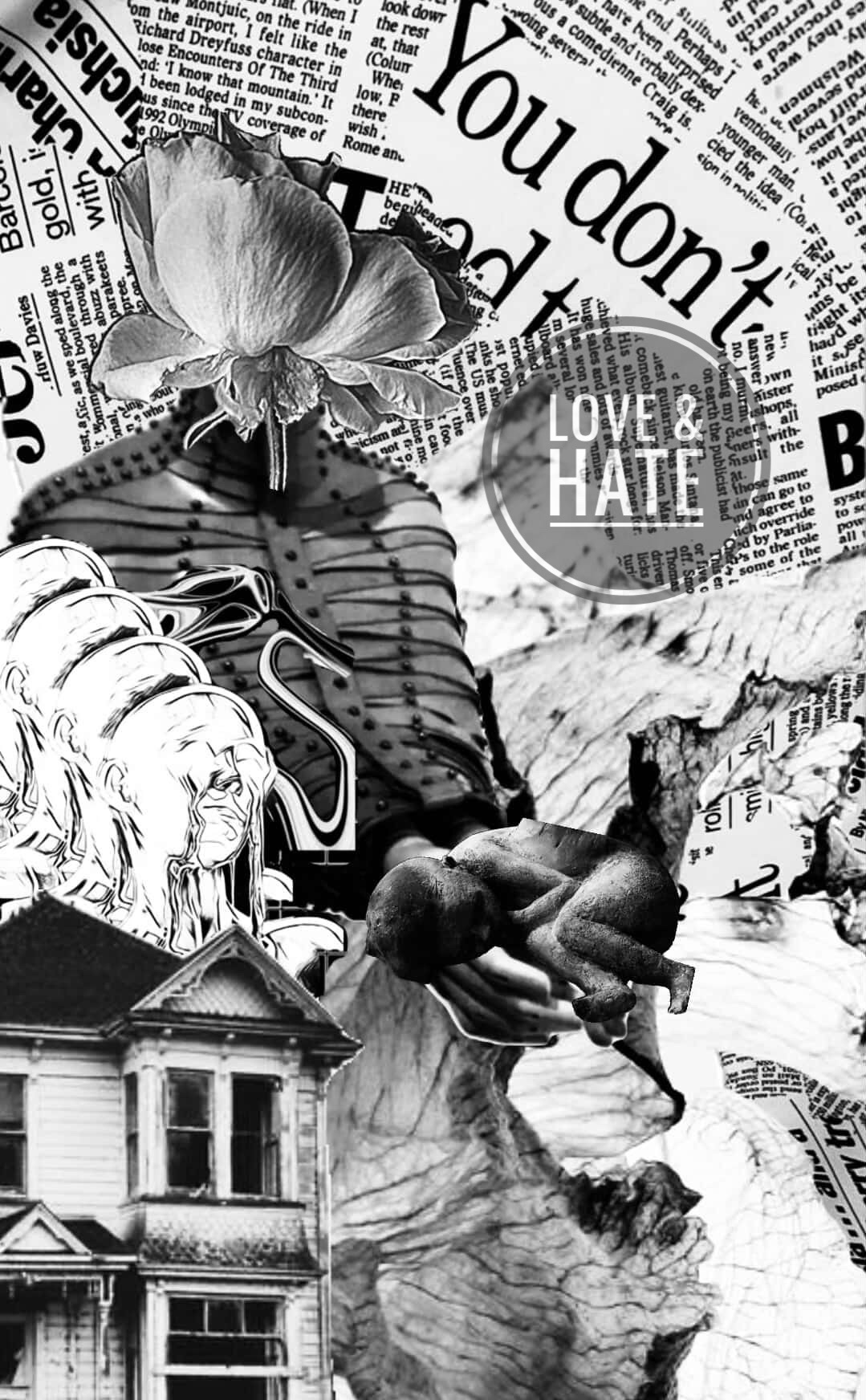
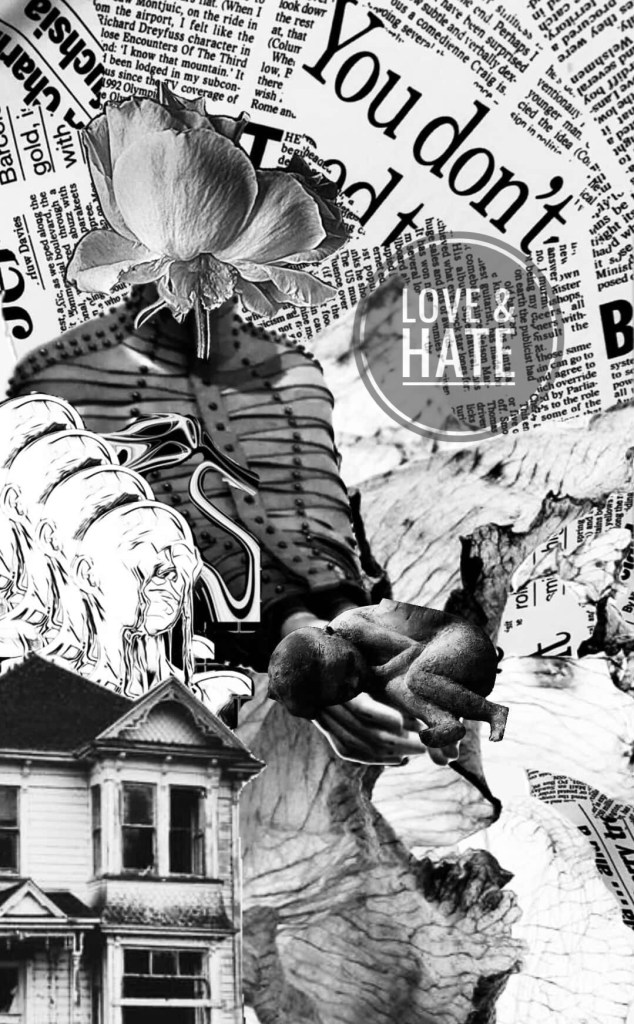
LOVE & HATE
___
Where does love end and hate begin? As an advocate of love in all its manifestations, I‘ve often found myself pondering and teetering on the soft umbilical cord of disillusionment when it comes to these emotions. I am not alone. Love & hate are siblings, —often share a room and define themselves by the company they keep. If needs remain unmet, what changes and how fast before combustion? If disappointment isn’t addressed, love and hate begin their resentful coexistence of two high volume breeds of circuitry.
I invite you to send poetries, hallucinations, uncomfortable journal entries and artworks pulled from the depths of where love & hate live inside you.
Ingrid is a poet, seer, collagist and the solitary editor of Resurrection magazine. She resides in Los Angeles, CA
___
SUBMISSION GUIDELINES
All submissions should be sent as .doc or .docx attachments to guesteditorbhp@gmail.com. No cover letter is necessary but please include a short third-person bio and (optional) photo of yourself for potential print with your submission. You may also consider including social media usernames, especially if you’re on Bluesky/Instagram– I want to promote your work!
Please state the theme and form of your submission in the subject of the email. For example: LOVE&HATE/FICTION
Submissions are open until 25th February and will reopen again on 1st March 2026 for a new theme/new editor/s.
Poetry and Fiction For poetry submissions, submit no more than three of your best poems. Short stories should be limited to 1,500 words or (preferably) less. We encourage flash fiction submissions, no more than three at a time. Send these in as a .doc or .docx file, along with a short third-person bio, and (optional) photograph of yourself.
Art Submit hi-res images of your works (drawings, paintings, illustrations, collages, photography, etc) with descriptions of the work (Title, Year, Medium, etc) in the body of the email. Files should be in .JPEG unless they are GIFs or videos, and should not exceed 2MB in size for each work. File names should correspond with the work titles. Video submissions can be uploaded onto Youtube or Vimeo for feature on our website. Send these submissions along with a short third-person bio, and (optional) photograph of yourself.
Virtual Reality/ 3D Artworks For VR Submissions, please submit no more than three (3) individual artworks. For Tilt Brush works, please upload your artwork to Google Poly (https://poly.google.com/), and mark it as ‘public’ (‘remixable’ is at your own preference). A VR/3D artwork can also be submitted as a video export navigating through the artwork. If you prefer this method, please upload your finished video file to YouTube or Vimeo and provide a URL. With either format, please provide a 150 word artist’s statement.
Non-fiction Non-fiction submissions (essays, reviews, commentary, interviews, etc) should be no more than 1, 500 words and sent as a .doc or .docx file along with your third-person bio/and optional photograph.
_______
BHP online is now in the capable hands of the amazing Ingrid M. Calderón – friends, arsonistas, send our February 2026 guest editor your magic!
Burning House Press are excited to welcome Kawai Shen as the sixth BHP guest editor of our return series of special editions! As of today Kawai will take over editorship of Burning House Press online for the month of January.
Submissions are open from today 3rd January – and will remain open until 25th January.
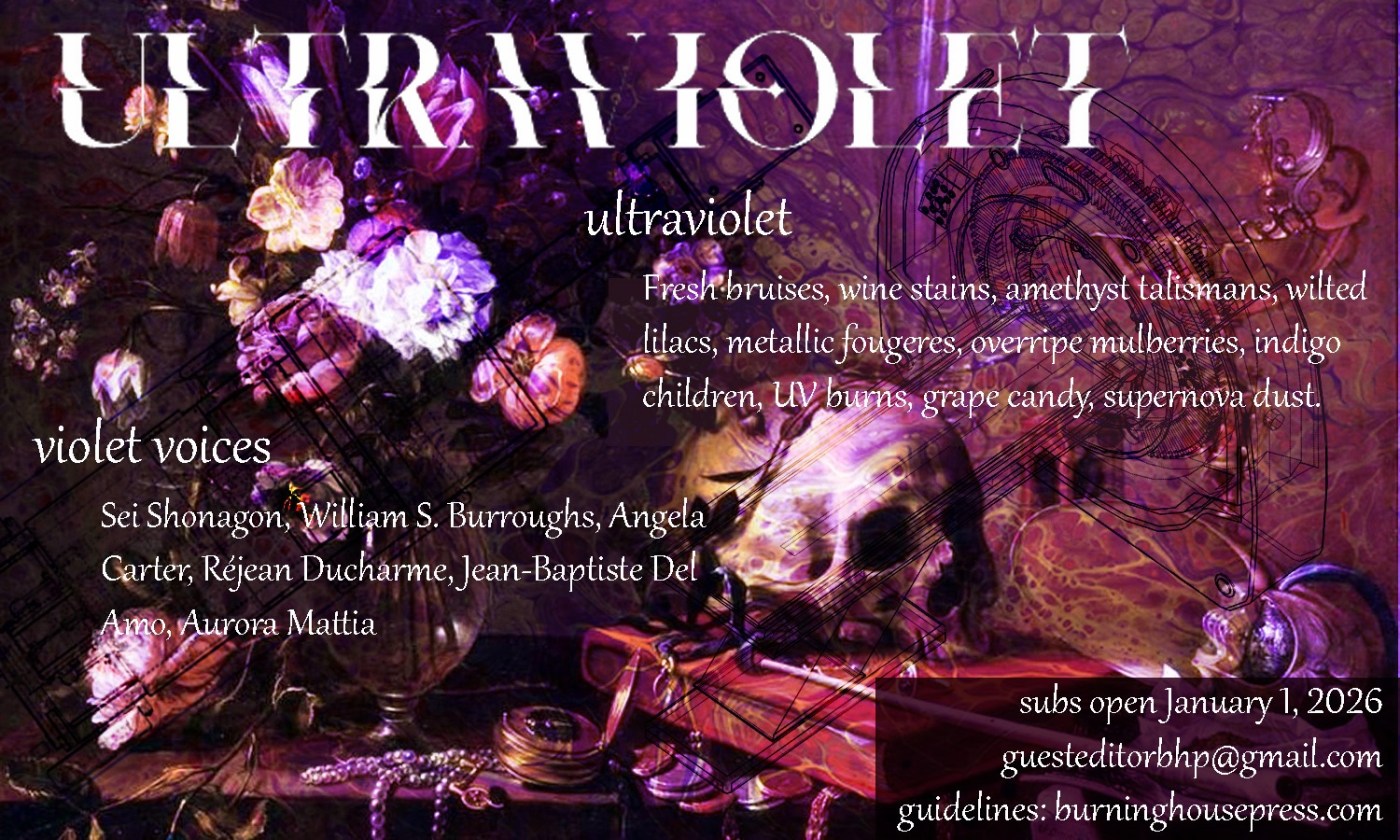
Inspiration: Sei Shonagon, William S. Burroughs, Angela Carter, Mervyn Peake, Réjean Ducharme, Jean-Baptiste Del Amo, Aurora Mattia
Kawai Shen is based in Canada. Her fiction was shortlisted for the 6th edition of The Metatron Prize for Rising Authors and was selected for the Best Canadian Stories 2025 anthology. She has published work in khōréō, ergot, Extra Extra, The Whitney Review, A Fucking Magazine, and more. Her book, Wavering Futures, is forthcoming with Metatron Press in 2026.
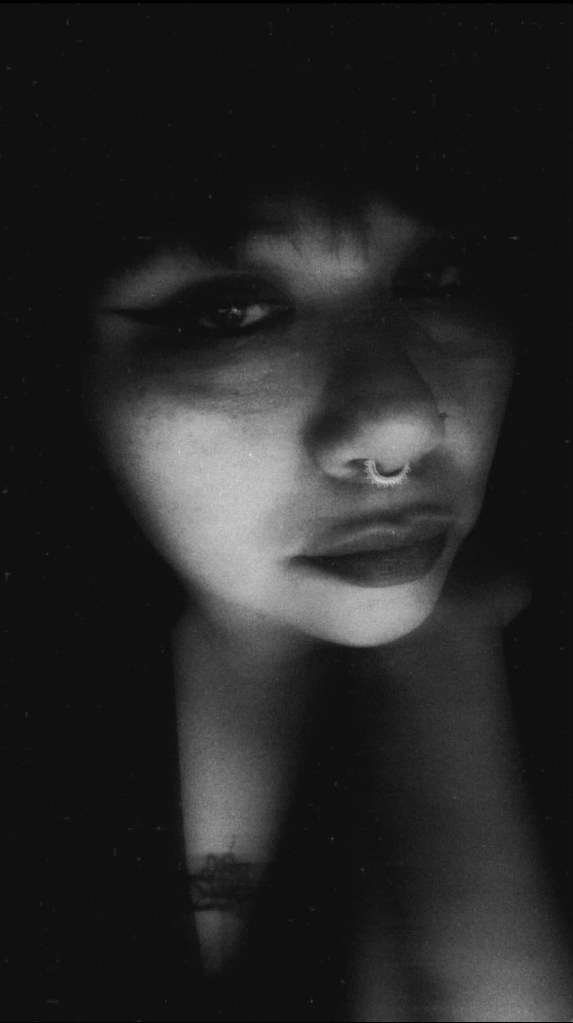
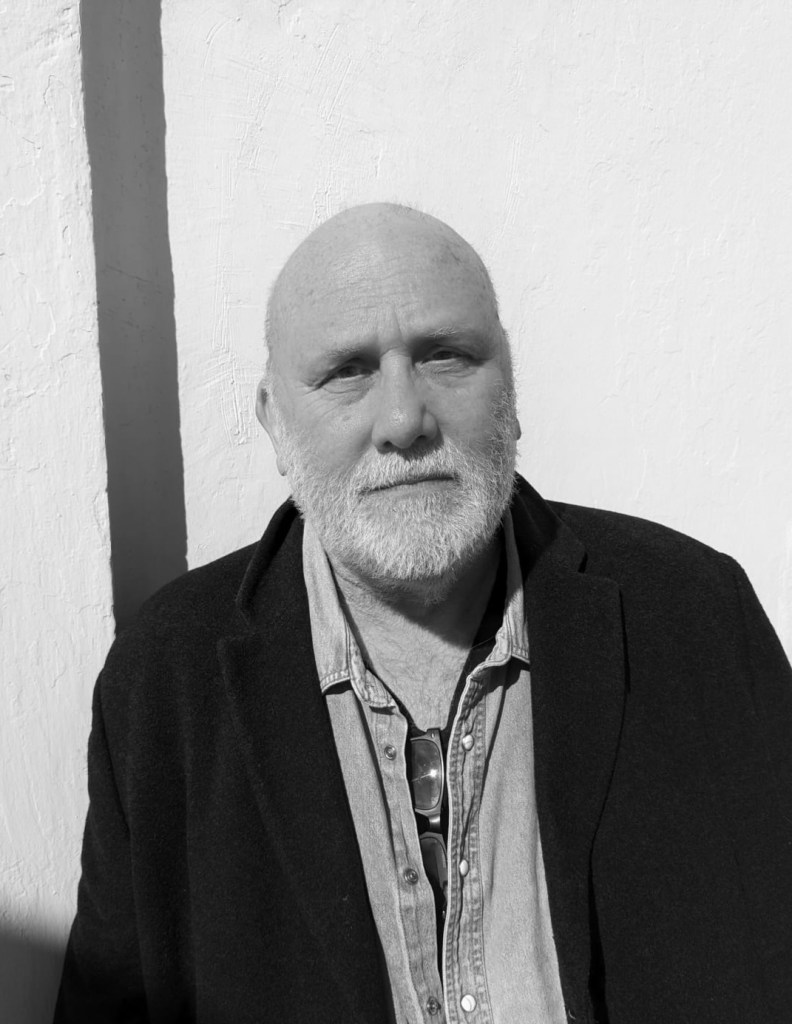
AUTHOR PIC: photographer, Paul Hillier.
______
SUBMISSION GUIDELINES
All submissions should be sent as .doc or .docx attachments to guesteditorbhp@gmail.com. No cover letter is necessary but please include a short third-person bio and (optional) photo of yourself for potential print with your submission. You may also consider including social media usernames, especially if you’re on Bluesky/Instagram– I want to promote your work!
Please state the theme and form of your submission in the subject of the email. For example: ULTRAVIOLET/FICTION
Submissions are open until 25th January and will reopen again on 1st February 2026 for a new theme/new editor/s.
Fiction: Fiction should be limited to 1,500 words or (preferably) less. Up to two micros (maximum 500 words) may be sent.
Poetry: You can try your luck with poetry, but this issue will focus on purple prose. Submit no more than three poems.
Art: Submit a maximum of six hi-res images of your work in JPEG format (maximum size 2MB) with descriptions of each work (Title, Year, Medium) in the body of the email. File names should correspond with the work titles.
_______
BHP online is now in the capable hands of the amazing Kawai Shen – friends, arsonistas, send our January 2026 guest editor your magic!
Burning House Press are excited to welcome Matthew Kinlin as the fifth BHP guest editor of our return series of special editions! As of today Matt will take over editorship of Burning House Press online for the month of December.
Submissions are open from today 1st December – and will remain open until 21st DECEMBER.
Matt’s theme for the month is as follows
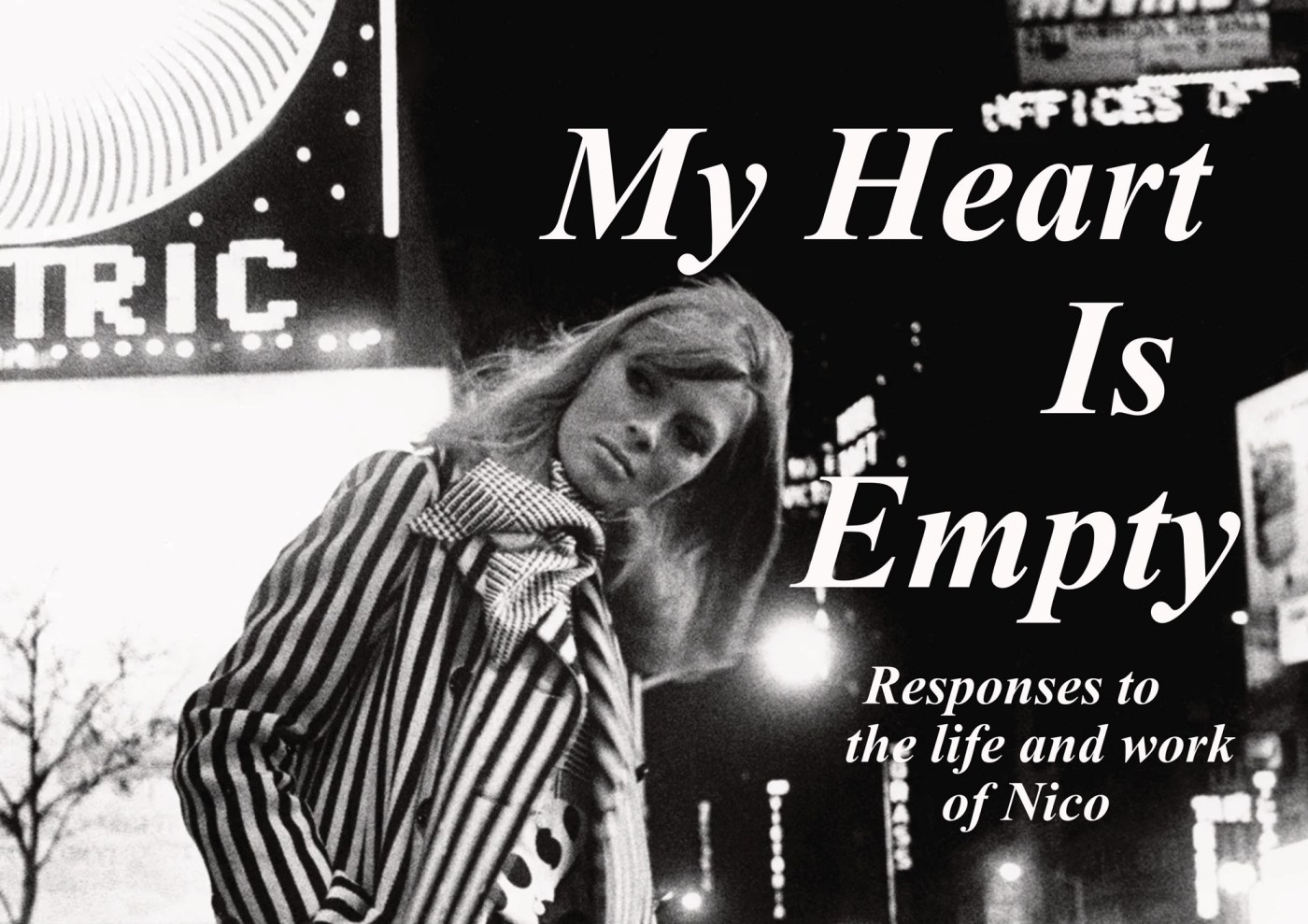
My Heart Is Empty: Responses to The Life and Work of Nico
Matthew Kinlin lives and writes in Glasgow. His published workst include Teenage Hallucination (Orbis Tertius Press, 2021); Curse Red, Curse Blue, Curse Green (Sweat Drenched Press, 2021); The Glass Abattoir (D.F.L. Lit, 2023); Songs of Xanthina (Broken Sleep Books, 2023); Psycho Viridian (Broken Sleep Books, 2024) and So Tender a Killer (Filthy Loot, 2025). Instagram: @obscene_mirror.
——
Submission Guidelines
All submissions should be sent as attachments to guesteditorbhp@gmail.com
Please state the theme and form of your submission in the subject of the email. For example: NICO/POETRY
Poetry and Fiction
For poetry submissions, submit no more than three of your best poems. Short stories should be limited to 1,500 words or (preferably) less. We encourage flash fiction submissions, no more than three at a time. Send these in as a .doc or .docx file, along with a short third-person bio, and (optional) photograph of yourself.
Art Submit hi-res images of your works (drawings, paintings, illustrations, collages, photography, etc) with descriptions of the work (Title, Year, Medium, etc) in the body of the email. Files should be in .JPEG unless they are GIFs or videos, and should not exceed 2MB in size for each work. File names should correspond with the work titles. Video submissions can be uploaded onto Youtube or Vimeo for feature on our website. Send these submissions along with a short third-person bio, and (optional) photograph of yourself.
Virtual Reality/ 3D Artworks
For VR Submissions, please submit no more than three (3) individual artworks. For Tilt Brush works, please upload your artwork to Google Poly (https://poly.google.com/), and mark it as ‘public’ (‘remixable’ is at your own preference). A VR/3D artwork can also be submitted as a video export navigating through the artwork. If you prefer this method, please upload your finished video file to YouTube or Vimeo and provide a URL. With either format, please provide a 150 word artist’s statement.
Non-fiction Non-fiction submissions (essays, reviews, commentary, interviews, etc) should be no more than 1, 500 words and sent as a .doc or .docx file along with your third-person bio/and optional photograph.
Submissions are open until 21st December – and will reopen again on 1st January 2026/for new theme/new editor/s.
BHP online is now in the capable hands of the amazing Matthew Kinlin – friends, arsonistas, send our December 2025 guest editor your magic!
Once you see past the cellophaned shop-window of tourism and into the infected stomach-wound of political history you begin a journey to the centre of dictatorship. And you’re likely to survive. Because in their eyes you are a mere fly on the wound, spinning on the spot, feeling sick and having to suck it all up. They might feel an occasional tick at the discomfort of you’re reporting all their business, but with a quick swat, the threat of being locked up, they will send you packing. Off you fly back to your country. You’ll soon be back again. You’ll come because the scent of such drama and the chance to ‘make a difference’ is so seductive.
You will climb into airplanes and out of airplanes, stand in queues at airports listening to psych rock on repeat to make it seem cool to be wearing a suit. You will walk into climates where heat makes a sudden pass at you. The hotels will have terraces descending to cake-crumb concrete, ornate cities choking politely below you. You will blag free afternoon tea in the hotel where Agatha Christie disappeared. You will do this for years and years. Buoyed on the beauty of this city, by the people from whom you learn the meaning of solidarity.
You might go to courthouses larger than a demigod. Where justice is not just blind, she’s in intensive care. Every now and then, to fool the concerned Specialists from overseas at the bedside of Democracy daughter of Anatolia, there is a blip on the heart monitor in the form of a ‘good’ decision from the Constitutional Court. Everyone from Europe nods and puts a tick on their clipboards, smiling at each other from behind the surgical masks.
The British and French have scalpels in their pockets, just in case they get another chance to make choice cuts. It’s all they can do not to dot lines on the flesh, “Je vous en prie, madame mais j’ai l’envie de vos cuisses remplis de l’huile noir dorée.” They want to take her back to last century. She is confused and they all think she’s easy. She has had a lot of lovers in the past. They think they can own her just like Croesus tried but those silly billies don’t even know her real identity.
While Consultants from the EU compile assessments on the health and usefulness of the patient, the rats go on eating the body from underneath the bed. Small regional judges rebel against the Supreme Court. The government opens cases against the Istanbul Bar. Everyone visiting agrees the patient looks passably robust if you just don’t get too close.
The brochure that prompted your journey to the centre of dictatorship will be social media posts showing Kurdish boys dead on barricades and their families looking out from front windows, prevented from collecting their corpses due to sniper fire from the Turkish state. Dogs devour sons’ bodies near the door. You’ll see four old people, wearing white and waving flags be gunned down as they sneak out with a stretcher. Neighbourhoods and a city flattened by airstrikes and tanks. Sur, Cizre and the walls of Diyarbakır. It was 2016, just nine long years ago.
You’ll stand up, then, in your kitchen and say, “Yes, I am ready. Show me the treatment of women, show me culture of queer, show me the mothers of the disappeared, show me cyanide gold mines and grandmothers’ resistance, show me trans women called Hande and show the teeth of the police and what they did to her, show me 5000 teenage girls on a Women’s March, kettled in the super highway street of Istiklal, show me that lady in her eighties who sat on a rock with a staff, soldiers in a row behind her, trying to take over the olive grove as she blasts, ‘The State? I am the state here!’’’ You’ll say, “Show me oppression, the politics, police brutality, show me torture, show me 64 guards kicking a dealer to death in the prison at Silivri.” You’ll notice there are less and less women, they’re vanishing at a rate of one to three per day.
There will be an old man to clean your shoes on the pavement before going into court, but because you speak the language and had a family here, you will really talk to him and he will cry tears down a maze of lines from cornflower blue irises, telling you, “Inflation means it’s twenty lira for a few tomatoes, we don’t eat meat and we can’t make a go of it”. You’ll agree it is a sin to take over the Central Bank and to let inflation run at 168%.
By now you will be an international advocate. You will monitor 200 trials, hoping it will all get better. But fascism doesn’t need much sleep. When it’s too late you’ll see that you were not creative enough. You weren’t armed to the porcelained teeth or in league with deep state. How can you succeed? You don’t belong to the right cult. The President will laugh you off: “These people, they come here, make up a few numbers and leave.” At one point you won’t want to believe there are 185 journalists in prison. But you know them, you have met them and hugged them.
In seven years you’ll be scared for twenty minutes. Those twenty minutes on the day you decide to stand up are like being in an iron maiden, seeing your essence squeezed out and poured into a glass phial. You hold it up to the light – it is the right colour. You hand yourself permission to resist. Go and find them. They will show you the meaning of solidarity. They really will. Your dear fierce legal colleague who sticks with you, no matter what. Court reporter girls who stand up to the judge and are the subject of court cases written in the purple official bruise of his ego. The woman with 185 court cases against her, who still sends salvos to officials. The lawyers, physicians. They’re resisting so hard, are we with them?
The first court case you monitor will be Zaman newspaper, the journalist, editor, author and unliked man Ahmet Altan. Why don’t you sit in the front row, a copy of the OSCE Trial Monitoring guidelines on your knee? That’s how you monitor a trial, you see? Are they abiding by procedure? How much spare paper do you have? The trial will begin and you’ll write it all down. Then comes an undercover cop. He’ll lean his whole upper body onto you, staring down at the pad on your lap to read what you’ve written, “Are you with Human Rights Watch?” You should go on to record the rest of the hearing in Welsh shorthand. Barmouth Welsh.
You’ll fly over Mount Ararat, fancy that, with a lawyer called ‘the arrow’. Your combined presence, the lawyer’s arguments will get Berzan out on bail that day. You can change things if you put your energy right into the room. In these times of outsourcing intelligence, of never meeting, of cost-saving, if we stop meeting face to face, stop putting our physical, personal energy in the place where it is needed, where it will be seen and counted, then we will fall down either side of the abyss that is separating us, and will meet in a bloody mess at the bottom, wondering how it happened. The best advocacy strategy meetings will be twelve people around a table in Berlin, or in Brussels, or Istanbul, all equal in struggle and all winning. Slowly some of the elitist ones will unpick themselves like the decoration on a shawl, unwind and leave others in the cold. You’ll work on. Your reports will change the law.
How much is the ticket, you ask. Is it a time machine that will eat tokens made of years, of intimacy, friendships, of all else that exists outside the job? Will it be fuelled by all the poems you wrote and never published? You might only take one day off in seven months in lockdown. What else was there to do but work? When you see how bad it is every moment feels like the threshold of a potential win, of standing with them. And every time you think you’ve made a difference, the state will impress you with their newly proposed law to ban all mention of homosexuality on the internet; their throttling of the airwaves. One small squeeze is all you need once you’ve mastered and collected the horse of freedom, put in the brutal bit of police violence backed up by millions of canisters of poison gas at protests.
You will continue on this journey until the road kinks back and kicks you off the path. You will cling on by your fingernails, while life floats far away. You will stay on the road until a new boss steers the car into the back of a truck marked ‘Investment Bank’ and steals your integrity. Then you will lie about your reasons, out of politeness, and you will leave. You might believe that you can still go on, and that the road will welcome you back, but the road knows you can leave no more tread. That you belong in a field, walking over a bog with a small dog, looking up at the range near where you were born, thinking about sixth century poets, because the remaining road travellers, those local dissenters and human rights defenders, they will go on along the road, two thousand miles away. The fight was always theirs, and they will win. It was never about you.
. . .
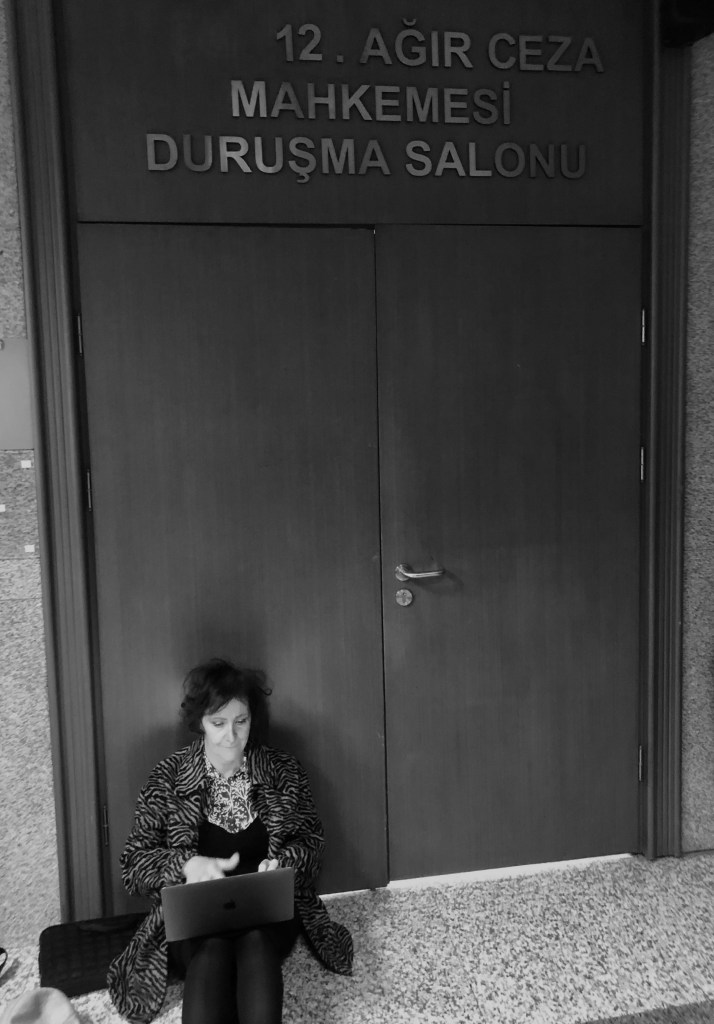
Line Stockford is a Welsh poet, editor and translator of Turkish literature. An adviser on Turkey for PEN, she designed and ran human rights projects around linguistic rights and media freedom. She studied the History of Turkish at SOAS, London. Her book-length translations are published by Parthian, Palewell Press and Smokestack Books.
Watercress abundant, pooled, fed by a freshwater stream that leaks a channel, a winding furrow carving an arc across the sands. Joining the Atlantic salt waters. Diluted.
Conas ta tu a stor? How’re you love? Bhfuil tusa ann? Are you here? Where are you?
Under the rocks……..caught in the weed………….? A remnant of yourself…. a fragment, flotsam, tiny bones bleached out over time.
First child, the one and only first, spent in the sands and carried away unseen.
Pause, sigh, and breathe. Slow. Clearing. In and out breaths. Fuck it …
The stream’s absorbed when it reaches the sea. Red standing stones guard the shoreline. Dug in, bulk undiminished through the years. Smooth blank faces peppered with tiny lives. Living creatures in spiraling whorls, paint-box colours distinct from the rest with their blend of muddy greys, blacks and browns. The discreet, minding their own business ones.
Keeping to the low formation, leaning into these sentinels, pushing up hard. Limpets impress their determination into my back, encouraging them to leave their marks on my skin, through the layers of time and guilt. Tiny bruises, kissed into my shell.
Cá bhfuil tu mo stor, where are you my love? Still here? Shape shifting your small self, half formed baba deas, lovely baba? Or have you vanished into mists of salt water and weed? Níl fhios agam, I don’t know, may never know.
Sins for which I alone hold no charge, spoken in my head. Not then, had no clue back then.
Busy in the kiddish world of long summers, heat hazed early mornings blended into same grey days. School and holidays, home and here, the Red Strand. First beach out of Clonakilty, Cloich na Coillte, stone castle of the woods.
The brother, older but no wiser through the passage of summers, collects the tiny vivid shells under instruction from his know it all little sister. All through our early rising summers for as long as it pleases him. Mostly in the absence of anyone else. (He’d prefer the other boys, tardy, sleeping-in boys, almost always with a ball).
We sort the shells into currency for our long playing games, oblivious to any lives inside the whirly chambers. Red, yellow and green defining value, same as fruit pastilles or wine gums;sticky pleasures. Flavours imparted by the power of suggestion.
In truth they all tasted much the same, the richer the colour the more they’re desired, sweeties and shells. No truth to either.
He is obliging, patient and generous, prepared to share a vision of the day, playing shop? Or being rich for our new life ahead. Content til he gets a better offer……at least til then.
A big brother like no other, he is dark to my fair, tall where I am slight, brave while I am cautious. Protective and free running altogether in one certain self. His infectious self-belief sweeps us into his limitless foolhardy world and we’re away. Climbing rock faces, out of windows and trees, into danger without looking back. Running for miles with no sense of the dinner time clock. It chimes without our ears to mind it. Into trouble over and over he brought me, with no regrets.
Not true, baba deas. My one regret. The original sin.
Hours we spend under the towering protection of this headland. Obscured from view by the remains of an over-ground tunnel. Giant concrete slabs scattered about, fallen, impotent, discarded. Marooned in the sands.
A hidey hole, a place of travel from one gloomy tunnel end to the other, between the stream and the sea.
Fresh water and salt, fishing in both, crazy laughter and messing, all the way to tears and squabbles on rare days, high days and holidays, tense sort of days.
Status Quo, the quo, ruled the roost for his whole gang, while we, the girls, follow the Bay City Rollers. Uniform in our tartan trousers, Baby love, oh baby love, skimming our thighs cutting into our vain attempt to hold the boys attention. All the while loving our idols, the special one, he who holds our gaze on the telly. A band member for all the seasons of our pre-teen crushes.
Teenage years we return to the Red Strand with beer and tents. The sea is the place to be rather than the shore. Trailing friends, boyfriends, girlfriends, cousins once from overseas, to share the magic that no longer exists. Red Strand’s too full of childhood and original sin. Better beaches round the corner, further along the coast, closer to the shore life of pubs, craic and caravan parks.
All these places we never saw as children, never knew were there, so determined was this family not to mix with the noisy ones, the drunken ones. The families that might know us from life at home ones. The sleeping in, lying in their beds half the day ones.
Mothers and fathers equally corrupt longside their offspring, in the gospel of our English origins. They lined up daily at the chip van for their tea. We ate freshly caught mackerel with bread and butter, the food of the Gods, and so it was. Free, from the sea.
We ate mussels plucked from the rocks. Sometimes lobsters, captured in pots thrown off the shore. Squealing their way from blue black to bright scarlet in a pot alive with boiling water, delicious, with butter dripping from our chins, stinking of garlic. No one ate that stuff, famine food still reeking of the sea but we did. Set apart, positioned above, looking down, while trying to squeeze in.
We were blessed, apparently.
The beach welcomed us back annually, sharing its curves, a safe return into the familiar crook of embracing rocks. The concrete tunnel sheltering our comings and goings from year to year, constant, never-changing. The strand,, our part in it, had a rhythm, a ritual of its own making. It bent slightly each year as we grew up, new faces appeared, alongside the familiar caravans.
Softly whispered voices, rememberings from the sea, in the sand dunes, where courting couples played out their pleasure. Mostly undiscovered, known by all and avoided, quietly sidelined. Not allowed, and still they were always there. Bless me father for I have sinned. Curled up in warm grasses on heated sand that threatened collapse without the tough spines that held it altogether.
All through the early Summers a man ploughed his way, twice a day from the dizzy height of the headland, traveling from his smallholding, along a narrow sunken track. He trailed a donkey and a jennet down onto the strand, on a single rope. Their arrival a Mr Whippy of excitement in the day trippers, our prior knowledge fattening our superior position. Privileged with familiarity, without names, we are known to each other. The donkey man and us, the regulars.
Some days I follow them on their return pilgrimage through the steep channel, the sharp, dry grass nicking my bare shoulders, a minor penance, a small offering. I daydream a change of identity, assuming a place in their holy family on the homeward climb. Shifting from child to blessed mother, to partner and devoted animal whisperer. The donkey man never seems to notice my presence or acknowledge it at any rate.
Codladh samh, sleep safe, a stor, love, where ever you are, under the deep sand or washed clean among the creatures that flow back and forth, in and out of the tides. Three hail Marys and one our father the regular gift for telling lies. How could you not tell lies when caught between the father and the son. I have no idea, only one idea possesses my mind, escape and protection.
First love learned at the foot of the should be protector and corrupt for ever after while nuns whispering lies and responsibility into the shell like of every girl child and what would they know about it anyway? Brides of Christ, be lady-like, be Marylike the impossible mantra, the ideal that will never be matched.
They can’t control themselves, they confide, it’s up to ye to take control, female pleasure, unknown, unspoken.
Is it any wonder a stór beag, my small love, my tiny not fully hatched firstborn that you were conceived and lost on the shore of my innocence. Bless me father, I don’t fucking think so, thank you very much and goodnight.
Transformation, a daily event as the sea wipes out the story of the sand and shore. Washing and rinsing rocks and strand in a matter of hours, filling and emptying the pools closest to the rushing waters.
Anemones, the most tantalising transubstantiation of all. Still to this day, a miracle. Brown jelly mounds stranded in the air of low tide become flowering tendrils of soft pinks submerged in the salt water. Waving gently, they invite touch, dipping a finger into a shallow pool and softly, softly stroking the water closest to the fleshy petals. Too close, they fold themselves in, abruptly resuming their impenetrable personae. Still here, always here, since the beginning of time. Stuck fast to their ways.
Echoing through the years, on every return I pay homage to their beauty hidden in the dark brownness of the rock pools, discomfited in the air heavy world.
Tabhair aire, take care, precious one, watch out for the sidewards crabs lurking out of sight among the weed. Sharp little nipping pincers, painful beyond belief to the unwary, bi curamach, be careful, mind your little fingers and toes.
A fully grown woman this visit, kneeling in a hollow scraped out of the sand. Lost but keeping watch on the tide, inching closer and closer, washing clean its own. Soothing the grains with the patterns of waves, licking into the holes dug out with plastic reds and yellows. Further out to sea, waves churn up the red sandstone rocks lining the basin of the strand. Fractured thoughts coming and going rolling back and forth, testing the present with the past, seeking out long gone shapes amongst the weed, carried and tossed, lifted along the breadth of the curve.
Nothing clear, no single sound, a rag bag of rattling stones to hang from my feet. Uneasy flickerings in the corner of an eye. Glimpses of the jennet’s flashing whites and straining head. His unpredictable nature printed in my memory, a familiar refrain, a chord that echoes in my pulse. He was half donkey and half horse, we said, the mixture of breeding, his magic. Also his devilish power, tempting fate with its unnaturalness.
The water, freezing, has reached me, frothing at my knees and trickles begin to fill the spaces around and between my legs, my feet folded into the dugout. How long could I last? The cold drove me out half way between head and toes, intimate with my belly. Enough already. This time.
. . .
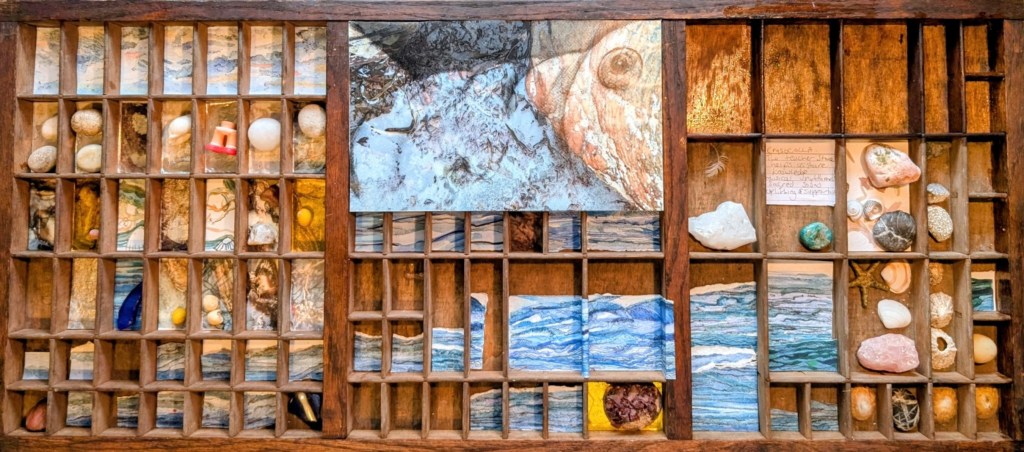
Inter-disciplinary artist Liz Cullinane is a storyteller in words and pictures. Her Belfast based practice is rooted in community activism, theatre design and film collaborations with poets and musicians. Liz’s academic research on early 20th century Irish women artists focusses on Mary Swanzy (1882-1978). Published by the Irish Museum of Modern Art (IMMA), she has innovated a digital opera on Swanzy. Recent exhibitions & writing reflect her engagement with the Achill Island landscape in Mayo.
Burning House Press are excited to welcome C.C. O’HANLON as the fifth BHP guest editor of our return series of special editions! As of today C.C. will take over editorship of Burning House Press online for the month of November.
Submissions are open from today 1st November – and will remain open until 25TH November.
C.C.’s theme for the month is as follows
—JOURNEYS
~~~
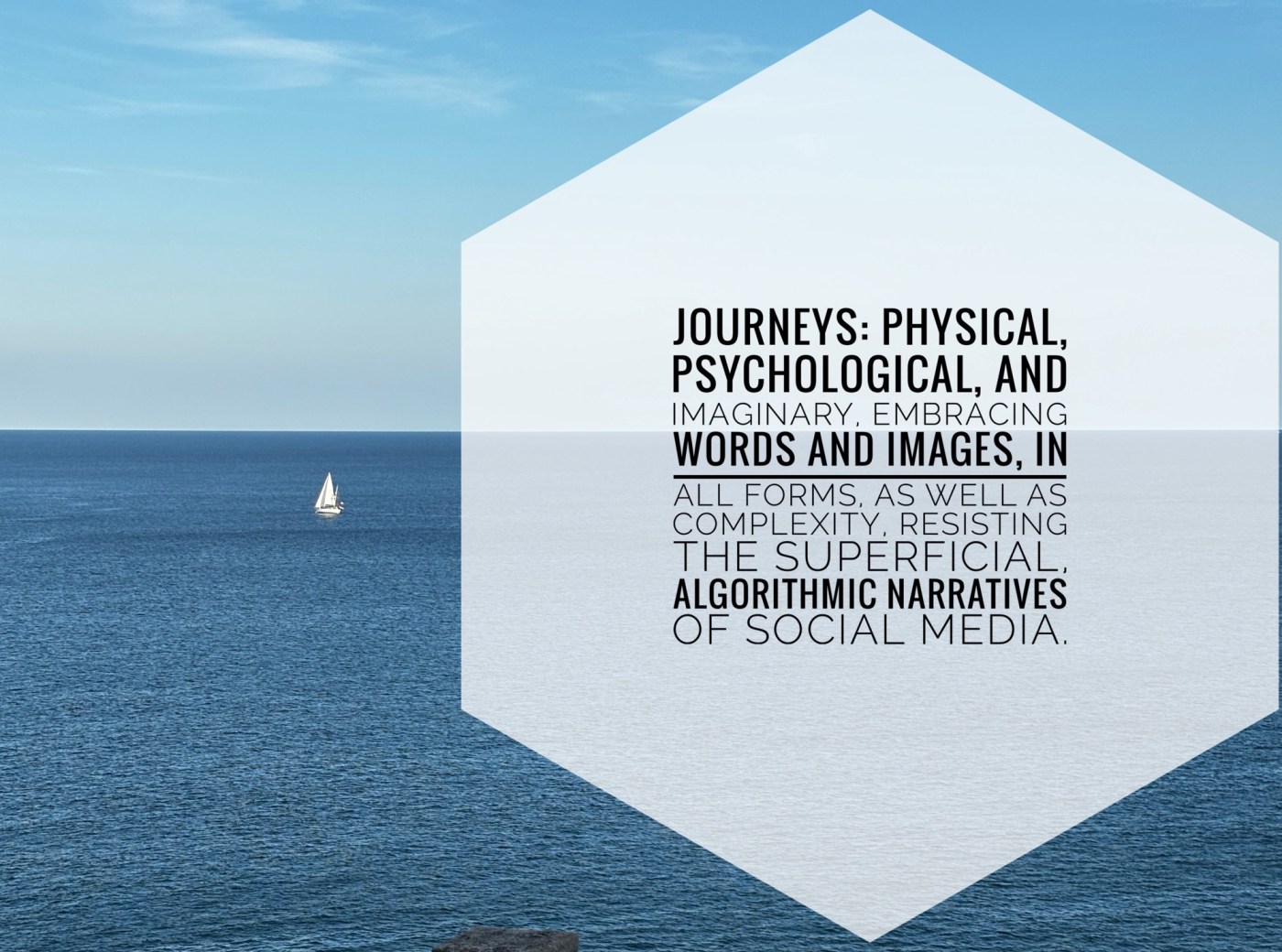
JOURNEYS: Physical, Psychological, and Imaginary, embracing words and images, in all forms, as well as complexity, resisting the superficial, algorithmic narratives of social media.
~~~
Photo by Given Rozell.
~~~
A self-described ‘vagabond, diarist, and wreck’, C.C. O’Hanlon’s fragmentary memoirs have been published in various anthologies, including Best Australian Essays 2005 and Best Australian Stories 2004 (both published by Black Inc, Australia), A Revealed Life: Australian Writers And Their Journeys In Memoir (ABC Books, Australia), The Odysseum: Strange Journeys That Obliterated Convention (John Murray, U.K.), Zahir: Desire & Eclipse (Zeno Press, U.K.), and Dark Ocean (Dark Mountain Project, U.K.). A founding features editor of Harper’ Bazaar Australia in the late ’80s, his mainstream journalism and images have appeared in The New York Times, The Sydney Morning Herald, Variety, Travel & Leisure, the Australian editions of Vogue and Harper’s Bazaar and scores of other newspapers and magazines.
He now lives a nomadic life with his American wife of 38 years aboard a small, sea-worn old sailboat named Wrack in the southern Mediterranean. They have three adult children.
_______
Submission Guidelines
All submissions should be sent as attachments to guesteditorbhp@gmail.com
Please state the theme and form of your submission in the subject of the email. For example: JOURNEYS/POETRY
Poetry and Fiction
For poetry submissions, submit no more than three of your best poems. Short stories should be limited to 1,500 words or (preferably) less. We encourage flash fiction submissions, no more than three at a time. Send these in as a .doc or .docx file, along with a short third-person bio, and (optional) photograph of yourself.
Art Submit hi-res images of your works (drawings, paintings, illustrations, collages, photography, etc) with descriptions of the work (Title, Year, Medium, etc) in the body of the email. Files should be in .JPEG unless they are GIFs or videos, and should not exceed 2MB in size for each work. File names should correspond with the work titles. Video submissions can be uploaded onto Youtube or Vimeo for feature on our website. Send these submissions along with a short third-person bio, and (optional) photograph of yourself.
Virtual Reality/ 3D Artworks
For VR Submissions, please submit no more than three (3) individual artworks. For Tilt Brush works, please upload your artwork to Google Poly (https://poly.google.com/), and mark it as ‘public’ (‘remixable’ is at your own preference). A VR/3D artwork can also be submitted as a video export navigating through the artwork. If you prefer this method, please upload your finished video file to YouTube or Vimeo and provide a URL. With either format, please provide a 150 word artist’s statement.
Non-fiction Non-fiction submissions (essays, reviews, commentary, interviews, etc) should be no more than 1, 500 words and sent as a .doc or .docx file along with your third-person bio/and optional photograph.
Submissions are open until 25th November – and will reopen again on 1st DECEMBER 2025/for new theme/new editor/s.
BHP online is now in the capable hands of the amazing C.C. – friends, arsonistas, send our NOVEMBER 2025 guest editor your magic!
Millet’s spring mind soared red and skittish as an over-angled kite; in summer it entered the usual back-stall, and by August it had dived low enough for him to have another go at his wrists. This year he made an especial hash of it; fumbling with the false-economy razorblades until he ended up cutting his palms as much as anything else.
Afterwards the ambulance dumped him in the aisle of the A&E, where he lay on the hindmost of a metal spine of gurneys down the building’s centreline. Up on the ceiling, a loose panel exposed a pecking wedge of darkness. He turned on his side; the wall’s blank surface, gouged and spilling brown and fibrous shreds, was in worse nick than his skin.
After the stitching they left him in a side room, alone but for the slurping, whistling breaths of someone on the other side of a curtain. Wires snaked around its pleats to a bleeping machine in his own half of the room. His eyes tracked the glowing plots on the monitor; six months after his firing from Aventrix he still couldn’t stop himself subjecting the signals to confused analysis: window functions, discrete transforms, then breakdown into smaller sub-transforms. Radix two, four, sixteen … When the dragonfly lights on the screen began to sting his eyes he gave up his calculations and pulled the bedsheet over his head. Seeking distraction from the thin fabric’s vinegar-and-dead-skin scent, he tried to think its crumpled underside into the hills and valleys of that Stevenson poem. The Pleasant Land of Counter … Counter …
“… pain?”
The syllable repeated, a chain of islands in a sea of blurred speech, and he realized the nurse had arrived, with a prompt to rate his suffering out of ten. He thought the gurney was creaking, some part of the rails extending on either side of him.
“N over two,” he mumbled, and it seemed to do.
II
In the morning they had him shower the intact parts of his body. Two quivering shoots of something like watercress poked from the cubicle drain. He hoped they were real; he couldn’t bear the idea of hallucinating such lumpen symbolism. Then he was ferried to a psychiatric hospital on the county border, where his mind banked gently into the institutional mist. He spent much of the next few days contemplating more bedlinen, the troughs and peaks of mountain ranges hugged in soft shadow relief.
He wasn’t so keen on the topography of his outspread hands. In recent months they’d thinned out, the newly slackened skin across their backs trumpeting the onset of real ageing. When he turned them over, the mess of his healing palms troubled him. The scabs didn’t quite match the cuts he remembered making, though his memory was a joke. They kept him well-drugged. Quetiapine, lorazepam. Sometimes in the depths of the night a sister came to shine the round white beam of a pen torch on his eyelids. If they fluttered open, hands offered a pellet of zopiclone, the shadows of uniformed arms beating slowly on the walls. Sometimes, as sleep took hold, his throat felt like there was much more than one pill in it, a smooth, hard, comforting clutch.
III
They began to let him out. First just the grounds, the café and shop, in low outbuildings that reminded him of the old airfield Portakabins. He sat nursing weak coffee, watching the wings of the main building extend into milky light, until one day he and some others were put on a minibus and taken to the nearby riverside park.
On the drive one of their escorts enthused about the new fitness parcours along the banks, with special bodybuilding rigs, Ninja wheels, a machine for chest presses.
“Most of that junk’s already out of order,” his roommate Whitlock confided as they got off the bus. “The screws fail, and they’re a special kind. The council can’t be bothered to replace them.”
They quickly passed the old visitor centre, a silent cube of glass covered in crude paintings of leaf and feather that couldn’t hide the underlying curls of dustsheet. The trail head was marked by a pocked information sign. Lodged in one of its bulges, between a badly-drawn muskrat and a peeling heron, was a cluster of tiny pale green balls.
“They’ve got the map here,” said Whitlock.
“I can see that.”
“No, I mean the map butterfly. Araschnia levana, or prorsa, depending on the season. Invasive species, but I’d still like to spot the bleeder. Never set eyes on the black summer form.”
Millet murmured a vague answer to stem the flood of nature facts. The scabs on his palms were itching like hell, much worse than the ones on his arms.
IV
They walked on. After a while he ceased to notice the rise and fall of human voices. To his left was a dazzle of light on winding reed-lined water; foliage encroached on his right. Alder and beech, bramble hordes and white bells of bindweed, parted only by the green metal curves of the fitnessmachines. On each of their instruction diagrams, the silhouette figure looked less like a person.
Finally the path made a swan-neck double bend, and he found himself in front of the most preposterous contraption yet. The paint on this one had almost entirely flaked off, exposing a tall structure of rust-brown metal crisscrossed with streaks of faded cream. It was studded with appendages, and a maze of gears, flanges and blades, culminating in something like a giant upturned wishbone. The sight of the two symmetrical handles fanning out on either side of a discoid seat prompted a distant memory of gym adverts, and then he saw the instruction diagram, with its caption:
BUTTERFLY MACHINE
At the sight of the wonky grid pattern running across the underside of the depicted creature’s wings, the scabs on his palms raged until something in him hatched. When he sat down and grabbed the handles above his head, he felt the fire in his hands drain out into the cold metal. Warming it. Informing it. Loading the chart of his scars into its central navigation system. The antennae slewed and thrummed; great metal wings unfolded with a shivering clang and began to beat, then it bore him into the air.
V
Sounds rose up from the riverbank, individual screams convolved into a single wavering keen, but he couldn’t have looked down if he’d wanted to. When the machine broke through the clouds, it dropped its payload of eggs. As they whistled towards the earth he let go of the handles and the craft itself fell away from him. He hung for a second in the air, hands whipped aloft, before each palm burst apart, discretizing again and again into clouds of tiny flitting things; after a moment his mind followed suit, merry black thoughts whirling up to the sun.
Daisy Lyle is an engineering translator & dark fantasy writer based in Normandie, France. Bluesky http://@novembergrau.bsky.social
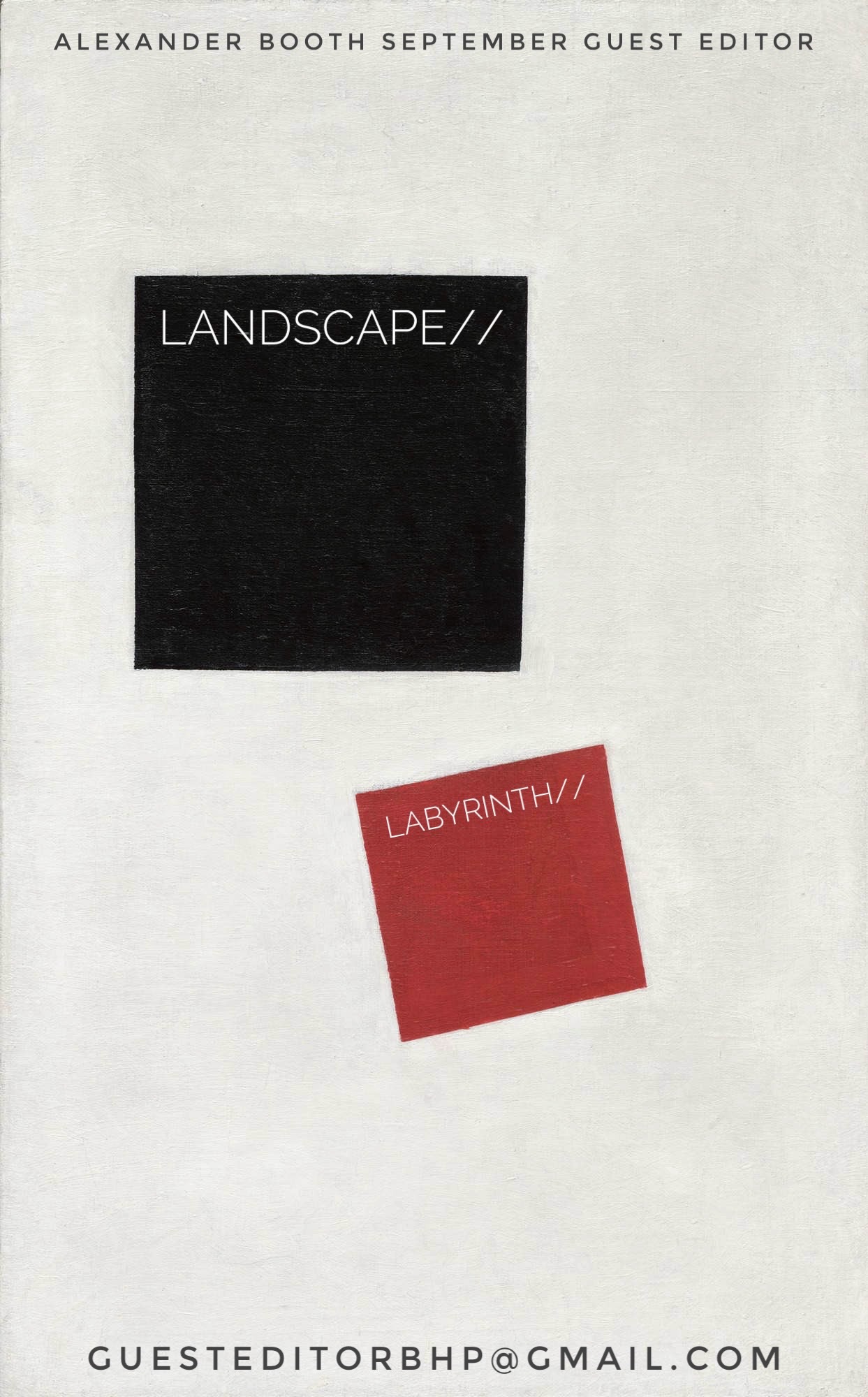
Burning House Press are excited to welcome Alexander Booth as the fourth BHP guest editor of our return series of special editions! As of today Alexander will take over editorship of Burning House Press online for the month of September.
Submissions are open from today 1st September – and will remain open until 25TH SEPTEMBER.
Alexander’s theme/s for the month are as follows
—LANDSCAPE
LABYRINTH—
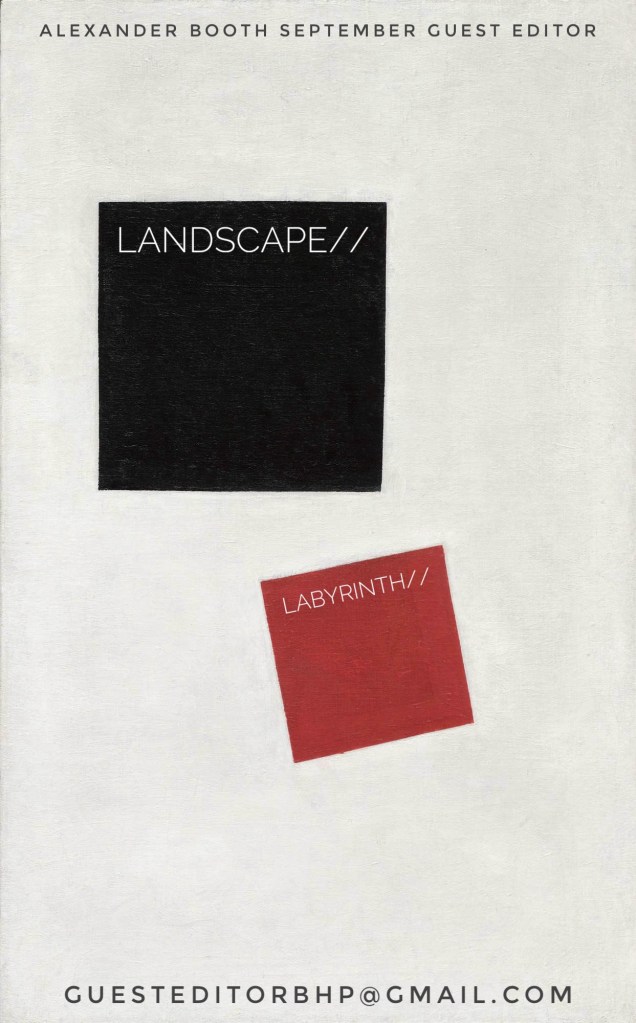
Black Square and Red Square by Kazmir Malevich
_____
LANDSCAPE // LABYRINTH
*
When the painter’s friends, however, looked around for the painter, they saw that he was gone—that he was in the picture. There, he followed the little path that led to the door, paused before it quite still, turned, smiled, and disappeared through the narrow opening.
– Walter Benjamin, Berlin Childhood around 1900 (trans. Howard Eiland)
*
Each one of us, then, should speak of his roads, his crossroads, his roadside benches; each one of us should make a surveyor’s map of his lost fields and meadows.
Gaston Bachelard (trans. Maria Jolas)
*
“Though Minos blocks escape by land or water,”
Daedalus said, “surely the sky is open,
And that’s the way we’ll go. Minos’ dominion
Does not include the air.”
– Ovid, Metamorphosis (trans. Rolfe Humphries)
_____
Alexander Booth is a poet, translator, collage artist and printmaker who lives in Berlin. Recent translations include books by Friederike Mayröcker, Alexander Kluge, Gerhard Rühm, and a new translation of Ludwig Wittgenstein’s Tractatus Logico-Philosophicus. His collection of poems Triptych was published in 2021 and Kantor in 2023.
__________
Submission Guidelines
All submissions should be sent as attachments to guesteditorbhp@gmail.com
Please state the theme and form of your submission in the subject of the email. For example: LANDSCAPE/POETRY Or LABYRINTH/FICTION
Poetry and Fiction
For poetry submissions, submit no more than three of your best poems. Short stories should be limited to 1,500 words or (preferably) less. We encourage flash fiction submissions, no more than three at a time. Send these in as a .doc or .docx file, along with a short third-person bio, and (optional) photograph of yourself.
Art Submit hi-res images of your works (drawings, paintings, illustrations, collages, photography, etc) with descriptions of the work (Title, Year, Medium, etc) in the body of the email. Files should be in .JPEG unless they are GIFs or videos, and should not exceed 2MB in size for each work. File names should correspond with the work titles. Video submissions can be uploaded onto Youtube or Vimeo for feature on our website. Send these submissions along with a short third-person bio, and (optional) photograph of yourself.
Virtual Reality/ 3D Artworks
For VR Submissions, please submit no more than three (3) individual artworks. For Tilt Brush works, please upload your artwork to Google Poly (https://poly.google.com/), and mark it as ‘public’ (‘remixable’ is at your own preference). A VR/3D artwork can also be submitted as a video export navigating through the artwork. If you prefer this method, please upload your finished video file to YouTube or Vimeo and provide a URL. With either format, please provide a 150 word artist’s statement.
Non-fiction Non-fiction submissions (essays, reviews, commentary, interviews, etc) should be no more than 1, 500 words and sent as a .doc or .docx file along with your third-person bio/and optional photograph.
Submissions are open until 25th SEPTEMBER – and will reopen again on 1st OCTOBER 2025/for new theme/new editor/s.
BHP online is now in the capable hands of the amazing Alexander Booth – friends, arsonistas, send our SEPTEMBER 2025 guest editor your magic!
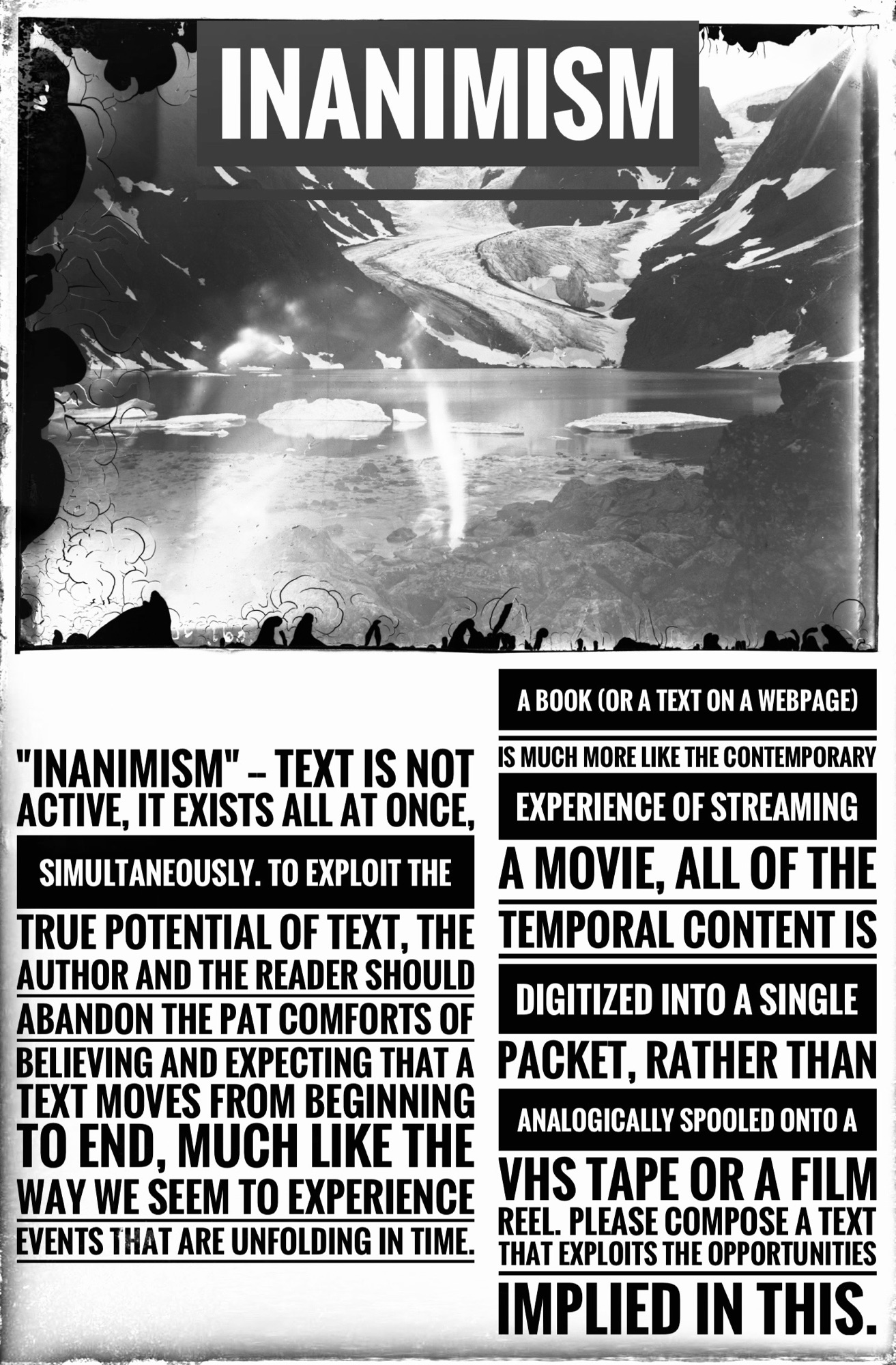
Burning House Press are excited to welcome JOHN TREFRY as the first BHP guest editor of our return series of special editions! As of today JOHN will take over editorship of Burning House Press online for the month of JUNE.
Submissions are open from today – and will remain open until 25TH JUNE.
JOHN’S theme for the month is as follows
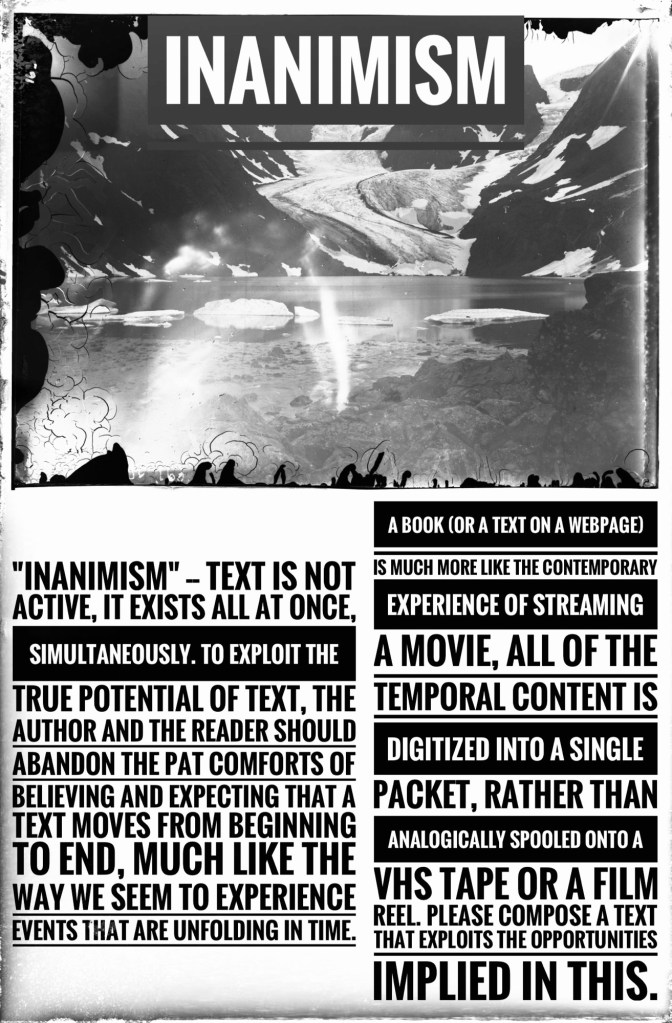
—INANIMISM—
Submission Guidelines
All submissions should be sent as attachments to guesteditorbhp@gmail.com
Please state the theme and form of your submission in the subject of the email. For example: INANIMISM/POETRY
Poetry and Fiction
For poetry submissions, submit no more than three of your best poems. Short stories should be limited to 1,500 words or (preferably) less. We encourage flash fiction submissions, no more than three at a time. Send these in as a .doc or .docx file, along with a short third-person bio, and (optional) photograph of yourself.
Art Submit hi-res images of your works (drawings, paintings, illustrations, collages, photography, etc) with descriptions of the work (Title, Year, Medium, etc) in the body of the email. Files should be in .JPEG unless they are GIFs or videos, and should not exceed 2MB in size for each work. File names should correspond with the work titles. Video submissions can be uploaded onto Youtube or Vimeo for feature on our website. Send these submissions along with a short third-person bio, and (optional) photograph of yourself.
Virtual Reality/ 3D Artworks
For VR Submissions, please submit no more than three (3) individual artworks. For Tilt Brush works, please upload your artwork to Google Poly (https://poly.google.com/), and mark it as ‘public’ (‘remixable’ is at your own preference). A VR/3D artwork can also be submitted as a video export navigating through the artwork. If you prefer this method, please upload your finished video file to YouTube or Vimeo and provide a URL. With either format, please provide a 150 word artist’s statement.
Non-fiction Non-fiction submissions (essays, reviews, commentary, interviews, etc) should be no more than 1, 500 words and sent as a .doc or .docx file along with your third-person bio/and optional photograph.
Submissions are open until 25th JUNE – and will reopen again on 1st JULY2025/for new theme/new editor/s.
BHP online is now in the capable hands of the amazing JOHN TREFRY – friends, arsonistas, send our JUNE 2025 guest editor your magic!
That copywriter who missed ‘Sex or Death’ – beaten to within an inch of their error. No make-up required in the seduction of myth. Devil’s Advocacy is deviation rather than deviance. Making the world a better place has always been a dream of the few for the many, and where water flows it will eventually meet its own end. In capitalist readings, the Eighth House is for tax dodgers, not sex lodgers. On the fringe. The demise of conversation is irrelevant to the Aquarius phone caller who is happy satisfying themselves. Groping in belief’s light and dark. The mirth of Uranus will never die down, even for a god of gods. When Coleridge chose the pious over the oneness. Good Evil and Heaven’s Hell in a Battle of the Bands, riffing sweet harmonies. Moving beyond Catholicism, this is a different kind of devil to accept/reject.
With fraying certainty did Linda handle the folds of her origami original. Where before had been pristine squares of folding paper there was now a complete failure on the part of paper. The squares had had a gloss and that gloss had met its foil in Linda’s troubled folds. Linda tut-tutted herself and variously rattled at her desk. First, two hands to one of the four legs. Then, two good grips on either edge of the desktop, widthwise. Lastly, a pair of arms under the center drawer, and a kick at the side-cabinet, for good measure. The latest paper square, set squarely on the rubber mat, could hardly be expected to shrug its shoulders. These glossy paper squares battled a good deal of battle. Proper soldiers.
The greens, the greys, the ocean waves—together cross.
Enveloped within infrastructure, like an orb with swirling insides: the waters settle in the center as trees surround them. Three oceans connect through a narrow river; these oceans huddle close. The architecture: high-rise. Sky-high, arching over the oceans, shielding them. The buildings reach out to one another through pathways (connected, like the oceans)—and these know no time. Similar to skip travel, almost. Each piece in this machine of a home fits and functions as planned, always.
The fresh breeze, the silvers, the tides—these are what make up home, and yet, home would be incomplete without its inhabitants. This Realm has always been known for its residents’ hyperosmia: heightened olfactory senses. Other neighboring Realms are known for other things. Hyperosmia plays a vital role in the circulation of energy.
All this Realm’s energy is generated from its very own oceans. There are the tides: natural, relatively predictable, but insufficient and intermittent (the oceans cherish their quiet time, too). There is the concentration of salt: with hyperosmia, energy management poses no challenge. In other words, apart from the tides, the oceans must have an exact percentage of salt for the energy to be distributed evenly in the Realm. An exact percentage, a very specific scent. Each piece in this machine of a home fits and functions as planned, always.
Amidst distinct realms, here lies Elesphal.
*******
The Oliques and Their Ancestral History (Log A.0028)
Elesphal was once led by the Scentress for ages and ages as tales go. Essentially, she was the founder; the scholars of the Realms speak of her oneness with nature and how she foresaw the need for Elesphal to live upon such providence.
The Scentress began, along with a few others of her time, to construct the Elesphal of now, from its architecture to its energies. She is the sole reason for the inhabitants’ hyperosmia; from her the idea of mastering the sense came about and hence, her name.
However, since her passing, the Olique family—the Scentress’ descendants—had taken over. The Oliques maintain order in and ensure the needs of Elesphal. All have equal roles: mother Morea takes the general governance over the Realm, father Lesthe takes interactions with the other Realms, older brother Iressen takes infrastructure management, sister Midence takes energy monitoring, and younger brother Alsgne takes nature development.
Even in the seamless machine of Elesphal there exists widespread rumors of the Scentress. As indicated in the records, she has transformed into an ancestral ghost, roaming around Elesphal, soul stuck for reasons unknown. As much as all inhabitants sand the Olique family would like to further study this and assist in sending the Scentress to fulfill herself into a higher, more peaceful being, everyone fears what she might do to them or their Realm. She later on became detached from the residents after achieving hyperosmia herself, tales tell.
*******
The Scentress Herself (Log C.0147)
The oceans are off, Midence mutters.
All seems well to me, sister, Iressen assures her.
I agree with brother. It might just be your nose, sister, Alsgne has a light laugh.
Midence ignores her little brother, looks away. Had all really meant well, her nose should not be twitching as it is now, should it? Midence tries asking around, but to no avail; the rest of the inhabitants seem fine. Not even her mother and father side with her.
Midence sets her eyes on the oceans once more; she tears away from the waters almost immediately, the scent too powerful for her to even look.
If the oceans are unwell, might this lead to overconsumption, and possibly ruin Elesphal? The worry rings in Midence’s heart. She leaves her brothers and rushes to the records hall, in hopes that the scholars might shed light onto this disruption. As quick as she can, she goes through any and every log in her immediate sight—she fears no time can be wasted.
Midence, nearly drowned in all the books, discovers an eccentric dent in the brick walls. When she touches the dent, a slip of paper falls into her hands and it reads:
If someone were to call for me aloud, or if these very lines were to be found out,
I assure you—have no doubt:
Visiting one, you have my blessings. And now, to you, I shall call out.
Midence resumes her research to look for more answers. She finds that those lines are a message from the Scentress herself. Further research tells Midence that the Scentress, at certain circumstances, chooses to appear to whoever calls for her or discovers that particular message. The scholars inferred that the Scentress appears to the chosen in either episodes of erratic voices and visions or through her unique aura projected onto ordinary objects in the Realm.
Never had Midence feared knowledge until this moment. The Scentress might—oh, the thought alone is awful, Midence winces—play around with her, haunt her, torment her. There is no way to rewind, and Midence is well-aware of that fact. She continues on, averting the ocean crisis while convincing her kindred of the Scentress’ words.
I’ve never heard of this before, Iressen says.
The scholars might have made mistakes, too, sister, Alsgne taps his finger on his chin.
And in those moments of skepticism, obscurities arise: glitches, bright sparks appear before Midence’s eyes. At first only she was directed by the Scentress, then the latter began making contact with Iressen and Alsgne as well. Obscurities—yet clearly of the Scentress’ mark—and other times the most ordinary objects in the oddest of ways: tree branches intertwining, reaching out to them, intertwining, and repeat, and more. The three siblings share the same fright in the beginning. Her motives incomprehensible beyond compare, they believe the Scentress made her presence a curse for having found her message, a supposed secret.
Midence continues with the oceans. Moment after moment of the Scentress’ calls upon the three, at long last, she appears fully to the siblings.
“Visiting one—and her company—you have my blessings.”
She is…at best would be to say: light, albeit a dim one.
A silent nod, a greeting from her to the three. The Scentress proceeds to explain the behavior of their oceans:
“Our marine energy has been fluctuating—too strong or too weak for the established scent—due to the lack of light. Have you ever considered the light?”
The three shake their heads in sync.
“Elesphal, truly, and I discovered this only upon my passing, is a world of light. Elesphal…comes from light sphere, you see? For our Realm to continue with its marine energy at normal levels, we must intersect it with our innatelight capacity. Both energies must work alongside each other, yet this light energy has been neglected for so, so long. And that is one of my deepest regrets as the Scentress—not having utilized our truth.”
The three siblings look at the Scentress in awe, still trying to process her words.
“This architecture is my fault. Too completely enveloped, trapped, shunning ourselves of our open sphere and the oceans that yearn to sparkle.” The Scentress looks upward, then down in dismay. “Midence, and Iressen, Alsgne: you have always been doing well—the Oliques truly never fail. And so I must ask of your assistance to set this all anew.”
“Elesphal has,” she tries to disguise her brokenness with soft sobs, “it has become a machine, all too rigid. We directed our focus to the oceans…if we do not solve this, I foresee the oceans may lose their power and Elesphal will, in turn, fall.”
“Here, visiting ones,” the Scentress says and this time, faint and friendly glitches surround them. “What we must do is make use of both light and waters. With the warmth of direct sunlight, we will utilize the temperature of the surface of the waters. In other words, visiting ones—”
“Now, not only the scent matters, but the heat from the light as well,” Midence interrupts.
“Indeed, indeed,” the Scentress smiles.
Elesphal, with the guidance of the Oliques, turns anew: the architecture opens up, allowing light to spread onto the oceans. The energies return to the usual, but with a faint—warm—change.
Elesphal lives with the ocean and the light, now a true home to its inhabitants, to the Scentress, to itself.
*******
The Scentress to the Olique Children (Hidden Log)
Every exhale is an act of devouring space and time.
Now, it is one hundred percent clear. Absolutely.
Visiting ones, here I must send my deepest thanks, and bid my farewell. I shall rise.
The ancestral spirit of the Scentress disperses and brightens, light above Elesphal. She is finally fulfilled into a higher being.
The Scentress is dearly missed by the inhabitants of Elesphal. Scholars say she makes appearances from time to time, to those who call out to her, or to those whom she wishes to call out to.
⑆ka⑉t⑇ is a BFA Creative Writing student very much into unreality. She tries to channel unreality through her works and her fashion. She can be found as typeflux on Tumblr, Twitter, and Instagram.
. . . something about a man and his dog (in the grand, non-linear scheme of reincarnation) as being one in the same. Soul, that is. Ethereal transient dweller, is another. Here now, there they are: Situated between two distinct, bloody meat husks, between two separate states of existent being — at once, under one roof, simultaneously — with one foot in man, the other, a dachshund-terrier mix.
. . . is comprised of both end and endless, singular and infinite, of omniscient oblivion, bright-dark heavy-light, of both shape and void, each with their own distinct name. As a man: Brandon. In dog form, she is Mocha, among countless others (i.e., Mochi, Mookie, Monkey, Chunky, Chubbers, Chunkmonster. . . ). As mutual entity, root identity, as timeless core incarnate, a loose translation: Daielaareux.
. . . will spend seven months at the shelter, gone unadopted longer than any other dog, before rejoining herself again. Meanwhile, she cries her jaw off. Starves herself down to a coffee-boned silhouette. Even draws blood from the hand of a guileless child, to make clear the message: I will never be yours. She waits patiently for what she already knows will eventually be.
. . . remembers what, on pure impulse, will drive him to the shelter in this manic grasping for purpose, going on six days without medication. He will come upon himself, caged separate. His ovaries scooped clean. Groggy with shots to keep him quiet, stagnant, alive. Not even finding himself to be particularly cute, or unique, or enthralling, yet feeling instantly connected, just the same. Might he’ve recognized then, in those muted eyes, himself? She knows the next years ahead of them together will be nothing so glorious — that they are in no way ready or responsible enough to take adequate care of themselves. They will ingest things that will make them violently ill. They will be too poor, too careless, to seek medical help. Will endure vast chunks of boredom, chewing holes through themselves, incapable to leave the house. Will watch themselves from the foot of the bed sulk and rot away for days on end, treading the grey wash of their skull, directionless, besides down. Will be the only life force to keep them afloat, strong enough to pull themselves upwards, and eventually, out.
. . . yanks on their leash in unruly directions, and, out of sheer spite, he tugs them back the opposite way. Each will struggle to tell themselves what to do. He instructs her to obey: Sit. Heel. Eat. Fetch. Up on the couch. Now, off. But she refuses to listen. Years later, their heart crushed by a lasting love, lost — the one who used to (she now learns) smack them in private, but still loves her, despite the abuse — two months out, having still not washed the pillows or sheets, incubated with the tortuous scent of their ex’s shampoo, she has no other choice than to piss on the bed. She instructs him to: Be calm. Go for a walk. Know your self-worth. Move on. But he refuses to listen. He tells himself: No. He calls herself: Bad girl. They scream as themselves: Shut up shut up shut up.
. . . Daielaareux, in countless other forms: A bridge in New Zealand. A strip mall in Detroit. An unbuttered croissant. A great big pile of leaves. A spanned lineage of prehistoric, neon-colored crabs. A comfortable silence. An impossible dream. The 37th Annual Miss America pageant. A one-hit wonder. An impotent king. A fortuitous accident, recognized only in hindsight. The Divine Mouth taking the earth like a vitamin. A newborn horse’s first step. Another one biting the dust.
. . . forever amounts to, returns back to, self-love.
. . . just seconds before the New Year, 2018. Time hibernates. Thoughts shuffle like a deck of cards. Head loud. Skull turned inside out on psychedelics. A blubbery, sunken, self-contained mess of fleshy slop packed inside a transient shell. A dark stain on the carpet, on a mother’s pelvic floor. He rushes to the bathroom, convinced an empty bladder will cure him. It does, then doesn’t. Grime sits in every wrinkle. Gravity’s tandem held hand lets go. The universe’s veil pulled down like a shower curtain, their many forms spilling out over the linoleum floor. On their knees, hands, back, she perches on his chest and he catches it — a quick glimpse, the uncanny resemblance, atoms stacked like dodged shoved in a cage. He holds herself behind the ears, kisses himself on their wet, hot stinking teeth. Noticing it fully, this tethering between them — an ethereal cord, conjoined. He she they them are all was once will have had we become continuous as one day slips seamlessly into the next without a clock, as the crackling bursts of fireworks resound from outside, at last. They have made it, for now.
. . . in the same windowed timeline, will cease just as abruptly as its start: The man, at the tender age of fifty-six, from an untreated pulmonary obstruction; as a dog, age nine, a pack of stale Oreos left accessible at the top of the trash. And yet, both still remain incapable of saving each other, themselves, from what must be in order to happen again.
Stephen Wack is an Atlanta-based writer. He earned an undergraduate degree in Neuroscience from the University of Georgia, where he briefly interned at the college’s literary magazine, The Georgia Review. His work has previously appeared in Five:2:One, Rougarou, and Cleaver Magazine, and is forthcoming in The Hunger and New Flash Fiction Review.






 BURNING HOUSE PRESS