
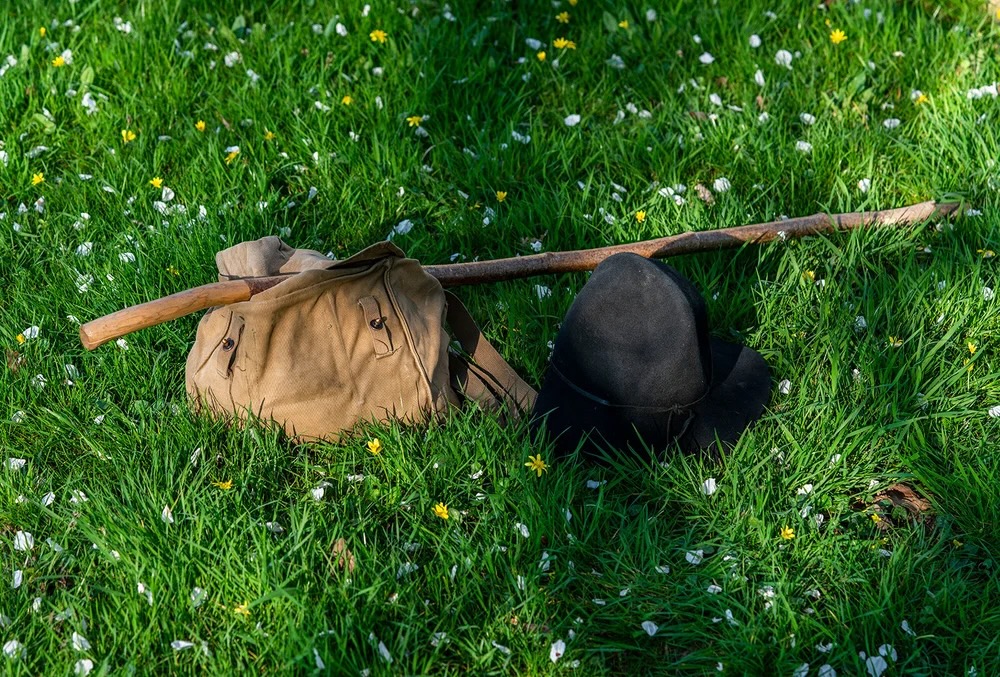
Photo by William Parsons
The Paradox of Connectivity
Modern life is increasingly connected: central heating to phone, fridge to supermarket, watch to heartbeat. Without touching a button we can chat with friends in Australia, while eating strawberries at Christmas.
Yet beyond this glimmering convenience looms a shadow-side. For modern life in Britain grows ever more disconnected. Food comes from a shelf, water from a tap, and community from an app. As for travel, it occurs at unfathomable speeds, as we rush along tarmac strips, strapped into metal boxes watching screens, following other cars and road-signs, turning when the sat-nav says so. Where travel once generated constant discovery via deep interaction with places and people, modern journeys have become a dream of pure destination, an increasingly impatient thrust toward instant arrival.
Travel by car (or train/plane) performs a conjurer’s sleight-of-landscape, a folding of the map, to magically shift us over vast landscapes without ever experiencing them. This is journey-making with minimal connection. Temperature is thermostatically controlled, sound is piped entertainment, hills are reduced to a slight extra weight in the heel, and rivers to the bump of a bridge under tyres. Between start and finish, everywhere becomes similar grey roads.
All of which causes separation, isolation and disempowerment. With our hyper-reality and digital lifestyles, we have forgotten how to look in our neighbour’s eyes and see how well they are. The smog of mortgages and motorways, and the ever-increasing pace and price of work/life, leaves little time to simply connect with the land, with ourselves and each other. Traditional guides fail us, religions plagued by scandal, and science proclaiming that spirit doesn’t even exist. In this modern landscape, it isn’t easy to break through to the Light.
The Way Forward
But there is good news. An ancient spiritual technology has been rediscovered, offering direct engagement with Source. You don’t need to dress smartly, sit still, feel guilty or get bored. No gurus are required, no intercessors or priestly authorities. It is a natural form of whole-body movement, a deep dance through imaginary labyrinths, and a hearty adventure.
Folk call it pilgrimage.
Pilgrimage is the ritual short-form of your life’s journey from birth to death. The aim is that by walking a short way correctly, you can put right your longer journey.
The basic technique of pilgrimage is to set an intention for wholeness, choose a holy place destination, and connect the two by walking. It is as simple, and infinitely complex, as that.
Walking is the oldest, slowest and deepest way to move across the earth. Intention is your motivation, the inner hope for healing that pushes you to make pilgrimage. And a holy place is somewhere in the world you feel can offer the wholeness you need, whether spiritual, mental or physical.
Finding your intention is the first step of pilgrimage. What lack needs filling, what question needs answering? Bringing this into consciousness – as words that can be repeated like a mantra – is a vital cog in the technology of turning a vague walk into a pilgrimage. If you don’t know which port you are sailing to, no wind is favourable (Seneca).
Next comes your choice of destination, a holy place that will harmonise in some way with your intention. You might choose somewhere intensely personal, the burial place of an ancestor or the site of a childhood memory. Or you may prefer to seek somewhere more universally well-known. Certain locations in this land have held the dreams of hundreds of generations of seekers, and in such holy places, deep echoes linger from those whose journeys went before.
You may find this word ‘holy’ troublesome, as if signalling pious spiritual exclusivity. But ‘holy’ doesn’t necessarily mean religious at all (though it can if you want). At root, the word derives from the Old English Halig, meaning wholesome and complete. The Scots word hale (as in ‘hale and hearty’) is its nearest living descendent. The same root word gave us ‘healthy’, ‘holistic’ & ‘healing’.
‘Holy’ is a very distinct word from ‘sacred’, though the two are often used interchangeably. Sacred derives from the Latin sacre, meaning set-apart, distant, unobtainable. ‘Sacred’ is like a distant star, beautiful but untouchable, while ‘holy’ is like a jug of water for the thirsty, something vital to integrate into the depth of your being.
Ultimately, what makes a destination holy is you, your need and the journey you offer. Wholeness (holiness) doesn’t sit around throbbing. It is activated by relationship. The healing magic needs you to need it. And there is no better way to activate this holiness than to take the time and energy to slowly walk toward it. The unreasonable dedication of an intentional journey on foot is a powerfully sincere sacrifice of time, energy and focus – making pilgrimage an effective key to unlock holy places in the land, body, mind and heart.
Deep Moving Roots
Bipedalism – walking on two feet – is our species’ original advantage, the biological life-hack that cast us as the upright strollers of the monkey family. Once we sourced this tech’ of walking, for two million years our ancestors were nomadic, roaming the planet in reverent pursuit of the herds and seasons. Constant movement shaped our evolution, creating the bodies and minds we have inherited today. Our species is homo perigrinus, and who we are grew from life on the path, our oldest home.
Yet a mere twelve thousand years ago, humanity ceased her restless roaming to begin cultivating agriculture and raising static dwellings. Arguably this was a bad move, leading to general imbalance.
Pilgrimage as an activity distinct from normal life arose in response. By providing a ritual reconnection with our ancient wandering freedom, pilgrimage helped keep alive the ancestral strength, beauty and wisdom of humanity’s nomadic inheritance.
Once you start seeing it, pilgrimage appears as one of our species’ great common forces. Wherever a stone has been raised, a temple built, or a spring recognised, so people have come (usually on foot) from near and far, bringing their hopes, dreams, offerings, prayers and songs. If you squint your eyes a bit, even our modern everyday journeys to the shops, to school or work, appear as (debased and frustrated) forms of pilgrimage.
The pilgrimage instinct is as fundamental a law of the human soul as gravity to our atomic reality. It doesn’t matter what faith (or lack) you follow, nor whether you believe in gravity or not. The apple always falls, and pilgrims always come.
But the path has not always been smooth, and pilgrimage has waxed and waned in these lands, attacked by the sharp hopes of kings and industrialists. While I was growing up, the peregrine precedent was almost invisible. Wanderers rarely passed my window. The Romany seemed settled, druids drove vans and troubadours endured mortgages. To be a tramp seemed to require alcoholism.
Yet today we witness the return of honest wandering society, as pilgrimage revives into a living British tradition, like Arthur awakening from his hill of slumber. Our hour of need has come.
Annoying the King
Those who decide the rules in society enjoy imposing their will upon us, because there is advantage to be gained in so doing, and because they can. Pilgrimage offers a shortcut to evade these heavy games of control. By taking the path, you can restore your ancient state of animal liberty, becoming wholly in charge of your time and passage through life, if only for a short-ish while.
Two hundred years ago, to be a British pilgrim you would have been sent to the workhouse or charged with vagrancy. Three hundred years ago, you could be transported to a penal colony or hanged. But today, pilgrimage is free for the dream.
You may feel you have little choice in life, pushed along by the normal forces of work, family and friends. But pilgrimage provides an opportunity – and challenge – to reclaim your personal autonomy, to plant a staff in the river and stride upstream.
For many people, there is a guilt response to this idea. The wonderful inefficiency of pilgrimage makes its time-demands look like gluttony. How can you possibly take two weeks to walk somewhere you could drive in two hours?
Such are the harsh internal shackles of convenience that govern the modern mind. For the responding question must surely be: to whom does your time on earth ultimately belong? Dare you stake one small portion for yourself? Can you really afford not to?
This is difficult to answer from the sofa. No matter what I write, you won’t really know until you step out, staff in hand and home on your back. Not even the ultra-rich truly own their time. But between the roads, the pilgrim inherits the earth.
As medieval scholar J. J. Jusserand said, pilgrimage has always had the power to “annoy the King”. And in our modern age, under the ever-watching eyes of state, corporate and digital kings aplenty, the freedom of pilgrimage shines brighter than ever.
“Liberty calls aloud, ye who would hear her voice…” (from a confiscated broadsheet, 1793)
I hope to see you on the path. Bring a song. It is not getting dark.
Walk well!
. . .
(The above is an extract from William Parsons’ forthcoming book, The S.O.N.G. of Pilgrimage.)
. . .
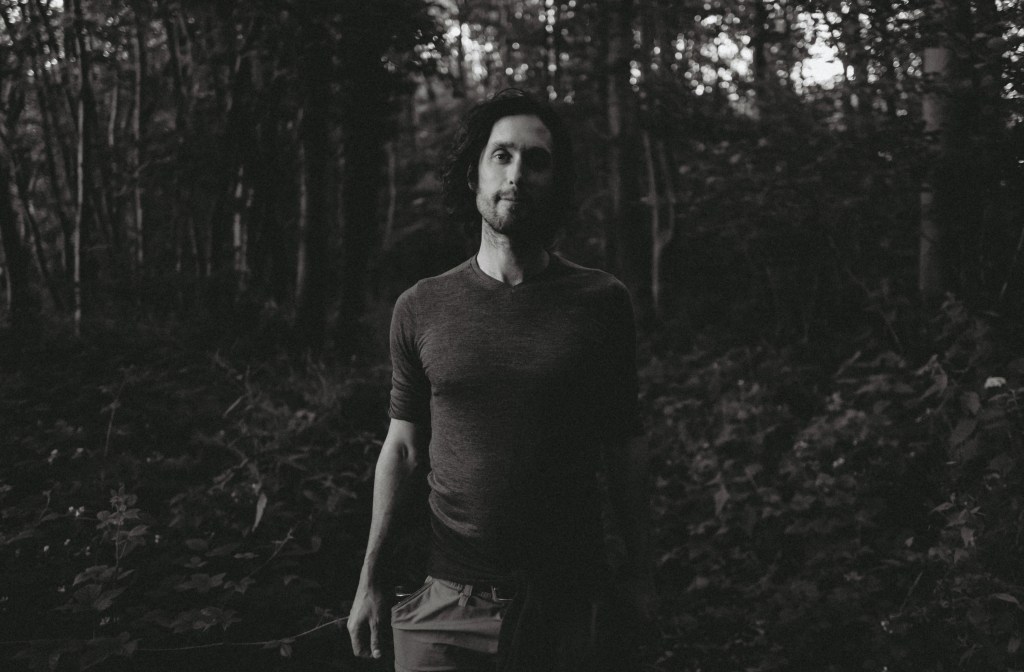
William Parsons has worked in British Pilgrimage since 2004. He spent his twenties as a wandering minstrel, in his thirties he founded the British Pilgrimage Trust, and in his forties he returned to freelance pilgrimage with a focus on writing. His work has reached most UK newspapers, TV channels and radio stations. He even got pilgrimage into Vogue. William lives in Glastonbury where he guerrilla plants Holy Thorns.

 BURNING HOUSE PRESS