Memorial to Lieutenant Hans Hermann von Katte. All photos by Marcel Krueger.
The border is the maddest line on the map, the most fluid, unnatural and dangerous. Tomasz Różycki, from Trial by Fire
On the 3rd of November, 1730, Lieutenant Hans Hermann von Katte, then 26 years of age, was led from his arrest cell on the Gendarmenmarkt in Berlin and, under guard and by carriage, transported to the fortress of Küstrin and his death.
Katte had been an intimate friend of the Prussian Crown Prince Frederick, who had been constantly abused by his father Frederick William I. In August 1730, the prince planned to desert the court and go to England. He wrote to Katte informing him of his intent to abscond and that Katte was to join him in The Hague. But in his haste the prince did not add Berlin to the address, and a diligent Prussian postmaster delivered the letter to another Lieutenant Katte who in turn reported its contents to the king.
The response of the father was to beat his son up, so badly that a member of the court had to step in to prevent the king from killing the prince. Frederick was then sent to the fortress of Küstrin under arrest, and the king ordered Katte’s unit to court martial the lieutenant. They did and sentenced him to life. The king was not happy, and asked the court to come together as: “They should administer justice and not gloss over it. The court martial should reconvene and rule differently.” They nevertheless upheld their sentence, and in the end it was the king alone who sent Katte to his death.
I am 295 years late to his execution. My journey from Berlin does not take me to death, yet, but as so often when travelling in Germany, to calamity and ruin. Leaving from Berlin-Lichtenberg, once one of the main stations of the GDR, in the early morning, I take a small regional train past the brown and green fields and forests of Brandenburg into the floodplain of the Oder, the Oderbruch. Autumn frost lingers on the forest paths and in the shadows of the railway embankment. This must be among my favourite things in the world: travelling by train on a glorious autumn morning, to look at the ruins of the past. My journey to the death of Katte is, after all, not only a Prussian pilgrimage but also one across the layers of the recent history of Europe and its leftovers.
The line I’m travelling on, now a branch line connecting the smaller towns and villages of Brandenburg with the capital, was once part of the Prussian Ostbahn, the eastern railway of the German Empire. From 1867 on it connected Berlin with the far reaches of the Reich, the province of East Prussia and its capital Königsberg, Kaliningrad in Russia today. From Berlin you could reach Königsberg via express in six hours and 38 minutes, and it was here that the successors of Katte in the Prussian army transported men and guns east, in 1914 and 1939. Double V’s of flocks of geese on the way to their winter quarters cross the blue autumn sky above my train chugging east, and I wonder if Katte saw similar things from his carriage, and if he thought about a future he would never see.
The empire is gone now, but its legacies remain. On the old station building at Seelow-Gusow the distance marker to the capital (Berlin 63 kilometres) is still intact, but the one indicating Küstrin has been chipped away, as if the authorities of the GDR did not want to remind their citizens of a town lost. During the Yalta Conference in February 1945, Stalin and the western Allies had agreed that Poland would be given former German territories: the southern half of the province of East Prussia and the provinces of Pomerania and Silesia. The German population was forcefully expelled and the areas repopulated with Poles expelled from the Kresy regions in the east of the country, which were in turn divided between Ukraine, Belarus, and Lithuania. Over five million Germans were forced to move west, and over three million Poles forced to follow them, all leaving their homes behind. The river Oder became the new border between Germany and Poland.
Ponds and creeks are increasingly visible from the train, and then we arrive at the Oder proper. The stream here is not a single border river with high banks, but more meandering, older, untamed. My train crosses at the confluence of the Oder and Wartha rivers, and rolls over two long bridges crossing both rivers and the low-lying marshlands between, before it comes to a halt in Kostrzyn nad Odrą in Poland, German Küstrin before 1945.
Kostrzyn nad Odrą is a newer settlement however, expanded from a former German suburb. In front of the train station there are signs indicating Stare Miasto, the old town. In many other towns across Poland, that means the medieval centre, places of cobblestones, cozy pubs, Christmas markets and buskers. In Kostrzyn however it means an absence. I walk towards the rivers again, cross the shiny new bridge for cars and pedestrians across the Warta and reach what was the border crossing until Poland joined the Schengen area in 2007. There’s a hotel, a McDonald’s, a gas station and one of the ubiquitous Polenmärkte, a market where Germans from Berlin and Brandenburg came — and sometimes still come — to buy cheap booze and cigarettes and get a haircut. Behind the hotel is the old town, or to be precise the lack of it.
Because of its position between the rivers, the Prussian authorities had decided to build a fortress here in the 16th century, which had grown into a sprawling red brick edifice with massive bastions when Katte and Frederick arrived. Following the unification of Germany in 1871 it was expanded again and became a mixture of civil and military architecture, with impressive merchant houses lining the cobbled streets along which trams clanked and the new middle class of the German Empire strolled. All of this existed until March 1945, when the Red Army defeated Wehrmacht defenders here in a brutal battle in which over 3000 men perished. When the smoke cleared, Küstrin lay in ruins. Over 90 percent of the old town and the fortress were destroyed. But unlike many other towns it was not rebuilt as the new Polish authorities preferred to develop the settlement nearby, its bricks instead shipped to Warsaw as building material.
The overgrown ruins of Kostrzyn.
The overgrown ruins of Kostrzyn.
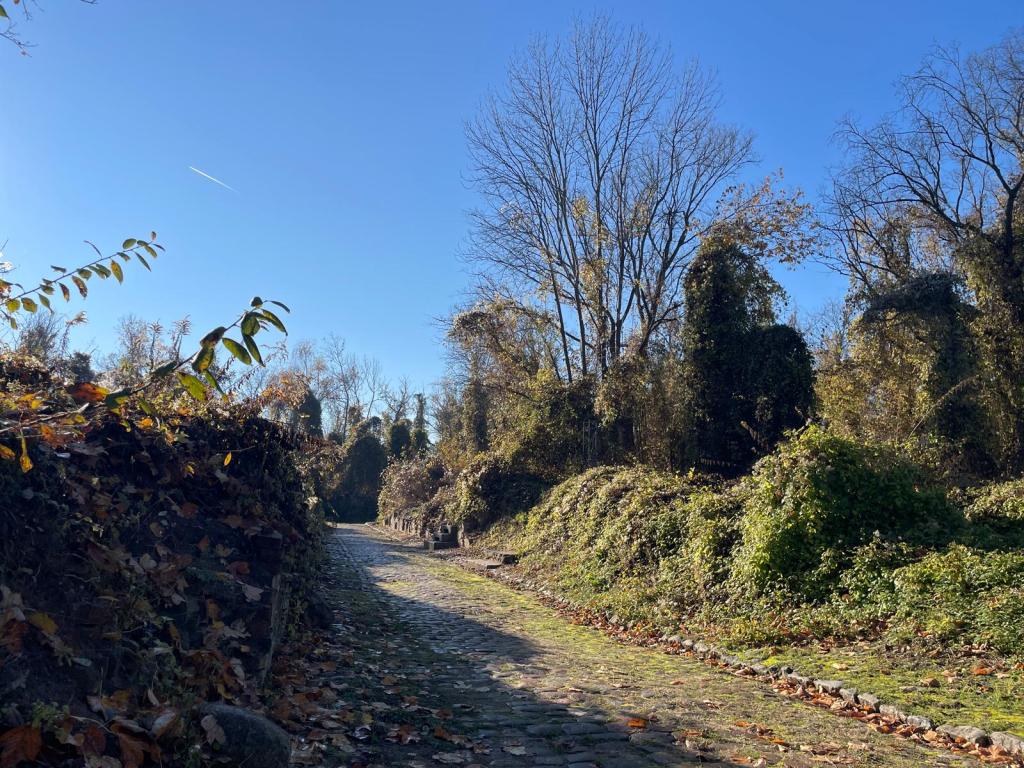
Today, what’s left of the old town is overgrown, trails and open spaces indicate where streets and squares used to be, sometimes still lined with curb stones in front of houses long gone or a few meters of cobbles poking out between the grass. New street signs in German and Polish point nowhere. Some of the Prussian bastions have been rebuilt and house a museum, but even on a sunny Saturday I have the former fortress almost for myself. There is a couple walking their dog, and a man in military fatigues is flying a drone over the ruins, but other than that it’s just me and the German ghosts.
I reach the rebuilt Brandenburg Bastion. Here, in the morning hours of November 6, 1730, Hans Hermann von Katte was led and forced to kneel, while his friend was made to watch on the orders of the king. According to some sources, Frederick shouted in French to Katte: “Please forgive me dear Katte, in God’s name, forgive me.” Katte called back: “There is nothing to forgive, I die for you with joy in my heart!” Frederick then fainted. Katte was allowed to say a prayer and then beheaded by sword, his body covered with a black cloth but left under Frederick’s window all night.
Katte’s friend never escaped the clutches of his father. Frederick remained imprisoned for another two years, and then joined to Prussian army. He would later acquire the moniker ‘the Great’ after fulfilling his father’s dream of a Prussian empire. While he married he remained childless, his court was almost exclusively male, and he is buried with his favourite dogs on the grounds of his castle of Sanssouci.
. . .
In the walls of the bastion sits a memorial plaque to Katte next to a passage to a small harbour by the banks of the Oder. The inscription reads, in German and Polish: Lieutenant Hans Hermann von Katte, born 1704 in Berlin, beheaded 1730 in Küstrin as escape agent of the Crown Prince Frederick. I step down through the gate, and a quintessential European panorama presents itself to me: red brick and catastrophes by the banks of a tranquil border river under a blue autumn sky.
As I walk back I look at Katte’s plaque again, and realise that someone had added two words in German to the frame in black marker. The memorial now reads: Lieutenant Hans Hermann von Katte, born 1704 in Berlin, beheaded 1730 in Küstrin as lover and escape agent of the Crown Prince Frederick.
. . .
Marcel Krueger is a German-Irish writer and translator living in Berlin. Through family history he explores the tragedies of Europe in the 20th century and what these mean for memory and identity today, especially focusing on Ireland, Germany and Poland. His essays have been published in The Guardian, Notes from Poland, 3:AM, Paper Visual Art, CNN Travel, New Eastern Europe, Przekrój, and The Irish Times, amongst others. Marcel is the co-editor of Elsewhere: A Journal of Place, and has published five non-fiction books in English and German, among them Berlin: A Literary Guide for Travellers (written together with Paul Sullivan, 2016) and Babushka’s Journey: The Dark Road to Stalin’s Wartime Camps (2018).



 BURNING HOUSE PRESS