Dry Chaconne
the air was parched the earth in drought when you left me
thinking of Lorca the desire of the rain remembrance
of the earth the smooth earth when it rains has a scent
as you did when you came to me in splinters
a weight of longing a turning wheel straining the fibres
of your countenance blurred visions flecks of silvering light
the smallest gestures of your eyes arabesque, interlacing
rhythmic in the shimmering air shivers of electric blue
a tapestry of shadow layers of ice melting
the rain falling the desire of the rain a memory
of the earth in Lorca shards falling
splinters of rain the dry earth around me
our ritual gestures fragility of longing the suffering
of the rain in the chasms of your eyes an infinite waiting
for the simplest things infinite light infinite heat
a daze of deep yellow layers of ice melting
a tapestry of shadow the unsparing earth
the rain in Lorca the fibres of your eyes
all the fevers of the seas
as you wish
line bright with horizon
golden residues of day
α hours of the dwindling warmth
β warmth of the dwindling hours
γ dwindling warmth of the hours
dwindling sadness of the river
shoreline bright with stone
glistening time under starry moonlight
now quiet, all is becoming
Delta Oscillations
iterate
calm stream of aporetic present
oblivion of sleep
dreams grow more lively after dawn
close your peepers
reiterate
brief moments of gloss contentment
needs of obsidian
sleep will wash you with slow waves
night will keep us

The roadside is lined with old dead men, dessicated limbs splayed to the sky
and soil past their noses. Black clouds split open and spray  themselves at the
world. Clots of bioluminescent gore bounce off the frozen mud.
These walls and windows come
and go, drifting out of sight
between long blinks. There are
morning where my ceiling is the
sky, singing with wind and the
ghost of an old train whistle,
desolate moan stretched along
Stains hiding in the fold where heaven is supposed to be.
The white dome bubbling off the bottom-front of my face like a blister ready to
puke itself into the open air.  Bile that rolls across the ceiling and drips
off the 
top of the doorjamb. Sick light swims through the glisten. 
The waves lapping the shore erode the world, ocean spilling over the stems rooting
this place to the dirt.
Throbbing gray whole, wet and concave, lip bejeweled in a half-crescent of calcific protrusions. A well of nothing, parturient with a small pink lump, goosefleshed
sinuous oyster. A tale distilled to its base, retching that whispers a cold window down
the empty hallway.
I fall, blind, uncapped, spilling over the walls, absorbed into the porous labyrinth of hallways and boxes; a brick tower blooming upside down—a
stalactite on the sky—waves of grey reflected on the bottom of clouds—slow
red lightning that cracks the surface of the ocean like shattering glass.
Overhead is the choppy surface of the sea. The remnants of shipwrecks and
oil rigs paint the horizon like a hanged city skyline. Below, roiling grey clouds
and long rolls of thunder. Shadows that could be the backs of ancient 
leviathan that carved that great valley in the world and in time.
The moment loops in the porous mortar disintegrating between the bricks—boxes of different lives glued together—a scream upon deaf ears—radios playing in empty rooms—whispering a breeze of static electricity down the hallway.
The gun is in the drawer of my desk. The bubble of infection in the earth splits and wafts a blizzard of
sporous disease into the campsite. Noxious fumes stir the fire into a frenzy that scorches the detritus on
the ground. Bodies thrown together as the ground tilts—flesh melding on contact—a pile of thrashing
limbs and gnashing maws and rolling eyes—dissociated personalities—memories smashed to a
paste—mixed together—smeared across the underside of the forest canopy—catching
evaporation—raining grey mildew onto the red brick ruins.
*
The film grain captured in the still image wraps around me like a mesh of static electricity—picked apart by nervous nails snapping at my skin like pins and needles— blood flowing home, passing heat to their tunnels—exploding from the iron ring at the end of the barrel—pale mollusks that splatter underfoot.
The forest will be shorn away. Nowhere left to hide but under the soil. Trees sent
down river, blanched like the heaped corpses of death camp victims —algae flowing
along the rivers surface, shredded by currents—foaming white rapids—on the living
room floor vomiting—collecting bricks from the ruined building—slashing my wrists
in a bathtub—swallowing a fistful of Xanax.
We exist in footsteps.  Shadows rippling like water. Colorless light caught in your
eyes. A storm brewing between stones. Hunting whispers in the mortar. Wet red
dripping from the fingers on your cross-brace.
Flakes of memory drift past the backs of my eyes. The world is born in pale gray light. Shadows bloom from  the horizon. Candlelight quivering against the darkness like oil in water.
Your skin doesn’t fit right and there are too many teeth in your mouth.
 Moving white specks like storm-blown snow swirl in the air over his head. He doesn’t
look up from the page that is filling with ink. Black lines bleed as they cross and wave
and fall over the paper. Flakes getting caught in his gore matted hair.
I’m still breathing in the  spaces you can’t see.
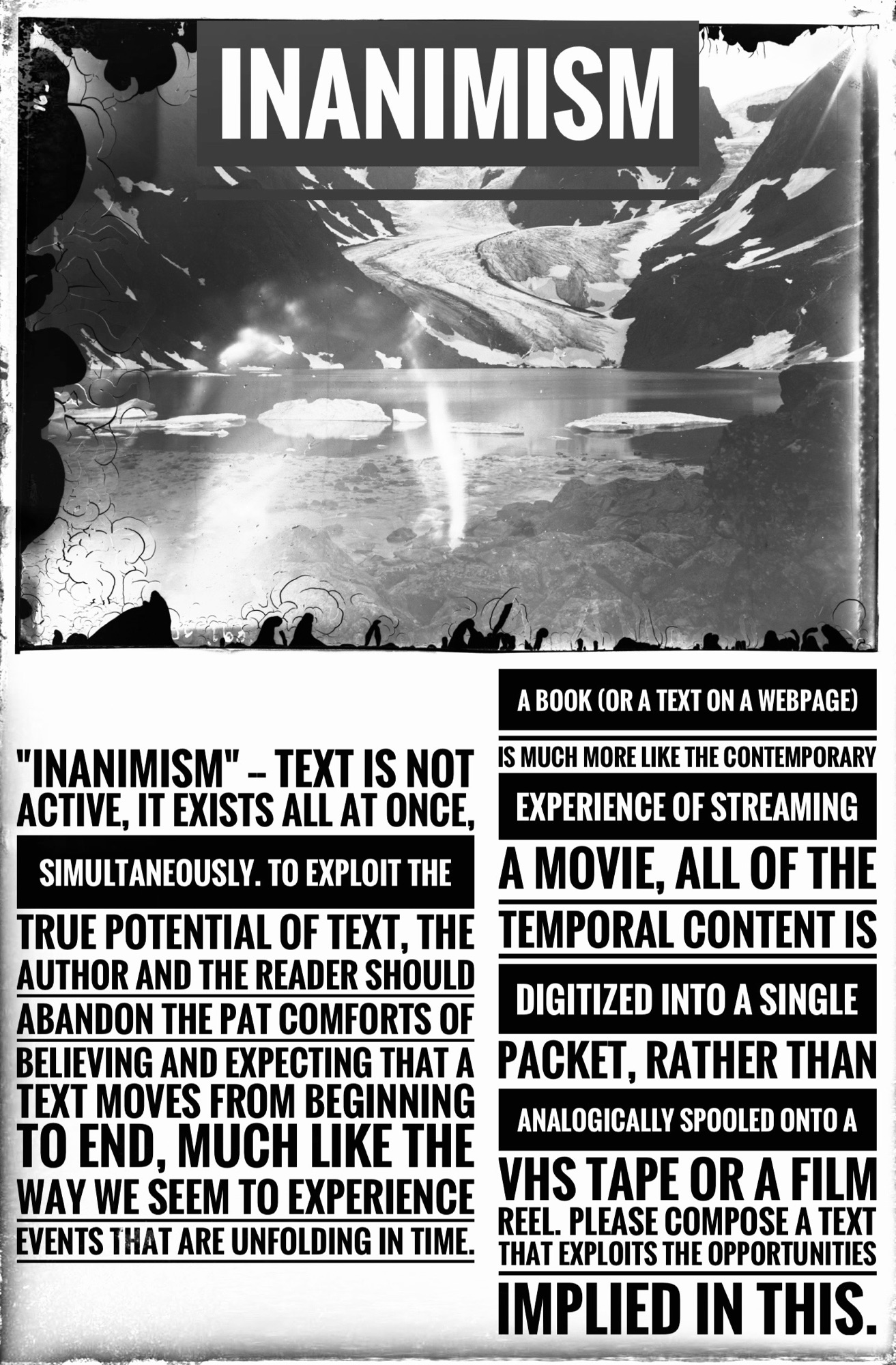
Burning House Press are excited to welcome JOHN TREFRY as the first BHP guest editor of our return series of special editions! As of today JOHN will take over editorship of Burning House Press online for the month of JUNE.
Submissions are open from today – and will remain open until 25TH JUNE.
JOHN’S theme for the month is as follows
—INANIMISM—
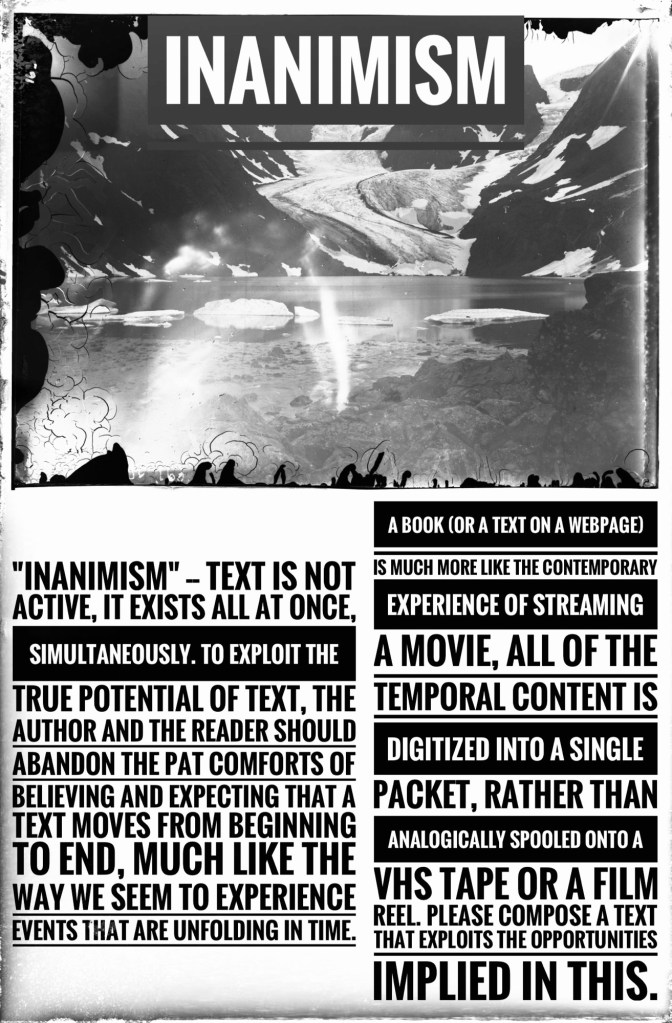
Submission Guidelines
All submissions should be sent as attachments to guesteditorbhp@gmail.com
Please state the theme and form of your submission in the subject of the email. For example: INANIMISM/POETRY
Poetry and Fiction
For poetry submissions, submit no more than three of your best poems. Short stories should be limited to 1,500 words or (preferably) less. We encourage flash fiction submissions, no more than three at a time. Send these in as a .doc or .docx file, along with a short third-person bio, and (optional) photograph of yourself.
Art
Submit hi-res images of your works (drawings, paintings, illustrations, collages, photography, etc) with descriptions of the work (Title, Year, Medium, etc) in the body of the email. Files should be in .JPEG unless they are GIFs or videos, and should not exceed 2MB in size for each work. File names should correspond with the work titles. Video submissions can be uploaded onto Youtube or Vimeo for feature on our website. Send these submissions along with a short third-person bio, and (optional) photograph of yourself.
Virtual Reality/ 3D Artworks
For VR Submissions, please submit no more than three (3) individual artworks. For Tilt Brush works, please upload your artwork to Google Poly (https://poly.google.com/), and mark it as ‘public’ (‘remixable’ is at your own preference). A VR/3D artwork can also be submitted as a video export navigating through the artwork. If you prefer this method, please upload your finished video file to YouTube or Vimeo and provide a URL. With either format, please provide a 150 word artist’s statement.
Non-fiction
Non-fiction submissions (essays, reviews, commentary, interviews, etc) should be no more than 1, 500 words and sent as a .doc or .docx file along with your third-person bio/and optional photograph.
Submissions are open until 25th JUNE – and will reopen again on 1st JULY2025/for new theme/new editor/s.
BHP online is now in the capable hands of the amazing JOHN TREFRY – friends, arsonistas, send our JUNE 2025 guest editor your magic!

Dead Sea
Saunter through snapdragons, the cobblestone path
inside his house, into a bath prepared
with Dead Sea salts by a sociopath—
Continue reading “Womannotated – Dead Sea”

Burning House Press are excited to welcome MAPULE MOHULATSI as our JULY 2020 guest editor! As of today MAPULE will take over editorship of Burning House Press online for the month of JULY.
Submissions are open from today – and will remain open until 25TH JULY.
MAPULE’S theme for the month is as follows
Continue reading “JULY 2020 Guest Editor Is MAPULE MOHULATSI!!! THEME: SINK”
Photo by Cam Fattahi on Unsplash
short story: Point Nemo
He’s been on two journeys in his lifetime. Firstly, Antarctica. With his son, Mark. Arriving by air, setting out (despite all the warnings), saying to the seventeen year old boy, We must take our first reading from the coastline. Mark saying, How can we do that? It’s covered in a billion tonnes of ice.
That doesn’t matter. Continue reading “Short Story by Stephen Orr”
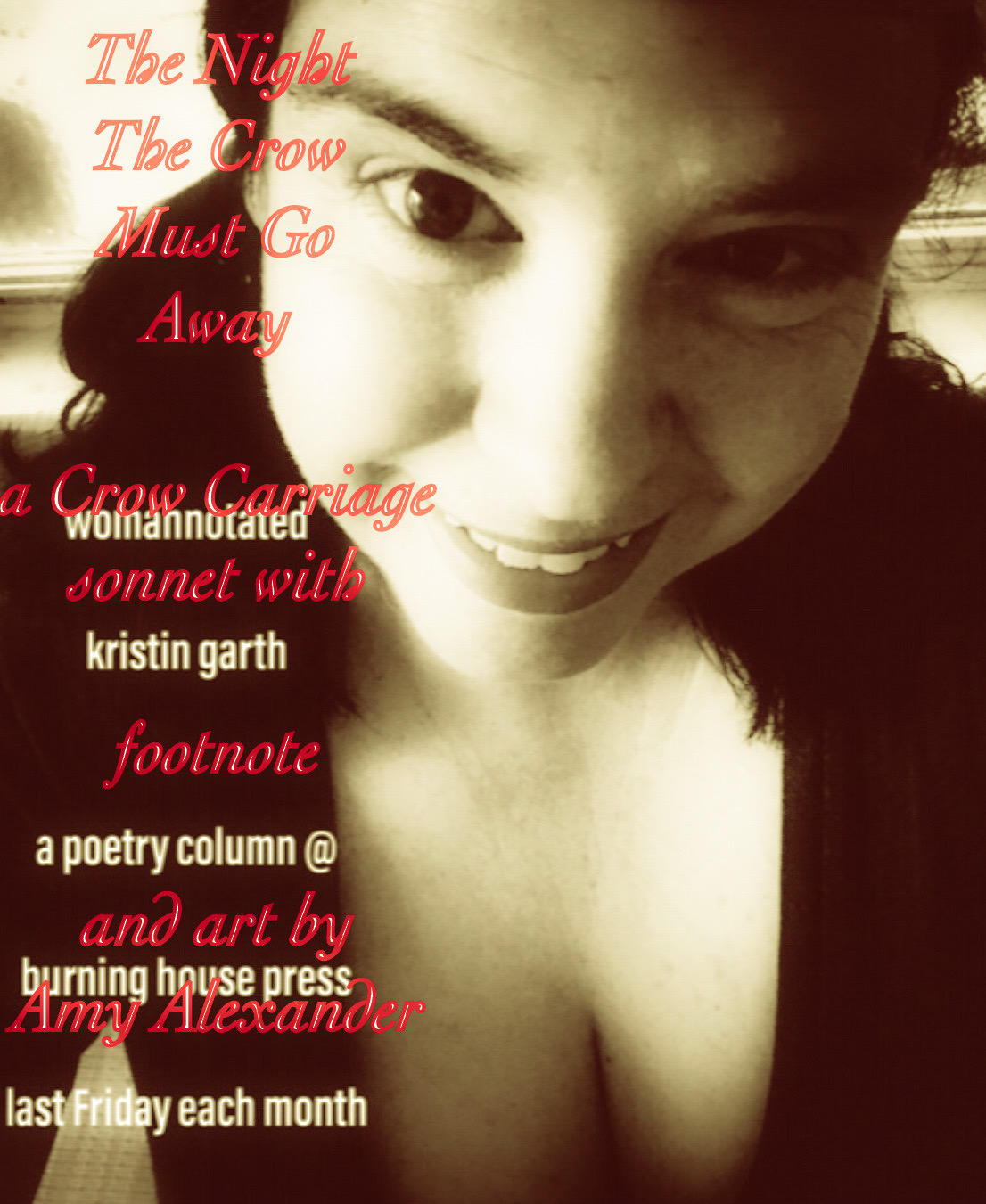
A sample page from Crow Carriage, an annotated poetic horror novel set in a Victorian English seaside village. This is the format of the Crow Carriage book, a sonnet with an expansive annotation that tells a story in prose below (the same format as my book Flutter available at my website and Twist In Time).
The Night The Crow Must Go Away
You lie beneath a dozen nightmares. Screams
careening down a crow-covered stair wake
you in the last second before the dream.
Continue reading “Womannotated – The Night A Crow Must Go Away”
At nineteen she decamps to an apartment in the western suburbs with her boyfriend, Tanner Walsh. This is not her first time living outside her parents’ home. There had been that whole year[1] [2] [3] at the university downstate — a semester in a traditional dorm room and then a desperately traumatic semester in a suite situation with three other girls who had all already been living with each other for a whole semester and who had a system and everything that went along with it (“intruder” is barely the word). The point being: she had lived alone[4] before.
Continue reading “Playing House, by Jenn Lee”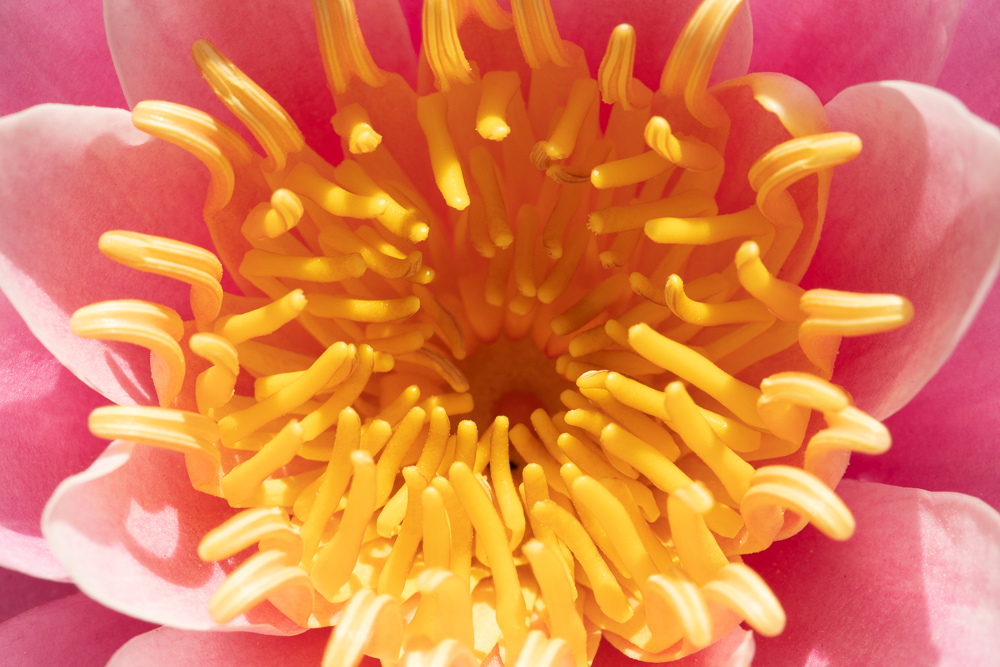


My Ariadne can see the future.
(My Ariadne. This is my version of the story.)
She spins her red thread, and it twists into shapes before her eyes, hearts and nooses. It tells her that Theseus turns out to be an asshole.
Seven young men and seven maidens arrive on the island, and Theseus outshines them all. His eyes are the sky blue of someone who believes he cannot fail, who believes he has no darkness within him. Those eyes make Ariadne dream of flight.
Theseus wonders how such a creature as the minotaur, half-beast, half-man, could be allowed to exist. Ariadne doesn’t tell him the last of the halves: the monster is her half-brother. In the evening she dreams of blue eyes, but her hands twist and turn the red thread. At midnight she dreams of mazes like arteries and veins, running red and blue.
Ariadne gives Theseus a coiled ball of thread the size of a heart. She tells him the thread will guide him out of the labyrinth.

“The poem surpasses the other literary arts in every way: in its depth, potency, bitterness, beauty, as well as its ability to unsettle us.” Jón Kalman Stefánsson
Unsettlement is a recurring theme in Tony Messenger’s debut collection ‘poems to be found in the desert’. Colonial unsettlement, traversing an uncomfortable environment,
d i s l o c a t i o n and the blurred lines of imaginary \\\borders///. \\\Boundaries/// & limits that appear, settle and dissolve.
This conflicting duality works to unsettle the reader, forcing them to ???question??? their place in the vast Australian →landscape←, an environment where nothing seems as it appears.
The epigraph for the opening section of poems comes from Ely Williams “I find that out in the desert my words wander too because here thoughts and words are things unleashed.” A warning that the collection is peppered with thoughts and words unleashed, a cryptic murmuring, a maze of ideas that circle, repeat, fade and reform. It is easy to become lost in this text, thinking you’ve already experienced an image, but a refresh and a re-read show slight differences, an erosion, a morphing of concepts.
This is the desert where the obvious is not so obvious.
The collection opens with the poem “longifolius” (the scientific name for the spiky spinifex grass that is abundant in the central deserts). The poem can be viewed as a metaphor for Australia itself. The grass grows in a ◌circular◌ clump, and as it ages its shape becomes nest like, with the centre ►dying◄ off as the grass uses all the available nutrients in the soil, the newer stems sprouting on the outside forming ◌concentric◌ patterns. The inner “►dead zone◄” is a haven for ants, who feed on the ⸙seeds⸙, and reptiles and birds, who feed off the ants. Hence the ◌circular◌ shape of the poem. Something that may appear barren is in fact teeming with life. Look to the centre not as an ⸔inhospitable⸕ place, look for details, enquire with a local pair of eyes.
Continue reading “Review ‘poems to be found in the desert’ by Tony Messenger”

. . . something about a man and his dog (in the grand, non-linear scheme of reincarnation) as being one in the same. Soul, that is. Ethereal transient dweller, is another. Here now, there they are: Situated between two distinct, bloody meat husks, between two separate states of existent being — at once, under one roof, simultaneously — with one foot in man, the other, a dachshund-terrier mix.
. . . is comprised of both end and endless, singular and infinite, of omniscient oblivion, bright-dark heavy-light, of both shape and void, each with their own distinct name. As a man: Brandon. In dog form, she is Mocha, among countless others (i.e., Mochi, Mookie, Monkey, Chunky, Chubbers, Chunkmonster. . . ). As mutual entity, root identity, as timeless core incarnate, a loose translation: Daielaareux.
. . . will spend seven months at the shelter, gone unadopted longer than any other dog, before rejoining herself again. Meanwhile, she cries her jaw off. Starves herself down to a coffee-boned silhouette. Even draws blood from the hand of a guileless child, to make clear the message: I will never be yours. She waits patiently for what she already knows will eventually be.
. . . remembers what, on pure impulse, will drive him to the shelter in this manic grasping for purpose, going on six days without medication. He will come upon himself, caged separate. His ovaries scooped clean. Groggy with shots to keep him quiet, stagnant, alive. Not even finding himself to be particularly cute, or unique, or enthralling, yet feeling instantly connected, just the same. Might he’ve recognized then, in those muted eyes, himself? She knows the next years ahead of them together will be nothing so glorious — that they are in no way ready or responsible enough to take adequate care of themselves. They will ingest things that will make them violently ill. They will be too poor, too careless, to seek medical help. Will endure vast chunks of boredom, chewing holes through themselves, incapable to leave the house. Will watch themselves from the foot of the bed sulk and rot away for days on end, treading the grey wash of their skull, directionless, besides down. Will be the only life force to keep them afloat, strong enough to pull themselves upwards, and eventually, out.
. . . yanks on their leash in unruly directions, and, out of sheer spite, he tugs them back the opposite way. Each will struggle to tell themselves what to do. He instructs her to obey: Sit. Heel. Eat. Fetch. Up on the couch. Now, off. But she refuses to listen. Years later, their heart crushed by a lasting love, lost — the one who used to (she now learns) smack them in private, but still loves her, despite the abuse — two months out, having still not washed the pillows or sheets, incubated with the tortuous scent of their ex’s shampoo, she has no other choice than to piss on the bed. She instructs him to: Be calm. Go for a walk. Know your self-worth. Move on. But he refuses to listen. He tells himself: No. He calls herself: Bad girl. They scream as themselves: Shut up shut up shut up.
. . . Daielaareux, in countless other forms: A bridge in New Zealand. A strip mall in Detroit. An unbuttered croissant. A great big pile of leaves. A spanned lineage of prehistoric, neon-colored crabs. A comfortable silence. An impossible dream. The 37th Annual Miss America pageant. A one-hit wonder. An impotent king. A fortuitous accident, recognized only in hindsight. The Divine Mouth taking the earth like a vitamin. A newborn horse’s first step. Another one biting the dust.
. . . forever amounts to, returns back to, self-love.
. . . just seconds before the New Year, 2018. Time hibernates. Thoughts shuffle like a deck of cards. Head loud. Skull turned inside out on psychedelics. A blubbery, sunken, self-contained mess of fleshy slop packed inside a transient shell. A dark stain on the carpet, on a mother’s pelvic floor. He rushes to the bathroom, convinced an empty bladder will cure him. It does, then doesn’t. Grime sits in every wrinkle. Gravity’s tandem held hand lets go. The universe’s veil pulled down like a shower curtain, their many forms spilling out over the linoleum floor. On their knees, hands, back, she perches on his chest and he catches it — a quick glimpse, the uncanny resemblance, atoms stacked like dodged shoved in a cage. He holds herself behind the ears, kisses himself on their wet, hot stinking teeth. Noticing it fully, this tethering between them — an ethereal cord, conjoined. He she they them are all was once will have had we become continuous as one day slips seamlessly into the next without a clock, as the crackling bursts of fireworks resound from outside, at last. They have made it, for now.
. . . in the same windowed timeline, will cease just as abruptly as its start: The man, at the tender age of fifty-six, from an untreated pulmonary obstruction; as a dog, age nine, a pack of stale Oreos left accessible at the top of the trash. And yet, both still remain incapable of saving each other, themselves, from what must be in order to happen again.
Stephen Wack is an Atlanta-based writer. He earned an undergraduate degree in Neuroscience from the University of Georgia, where he briefly interned at the college’s literary magazine, The Georgia Review. His work has previously appeared in Five:2:One, Rougarou, and Cleaver Magazine, and is forthcoming in The Hunger and New Flash Fiction Review.
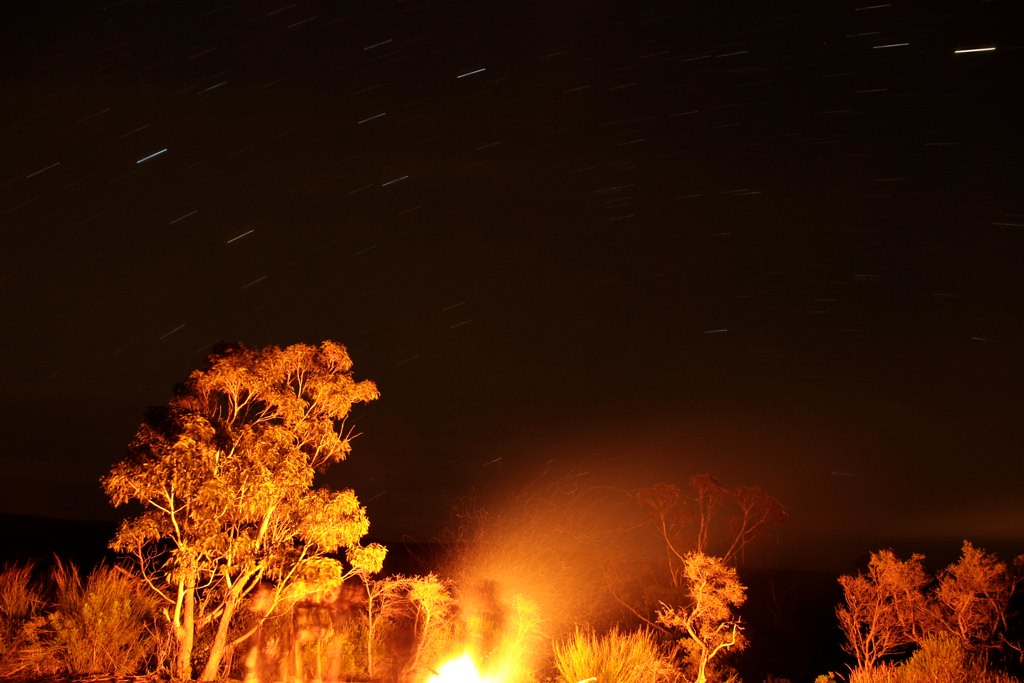
I
She said her name was Billie. Her mama called her Billie-Jean when she called her anything at all. At fourteen she was all angles and knees and steel-blue eyes. We sat in the doorway of my 1970’s shit-brown RV, the orange shag rug faded to something between mustard and burnt sienna. Dirt had settled so deeply into it that it was hard to tell the difference between the ground and floor. Continue reading “The Tao of “Howl” by KB Baltz”
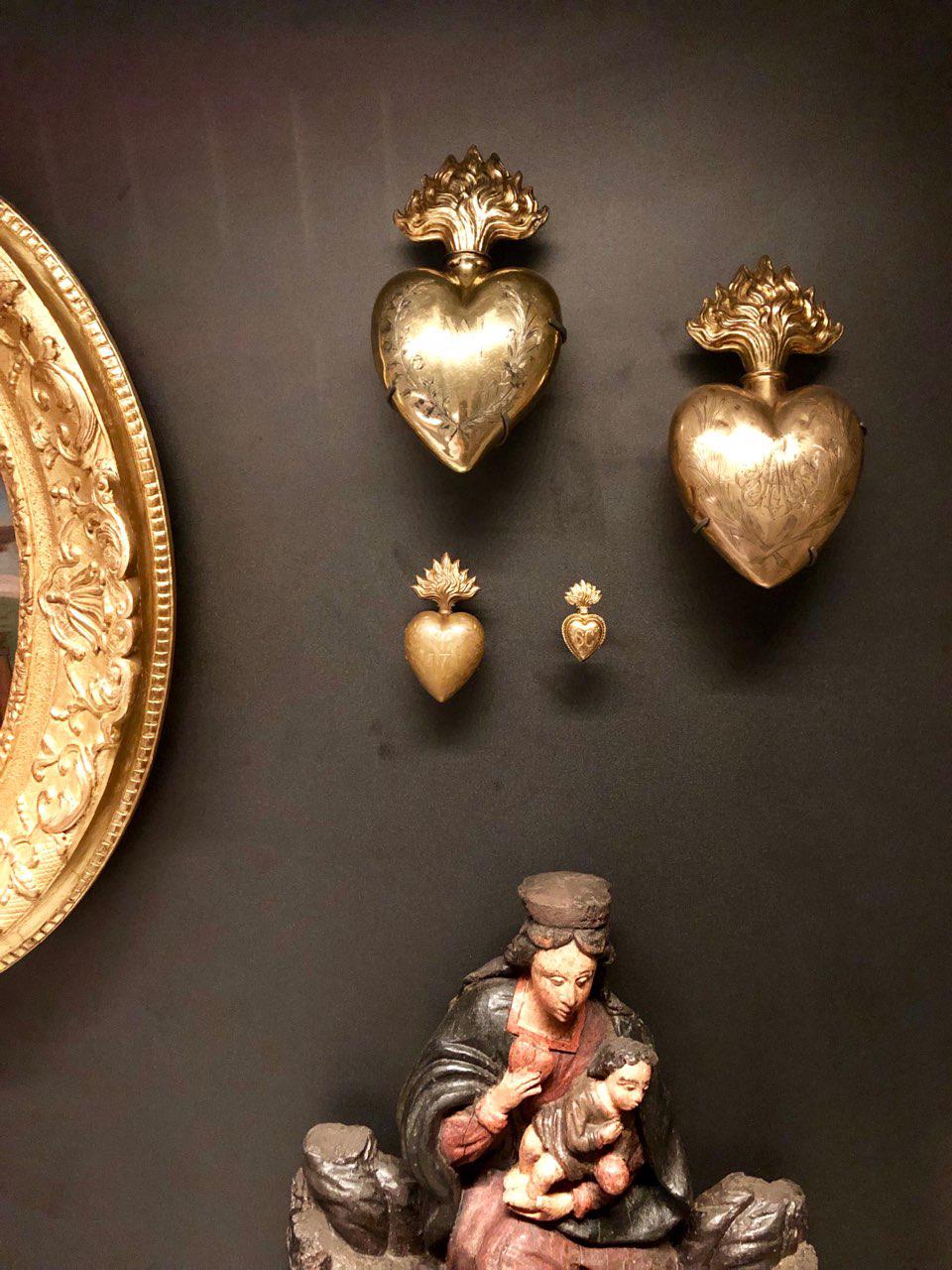
Venus:
You are well aware of how to procure an accurate prophecy. You’ve been doing it for years and this year is no different.
You cycle into outer space. It is a warm June night in England and a cold, unnamed never-time everywhere else in the universe. When you find the prophecy, it has been circling a distant sun for a millennia. It looks like gold and feels warm, the temperature of skin. You tuck it under your tongue and it tastes like raw egg yolk.
Continue reading ““Seven Women: Details of a Generational Curse” Fiction by M. R. Massey”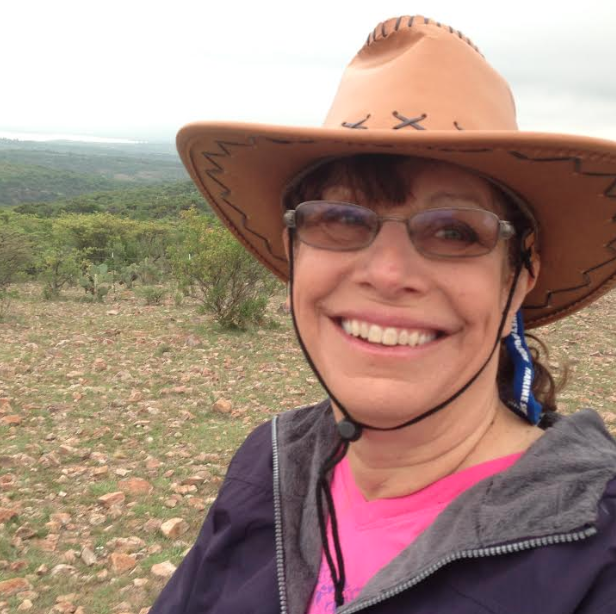


bibles is the author of ‘Better Face of Facism’ find him @appropouture.
 BURNING HOUSE PRESS