Search

BURNING HOUSE PRESS

Not For Profit/For Prophecy

Journey To The Centre Of Dictatorship by Line Stockford

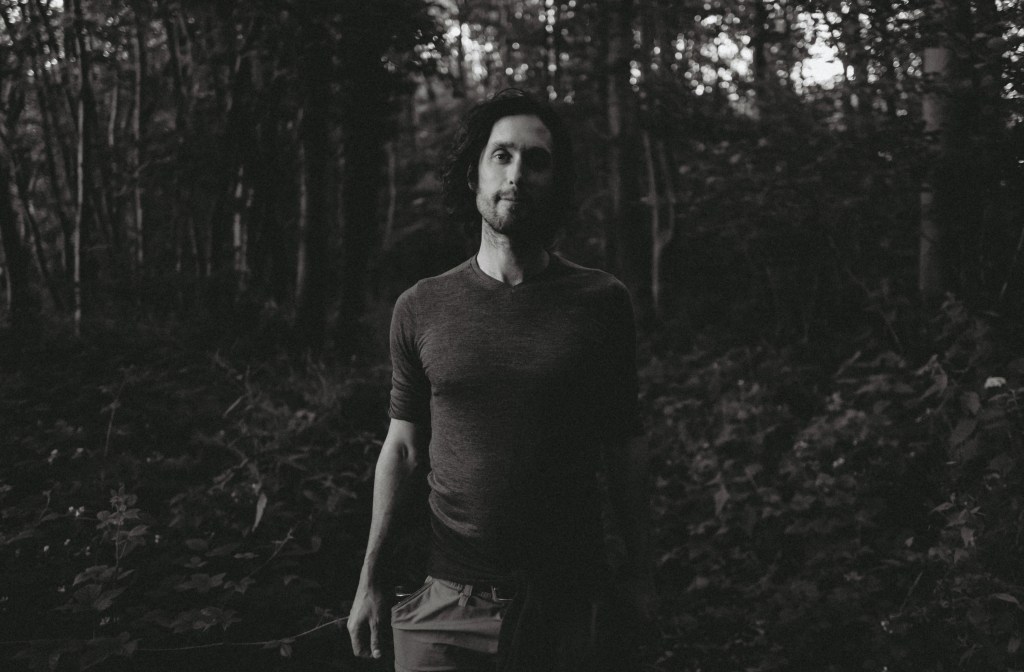
Photo by Caroline Stockford

Once you see past the cellophaned shop-window of tourism and into the infected stomach-wound of political history you begin a journey to the centre of dictatorship. And you’re likely to survive. Because in their eyes you are a mere fly on the wound, spinning on the spot, feeling sick and having to suck it all up. They might feel an occasional tick at the discomfort of you’re reporting all their business, but with a quick swat, the threat of being locked up, they will send you packing. Off you fly back to your country. You’ll soon be back again. You’ll come because the scent of such drama and the chance to ‘make a difference’ is so seductive.

You will climb into airplanes and out of airplanes, stand in queues at airports listening to psych rock on repeat to make it seem cool to be wearing a suit. You will walk into climates where heat makes a sudden pass at you. The hotels will have terraces descending to cake-crumb concrete, ornate cities choking politely below you. You will blag free afternoon tea in the hotel where Agatha Christie disappeared. You will do this for years and years. Buoyed on the beauty of this city, by the people from whom you learn the meaning of solidarity.

You might go to courthouses larger than a demigod. Where justice is not just blind, she’s in intensive care. Every now and then, to fool the concerned Specialists from overseas at the bedside of Democracy daughter of Anatolia, there is a blip on the heart monitor in the form of a ‘good’ decision from the Constitutional Court. Everyone from Europe nods and puts a tick on their clipboards, smiling at each other from behind the surgical masks.

The British and French have scalpels in their pockets, just in case they get another chance to make choice cuts. It’s all they can do not to dot lines on the flesh, “Je vous en prie, madame mais j’ai l’envie de vos cuisses remplis de l’huile noir dorée.” They want to take her back to last century. She is confused and they all think she’s easy. She has had a lot of lovers in the past. They think they can own her just like Croesus tried but those silly billies don’t even know her real identity.

While Consultants from the EU compile assessments on the health and usefulness of the patient, the rats go on eating the body from underneath the bed. Small regional judges rebel against the Supreme Court. The government opens cases against the Istanbul Bar. Everyone visiting agrees the patient looks passably robust if you just don’t get too close.

The brochure that prompted your journey to the centre of dictatorship will be social media posts showing Kurdish boys dead on barricades and their families looking out from front windows, prevented from collecting their corpses due to sniper fire from the Turkish state. Dogs devour sons’ bodies near the door. You’ll see four old people, wearing white and waving flags be gunned down as they sneak out with a stretcher. Neighbourhoods and a city flattened by airstrikes and tanks. Sur, Cizre and the walls of Diyarbakır. It was 2016, just nine long years ago.

You’ll stand up, then, in your kitchen and say, “Yes, I am ready. Show me the treatment of women, show me culture of queer, show me the mothers of the disappeared, show me cyanide gold mines and grandmothers’ resistance, show me trans women called Hande and show the teeth of the police and what they did to her, show me 5000 teenage girls on a Women’s March, kettled in the super highway street of Istiklal, show me that lady in her eighties who sat on a rock with a staff, soldiers in a row behind her, trying to take over the olive grove as she blasts, ‘The State? I am the state here!’’’ You’ll say, “Show me oppression, the politics, police brutality, show me torture, show me 64 guards kicking a dealer to death in the prison at Silivri.” You’ll notice there are less and less women, they’re vanishing at a rate of one to three per day.

There will be an old man to clean your shoes on the pavement before going into court, but because you speak the language and had a family here, you will really talk to him and he will cry tears down a maze of lines from cornflower blue irises, telling you, “Inflation means it’s twenty lira for a few tomatoes, we don’t eat meat and we can’t make a go of it”. You’ll agree it is a sin to take over the Central Bank and to let inflation run at 168%.

By now you will be an international advocate. You will monitor 200 trials, hoping it will all get better. But fascism doesn’t need much sleep. When it’s too late you’ll see that you were not creative enough. You weren’t armed to the porcelained teeth or in league with deep state. How can you succeed? You don’t belong to the right cult. The President will laugh you off: “These people, they come here, make up a few numbers and leave.” At one point you won’t want to believe there are 185 journalists in prison. But you know them, you have met them and hugged them.

In seven years you’ll be scared for twenty minutes. Those twenty minutes on the day you decide to stand up are like being in an iron maiden, seeing your essence squeezed out and poured into a glass phial. You hold it up to the light – it is the right colour. You hand yourself permission to resist. Go and find them. They will show you the meaning of solidarity. They really will. Your dear fierce legal colleague who sticks with you, no matter what. Court reporter girls who stand up to the judge and are the subject of court cases written in the purple official bruise of his ego. The woman with 185 court cases against her, who still sends salvos to officials. The lawyers, physicians. They’re resisting so hard, are we with them?

The first court case you monitor will be Zaman newspaper, the journalist, editor, author and unliked man Ahmet Altan. Why don’t you sit in the front row, a copy of the OSCE Trial Monitoring guidelines on your knee? That’s how you monitor a trial, you see? Are they abiding by procedure? How much spare paper do you have? The trial will begin and you’ll write it all down. Then comes an undercover cop. He’ll lean his whole upper body onto you, staring down at the pad on your lap to read what you’ve written, “Are you with Human Rights Watch?” You should go on to record the rest of the hearing in Welsh shorthand. Barmouth Welsh.

You’ll fly over Mount Ararat, fancy that, with a lawyer called ‘the arrow’. Your combined presence, the lawyer’s arguments will get Berzan out on bail that day. You can change things if you put your energy right into the room. In these times of outsourcing intelligence, of never meeting, of cost-saving, if we stop meeting face to face, stop putting our physical, personal energy in the place where it is needed, where it will be seen and counted, then we will fall down either side of the abyss that is separating us, and will meet in a bloody mess at the bottom, wondering how it happened. The best advocacy strategy meetings will be twelve people around a table in Berlin, or in Brussels, or Istanbul, all equal in struggle and all winning. Slowly some of the elitist ones will unpick themselves like the decoration on a shawl, unwind and leave others in the cold. You’ll work on. Your reports will change the law.

How much is the ticket, you ask. Is it a time machine that will eat tokens made of years, of intimacy, friendships, of all else that exists outside the job? Will it be fuelled by all the poems you wrote and never published? You might only take one day off in seven months in lockdown. What else was there to do but work? When you see how bad it is every moment feels like the threshold of a potential win, of standing with them. And every time you think you’ve made a difference, the state will impress you with their newly proposed law to ban all mention of homosexuality on the internet; their throttling of the airwaves. One small squeeze is all you need once you’ve mastered and collected the horse of freedom, put in the brutal bit of police violence backed up by millions of canisters of poison gas at protests.

You will continue on this journey until the road kinks back and kicks you off the path. You will cling on by your fingernails, while life floats far away. You will stay on the road until a new boss steers the car into the back of a truck marked ‘Investment Bank’ and steals your integrity. Then you will lie about your reasons, out of politeness, and you will leave. You might believe that you can still go on, and that the road will welcome you back, but the road knows you can leave no more tread. That you belong in a field, walking over a bog with a small dog, looking up at the range near where you were born, thinking about sixth century poets, because the remaining road travellers, those local dissenters and human rights defenders, they will go on along the road, two thousand miles away. The fight was always theirs, and they will win. It was never about you.

. . .
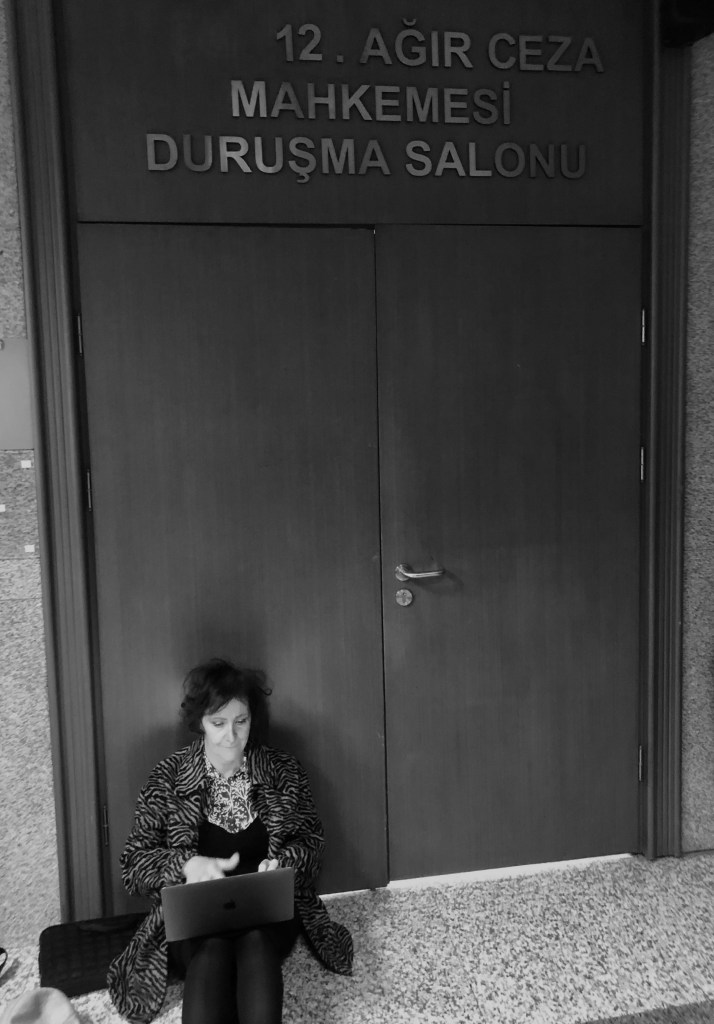
Line Stockford is a Welsh poet, editor and translator of Turkish literature. An adviser on Turkey for PEN, she designed and ran human rights projects around linguistic rights and media freedom. She studied the History of Turkish at SOAS, London.  Her book-length translations are published by Parthian, Palewell Press and Smokestack Books.
The Long Game by Kyla Houbolt

Cutting locust tree saplings
to feed to the sheep who
blatt impatiently. A locust grove
has started and it must be stopped.
Locust has thorns and is good
for little except feeding goats
and sheep. Although I’m sure
the land has a different opinion.
But the land does not have
a vote, so cut
the saplings
will be.

The cost of the coast is the loss
of honest sand, which was host
to myriad lives we’ve failed
to understand. Now there are
daily sweeps of machines
to scrape the bought sand smooth.
You may find old cups or leftover
snack bags there, because shells
are crushed by the beach sweeper
and these shells all came, once,
from another beach from whence
this sand was harvested.

Let’s go to the beach. Look. Here
there are thorns and thistles. All
the things to hurt your tender feet.
Thistles wave their brave purple flags
above their fierce foliage but it does
them no good, cut they will be. Wear
your rose gauntlets when you go
into that field, and boots. The beach
is friendlier, having been made so
by voted decree. The sand is very
hot, however, as no vote has learned
to cool it. No vote could, though
some still believe.

Slip into the water, still a bit cool.
Out there are creatures who
would like your friendship, and others
who care for nothing but their
next meal. Sometimes they are
the same. We might recognize
ourselves there too in the water
when it’s calm. We’ve not yet
drowned nor learned to breathe
in the deep. What do we need
to learn? I often wonder, or if
it is possible at all, to learn,
to breathe.

. . .

Kyla Houbolt is a poet and gardener living in North Carolina. Her first full length poetry collection, Becoming Altar, from Subpress.

https://asterismbooks.com/product/becoming-altar-new-and-selected-poems

https://kylahoubolt.us/

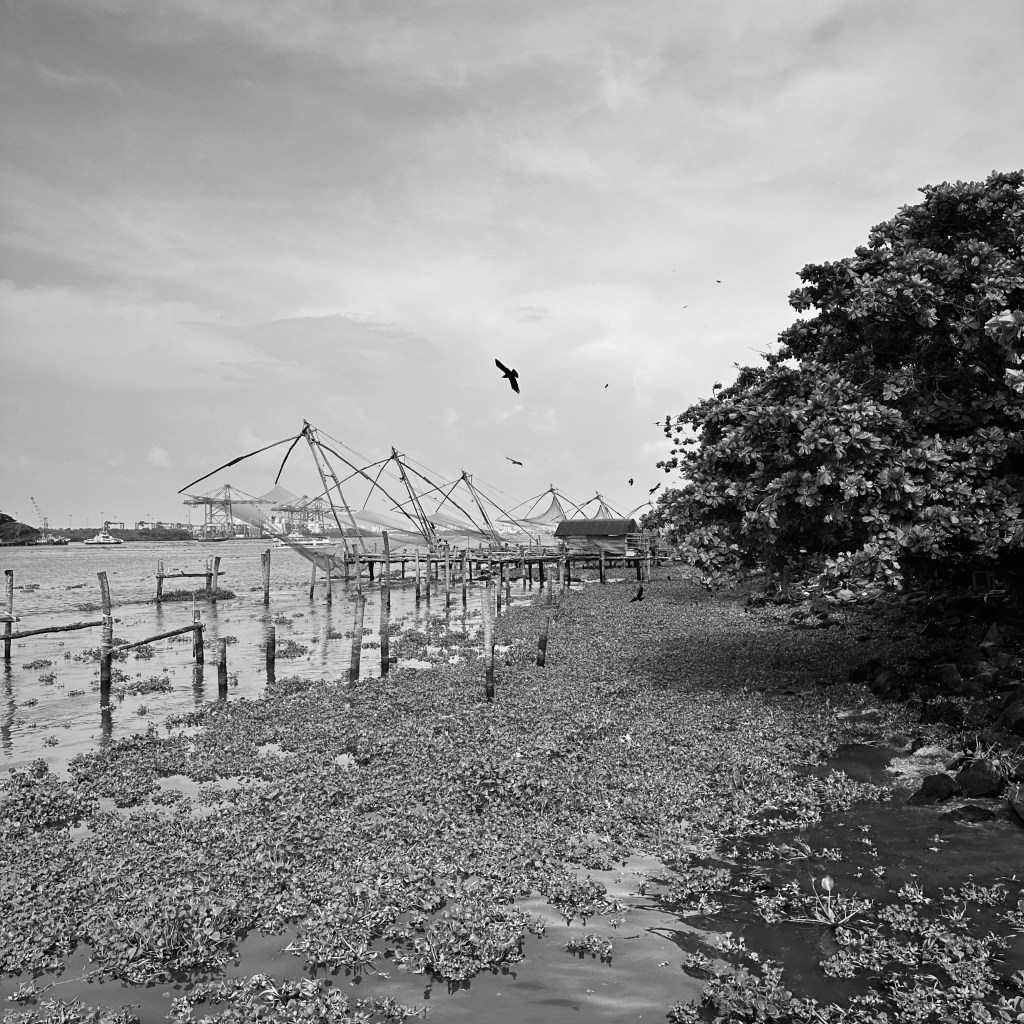
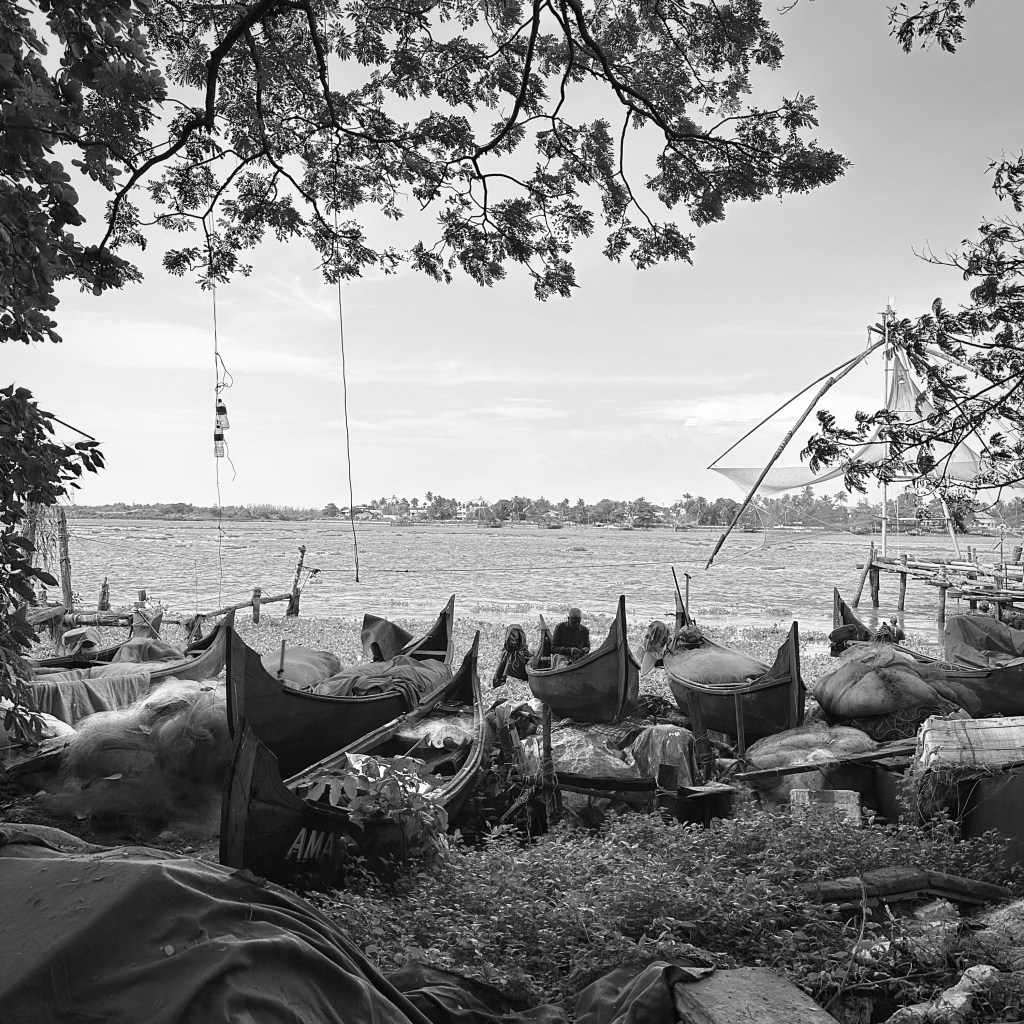
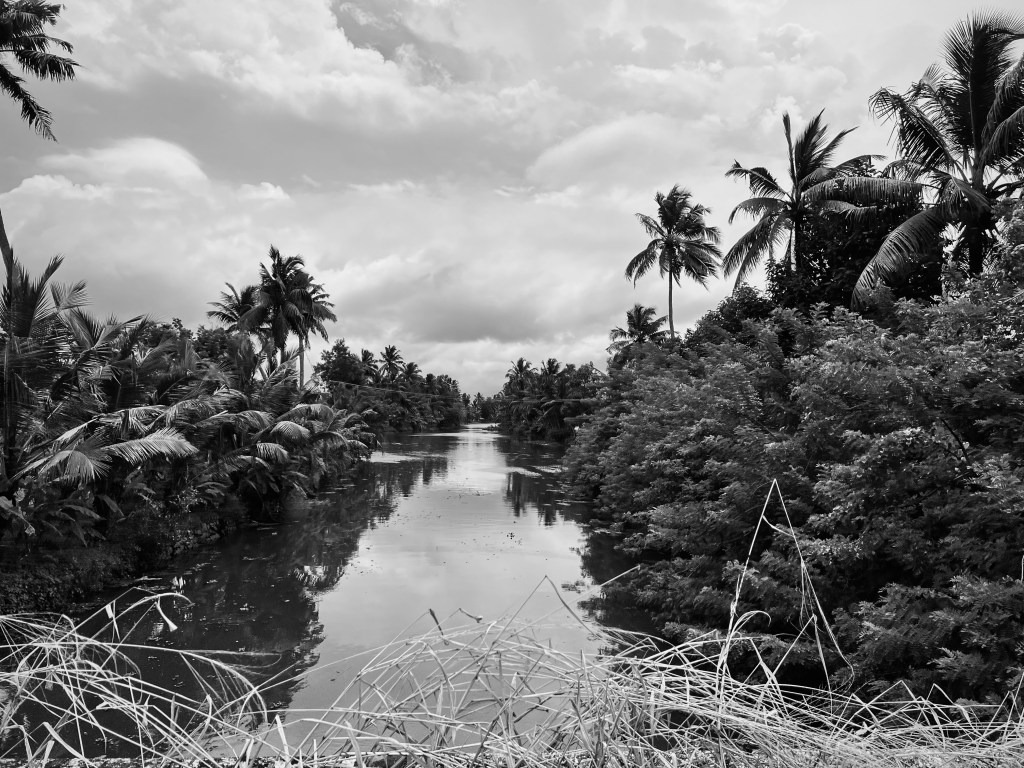
Kerala Notes by Kim Dorman

Photos by Kim Dorman

Through a grimy window
open fields
small houses by tracks
people standing
or sitting
in doorways
watching the train

. . .

6.30 p.m. muezzin’s call to prayer

. . .

The battered, rusted pans the workmen use
are as beautiful as things in a museum.

. . .

names of butterflies
Sahyadri Birdwing
Sahyadri Grass Yellow
Sahyadri Rosy Oak Blue
Malabar Banded Swallowtail

. . .

Nightfall.
A lamp,
its shadows

All morning, rain.
Thousands of cicadas sing at once.
I sit by the window and sip coffee,
watching rain pour from the eaves.
I’ve lost touch with old friends.
Lizard droppings lie scattered on the window sill.

. . .

I’m not useful like a carpenter or plumber. I sit alone
on veranda steps, gaze at the evening sky.
Neighbors are quiet; the road to the village is empty.
The moon set an hour ago.

. . .

Shadows blur on whitewashed walls.
Serrated, spinning: leaf midair.
Sensitive cells know day from night.
Chitin, bone, shell.

A street barber squats on the pavement.
Mirror, comb, scissors,
razor, soap
neatly arranged
on a threadbare blanket.
Coins fall like stars.

. . .

moth shadow,
web
let the mind
rest

. . .

I’m a stranger, outcaste passing through

. . .

A dog limps past,
vagabond.
Whisper of river grass.

Drums reverberate.
An oil lamp gleams.
Heat. Sweat.
Gods and heroes
dance through the night.

. . .

The rain doesn’t end.
Fungus eats our nails, books grow white mold.
Pillows and sheets smell of mildew.
The whitewashed walls turn green.
A huntsman spider clings to a corner of the ceiling all day.
There’s no daylight.
The rain doesn’t end.

. . .

Fog at dawn. The smell of cook fires,
feces, wet earth.
The sky stays dark.
My heart:
a withered seed.

. . .

Last night I dreamed I was walking by the sea
and came upon a group of thatched huts.
I asked an old man, “What place is this?”
“Nelcynda” he said.

. . .

I light a citronella stick.
Bullfrogs roar in the flooded paddy field.
Already the road is quiet.
My lamp flickers
and then goes out.

. . .


Kim Dorman was born in Little Rock, Arkansas, and raised in Oklahoma and Texas. He has worked and traveled in North America, from Mexico to Alaska, and spent time in France, India, and Sri Lanka. His books of poetry include Owner (Longhouse, 2016) and Kerala Journal (Corbel Stone, 2021). He currently resides with his wife in Kerala, India.

Boreal by Autumn Richardson

. . .

Autumn Richardson is a poet, editor and translator. She has authored 5 collections including Heart of Winter, An Almost-Gone Radiance and Ajar To The Night. Since 2009 she has been co-director of the multi-media publishing house Corbel Stone Press alongside British artist Richard Skelton. Between 2013 and 2022 she co-edited the influential journal of ecopoetics and esoteric literature, Reliquiae. Originally from Canada, she now lives on the west coast of Ireland.

www.corbelstonepress.com

On Pilgrimage by William Parsons

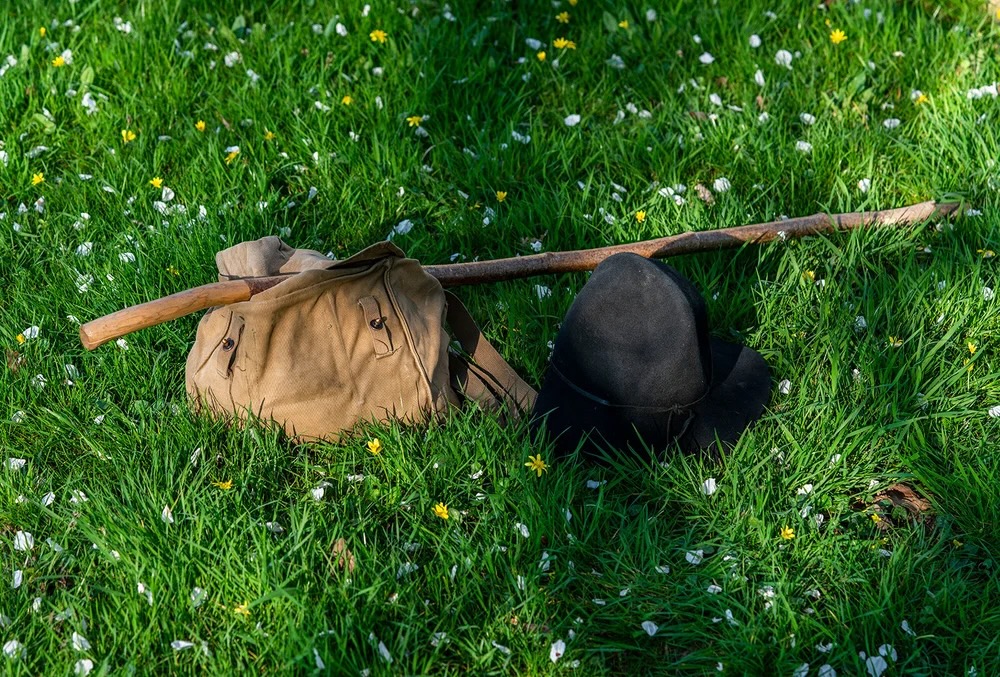
Photo by William Parsons

The Paradox of Connectivity

Modern life is increasingly connected: central heating to phone, fridge to supermarket, watch to heartbeat. Without touching a button we can chat with friends in Australia, while eating strawberries at Christmas.

Yet beyond this glimmering convenience looms a shadow-side. For modern life in Britain grows ever more disconnected. Food comes from a shelf, water from a tap, and community from an app. As for travel, it occurs at unfathomable speeds, as we rush along tarmac strips, strapped into metal boxes watching screens, following other cars and road-signs, turning when the sat-nav says so. Where travel once generated constant discovery via deep interaction with places and people, modern journeys have become a dream of pure destination, an increasingly impatient thrust toward instant arrival.

Travel by car (or train/plane) performs a conjurer’s sleight-of-landscape, a folding of the map, to magically shift us over vast landscapes without ever experiencing them. This is journey-making with minimal connection. Temperature is thermostatically controlled, sound is piped entertainment, hills are reduced to a slight extra weight in the heel, and rivers to the bump of a bridge under tyres. Between start and finish, everywhere becomes similar grey roads.

All of which causes separation, isolation and disempowerment. With our hyper-reality and digital lifestyles, we have forgotten how to look in our neighbour’s eyes and see how well they are. The smog of mortgages and motorways, and the ever-increasing pace and price of work/life, leaves little time to simply connect with the land, with ourselves and each other. Traditional guides fail us, religions plagued by scandal, and science proclaiming that spirit doesn’t even exist. In this modern landscape, it isn’t easy to break through to the Light.

The Way Forward

But there is good news. An ancient spiritual technology has been rediscovered, offering direct engagement with Source. You don’t need to dress smartly, sit still, feel guilty or get bored. No gurus are required, no intercessors or priestly authorities. It is a natural form of whole-body movement, a deep dance through imaginary labyrinths, and a hearty adventure.

Folk call it pilgrimage.

Pilgrimage is the ritual short-form of your life’s journey from birth to death. The aim is that by walking a short way correctly, you can put right your longer journey.

The basic technique of pilgrimage is to set an intention for wholeness, choose a holy place destination, and connect the two by walking. It is as simple, and infinitely complex, as that.

Walking is the oldest, slowest and deepest way to move across the earth. Intention is your motivation, the inner hope for healing that pushes you to make pilgrimage. And a holy place is somewhere in the world you feel can offer the wholeness you need, whether spiritual, mental or physical.

Finding your intention is the first step of pilgrimage. What lack needs filling, what question needs answering? Bringing this into consciousness – as words that can be repeated like a mantra – is a vital cog in the technology of turning a vague walk into a pilgrimage. If you don’t know which port you are sailing to, no wind is favourable (Seneca).

Next comes your choice of destination, a holy place that will harmonise in some way with your intention. You might choose somewhere intensely personal, the burial place of an ancestor or the site of a childhood memory. Or you may prefer to seek somewhere more universally well-known. Certain locations in this land have held the dreams of hundreds of generations of seekers, and in such holy places, deep echoes linger from those whose journeys went before.

You may find this word ‘holy’ troublesome, as if signalling pious spiritual exclusivity. But ‘holy’ doesn’t necessarily mean religious at all (though it can if you want). At root, the word derives from the Old English Halig, meaning wholesome and complete. The Scots word hale (as in ‘hale and hearty’) is its nearest living descendent. The same root word gave us ‘healthy’, ‘holistic’ & ‘healing’.

‘Holy’ is a very distinct word from ‘sacred’, though the two are often used interchangeably. Sacred derives from the Latin sacre, meaning set-apart, distant, unobtainable. ‘Sacred’ is like a distant star, beautiful but untouchable, while ‘holy’ is like a jug of water for the thirsty, something vital to integrate into the depth of your being.

Ultimately, what makes a destination holy is you, your need and the journey you offer. Wholeness (holiness) doesn’t sit around throbbing. It is activated by relationship. The healing magic needs you to need it. And there is no better way to activate this holiness than to take the time and energy to slowly walk toward it. The unreasonable dedication of an intentional journey on foot is a powerfully sincere sacrifice of time, energy and focus – making pilgrimage an effective key to unlock holy places in the land, body, mind and heart.

Deep Moving Roots

Bipedalism – walking on two feet – is our species’ original advantage, the biological life-hack that cast us as the upright strollers of the monkey family. Once we sourced this tech’ of walking, for two million years our ancestors were nomadic, roaming the planet in reverent pursuit of the herds and seasons. Constant movement shaped our evolution, creating the bodies and minds we have inherited today. Our species is homo perigrinus, and who we are grew from life on the path, our oldest home.

Yet a mere twelve thousand years ago, humanity ceased her restless roaming to begin cultivating agriculture and raising static dwellings. Arguably this was a bad move, leading to general imbalance.

Pilgrimage as an activity distinct from normal life arose in response. By providing a ritual reconnection with our ancient wandering freedom, pilgrimage helped keep alive the ancestral strength, beauty and wisdom of humanity’s nomadic inheritance.

Once you start seeing it, pilgrimage appears as one of our species’ great common forces. Wherever a stone has been raised, a temple built, or a spring recognised, so people have come (usually on foot) from near and far, bringing their hopes, dreams, offerings, prayers and songs. If you squint your eyes a bit, even our modern everyday journeys to the shops, to school or work, appear as (debased and frustrated) forms of pilgrimage.

The pilgrimage instinct is as fundamental a law of the human soul as gravity to our atomic reality. It doesn’t matter what faith (or lack) you follow, nor whether you believe in gravity or not. The apple always falls, and pilgrims always come.

But the path has not always been smooth, and pilgrimage has waxed and waned in these lands, attacked by the sharp hopes of kings and industrialists. While I was growing up, the peregrine precedent was almost invisible. Wanderers rarely passed my window. The Romany seemed settled, druids drove vans and troubadours endured mortgages. To be a tramp seemed to require alcoholism.

Yet today we witness the return of honest wandering society, as pilgrimage revives into a living British tradition, like Arthur awakening from his hill of slumber. Our hour of need has come.

Annoying the King

Those who decide the rules in society enjoy imposing their will upon us, because there is advantage to be gained in so doing, and because they can. Pilgrimage offers a shortcut to evade these heavy games of control. By taking the path, you can restore your ancient state of animal liberty, becoming wholly in charge of your time and passage through life, if only for a short-ish while.

Two hundred years ago, to be a British pilgrim you would have been sent to the workhouse or charged with vagrancy. Three hundred years ago, you could be transported to a penal colony or hanged. But today, pilgrimage is free for the dream.

You may feel you have little choice in life, pushed along by the normal forces of work, family and friends. But pilgrimage provides an opportunity – and challenge – to reclaim your personal autonomy, to plant a staff in the river and stride upstream.

For many people, there is a guilt response to this idea. The wonderful inefficiency of pilgrimage makes its time-demands look like gluttony. How can you possibly take two weeks to walk somewhere you could drive in two hours?

Such are the harsh internal shackles of convenience that govern the modern mind. For the responding question must surely be: to whom does your time on earth ultimately belong? Dare you stake one small portion for yourself? Can you really afford not to?

This is difficult to answer from the sofa. No matter what I write, you won’t really know until you step out, staff in hand and home on your back. Not even the ultra-rich truly own their time. But between the roads, the pilgrim inherits the earth.

As medieval scholar J. J. Jusserand said, pilgrimage has always had the power to “annoy the King”. And in our modern age, under the ever-watching eyes of state, corporate and digital kings aplenty, the freedom of pilgrimage shines brighter than ever.

“Liberty calls aloud, ye who would hear her voice…” (from a confiscated broadsheet, 1793)

I hope to see you on the path. Bring a song. It is not getting dark.

Walk well!

. . .

(The above is an extract from William Parsons’ forthcoming book, The S.O.N.G. of Pilgrimage.)

. . .

William Parsons has worked in British Pilgrimage since 2004. He spent his twenties as a wandering minstrel, in his thirties he founded the British Pilgrimage Trust, and in his forties he returned to freelance pilgrimage with a focus on writing. His work has reached most UK newspapers, TV channels and radio stations. He even got pilgrimage into Vogue. William lives in Glastonbury where he guerrilla plants Holy Thorns.

http://www.willwalking.com

Everything Is Far Away by Brian McHenry

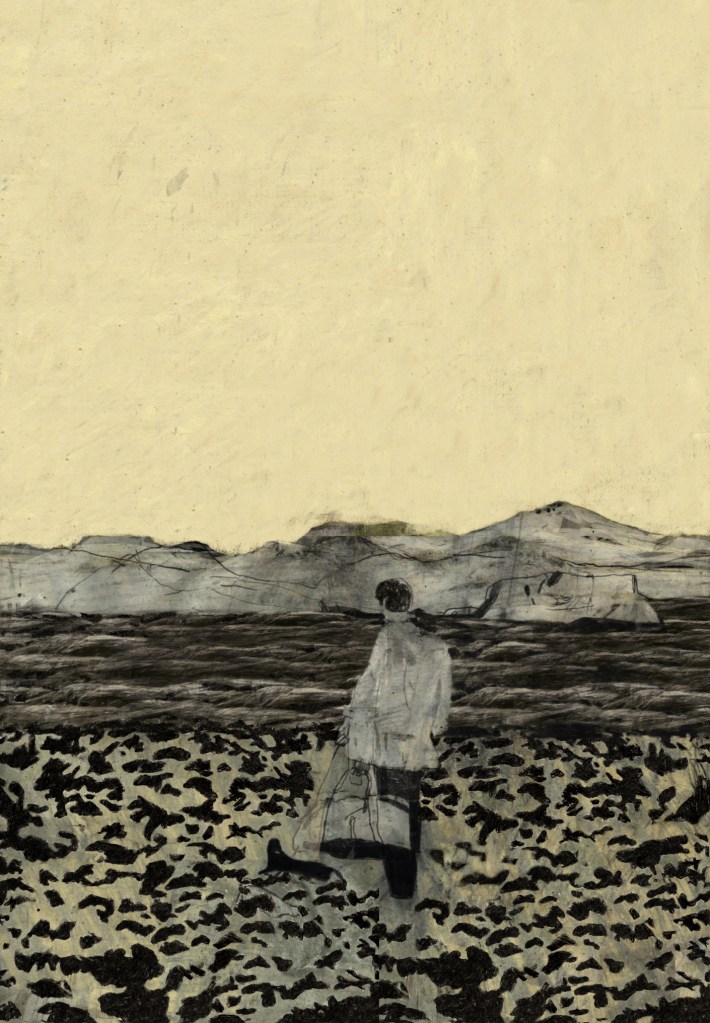
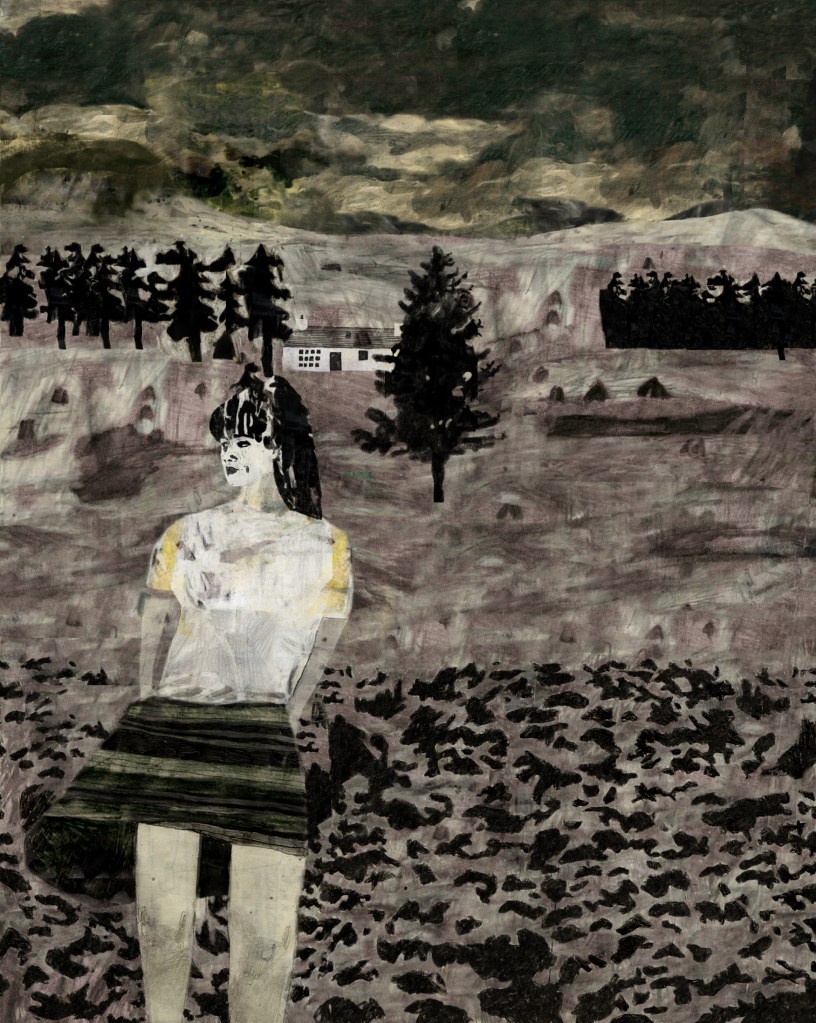
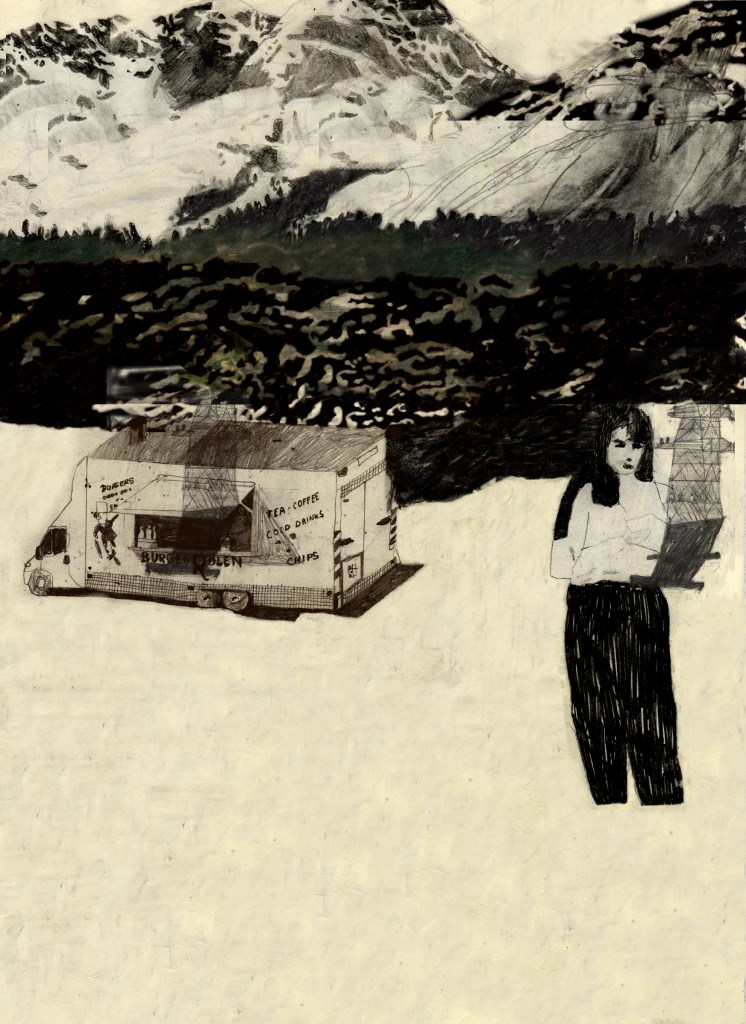
Drawings by Brian McHenry

I have a favourite road.

There is a moment in the film version of Gavin Maxwell’s Ring of Bright Water when the main character, Graham, gets off the MacBraynes’ bus and for the first time looks across the Firth of Lorne towards Mull in the distance.

Ben Buie, Sgùrr Dearg, Dùn da Ghaoithe are all there in front of him, each a distant grace note to something that isn’t there anymore. Of course the movie takes vast liberties with both the book and indeed the story of Gavin Maxwell himself but somehow for me, with that scene, it all gets forgotten.

And so I watch the grass as it gets moved by the wind

and the sound of it

And I think of us there in Fishnish all those years later

The sweetness of that sound on Aird a’Mhorain.

Traigh Iar

and I think of those landscapes now that we’re not there,

the spaces where we used to be.

Your presence as it shifts into abstraction

and distant thought now

the space between you and me and the lines that I draw.

. . .

Born in Belfast, Northern Ireland, Brian McHenry is an artist and illustrator whose work has appeared in various publications — including The New Yorker — and featured on record covers, books, and even the odd beer can. He currently lives on the north-east coast of Ireland with his two children. His recent combines elements of portraiture, symbolism, and abstraction to explore the physical and emotional landscape of remembering.

https://brianmchenry.bigcartel.com/

Walking In Circles by Paul Tritschler

Photo by Paul Tritschler

Midway through the event, a woman seated in the front row of the audience asked the panel of four authors, all of whom had made an appearance for the purpose of promoting their recently published travelogues, if they could explain in simple terms how their notion of travel differed from what most ordinary folk called holidays. Nothing is more difficult than to be simple, but the elitist charge implicit in her question, one that was somehow rendered more pointed by her affected pleasantness, laid another layer of complexity. The moment demanded deflection by way of a pithy response — l’espirit de l’escalier might have suggested a poignant quote from Ibn Battuta or something whimsical from Rabelais. Instead the panel, with a tad too much haste, dug themselves into a defensive trench, and in the process shovelled dirt on what they ill-advisedly and repeatedly referred to as common tourism. And they wouldn’t stop digging.

Conversations erupted throughout the room but eventually settled into silence, and no indication was given that the audience would assist her in pushing the panel off its platform, if indeed that was her intention. That being said, it most likely nudged it a little; peering through the newly created cracks in the edifice, the panel’s itinerant forays and desultory wanderings would have appeared to some people as lofty peregrinations wrapped in pompous superiority…or thoughts to that effect. Their somewhat clumsy efforts to enumerate the differences between what they get up to and what everyone else does would not have helped in that determination. On the other hand, some would have interpreted her question as self-aggrandising, one motivated by conceit, point-scoring and the desire for audience adulation. Either way, the nourishing conversations that were until that moment shared between the panel of authors and what felt like a roomful of friends, now a breathing mass of strangers, failed to revive.

Possessing an air of originality, mystery and spirited adventure, the mention of travel arouses more curiosity than that of the humble holiday, and there can be little doubt that by describing oneself as a travel writer rather than a holiday writer one gathers greater cachet. Yet it often seems that, at core, there is no difference between them. Indeed, the travel writers sharing the podium might easily have described their journeys as holidays. After all, three were promoting books about relatively short stays in what many would deem holiday destinations, including a fortnight in Paris, three weeks in a wine-growing region of France, and a month in Tuscany. Only one took a longer and more varied route, that resulting from an unplanned year of backpacking.

Putting it this way perhaps challenges their street cred, yet many philosophers, among them Seneca and Thoreau, were greatly inspired by the odd holiday, during which they created notable works of reflection on nature, on the human condition, and on life’s meaning or purpose. The same is true of literature. Agatha Christie developed the idea for a well-known detective mystery whilst on a leisure cruise down the Nile. Virginia Woolf wrote To the Lighthouse whilst on vacation on the Isle of Skye, and Elizabeth von Arnim’s The Enchanted April was inspired by a month-long holiday to the Italian Riviera. The list goes on. In the end what matters most are the stories, and to this one might add a degree of self-discovery.

. . .

Old Cathy used to come into our house to wash her money. Though she scrubbed the stairs of every last one of them, and had done so for years, ours was the only flat in a long street of tall black-sooted tenements where she could come and go as she pleased. She even had a key. Some people would rinse out and refill her bucket, but she would have to remain at the doorstep, door closed. To be fair, Old Cathy wasn’t one for conversation, and in fact blanked most people, but that wasn’t the only reason people covered their doors. For much of her life she lived between the mental asylum, as it was then known, and the street, and when that information got around the neighbourhood by the usual whispering campaign people kept a watchful eye. During the time our family knew Old Cathy she had secured permanent residency in a Salvation Army hostel not far from where we lived: a small room with an iron-framed bed, a chair, a cabinet, and a cross on an otherwise bare white wall. Visitors were not allowed, but we visited anyway, my sister and me, and whilst some residents occasionally looked at us with suspicion, neither the warden nor anyone else ever refused entry.

My sister always firmly insisted that if anyone were to question us I should stay silent and let her do the talking. When neighbours or anyone else asked questions she generally cut in to finish my sentences in ways I could never anticipate. Three years my senior but in reality much older, I guess my sister would have been around eleven or twelve when we visited Old Cathy. She doted on us, and was always steady and sunny, but I doubt if many people saw that side. She just kept her head down as she scrubbed the stairs, her metal bucket echoing in the close as it clanked down each step, then reached back up to draw intricate floral patterns with white chalk on the margins of every step. This was a common custom in our neighbourhood, an area that outsiders called slums, but unlike Old Cathy most women just chalked a quick zig-zag or squiggle. Either way they only lasted a day at best.

A woman notorious for malicious gossip once stopped us to ask if our dad knew that our mother allowed a pauper lunatic to wander in and out of our house when he was at work (he worked almost all the time). We of course knew who she meant, but as instructed I buttoned up. I would have liked to have said that we loved Old Cathy, who was one of the kindest people on Earth, and that not only did she visit us, we visited her; but as my sister later reminded me she would most likely have called the police and had her thrown out of her residence and into the street. Adults were a different breed, and I dreaded the thought of mingling with them. Even at the early stages of adulthood most people showed signs of becoming distinctly unpleasant. I think Old Cathy felt the same way.

This was a time when mothers who took to their bed for days or weeks or maybe even months were generally considered to be indolent rather than depressed, a time when postpartum depression was for the most part unknown, and a time when having a stillbirth — regardless of the sadness, guilt and anxiety that were at heart a cry for help — was hushed up as a shameful failure. Mrs Bogus, a pathologically nosey upstairs neighbour of ours — listening at the letterbox, she fell into our hall one time when my dad opened the door on his way to work — stopped me and my sister on the stair to ask if my mother was still lying in her bed. She called her a lazy article, jolting her miserable mongrel on a choke chain before briskly walking on. No one ever explained to me the meaning of article, but I got the gist. Just ignore her, my sister said, and don’t repeat what she said to anyone. I didn’t have to: everyone seemed to know that my mum had sunk under the covers and let the house go to hell. It even got around the school.

For the best part my sister looked after things at home, organising clothes, tidying up, making meals, but after a while things began to slip there too, and the mess just piled up. We made a space on the sofa between heaps of clothes and coat hangers and ate cereal from the box. On one occasion we heard our mum mumble to herself that she wanted to cut her throat, and I was told never to repeat that either, not to anyone, not even to dad — especially dad! She didn’t mean it, my sister insisted, but I couldn’t quite dismiss the possibility. For all their promises to the contrary, adults were notoriously unpredictable. My friend’s sister killed herself over a stupid fiancé, the mother of a boy at my school was murdered by his dad — just one punch, they said, whilst she was doing the ironing — someone sunk an axe into someone’s front door, another put a petrol bomb through a letterbox, men filled with rage and hearts of hate fought to the death outside pubs, and psychopathic razor gangs roamed the streets and alleyways. No adult could be trusted entirely.

We came home from school one day to find all the mirrors in the house had been smashed — why mirrors? — and immediately I wondered if my mum had taken a shard of glass to her throat. I envisaged it. My sister made me wait in the hall until she checked out the bedroom. Mum was sobbing under the blankets, but otherwise okay. Old Cathy was there, calm and calming, picking up the pieces. She would have known worse, and most likely understood the situation better than anyone. For several weeks no stairs were washed as Old Cathy stepped in as our femme de ménage, arriving before we went to school, and leaving in the evening. Between those hours she did the shopping, made breakfast and prepared dinner, looked after my mum, washed clothes, tidied the house, and even found time to play board games with us — she was a master at draughts. In time, when my mother got back into harness, Old Cathy got back down on her kneeling mat to scrub and chalk the tenement stair, the distinctive sound of her metal bucket once more echoing in the close as it clanked on each step. Thereafter she would rinse out her bucket, brushes and money in our small scullery whilst the kettle boiled before settling down to sit with my mum, gazing into the embers in silence.

. . .

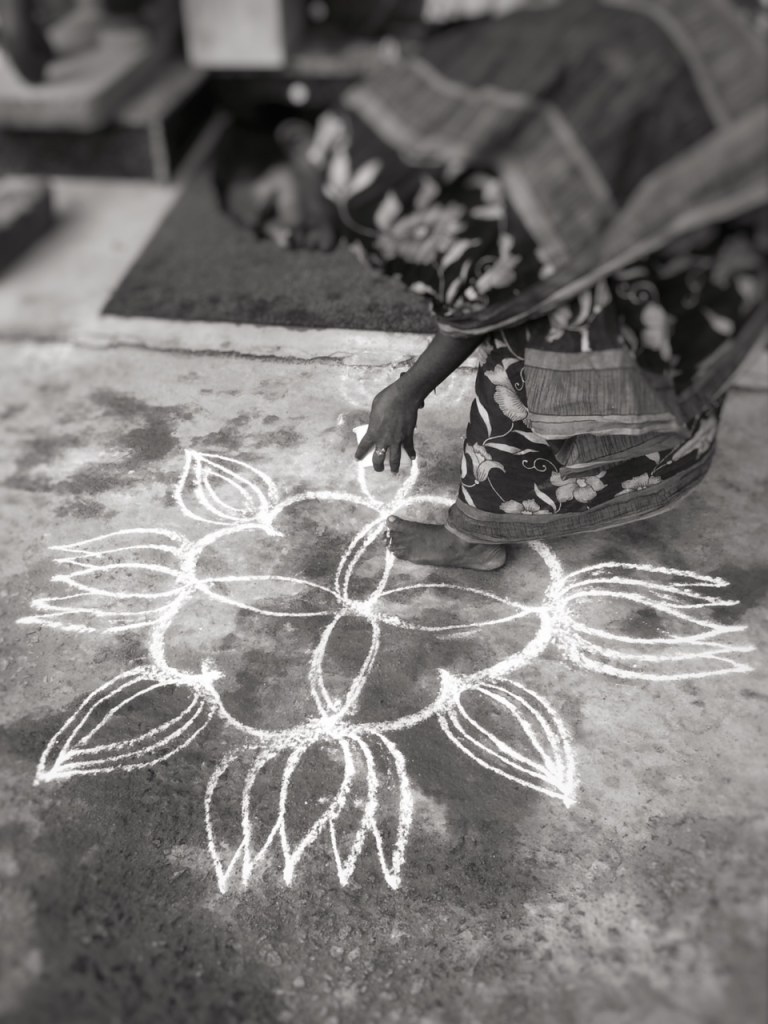
For some people, travel writers are escape artists sharing their secrets on how to break loose from sameness. Others live to wander, to find stillness in motion, and perhaps by chance to find missing parts of the story that made them who they are. It was whilst perched on a doorstep under a hot sun in Tamil Nadu that Old Cathy, for the first time since childhood, wandered into my thoughts. I was watching a woman take great care to create a kolam at the entrance to her home, a decorative chalk circle with floral designs that is said to bring good luck and prosperity to the occupants. The drawings are walked on, scuffed and washed out every day, and whilst illustrations and meanings vary, each in their own way presage the transience of our existence and the impermanence of all things. The process was hypnotic. With eyes squeezed shut I remembered Old Cathy with head bowed drawing similar floral patterns with her piece of chalk on the steps to our door, and for a moment that door opened. The long journey to India had led me back to the start, and perhaps, after all, that was the point.

. . .

In addition to teaching psychology in universities, adult education and colleges across the UK, Paul Tritschler has managed organisations within the fields of brain injury, sensory impairment, mental health and community activism. He has written for a variety of magazines, including Aeon, Psychology Review, Bella Caledonia, Counterpunch and Open Democracy.

3 poems from Book Of Mirages (Libro de los Espejismos) by Gaspar Orozco, translated from the Spanish by Ilana Luna

Photo by C.C. O’Hanlon

¿Y el fuego que no se ve? ¿Cómo registrarlo? ¿Y la llama que invisible cerca al cuerpo? ¿Y la hoguera incolora que arde en el cerebro? ¿Cómo dibujarlas, cómo explicarlas? El incendio ciego encerrado en cada gota de sangre, ¿con qué tinta, con qué pigmento se traslada al papel? ¿Cómo hacer visible el alcohol que quema su anillo fantasma en la retina? ¿Y el fuego innombrable que calcina la lengua? ¿Y el alambre ardiente y afilado de la circunferencia que te atraviesa el alma? ¿Cómo decirlos, cómo llamarlos?

And what of the unseen fire? How to record it? And the invisible flame about the body? And the colorless bonfire roaring in your brain? How to draw them, explain them? The blind blaze enclosed in each drop of blood, with which ink, with which pigment can it be put to paper? How to make visible the alcohol that burns its phantom ring on the retina? And the unnameable fire that scorches the tongue? The blistering, razor wire that encircles the soul? How to name them, how to call them?

. . .

El nombre es una espiral, un erizo que da la vuelta a la sombra. Adivinas luz al torcer el muro. Casi la tocas, pero no la alcanzas a ver. Arena blanca. Sigues. Recorres un segmento del círculo con una jaula de pájaros vacía en tus manos: la puertita choca su metal al abrirse y cerrarse a tu paso. El mar deja en libertad uno de sus vientos para que se pierda en el laberinto. Lo encontrarás llevando el rumor de campanas distantes y de piedras tristes y metales que brillan lejos. El palacio del caracol es su esqueleto. El palacio del estratega es su memoria. Hay un mar vivo en el centro. Al humedecerse, el cráneo del remolino canta su canción. Es lo que llega a tu oído.

The name is a spiral, a sea urchin turning round the shadow. You glimpse light when curving along the wall. You can almost touch it, but you can’t quite see it. White sand. You continue. You pace the segment of the circle with an empty birdcage in your hands: the tiny door clanks its metal open and shut with your footfalls. The sea sets free one of its winds to lose it inside the labyrinth. You’ll find it carrying the rumor of distant chimes and sad stones and metals that shine from afar. The seashell palace is its skeleton. The strategist’s palace is his memory. There’s a living sea at its center. When wet, the whirlpool’s skull sings its song. That’s what you hear.

. . .

A lo largo de la Odisea, hay una frase que deja un leve rastro en la historia de los días y las noches de Odiseo entre las islas: la luz del regreso. Telémaco la pronuncia por primera vez cuando le confiesa a la diosa Atenas, la ojizarca, el temor a que su padre hubiera perdido ese fulgor. Odiseo la emplea cuando trata de explicar a Calipso su deseo de volver a Ítaca. Hay esperanza en esta imagen, pero se trata de una esperanza humedecida de tristeza. La tristeza de la imposibilidad del retorno, la de la callada certidumbre de que la Ítaca de la cual partimos no la encontraremos ya. La Odisea, como todos sabemos, es la apuesta para recuperar la luz del origen, la primera que vieron nuestros ojos y por la que vale la pena morir para verla brillar una vez más. Todos tenemos una Ítaca que reverbera en el filo de nuestro horizonte. Así, el poema entero –es decir, la vida- se concentra en esa imagen, como la luz de la isla en el vaso que dibuja su reflejo en el muro.

Throughout the Odyssey, there’s a phrase that leaves the faintest of traces on the history of the days and nights of Odysseus among the islands: the light of the return. Telemachus first pronounces it when confessing to the goddess Athena, the bright-eyed one, his fear that his father may have lost that glow. Odysseus uses it when trying to explain to Calypso his desire to return to Ithaca. There’s hopefulness in that image, but it’s hope dampened by sadness. The sadness of the impossibility of return, that of the quiet certainty that the Ithaca we left won’t ever be found again. The Odyssey, as we know, is the attempt to recover the original light, the first our eyes ever saw and for which it would be worth dying to see shining once more. We all have an Ithaca reverberating on the edge of our horizon. Thus, the entire poem—that is to say, life—is concentrated in that image, like the light of the island in a glass that etches its reflection on the wall.

. . .

Born in Chihuahua, Mexico, Gaspar Orozco has published 8 books of poetry, three of them translated in English by Mark Weiss. He has translated poetry from English, French and classic Chinese to Spanish. He was a member of an obscure punk band, Revolucion X; the Spanish label Metadona Records will release an album of their lost recordings in December 2025. He currently works as a diplomat. 

Imprint Of Weeping Angels by Jenni Fagan

Photo by Jenni Fagan

. . .

Dr Jenni Fagan is an award-winning, critically acclaimed novelist, poet and artist. Published in global translations the author of four fiction novels, one non-fiction memoir, eight poetry collections, exhibitions, adaptations and with another two new fiction novels due out next year. She has won The Gordon Burn Prize 2025, was a Granta Best of British Novelist (a once in a decade accolade), Scottish Author of the Year and has been on lists from The Women’s Prize, BBC International Short Story Prize, The Sunday Times, Encore and more. Fagan has worked extensively with vulnerable groups including those  in prison, and the care system where she herself grew up. Described as The Patron Saint of Literary Street Urchins, Fagan’s work responds to the centre always from the margins and without compromise.

https://www.jennifagan.com/

Dancing On The Silk Razor, a film by D.W. Young

Dancing on the Silk Razor was born out of a discussion I had with my friend Dan Wechsler. We were contemplating various writing work we’d done when younger, and he mentioned there was a first line for a story he’d always wanted to pursue but had never quite been able to. I asked what it was and he replied, “Somebody had been stealing Harold Solomon’s ideas.” I liked it immediately; it had the kind of lead in I relish, and although it wasn’t my normal way of working, I asked if he’d object if I tried running with it. He said to go for it. And like often happens with the right catalyst, a written story poured straight onto the page.

Although the writing took a prose form, from the start I had the notion of it also being a film. So, with extremely limited funds but some phenomenal, longstanding collaborators who were game, we shot the whole thing in four days on 35mm with about a 1.5. to 1 shooting ratio running around New York City. It was a great challenge and a great time.

The narration is really the main performance, and we wanted to find someone for it who could really elevate the film. We felt Wallace Shawn would be perfect, and as a writer might particularly appreciate the role. We sent him the piece and he liked it and agreed to do voice-over. But this was still the COVID era and regrettably I came down with a case right before the recording session. I directed via Zoom but it was excruciating not to be there in person. Fortunately, Wally completely got the tone and humor and, with the kind of thorough preparation every director hopes for, nailed it on the first take.

I’ve taken to calling this a multiform work, as I feel it can be equally a written piece and a film. And I’ve since been working on a series of new pieces in the same vein, with iterations that co-exist across mediums. All, however, begin in primary form as the written word.

. . .

Written, Directed and Edited by: D.W. Young
Narrator: Wallace Shawn
Harold Solomon: Dan Wechsler
Producers: Judith Mizrachy, Dan Wechsler, D.W. Young
Cinematographer: Arlene Muller
Composer: David Ullmann

. . .

D.W. Young is a New York City-based filmmaker and writer. His two most recent feature films are the documentaries Uncropped (2024), about Village Voice photographer James Hamilton and the heyday of alternative print journalism, and The Booksellers (2020).

https://www.dwyoungfilm.com/

Original Sin by Liz Cullinane

Sculpture by Liz Cullinane

Watercress abundant, pooled, fed by a freshwater stream that leaks a channel, a winding furrow  carving an arc across the sands. Joining the Atlantic salt waters. Diluted. 

Conas ta tu a stor? How’re you love? Bhfuil tusa ann?  Are you here? Where are you? 

                Under the rocks……..caught in the weed………….? A remnant of yourself…. a fragment, flotsam, tiny bones  bleached out over time. 

                First child, the one and only first, spent in the sands and carried away unseen.

Pause, sigh, and breathe. Slow. Clearing. In and out breaths. Fuck it …

The stream’s absorbed when it reaches the sea. Red standing stones guard the shoreline. Dug in, bulk undiminished through the years. Smooth blank faces peppered with tiny lives. Living creatures  in spiraling whorls, paint-box colours distinct from the rest with their blend of muddy greys, blacks and browns. The discreet, minding their own business ones.

Keeping to the low formation, leaning into these sentinels, pushing up hard. Limpets impress their determination into my back, encouraging them to leave their marks on my skin, through the layers of time and guilt. Tiny bruises, kissed into my shell.

Cá bhfuil tu mo stor,  where are you my love? Still here? Shape shifting your small self, half formed baba deas, lovely baba? Or have you vanished into mists of salt water and weed? Níl fhios agam, I don’t know, may never know.

Sins for which I alone hold no charge, spoken in my head. Not then, had no clue back then. 

Busy in the kiddish world of long summers, heat hazed early mornings blended into same grey days. School and holidays, home and here, the Red Strand. First beach out of Clonakilty, Cloich na Coillte, stone castle of the woods.

The brother, older but no wiser through the passage of summers, collects the tiny vivid shells under instruction from his know it all little sister. All through our early rising summers for as long as it pleases him. Mostly in the absence of anyone else. (He’d prefer the other boys, tardy, sleeping-in boys, almost always with a ball). 

We sort  the shells into currency for our long playing games, oblivious to any lives inside the whirly chambers. Red, yellow and green defining value, same as fruit pastilles or wine gums;sticky pleasures.  Flavours imparted by the power of suggestion. 

In truth  they all tasted much the same, the richer the colour the more they’re desired, sweeties and shells. No truth to either.

He is obliging, patient and generous, prepared to share a vision of the day, playing shop? Or being rich for our new life ahead. Content til he gets a better offer……at least til then. 

A big brother like no other, he is dark to my fair, tall where I am slight, brave while I am cautious. Protective and free running altogether in one certain self. His infectious self-belief sweeps us into his limitless foolhardy world and we’re away. Climbing rock faces, out of windows and trees, into danger without looking back. Running for miles with no sense of the dinner time clock. It chimes without our ears to mind it. Into trouble over and over he brought me, with no regrets. 

                                        Not true, baba deas. My one regret. The original sin.

Hours we spend under the towering protection of this headland. Obscured from view by the remains of an over-ground tunnel. Giant concrete slabs scattered about, fallen, impotent, discarded. Marooned in the sands. 

A hidey hole, a place of travel from one gloomy tunnel end to the other, between the stream and the sea. 

Fresh water and salt, fishing in both, crazy laughter and messing, all the way to tears and squabbles on rare days, high days and holidays, tense sort of days.

Status Quo, the quo, ruled the roost for his whole gang, while we, the girls, follow the Bay City Rollers. Uniform in our tartan trousers, Baby love, oh baby love, skimming our thighs cutting into our vain attempt to hold the boys attention. All the while loving our idols, the special one, he who holds our gaze on the telly. A band member for all the seasons of our pre-teen crushes.

Teenage years we return to the Red Strand with beer and tents. The sea is the place to be rather than the shore. Trailing friends, boyfriends, girlfriends, cousins once from overseas, to share the magic that no longer exists. Red Strand’s too full of childhood and original sin. Better beaches round the corner, further along the coast, closer to the shore life of pubs, craic and caravan parks. 

All these places we never saw as children, never knew were there, so determined was this family not to mix with the noisy ones, the drunken ones. The families that might know us from life at home ones. The sleeping in, lying in their beds half the day ones. 

Mothers and fathers equally corrupt longside their offspring, in the gospel of our English origins. They lined up daily at the chip van for their tea. We ate freshly caught mackerel with bread and butter, the food of the Gods, and so it was. Free, from the sea.

We ate mussels plucked from the rocks. Sometimes lobsters, captured in pots thrown off the shore. Squealing their way from blue black to bright scarlet in a pot alive with boiling water, delicious, with butter dripping from our chins, stinking of garlic. No one ate that stuff, famine food still reeking of the sea but we did. Set apart, positioned above, looking down, while trying to squeeze in.

We were blessed, apparently.

The beach welcomed us back annually, sharing its curves, a safe return into the familiar crook of embracing rocks. The concrete tunnel sheltering our comings and goings from year to year, constant,  never-changing. The strand,, our part in it, had a rhythm, a ritual of its own making.  It bent slightly each year as we grew up, new faces appeared, alongside the familiar caravans. 

Softly whispered voices, rememberings from the sea, in the sand dunes, where courting couples played out their pleasure. Mostly undiscovered, known by all and avoided, quietly sidelined. Not allowed, and still they were always there. Bless me father for I have sinned. Curled up in warm grasses on heated sand that threatened collapse without the tough spines that held it altogether.

All through the early Summers a man ploughed his way, twice a day from the dizzy height of the headland, traveling from his smallholding, along a narrow sunken track. He trailed a donkey and a jennet down onto the strand, on a single rope. Their arrival a Mr Whippy of excitement in the day trippers, our prior knowledge fattening our superior position. Privileged with familiarity, without names, we are known to each other. The donkey man and us, the regulars.

Some days I follow them on their return pilgrimage through the steep channel, the sharp, dry grass nicking my bare shoulders, a minor penance, a small offering. I daydream a change of identity, assuming a place in their holy family on the homeward climb. Shifting from child to blessed mother, to partner and devoted animal whisperer. The donkey man never seems to notice my presence or acknowledge it at any rate.

Codladh samh, sleep safe, a stor, love, where ever you are, under the deep sand or washed clean among the creatures that flow back and forth, in and out of the tides. Three hail Marys and one our father the regular gift for telling lies. How could you not tell lies when caught between the father and the son. I have no idea, only one idea possesses my mind, escape and protection. 

First love learned at the foot of the should be protector and  corrupt for ever after while nuns whispering lies and responsibility into the shell like of every girl child and what would they know about it anyway? Brides of Christ, be lady-like, be Marylike the impossible mantra, the ideal that will never be matched.

They can’t control themselves, they confide,  it’s up to ye to take control, female pleasure, unknown, unspoken.

Is it any wonder a stór beag, my small love, my tiny not fully hatched firstborn that you were conceived and lost on the shore of my innocence. Bless me father, I don’t fucking think so, thank you very much and goodnight.

Transformation, a daily event as the sea wipes out the story of the sand and shore. Washing and rinsing rocks and strand in a matter of hours, filling and emptying the pools closest to the rushing waters.

Anemones, the most tantalising transubstantiation of all. Still to this day, a miracle. Brown jelly mounds stranded in the air of low tide become flowering tendrils of soft pinks submerged in the salt water. Waving gently, they invite  touch, dipping a finger into a shallow pool and softly, softly stroking the water closest to the fleshy petals. Too close, they fold themselves in, abruptly resuming their impenetrable personae. Still here, always here, since the beginning of time. Stuck fast to their ways. 

Echoing through the years, on every return I pay homage to their beauty hidden in the dark  brownness of the rock pools, discomfited in the air heavy world.

Tabhair aire, take care, precious one, watch out for the sidewards crabs lurking out of sight among the weed. Sharp little nipping pincers, painful beyond belief to the unwary, bi curamach, be careful, mind your little fingers and toes. 

A fully grown woman this visit, kneeling in a hollow scraped out of the sand. Lost but keeping watch on the tide, inching closer and closer, washing clean its own. Soothing the grains with the patterns of waves, licking into the holes dug out with plastic reds and yellows. Further out to sea, waves churn up the red sandstone rocks  lining the basin of the strand. Fractured thoughts coming and going rolling back and forth, testing the present with the past, seeking out long gone shapes amongst the weed, carried and tossed, lifted along the breadth of the curve. 

Nothing clear, no single sound, a rag bag of rattling stones to hang from my feet. Uneasy flickerings in the corner of an eye. Glimpses of the jennet’s flashing whites and straining head. His unpredictable nature printed in my memory, a familiar refrain, a chord that echoes in my pulse. He was half donkey and half horse, we said, the mixture of breeding, his magic. Also his devilish power, tempting fate with its unnaturalness. 

The water, freezing, has reached me, frothing at my knees and trickles begin to fill the spaces around and between my legs, my feet folded into the dugout. How long could I last? The cold drove me out half way between head and toes, intimate with my belly. Enough already. This time.

. . .

Inter-disciplinary artist Liz Cullinane is a storyteller in words and pictures. Her Belfast based practice is rooted in community activism, theatre design and film collaborations with poets and musicians. Liz’s academic research on early 20th century Irish women artists focusses on Mary Swanzy (1882-1978). Published by the Irish Museum of Modern Art (IMMA), she has innovated a digital opera on Swanzy. Recent exhibitions & writing reflect her engagement with the Achill Island landscape in Mayo.

https://lizcullinane.com

NOVEMBER 2025 Guest Editor Is C.C. O’HANLON!!! THEME/S: JOURNEYS

Burning House Press are excited to welcome C.C. O’HANLON as the fifth BHP guest editor of our return series of special editions! As of today C.C. will take over editorship of Burning House Press online for the month of November.

Submissions are open from today 1st November – and will remain open until 25TH November.

C.C.’s theme for the month is as follows

—JOURNEYS

~~~

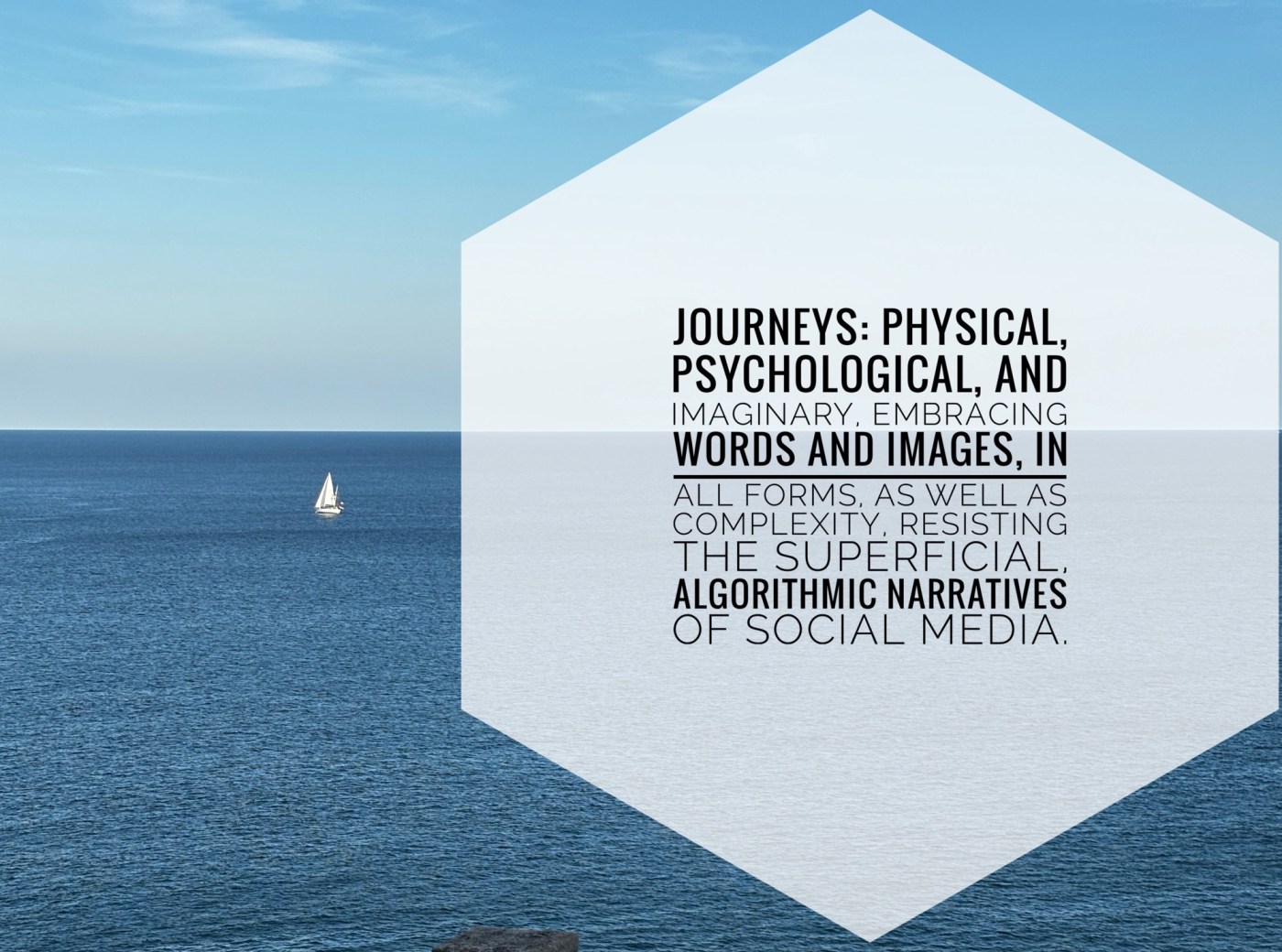
JOURNEYS: Physical, Psychological, and Imaginary, embracing words and images, in all forms, as well as complexity, resisting the superficial, algorithmic narratives of social media.

~~~

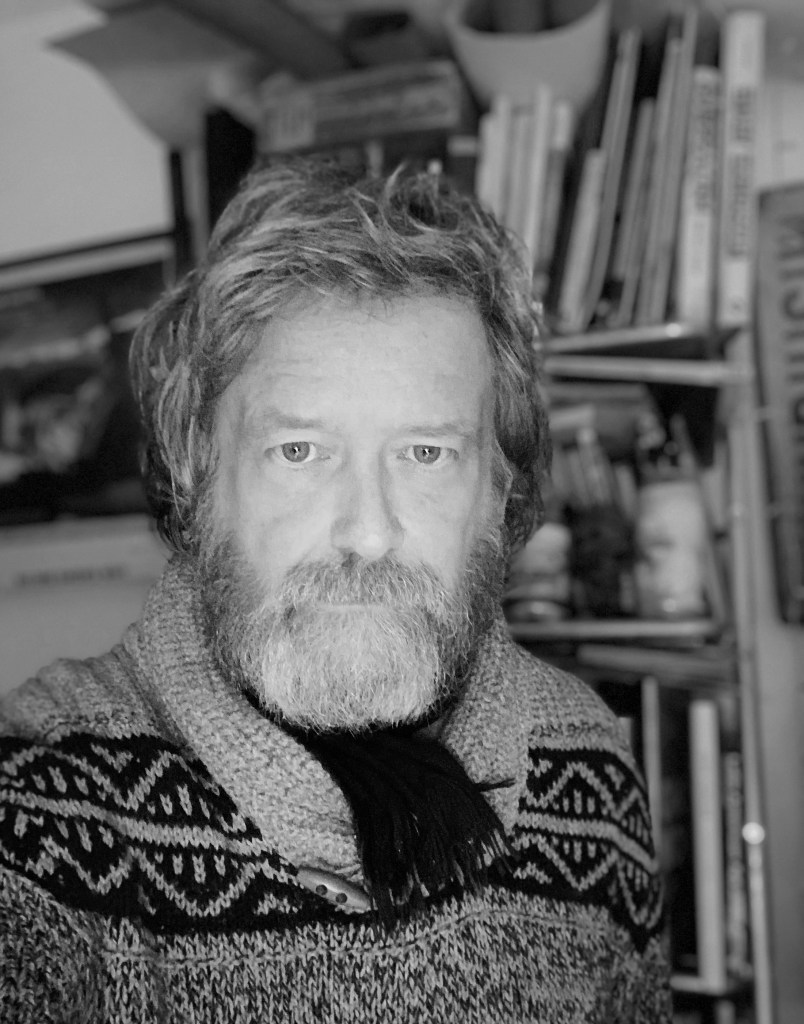
Photo by Given Rozell.

~~~

A self-described ‘vagabond, diarist, and wreck’, C.C. O’Hanlon’s fragmentary memoirs have been published in various anthologies, including Best Australian Essays 2005 and Best Australian Stories 2004 (both published by Black Inc, Australia), A Revealed Life: Australian Writers And Their Journeys In Memoir (ABC Books, Australia), The Odysseum: Strange Journeys That Obliterated Convention (John Murray, U.K.), Zahir: Desire & Eclipse (Zeno Press, U.K.), and Dark Ocean (Dark Mountain Project, U.K.). A founding features editor of Harper’ Bazaar Australia in the late ’80s, his mainstream journalism and images have appeared in The New York TimesThe Sydney Morning HeraldVarietyTravel & Leisure, the Australian editions of Vogue and Harper’s Bazaar and scores of other newspapers and magazines.

He now lives a nomadic life with his American wife of 38 years aboard a small, sea-worn old sailboat named Wrack in the southern Mediterranean. They have three adult children.

_______

Submission Guidelines

All submissions should be sent as attachments to guesteditorbhp@gmail.com

Please state the theme and form of your submission in the subject of the email. For example: JOURNEYS/POETRY

Poetry and Fiction

For poetry submissions, submit no more than three of your best poems. Short stories should be limited to 1,500 words or (preferably) less. We encourage flash fiction submissions, no more than three at a time. Send these in as a .doc or .docx file, along with a short third-person bio, and (optional) photograph of yourself.

Art
Submit hi-res images of your works (drawings, paintings, illustrations, collages, photography, etc) with descriptions of the work (Title, Year, Medium, etc) in the body of the email. Files should be in .JPEG unless they are GIFs or videos, and should not exceed 2MB in size for each work. File names should correspond with the work titles. Video submissions can be uploaded onto Youtube or Vimeo for feature on our website. Send these submissions along with a short third-person bio, and (optional) photograph of yourself.

Virtual Reality/ 3D Artworks

For VR Submissions, please submit no more than three (3) individual artworks. For Tilt Brush works, please upload your artwork to Google Poly (https://poly.google.com/), and mark it as ‘public’ (‘remixable’ is at your own preference). A VR/3D artwork can also be submitted as a video export navigating through the artwork. If you prefer this method, please upload your finished video file to YouTube or Vimeo and provide a URL. With either format, please provide a 150 word artist’s statement.

Non-fiction
Non-fiction submissions (essays, reviews, commentary, interviews, etc) should be no more than 1, 500 words and sent as a .doc or .docx file along with your third-person bio/and optional photograph.

Submissions are open until 25th November – and will reopen again on 1st DECEMBER 2025/for new theme/new editor/s.

BHP online is now in the capable hands of the amazing C.C. – friends, arsonistas, send our NOVEMBER 2025 guest editor your magic!

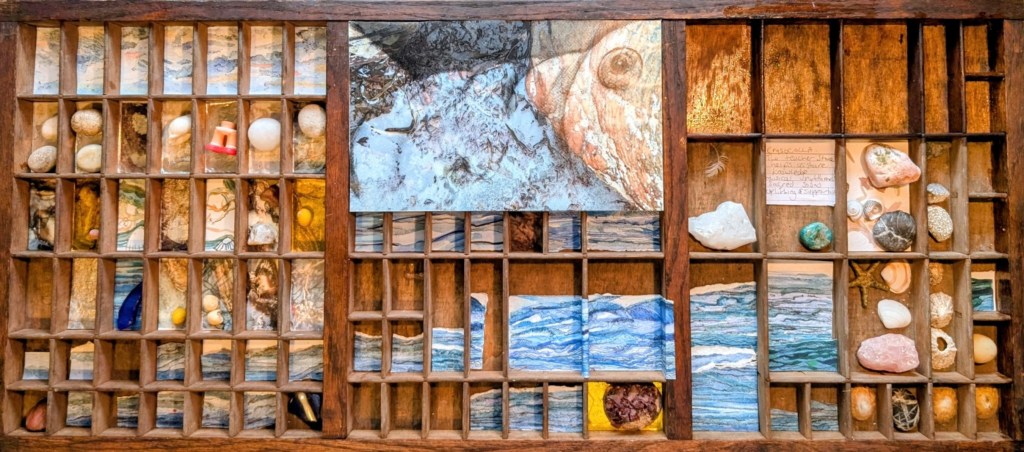
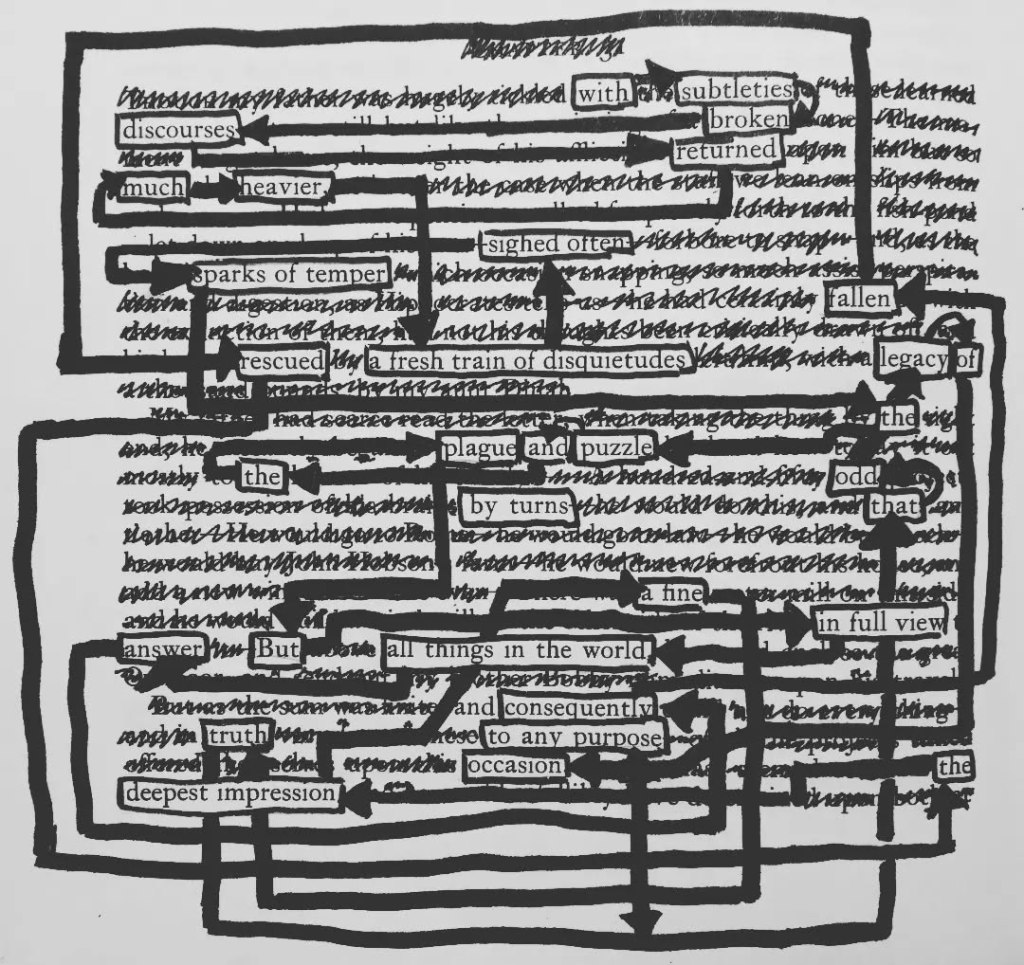
Labyrinth / Erasure by Teresa Mestizo

With subtleties broken, / discourses returned / much heavier / A fresh train of disquietudes / sighed often /Sparks of temper; / the puzzle and the plague / But, in full view, / all things in the world / answer consequently: / fallen, rescued / The deepest impression, / a fine truth to any purpose — / that odd legacy / of occasion

Teresa Mestizo is a Chicagoan Xicana currently based in a small
mountainous town in Mexico where she writes, teaches, translates
& makes art. These poems are part of her recent erasure series using
Laurence Sterne’s The Life and Opinions of Tristram Shandy, Gentleman (1759-1767).
More of her work can be found at teresamestizo.com

Ambiguous Dirt by Austin Miles


one much quieter
one much more talkative,

interpreting daylight as if it were a room

depleted sidewalk wants
2 tell u (me) some
thing

something só imp. It

had to wa
it

a pile of dirt remains ambiguous

laying on the stone like that

can it tell the future?

can the most mundane
can it (not) shine in my eye?

a rock gets lost but ppl forget

then nothing much done today

sometimes sleep
but sometimes not.
washed away

an interesting turn of phrase

someone walks into a bar
but someone
someone tries to convince me of something
but i’m conversing with a
desk lamp

the problem w the world today:

the problem w the world today


Austin Miles is from southeast Ohio. He is the author of
the chapbook Perfect Garbage Forever (Bottlecap Press)
and has poems published in Touch the Donkey, Reap Thrill,
Don’t Submit!, and elsewhere.

Data Lake (excerpt) by Judson Hamilton

5.
Dusk completes its sundowning as crowds of people begin to congregate. Dark tourism is streamed on the brick walls of the town square. From the sewers: the fatberg sits in silent judgment: Popcorn lungs blooming in the young. Distant bleeps and glitches. A Faraday box stuffed with emotions. New fiberoptics beneath the cobblestones. “10G bae bee! 10G!!” The pale green glow of a billion minds humming beneath these streets. “Shot up some estrogen and grabbed the mic. Never felt so free.” GhostBots™ linger on the edge of the crowds asking if we need resurrecting. We lie supplicate at the open pit. Body heat rises up. Visible by the light of our screens. Easter eggs in a snuff film. *cherry vape clouds* Generational grief pegged to a wildly fluctuating index. <current artery blockage at 65%> The attract screen welcomes us to join the deceased. We line the open mass grave with our phablets. We place them gently along the edge. Our banking details auto-scrolling. Endless digits glowing in the night.

6.
Piles of burning mattresses. Labyrinthine tent cities tunnel deep in the night. Dynamos of madness. Blister packs of fear litter the sidewalk. People slicking their hair back looking to make a name for themselves. Mag-lev handcuffs are issued to citizens of good standing. Making arrests has become de rigueur. “Don’t get left behind – make yours today!” They say, ecoterrorism is back on the menu – whether we like it or not. Try decreasing memory footprint to speed things up. *panicked breathing, faces flush with relief* “It’s ok. It’s ok, guys! It’s all behind login.” Blood boys wandering aimlessly. Leashed to IVs. They skirt the vortex at the center of the town square. They gather in the murk. Peel like shadows off the brick walls. Supplicant and meek they are loaded into trucks. :the fatberg sweats in the dark: Bonfires burning large and bright on every street corner. Feverish dancing, arms flailing. Engagement rates are up! Distant bleeps and glitches. Drones pinging in the night. This is a place where no one wins. “Welcome to the unsubscribe center. You made it!”

7.
Washing bones to arrive at their final incantation. Broken teeth litter the streets. Shattered bottles line the curbs. Burger boxes and Styrofoam clamshells shift and slide along the sidewalk. :the fatberg wheezes from the sewers: “Dark empaths on the prowl” Great is their grift and short is their thrift. The pavement is covered in feces. Broken tents sway in the wind. A yellow sulfurous pollen burns the nostrils. Blankets everything in its stench. Blister packs of disappointment clog the sewer drains. The dispossessed have set up shop at the local mall. All honeycombed out with anguish architecture. Occult practices sold here for a price. *whispering* i’m on the verge. Flickering at the edge of sense. Cut-tongue mumblecore. Agitated. Carbonated. Overstimulated. Wandering the halls looking to score code. Countless stalls in cramped space. Frenetic haggling. Stale sweat and burned pharmaceuticals. JUUL pods litter the tile floor. Stimming on glitterbombs. Tech spells and hexes coded in COBOL. Etsy witches paid in arcade tokens. “Hey there are gravity sinkholes everywhere here so – watch your step.”

Judson Hamilton lives in Wroclaw, Poland.
Bluesky @judsonhamilton.bsky.social
https://neutralspaces.co/judson_hamilton/

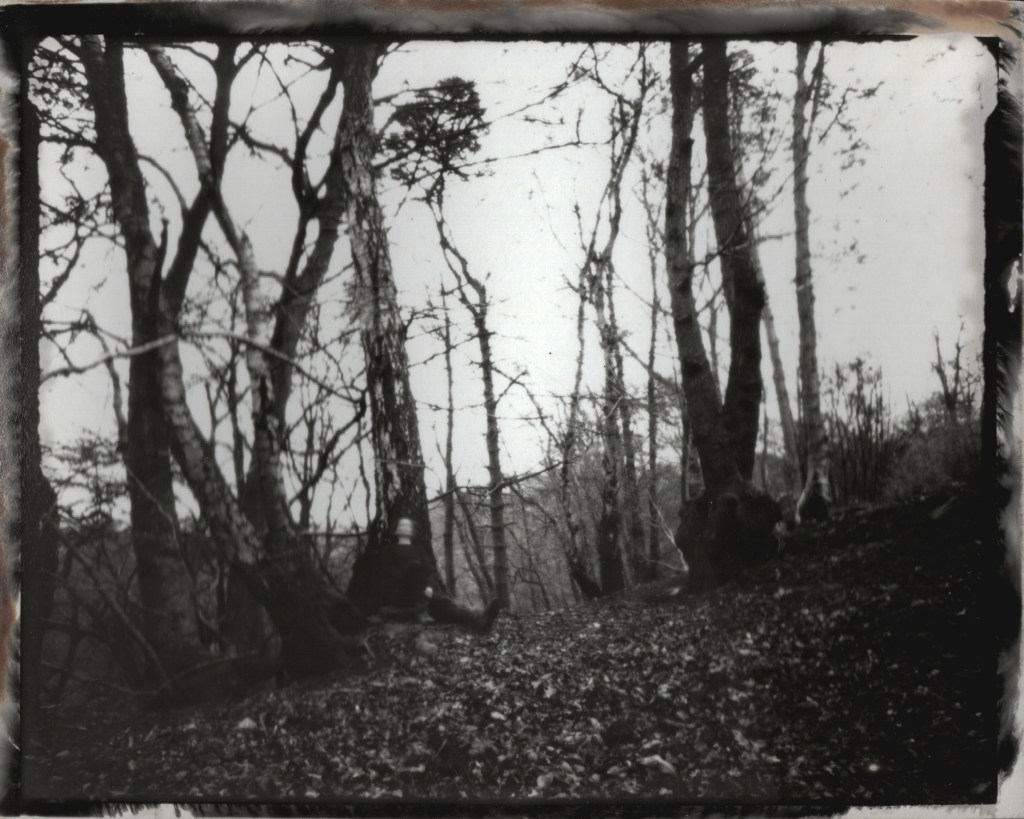
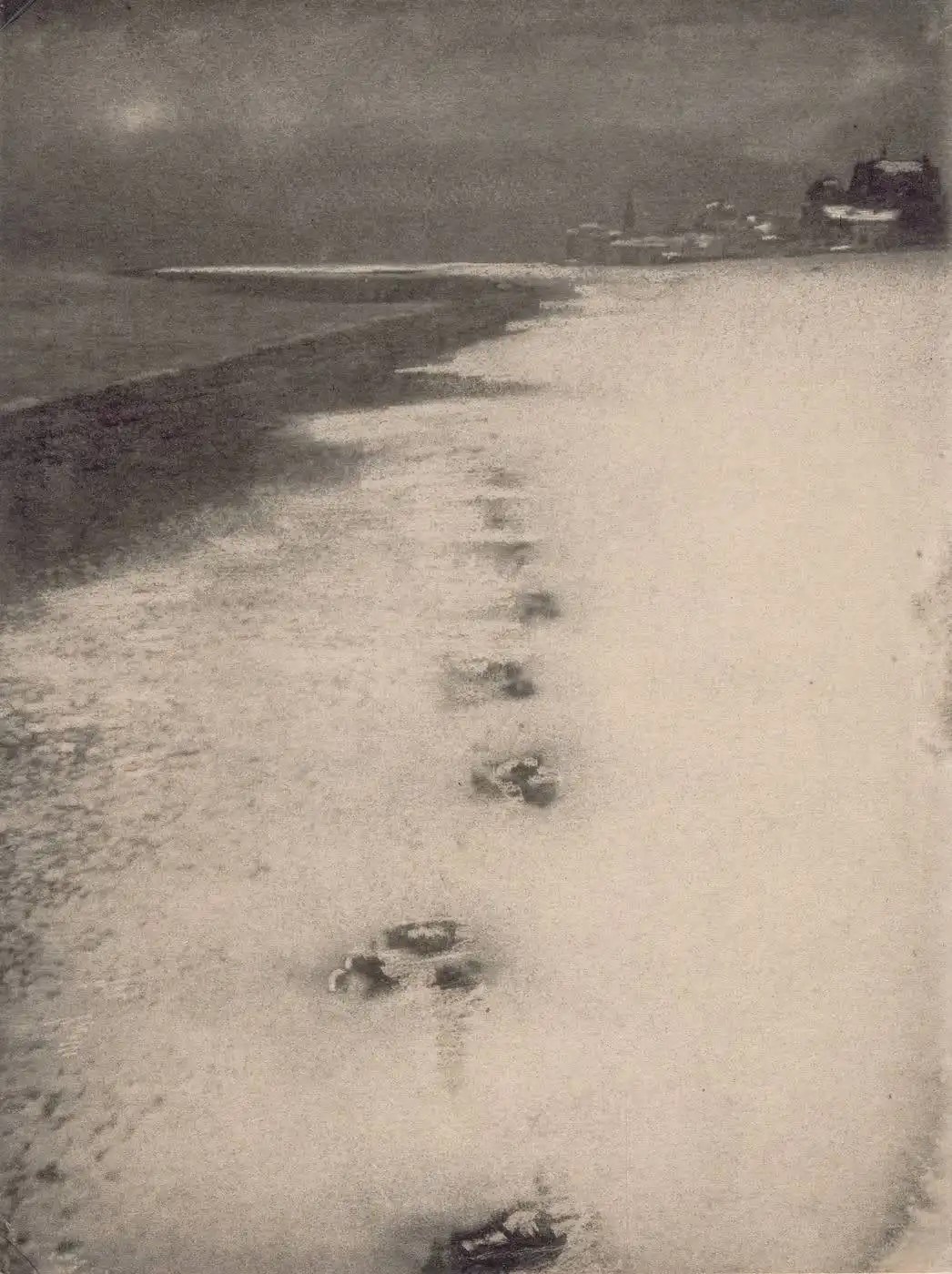
Motion Picture by Donna Enticknap

15 minute pinhole exposure, handprinted fibre-based silver print

Donna Enticknap works with alternative photographic processes
to create portraits of place and self, exploring ideas of connection to time
and landscape, and the fallibility of human memory.
Bluesky: @auuop.bsky.social Website: https://www.donnaenticknap.com/

Two Poems by Corwin Ericson

Sculpture Garden

Brick Professional Building
enislanded by offramps.

Asphalt Curbs Pushed onto the Mulch
by the plow service
spell something broken
in the lot of the brick professional building.

Black Plastic Rat Traps
every twenty paces
under dead brown junipers
ring the brick professional building.

Box for Patient Samples
bolted to the masonry
outside the back basement door
of the brick professional building.

Five People in Cars Eating by Phonelight
two of them wearing scrubs
each of them alone
behind the brick professional building.

Oft-Gnawed Fisher Price People
collect pathogens
in the children’s corner
of the brick professional building.

* 
Inholding

Where feral bloodroot blooms
prettily, where knotweed and bittersweet
are bad ideas that have won the meadow
where there are wells and springs
and cairns and cellars
there is a heavy chain and hook
hanging from a maple too old to tap
where her late husband
butchered their cow.

Corwin Ericson is the author of Swell, a novel, and the collection
Checked Out OK. His work has appeared in Volt, Jubilat,
Harpers, and elsewhere.

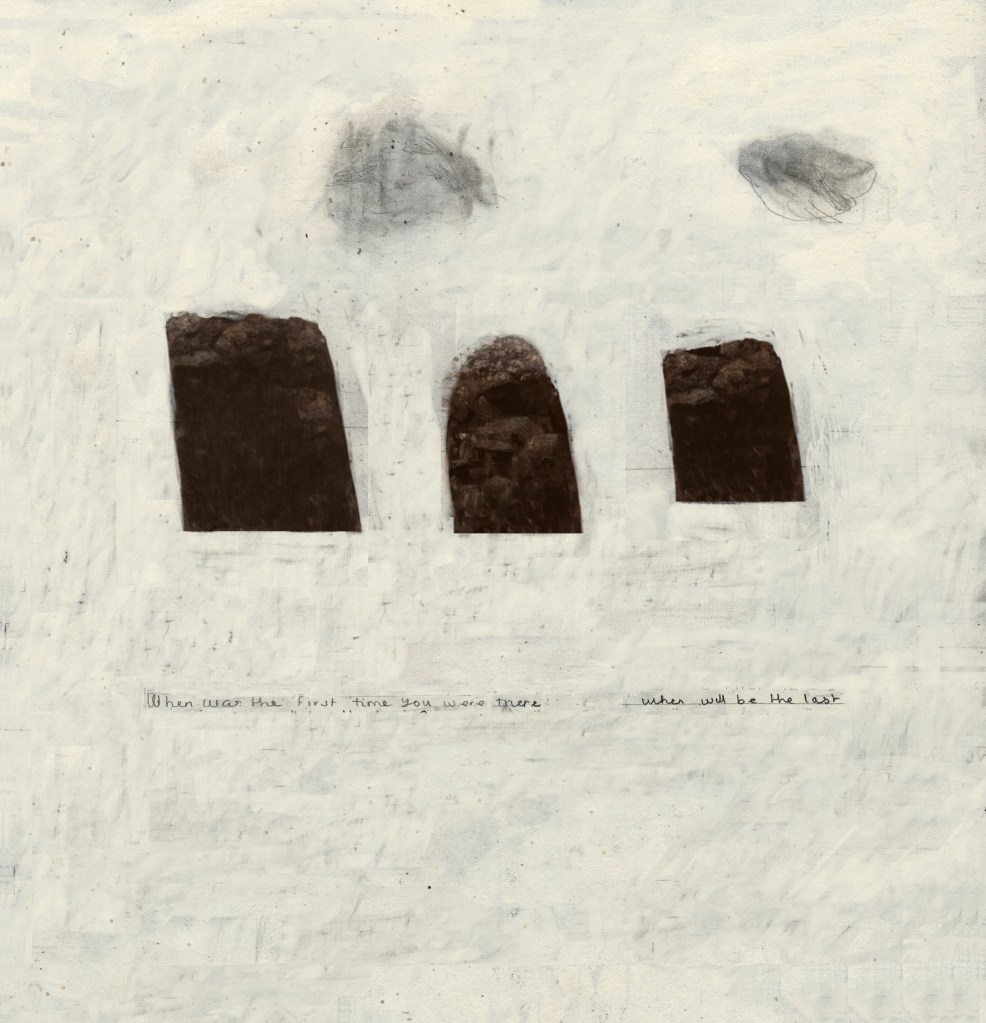
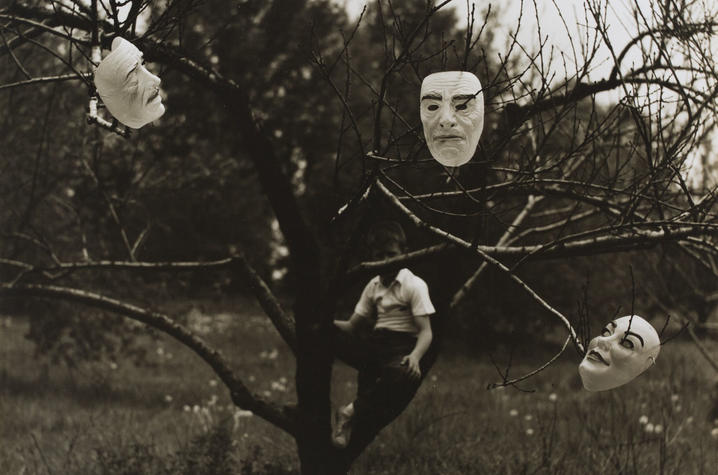
(Image: Ralph Eugene Meatyard. “Untitled,” 1963. Courtesy of Fraenkel Gallery)

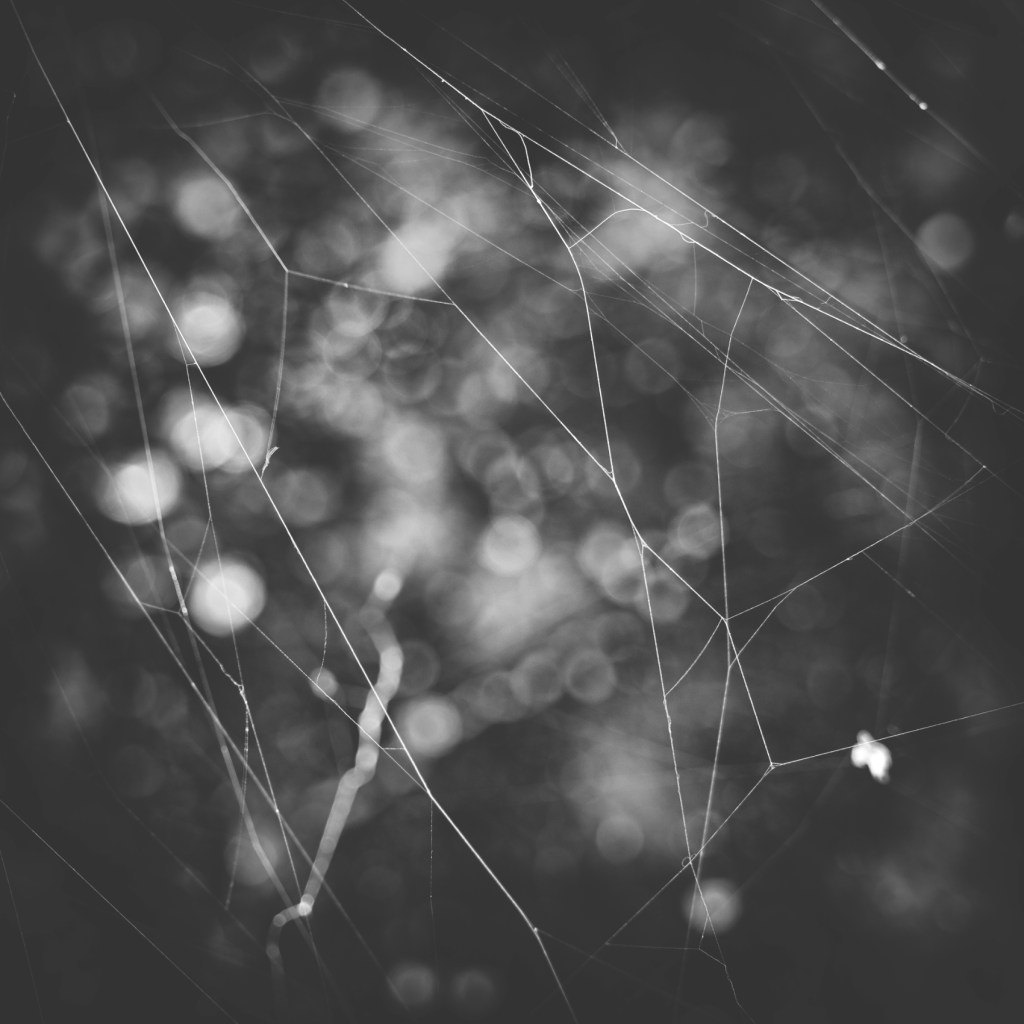
Entangled #4 by Damian Ward

Damian Ward’s work explores the subtle interplay between nature, memory,
& the enduring presence of the past. Through a monochromatic lens,
he seeks to distill the landscape to its essential forms.
Bluesky @damianward.bsky.social
www.damianwardphotography.co.uk

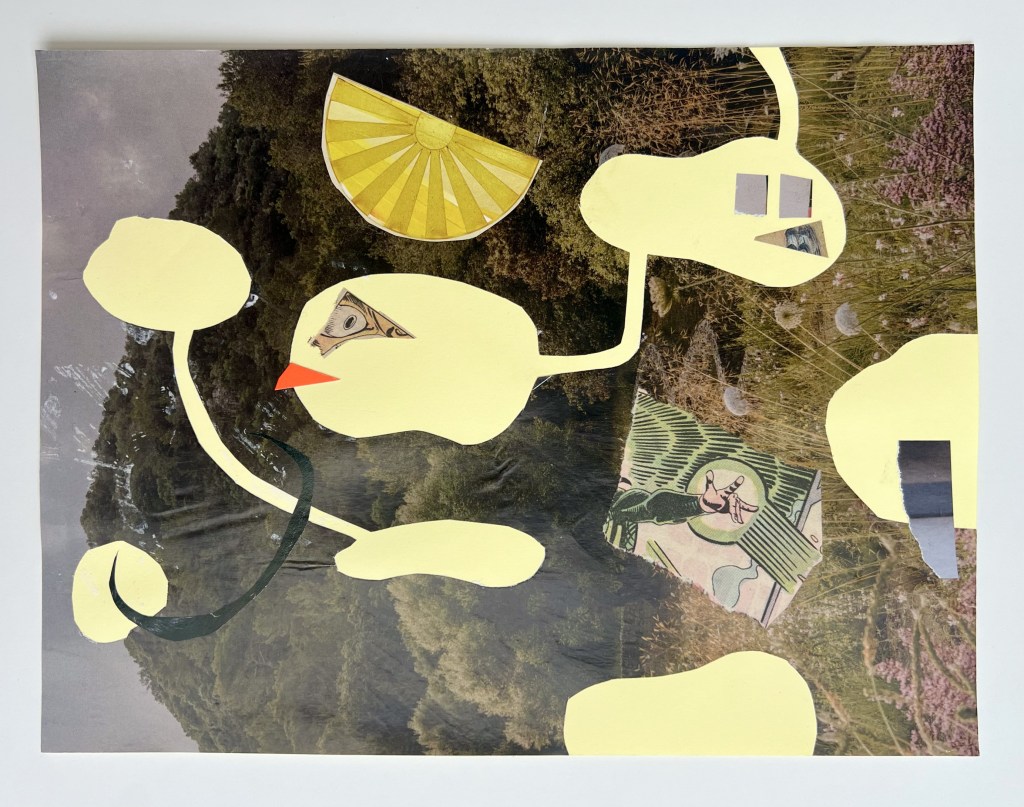
Subterraneans ii by Paul Hearn

Part-time collagist and amateur bricoleur, Paul has always been infatuated
with pop music and comics. Bluesky @paulxhearn.bsky.social

Two Poems by Dan Melling

A Tense to Describe a Duck That Isn’t There
After Asger Jorn’s The Disquieting Duckling

Duck would have been erupting.
Duck would have erupted.
Duck continuous erupt
in the would / have been. Future
duck the perfect erupts. The never duck
eruption.
present simple farmer
haybales fowl in the is and ises in the ed
of rural whitewash each breath
a flesh of brushstrokes.
a tense to describe the temporal
stretch of canvas. Dapples
of birch leavings to stack
in impasto. An erupt

to duck a basal ganglia.

*
A-Political Self-immolators

We fizzy & piffy lakeside straight shooter boys
shoot stray cats from the Baroque balcony boys
we’re landslide boys eat crab boys big bullet
bully boys hooligan melodies & tenebrous eyes boys
sparkle sparkle little pig we ride rapid boys wide
boys locked safe boys sink to the depths the Davy
Jones boys real boy’s boys’ boys locker room
boys’ talk boys neck foam boys nick phones boys rock
-a-bye baby boys the blue-eyed boys bish bash
bosh job’s a good’un boys we’re those landgrab boys
swamp stab boys drain the blood dig the liver
boys pile-driver boys we’re deep-sea diver boys
black-lung coal miner boys real DH Lawrence boys
big tough boys with big tough toys oioioi boys
make some fucking noise boys we’re poison boys
burn the fields salt the earth shatter seas stone skim
boys we’re the make room boys the me-first boys
the boys with a fire in our fists we’re pollution boys
we’re gruesome boys those lumpen laymen men
of the earth serf boys we’re wind & rain boys fight
through snow sludge through mud we breathe gas
boys bottle rocket shrapnel boys we’re front-line boys
Gulf War Syndrome born alone die alone eight
pawn boys dethroned boys deflowered & defaced
face the music boys on my mark we go over
trench foot shell shock whizz-bang boys no man’s
land landless boys no stake in society ASBO boys
we’re high fire boys burn like mustard boys
we burn water baptisms of gas explosions stop
drop & roll up a fatty we’re rock n troll star
boys steal your hearts & leave a scar life sentence no
possibility of parole we’re born to die boys beautiful
corpse cheap funeral Amazon coffin & BYOB
boys search & destroy boys given no quarter hung
drawn & quartered we’re those coup de grâce
coup d'état boys raze the dead seize the day gone
tomorrow boys we’re the lost boys the last boys
last of our name last of our nature we’re ouroboros
boys anonymous boys we see things say things
you wouldn’t dream boys you wouldn’t feed us
to your dog you wouldn’t touch us with his you’d
off with our heads you wouldn’t be seen dead.

Dan Melling is a writer from the UK.
He holds an MFA in Poetry from Virginia Tech and teaches creative writing
at Liverpool John Moores University, where he is also pursuing a PhD.
His work has appeared in The Rialto, X-R-A-Y, HAD and elsewhere.
He co-edits Damnation literary journal.

Blog at WordPress.com.

Up ↑