Driving from Edinburgh to Cairnryan, still in a state of dulled lucidity, unable to fully grasp the enormity of the journey. Once boarded, sounds, smells and motion wake me. I notice the dissipating sleep inertia while cruising. I observe how coastlines move along the ferry. Waves delineate the present, allude to the past and possibly a future. In my mind, I draw the shores with cliffs and hills, inlets and rivers flowing. Sketch the clouds too.
Some ancestors endeavoured the same voyage. Probably many times. Perilous on occasion. From Argyle to Antrim. Settling. My family’s history, a fragmented genealogy, has recently become more important to me. I’ve managed to connect dots, milestones and major events.
Forefathers joined rebellions and fought for hope. Romantically perhaps, I wish valorous and chivalrous men engaged in battles to protect the vulnerable and those who couldn’t stand up for themselves. But I know these forefathers — particularly the first ones who crossed from Normandy to lead the charge at Hastings — were mercenaries. Medieval warriors for coin who later became part of more rewarding and legitimate causes. Fights for freedom. Something I like to mention with pride.
Thinking of those many descendants and generations through centuries of being and remaining unsettled. Stories to make sense of my own existence.
The crossing is smooth. Too short for elaborate meanderings. As I never used this ferry crossing before, ruminating through history appeals, is pertinent. Locations as markers of my mariner heritage: Loch Ryan, Carrickfergus and Whiteabbey. An ancient maritime route. Connecting Scotland and Ireland, trading and exchanging stories, for centuries.
Docking in Belfast comes as an interruption. Like the ancestors, who feel so discernible now, this is a brief stay. Layover, a pause. I walk and my antecedents walk with me. Unsteady and slow, vague and opaque. But they are there. Here.
. . .
Reaching Ireland feels like an achievement, culmination of many attempts and struggles. There’s a sense of accomplishment. Finality or not. So…I tell myself this won’t be the last time. Self-reassurance feels like cheating life. And death. Perhaps I have always been a cheat, an imposter — a syndrome that has plagued me since early teens.
I see opportunity for new experiences, even repeats, as a welcome sign, a bonus, a rewarding gift for my own persistence and perseverance. An inherited determination that has possibly prolonged my life, or slightly plateaued the progression of symptoms and appears to have altered the course of expectations, both from the clinicians perspective and our (family and me) own.
“Life expectancy is six to nine years for most. Some get twelve.” It says so on the website, in the leaflets. Nine years in, I sincerely believe I have more than three years left in me. A calculation I have never expressed, never shared. An aspirational awareness.
When the new neurologist affirms the diagnosis — Corticobasal Degenerative Syndrome — he immediately adds ‘atypical’ with a gentle smile, referring to an uncharacteristically slower decline than expected. I return his smile. As if we bond in a complicity to deceive the expected. Gratitude, an element of self deprecation and a desire to cheat the norm. He tells me there’s no certitude, no predictability or any clinical factors to provide a reliable prognosis. But he knows the numbers as well as I do. He too, understands time. And he knows it’s irreversible and incurable, degenerative. Curtains are closing, slowly yet very surely. He knows, he alludes to it and he gives me another, now even more compassionate smile. I like his manner, his tone and expressions, his clarity, his twinkle. A shimmer like tiny stars on dark curtains.
Some use the word gift, as if a benevolent creature rewards me. I accept it all: my condition, the illness, the lack of clarity and certainty of prognosis, the inability to obtain assurance. There’s defiance and acceptance. I resist limitations while embracing an increasingly disabled life.
I no longer drive myself. I miss it. The car, the independence, possibilities and destinations. Actually, I no longer have the ability to do much myself. Beyond some thinking. And even that is difficult. For more than three quarters of the hours of the day, I struggle with everything. 75 per cent of the time I exist in near to full obscurity. I live in the vicinity of perpetual fog, my life floating around mist banks. Fog formations over bodies of water with me on a boat without mast or sail, no oars nor anchors. To me this mist, the fog, appears monochrome, as rudimentary woven linen and lace. Écru. Raw and untreated. Weirdly tangible. Veils, retaining some elegance and delicacy, rather than heavy ruby theatrical curtains. They open a few hours each day when I feel freed, am allowed to wonder and be lucid.
Definitely happy. Really happy. Childishly happy.
Despite that, some hours later, I am always ushered back to my veiled sense. An uncertain existence, where all true consciousness evaporates, just leaving some cloud-like space I fill with unknown. Unknowns. Plural.
Repetitive oscillatory motions, erratic pendulum patterns. Yet, I am truly happy.
Embarking on this road trip, I emphatically exclaimed it — “I am the happiest I have ever been.” — unsure if anyone would believe me. And maybe it did sound unreal, not credible, callous even. Surely, key events in my life Have rendered me happier. No! Maybe this is a different connotation of happiness, or as I see it, another realm, a new dimension.
An end-of-life prolepsis, ahead of time. An early fictionalised version, or view, with sea horizon clarity on a bright day. Translucent and floating above aquamarine, turquoise, cyan and seafoam. Tangible glee, near-delirious high spirits I can hold in my hand as tanzanite, reminding me of trichroic properties. Appearances of sea blues, sunset violet, with lavender tones, hints of tangerine, blood orange and burgundy.
It is not contentment, not merely gratification, neither fulfilment nor a feeling of comfort. It is an elevated joy, elation and the discovery of tingling delight. Even a somewhat tantalising notion of new found jouissance, discovery of late life ecstasy. Rather apt, timely. My own renaissance.
As physical excruciating pain has a hold over me, like a threatening hang-man standing on a scaffold not too far away, smiling. Agony always is an ugly face.
When I mention joy and happiness, others often find it impossible to imagine. Maybe because of my facial expression, at times anguished, when muscles jerk and spasm and my entire body is assaulted by torrents of aches.
Or maybe because of the finality. What appears contradictory makes it even more special for me.
The north to south drive crisscrossing counties and sceneries is not so much a reminder of previous returns home, but a refreshing perspective of an amazing varied tapestry of places and meanings. New, old, new, old. Non-linear meaning, circular mapping, a cartographer’s wild dance and rites of spring. Around a fire with flames reaching up as if to colour the night sky yellow to amber. Past autumn, in a brightness of winter. Anticipation of renewal.
Closer to home, it is more recognisable.
Memory-lane is flanked by old copper beach trees whose drooping branches appear to prepare for weeping. Nature’s anticipation of sadness and a reminder of cycles. Limbs surrender. This is not my dolorous time. Not yet. Desolation emerges in shapes from crystalline and fluid to sharply outlined and clear. Coloured or black. Sorrow hangs on branches as a substitute for once vibrant leaves. They all fell and are heaped along the path to form floating ephemeral dams and ditches, they’re soft-walling the roadside but it’ll only take the lightest breeze to displace them. I like the lightheartedness of that thought. Any glumness I might have carried on my shoulders floats away. Anticipatory melancholy instead of deepest darkest grief, is what I note about this lane.
Sweetest melancholy. Pensive and pending in this moment. Slow yet still rhythmic. Poetic and impressionistic vibrant.
While I look at the sky, we’re driving slowly towards the river, swollen as if the banks are no longer able to contain the landscape, flooding the cartographers precision with new impressions. I settle for seeing clouds simply move. Different boundaries. New horizons. Not for me. Or not for long for me. Again, I wonder if cloudscapes, seascapes and landscapes, those I happily contoured or traveled through for decades, are as inviting to generations following the imprints. In sand or dust or ash.
This visit is about letting go. Like clouds. Or feathers of smoke from the wood and peat fire that invites me to sit down. Perhaps have a drink. Smile. Or not. Yes, smile.
Smile…
. . .
In 2013, Bo Mandeville moved from Ireland to North Wales to run the National Writers’ Centre. After less than two years in the post, he had to retire due to a neurodegenerative disorder. Over the years, his multidisciplinary practice has taken him from Ireland and Belgium to France, Netherlands, Germany and the United States. His work spans cultural anthropology, film-making, writing and creating (mainly) anonymous, ephemeral land art. He set up and directed several multidisciplinary arts projects and festivals, curated film events and was a board member of an EU Film Festival organisation. Bo has scripted several film projects, produced and co-directed documentary films and gave talks about film at events and colleges.
Memorial to Lieutenant Hans Hermann von Katte. All photos by Marcel Krueger.
The border is the maddest line on the map, the most fluid, unnatural and dangerous. Tomasz Różycki, from Trial by Fire
On the 3rd of November, 1730, Lieutenant Hans Hermann von Katte, then 26 years of age, was led from his arrest cell on the Gendarmenmarkt in Berlin and, under guard and by carriage, transported to the fortress of Küstrin and his death.
Katte had been an intimate friend of the Prussian Crown Prince Frederick, who had been constantly abused by his father Frederick William I. In August 1730, the prince planned to desert the court and go to England. He wrote to Katte informing him of his intent to abscond and that Katte was to join him in The Hague. But in his haste the prince did not add Berlin to the address, and a diligent Prussian postmaster delivered the letter to another Lieutenant Katte who in turn reported its contents to the king.
The response of the father was to beat his son up, so badly that a member of the court had to step in to prevent the king from killing the prince. Frederick was then sent to the fortress of Küstrin under arrest, and the king ordered Katte’s unit to court martial the lieutenant. They did and sentenced him to life. The king was not happy, and asked the court to come together as: “They should administer justice and not gloss over it. The court martial should reconvene and rule differently.” They nevertheless upheld their sentence, and in the end it was the king alone who sent Katte to his death.
I am 295 years late to his execution. My journey from Berlin does not take me to death, yet, but as so often when travelling in Germany, to calamity and ruin. Leaving from Berlin-Lichtenberg, once one of the main stations of the GDR, in the early morning, I take a small regional train past the brown and green fields and forests of Brandenburg into the floodplain of the Oder, the Oderbruch. Autumn frost lingers on the forest paths and in the shadows of the railway embankment. This must be among my favourite things in the world: travelling by train on a glorious autumn morning, to look at the ruins of the past. My journey to the death of Katte is, after all, not only a Prussian pilgrimage but also one across the layers of the recent history of Europe and its leftovers.
The line I’m travelling on, now a branch line connecting the smaller towns and villages of Brandenburg with the capital, was once part of the Prussian Ostbahn, the eastern railway of the German Empire. From 1867 on it connected Berlin with the far reaches of the Reich, the province of East Prussia and its capital Königsberg, Kaliningrad in Russia today. From Berlin you could reach Königsberg via express in six hours and 38 minutes, and it was here that the successors of Katte in the Prussian army transported men and guns east, in 1914 and 1939. Double V’s of flocks of geese on the way to their winter quarters cross the blue autumn sky above my train chugging east, and I wonder if Katte saw similar things from his carriage, and if he thought about a future he would never see.
The empire is gone now, but its legacies remain. On the old station building at Seelow-Gusow the distance marker to the capital (Berlin 63 kilometres) is still intact, but the one indicating Küstrin has been chipped away, as if the authorities of the GDR did not want to remind their citizens of a town lost. During the Yalta Conference in February 1945, Stalin and the western Allies had agreed that Poland would be given former German territories: the southern half of the province of East Prussia and the provinces of Pomerania and Silesia. The German population was forcefully expelled and the areas repopulated with Poles expelled from the Kresy regions in the east of the country, which were in turn divided between Ukraine, Belarus, and Lithuania. Over five million Germans were forced to move west, and over three million Poles forced to follow them, all leaving their homes behind. The river Oder became the new border between Germany and Poland.
Ponds and creeks are increasingly visible from the train, and then we arrive at the Oder proper. The stream here is not a single border river with high banks, but more meandering, older, untamed. My train crosses at the confluence of the Oder and Wartha rivers, and rolls over two long bridges crossing both rivers and the low-lying marshlands between, before it comes to a halt in Kostrzyn nad Odrą in Poland, German Küstrin before 1945.
Kostrzyn nad Odrą is a newer settlement however, expanded from a former German suburb. In front of the train station there are signs indicating Stare Miasto, the old town. In many other towns across Poland, that means the medieval centre, places of cobblestones, cozy pubs, Christmas markets and buskers. In Kostrzyn however it means an absence. I walk towards the rivers again, cross the shiny new bridge for cars and pedestrians across the Warta and reach what was the border crossing until Poland joined the Schengen area in 2007. There’s a hotel, a McDonald’s, a gas station and one of the ubiquitous Polenmärkte, a market where Germans from Berlin and Brandenburg came — and sometimes still come — to buy cheap booze and cigarettes and get a haircut. Behind the hotel is the old town, or to be precise the lack of it.
Because of its position between the rivers, the Prussian authorities had decided to build a fortress here in the 16th century, which had grown into a sprawling red brick edifice with massive bastions when Katte and Frederick arrived. Following the unification of Germany in 1871 it was expanded again and became a mixture of civil and military architecture, with impressive merchant houses lining the cobbled streets along which trams clanked and the new middle class of the German Empire strolled. All of this existed until March 1945, when the Red Army defeated Wehrmacht defenders here in a brutal battle in which over 3000 men perished. When the smoke cleared, Küstrin lay in ruins. Over 90 percent of the old town and the fortress were destroyed. But unlike many other towns it was not rebuilt as the new Polish authorities preferred to develop the settlement nearby, its bricks instead shipped to Warsaw as building material.
The overgrown ruins of Kostrzyn.
The overgrown ruins of Kostrzyn.
Today, what’s left of the old town is overgrown, trails and open spaces indicate where streets and squares used to be, sometimes still lined with curb stones in front of houses long gone or a few meters of cobbles poking out between the grass. New street signs in German and Polish point nowhere. Some of the Prussian bastions have been rebuilt and house a museum, but even on a sunny Saturday I have the former fortress almost for myself. There is a couple walking their dog, and a man in military fatigues is flying a drone over the ruins, but other than that it’s just me and the German ghosts.
I reach the rebuilt Brandenburg Bastion. Here, in the morning hours of November 6, 1730, Hans Hermann von Katte was led and forced to kneel, while his friend was made to watch on the orders of the king. According to some sources, Frederick shouted in French to Katte: “Please forgive me dear Katte, in God’s name, forgive me.” Katte called back: “There is nothing to forgive, I die for you with joy in my heart!” Frederick then fainted. Katte was allowed to say a prayer and then beheaded by sword, his body covered with a black cloth but left under Frederick’s window all night.
Katte’s friend never escaped the clutches of his father. Frederick remained imprisoned for another two years, and then joined to Prussian army. He would later acquire the moniker ‘the Great’ after fulfilling his father’s dream of a Prussian empire. While he married he remained childless, his court was almost exclusively male, and he is buried with his favourite dogs on the grounds of his castle of Sanssouci.
. . .
In the walls of the bastion sits a memorial plaque to Katte next to a passage to a small harbour by the banks of the Oder. The inscription reads, in German and Polish: Lieutenant Hans Hermann von Katte, born 1704 in Berlin, beheaded 1730 in Küstrin as escape agent of the Crown Prince Frederick. I step down through the gate, and a quintessential European panorama presents itself to me: red brick and catastrophes by the banks of a tranquil border river under a blue autumn sky.
As I walk back I look at Katte’s plaque again, and realise that someone had added two words in German to the frame in black marker. The memorial now reads: Lieutenant Hans Hermann von Katte, born 1704 in Berlin, beheaded 1730 in Küstrin as lover and escape agent of the Crown Prince Frederick.
. . .
Marcel Krueger is a German-Irish writer and translator living in Berlin. Through family history he explores the tragedies of Europe in the 20th century and what these mean for memory and identity today, especially focusing on Ireland, Germany and Poland. His essays have been published in The Guardian, Notes from Poland, 3:AM, Paper Visual Art, CNN Travel, New Eastern Europe, Przekrój, and The Irish Times, amongst others. Marcel is the co-editor of Elsewhere: A Journal of Place, and has published five non-fiction books in English and German, among them Berlin: A Literary Guide for Travellers (written together with Paul Sullivan, 2016) and Babushka’s Journey: The Dark Road to Stalin’s Wartime Camps (2018).
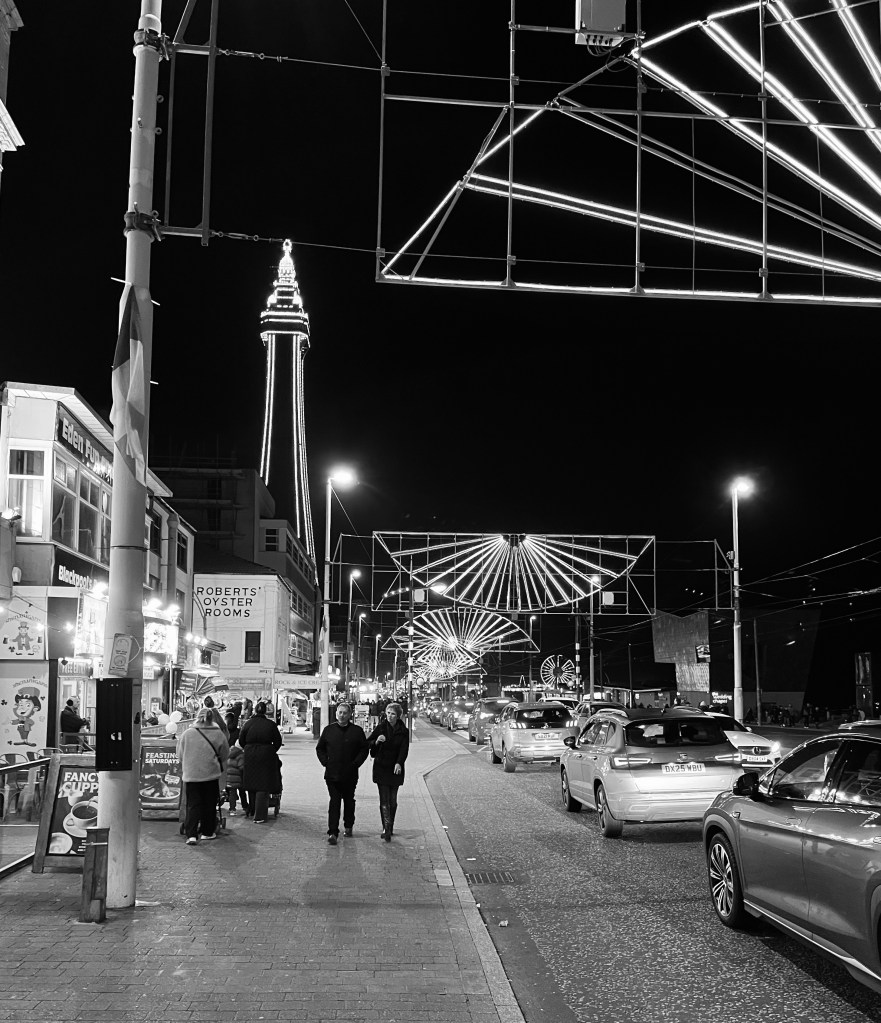
The North Shore, Blackpool. All photos by Stefan Svennson.
Every year, in the last week of June, the mills, engine rooms, and coal mines in Oldham closed down, and an exodus followed. My great-grandparents, George and Alice (both born in 1867), dressed to the nines, would board the ‘Wakes Week Special’ at the station and head for Shangri-La. The railway served as a steam-powered conveyor belt that shifted human assemblies from the factory floor to a manufactured seaside resort I had the best of reasons to return to Blackpool. It was a joke of a place where you could let rip, lose yourself and fall in love. It was my seaside heritage and had become synonymous with northern soul.
The West Coast express from Euston was packed with jovial passengers, many bursting with stories, but even before Watford Junction, I was in the zone, oblivious to my surroundings, absorbed totally in forcing sonic madeleines up to the surface. The first to return was the voice of my father, “Look, son, can you see it, there, faraway beyond Crow Wood?” From the same vantage spot on Billinge Marilyn looking out to where the skyline met the Irish Sea we had seen an island of unearthly beauty covered with trees. Once he was certain I had spotted the thin vertical silhouette that he said was the Eiffel Tower, he started to parrot, “There’s a famous seaside town called Blackpool, that’s noted for fresh air and fun, and Mr and Mrs Ramsbottom went there with young Albert, their son. “
I eventually arrived with my bucket and spade at the advanced age of eight and a half. Outside the Fun House on the South Shore, an automaton with large, round eyes, bright red lips, and a disconcerting gaze sat inside a glass cabinet. A crown was resting on its frizzy hair and a sad Pierrot sat on its lap. As it rocked on its throne, it emitted a deranged cackle that I felt compelled to imitate and which, like a nursery rhyme, would become indelible. At the Winter Gardens, I had been mesmerised by a magician in his tailcoat and white bow tie called the Amazing Yoxani who was bound, placed in a bag, and then locked in a large trunk by a female assistant. The heavy curtain fell, and when it rose moments later, there he was, bowing and smiling at the audience. He then bounded over to the trunk, unlocked it, and liberated his female assistant. I knew it was a trick, but it didn’t matter but it felt very real. Cinematic flashbacks of the wooden hut for lost children at the entrance of Pleasure Beach, the pennies that never fell from the shelves in the amusement arcade, sheets of spray spilling onto the promenade and the drawn curtains of the fortune tellers’ kiosks flooded in as the train approached Warrington. In the menagerie at the Tower, I listened to a recording of Stanley Holloway reciting his monologue of Albert and the Lion. Dressed in his Sunday best, young Ramsbottom had stuck a stick with a horse’s head handle into Wallace, the lion’s ear and paid for it with his life. My father had frightened me by telling me it was a true story.
My paternal grandparents, Ben (born 1892), a machine fitter and Doris (born 1899), had also gone to Blackpool by train from Oldham during wakes week. Granny once told me that when the Tower and the gleaming sands came into view through the carriage window , the atmosphere changed. The starchiness vanished, and the excited holidaymakers burst out singing, passing round bags of sweets. She also told me of a rainy day on the promenade when she had watched with astonishment as a group of miners she recognised from Wood Park Colliery had passed her jigging with joy.
I changed trains at Preston and on the last short leg through the flat and characterless Fylde plain a man sitting opposite me asked me if I was off to see the ‘Lights’. When I told him I was going dancing, he replied, “You’ve got the right place, pal, they even dance in the street.” Blackpool North had an end-of-the-line feel. Its platforms were deserted, and its surroundings resembled a sanitary landfill. Inside the station, there was a large concourse with no seats that served as a holding area beyond the automatic ticket barriers. Two long queues of passengers snaked round its perimeter. A gaggle of officious station foremen guarded the platforms to ensure orderly boarding for the trains to Lime Street and Manchester Airport. Outside the station, there was a connecting underpass to the tram interchange. Head down, I hurried past a group of inert heroin addicts and a man wrapped in a layer of homemade lard, clutching a can of ale. Behind me, I heard the low hum of a modern tram gliding towards the shore. Talbot Road felt edgy, cut off and run down with swathes of arrested brownfield development. Even in the town centre, there was a moribund low season feel. The many multi-storey car parks and spacious lots were almost empty and the few people in the street seemed in a hurry to get home
In a few minutes, I reached the Golden Mile . The priapic Tower was lit in indium blue, and the Prom bathed in electric sunshine. There were many live shows and music venues on the strip. At the entrance to the North Pier a middle-aged woman where I bought some sticks of rock called me ‘sweetheart’ in a cheery Lancashire brogue. The illumination and movement had lifted my spirit. Someone had written in chalk on the pavement, Yesterday is history, tomorrow is a mystery, today is a gift of God, which is why we call it the present. It was a sin to be unhappy in Blackpool. The Scots and Scouse hordes were walking the walk, and there was a hen party from Yorkshire. I could hear the sea booming in the dark dusk. Ocean Boulevard, The Esplanade and the Atlantic were the set for our shared illusion. Dray horses with jingling bells were clip-clopping towards Central Pier pulling pink Cinderella carriages sprinkled with tinsel
There was already a line of old souls outside the Tower Ballroom, intent on securing tables close to the dance floor. I walked towards Pleasure Beach, hoping to hear the bellowing mechanical laugh of the ‘King of Fun’, but all I could reconnect with was uptown Motown and Stax music coming from the crowded bars. The scaffolding of the roller coasters resembled glittering lattices in the darkness. Their cars, full of screaming late-night riders crawled up the steep inclines before shooting comet-like through a starless sky. The Blue Waves, The Windmill and The Sands were derelict, but there were still plenty of pet-welcoming boarding houses advertising Free Showers. The Sea Front Camelot Tea Rooms, which I felt I remembered from seventy years ago, was offering every permutation of the Full English breakfast.
When I returned to the Tower, the queue had been replaced by a strong smell of vinegar and fried onions. I looked up at its archways, stained glass windows and the vertiginous criss-cross lattice of iron and steel. I showed my ‘Togetherness’ wristband to the smiling doorman and climbed the stairs to Circus Walkway. As I rounded the first corner, I was hit by the sound of Frankie Beverly belting out If That’s What You Wanted. I started to mouth the lyrics with the same autonomic reflexes that compelled me to mimic heading a ball every time I watched a corner kick:
Ha! Since I’ve been left here, darling, I’ve been walking into closed doors, call yeah! I needn’t tell you how much I love you, but I just can’t take it no more, ah yeah!
The final three in the Dance Championship, Tower Ballroom, Blackpool.
The ballroom on Level 3 was rococo with Victorian knobs on. It was adorned with columns, arches, cherubs, friezes and balconies. A large crystal chandelier hung from the sliding roof. An invocation to the dance written by William Shakespeare, “Bid me discourse; I will enchant thine ear”, written for Venus in her seduction of Adonis, was emblazoned on the top of the proscenium arch. Below the stage, the Mighty Wurlitzer used to orchestrate the quickstep, tango and waltzes lay dormant for the weekend. The disc jockey, Richard Searling was tucked unobtrusively between two large LED video screens whose purpose was to magnify and project the spinning discs. The music was rawer and looser than Motown but had the same mono, four on the floor backbeat. Every record had a hook line that was repeated over and over and the beat was kept heavy. I imagined the clanking and grinding of engines, the honking of forklifts and the rhythmical high-pitched clatter of looms on the mill floor. A fervent, supercharged excitement rose from the ballroom’s sprung wooden dancefloor. The dancers’ intricate backward swerves, dervish spins, Soul Train turns, backdrops, swallow dives, and somersaults of the dancers reminded me of the amphetamine-driven rats I had studied in the speed laboratory. The music seemed timeless. Soon I was floating out on the floor, feeling the syncopated horns and strings, galvanising my thinning muscles. I was still the old modernist, making moves I didn’t know I still had in me. I owned the music, kept the faith and was not too old to dream.
The stars of the northern soul scene were black American artists, almost unknown to the general public and a handful of blue-eyed white singers like Frankie Valli, Timi Yuro and Dean Paris. The disc jockeys were unfussy magicians who constructed an illuminated reality from pieces of plastic and were able to create an illusory willing suspension of belief . Most of the favourite tracks were obscure flops from the sixties and seventies with furious melodies, heavy syncopation and powerful vocals. Years of communal connoisseurship had led to an impeccable quality control. As the hours passed, listening to the music, I fell into a trance. There were moments when I was carried back to the Abracadabra magic show with a white rabbit materialising from an empty top hat and a bunch of scarves rising in defiance of gravity. The music became a healing force that loved me back.
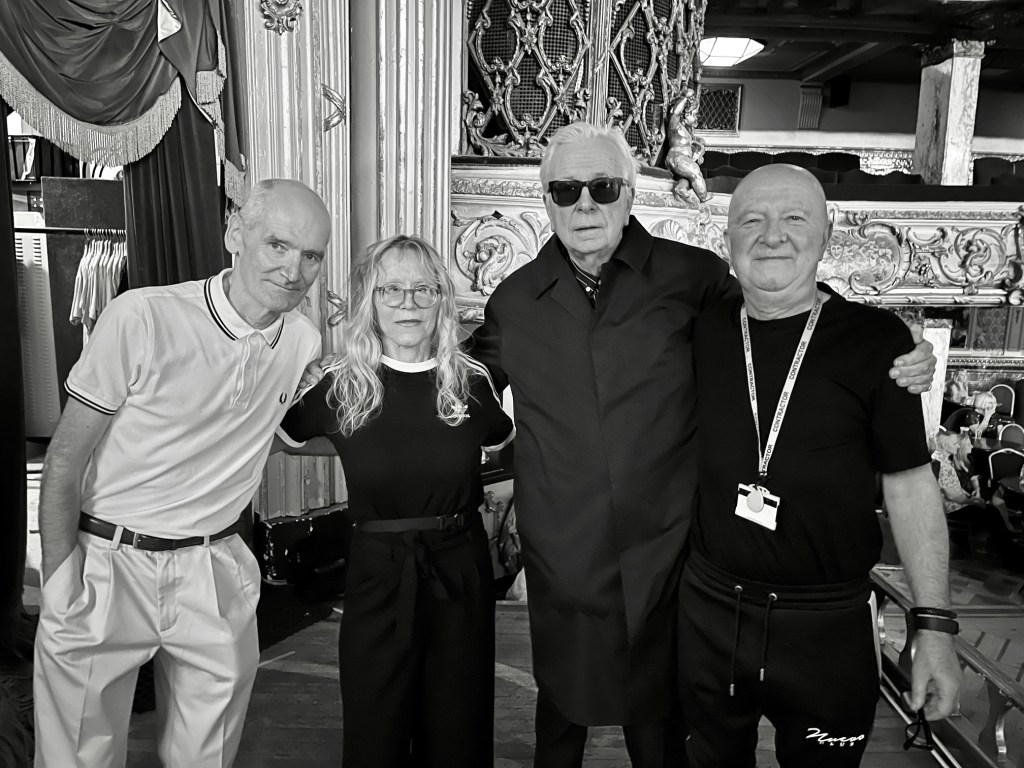
Around midnight on the second day, I climbed up to the sweeping upper balcony and looked down, scouring the floor for the Dopamine Dancer and for David, the Boy Miracle from Stirling, who had been brought back to life after a brainstorm by a northern soul tape. The stomping was spontaneous, improvised and high energy. There was no leader, everyone was free to express themselves in their own way but a strong sense of etiquette existed on the floor. Each dancer reacted to those in closest proximity and avoided getting too close by steering an instinctive course, which returned them to their own spot sometimes marked by a pool of sweat. Everyone was committed to having the best night ever. Fifty five years after it began northern soul was now being kept alive by the children and grandchildren of the pioneers from the iconic venues like the Torch, the Highland Room, The Casino, The Catacombs, the Pier, the Ritz and the 100 Club, Some renegades from the funk and disco scene who had belatedly found the holy grail and a few visitors from the Japanese, Australian and Canadian scenes injected new blood. Some of the old soulies were now too unwell to dance but still got high on the music, and there was still plenty of fast footwork in evidence from bald elderly men in Fred Perry shirts, vests and baggy trousers and glowing women of a certain age with long circle skirts and lightweight tops. The motion was soulful, passionate and beautiful to watch. First, I spotted David in a white shirt sitting with friends in ‘ Scotch Corner’ close to the stage on the left in front of the record stalls. Then I picked out Anne, the Dopamine Dancer freed from the shackles of Parkinson’s disease, dancing in the middle of the ballroom. Music had released her handbrake and she could dance all night
From Left to Right: David, Anne, A. J. Lees and Richard Searling, on the stage at the Tower Ballroom, Blackpool, November 8, 2025.
On Sunday afternoon, I took a tram back to the station with my heartbeat still turned up and wreathed in a glow of animation. A burly man with a loud voice told me it was a free ride then warned me to transfer my wallet to my back pocket. As my train pulled out of Blackpool North. I felt that I had become truer to myself. The invigorating make-believe world of northern soul was a portal to authenticity. It brought home that the high bogus of scientific fraud, doctored clinical trials and the sale of counterfeit medicine had dragged me down. Some technological titans who believed in the infallibility of machines were trying to reduce medicine to a measurement and I had read about unaccountable customer-friendly chatbots that encouraged the suicidal to kill themselves. Moving to the music had helped me rebuild and resynchronise. The trip to Soul Town told me I needed to take more time out to dance on the edge of volcanoes and spend time watching the sunbeams flirt with the shadows. I would continue to respect data, but I must never lose my delight in magic and faith in God
Footnote: In 1923 Blackpool football club founded in 1887 adopted a distinctive tangerine shirt with its team wearing it for the first time in a 2-2 draw against Oldham Athletic. I associate tangerine with warmth, high energy, adventure and cheerfulness.
. . .
A.J. Lees is a Professor of Neurology at the National Hospital, Queen Square and University College London. , He pioneered the use of apomorphine for the treatment of Parkinson’s disease and has received international acclaim for his expertise in the treatment of abnormal movement disorders. He is also an original member of the Highly Cited Researchers ISI database. Born in St Helens Merseyside, he qualified in medicine at the Royal London Hospital Medical College, Whitechapel in 1970 and received his training in neurology at L’Hôpital de la Salpêtrière, Paris and University College London Hospitals. His book Mentored by a Madman, The William Burroughs Experiment (Notting Hill and New York Review of Books) published in 2016 explains the unlikely association between his neurological career and the author of Naked Lunch. His latest book Open the Door to your Heart describes the importance of dance music in his own life and in the restoration of function in some of his patients.
All this started on a lonely bench at Frustration Station.
There I was, sitting, with a crushing sense of defeat, of failure, and a nagging urge to engage in some kind of creative process again. My life had unravelled slowly but predictably so, over the past few years. 2020 was the last straw.
I used to dream up shows, and stage them at festivals, fringe theaters, and clubs.
Exit – Irreverent Sideshows. Enter – Irrelevant Slideshows.
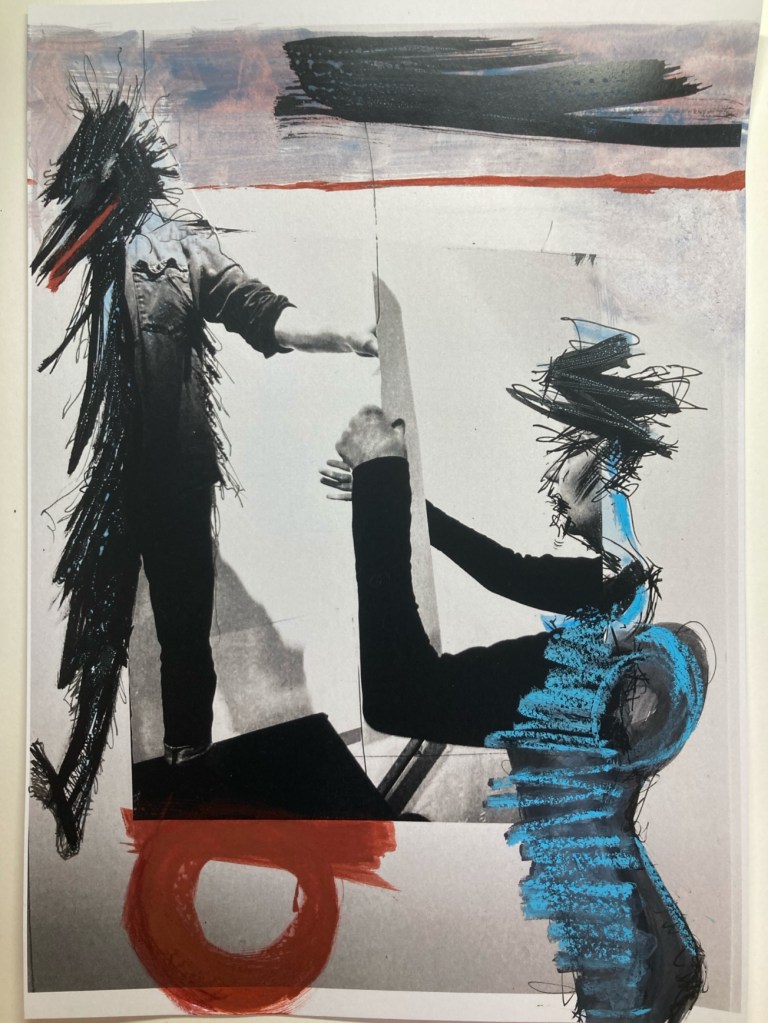
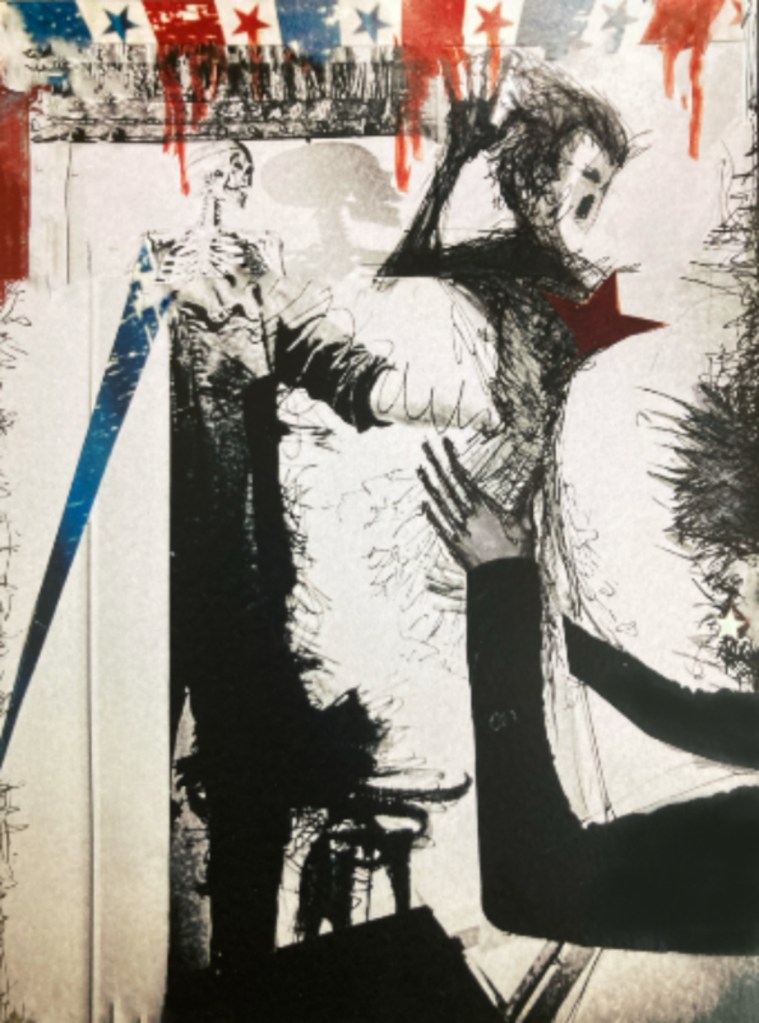
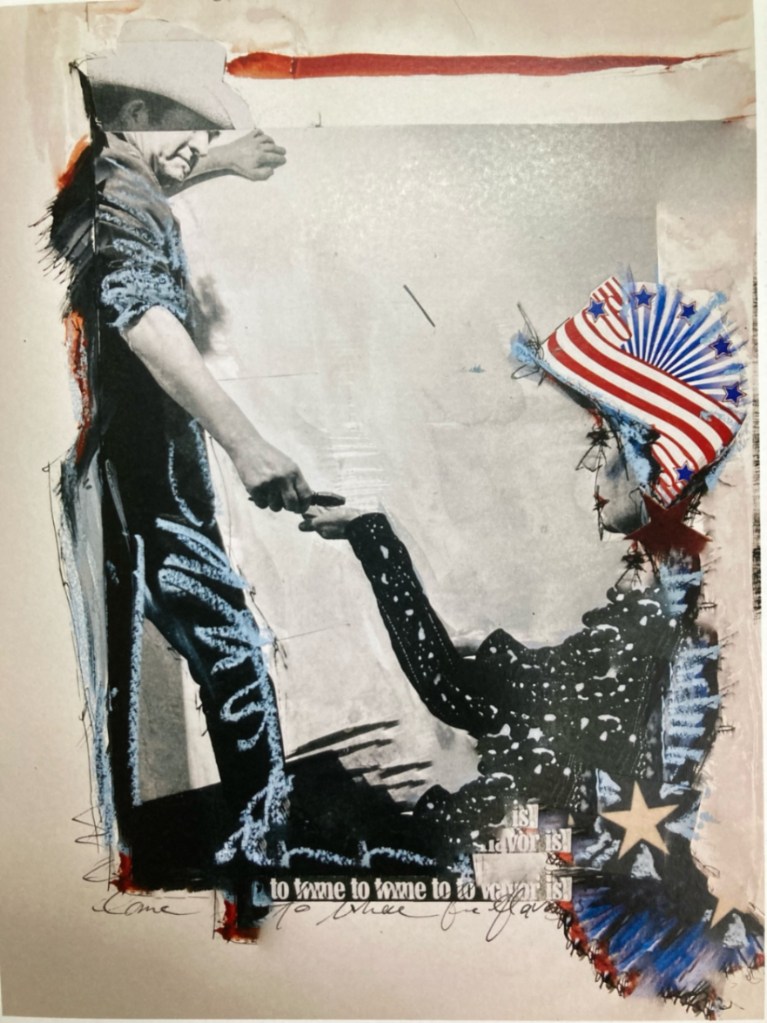
Working in 2D was not my thing but I was left with no better options. I started playing around with a series of photographs I had taken of two friends taking down an exhibition. I had documented their ‘performance’ — their gestures, interactions, and movements — against the white walls of the gallery.
I don’t usually print the photos I shoot but this time I did. All of them, and more than one copy of each. I propped them up against the wall at the edge of my chaotic desk.
Waiting? Maybe.
I wandered down a path without any sense (nor care) of where I was going. No purpose, no intention, no destination — a random walk in the dark. I let my pen run over the images, then added brush strokes to some, before reprinting them, then more of the same. Over and over.
After a couple of months, I was on a roll, reworking the same photographs again and again, experimenting with collage, color, different inks and paints, re-photographing, and re-printing, adding more ink and paint. I was like a child throwing toys around a sandbox and loving it.
In spring 2025, almost a year after I had shot the original photographs, I stopped for a moment and looked. I said ‘Hi’ to my new friends. I was ready to dance, to transform the photographs more purposefully, and bend them gently along a curve of intention.
I’m not planning to leave this dance floor any time soon. I might even change the music, learn some new moves.
. . .
anna f.’s background is in architecture and predominantly in theatre. She’s the founder and director of the performance group Irreverent Sideshows and recently started the visual arts project Irrelevant Slideshows. She lives in London.
I hold the memories delicately in my fingers wherever I go.
. . .
March 29, 2024, in New Orleans, Louisiana: things at the tattoo shop hadn’t panned out. Business was mind-numbingly slow, and the owner of the shop I was working at decided to let everyone go and use the shop as his own private studio.
I felt relieved, more than anything. I have a deep love for tattooing, but I didn’t feel that working at a shop was what I needed at that moment in time. It was a time in which I was deeply avoidant of anything that could lock me down. I had a gnawing need to move with agility. Any direction, any time. I was shirking structure, seeking something beyond it. I knew I was looking for something, but I didn’t know what it was. I was only sure that I hadn’t found it, yet. In the meantime: my world was wide open.
That day, I collected the last of my things from the tattoo shop. I finished the illustrations I had been working on for some friends’ puppet show. I cut my hair. I drew on long-winged eyeliner, stood in front of the mirror in my room, and looked myself in the eyes. I said: “I want something to happen.”
I had alcoholic Monster energy in my fridge that I’d been keeping for an auspicious moment. The Beast Unleashed – Mean Green. I took it.
I went out.
Someone who was just a distant friend at the time was organizing a punk show in a local liquor store parking lot. It was my understanding that the store loved it when punks put on shows there: it was great for business. I love a punk show, I especially love a punk show in a weird location, so I have to go. The friend I’d made plans to go with canceled last minute. Her ex was there, staring daggers into my back. Talking to my friend Vex, they said, “It seems you’re doing a lot of Closure Things.” I agreed.
Some friends I knew to varying degrees, including my roommates at the time, were putting on a renegade show afterwards. Freak rave with noise interludes. The location, given by hotline, was in a large abandoned lot in a weird part of town- this dead nowhere zone nestled between an overpass and a mostly-abandoned residential neighborhood that had been plagued by strings of misfortune.
I pulled up a dark dirt road in my silver Subaru Legacy and parked. A brightly-painted Ford Ranger pulled up nearby. Two figures hopped out. One, Guinevere, a friend, the writer of the puppet show I had been making illustrations for. Two, Lucian, someone from out of town, who I had met briefly a few days before.
“Oh hey, we were just talking about you,” Guinevere called out.
I was surprised: “Talking shit, I hope!”
We wandered into the weeds, then deeper down a scraggly tunnel of bushes and small trees, the path lined with occasional glow sticks. On the other side of the tunnel: a decaying corrugated metal warehouse.
The spot and surrounding neighborhood had been scoped out long before the event, but the day of the show a huge overturned bus had suddenly appeared in the middle of the building. It seemed like the abandoned warehouse was also someone’s chop shop for scrapping stolen vehicles. Music and visual gear was set up atop the engineless bus. We all climbed on and around the looted vehicle, spun on a freely rotating wheel aloft, jumped through windows above to windows below.
After a while, the novelty wore off, and the undertone of conflict between various coupled friends was becoming ever-more perceptible, so I made my escape to a fire pit outside.
Monster finally cracked open, I found myself talking to Lucian from out of town. We talked a long time about travel, brutalist architecture, and other things that slip my mind now. He said he’d just bought a boat in Martinique, an island in the Caribbean I had never heard of. He didn’t live anywhere. New Orleans was only a stopover on the way to his new boat, bought sight unseen with a broken motor. He seemed confident he could fix it. I believed him. I thought, how cool, I’m sure he’ll have a great time.
Just then, a strange man with a can of beer swayed over to the fire. He was wearing black and white vertically striped pants and looked like oogle beetlejuice. I had never seen this man before in my life. He interrupted the conversation I was having with L. “Excuse me…excuse me, can I just ask you something?” He was looking at me.
“Can I just ask you… what do you see in this guy?” He pointed at Lucian.
He must think I’m dating him or something, I thought. He had no idea this was the first time I’d ever had a real conversation with Lucian, who was pretty much a stranger to me. I thought, the only way to get out of this is to say something funny.
I said, “It’s because he has a boat.”
Oogle beetlejuice laughed. “Oh, so you’re a boat digger, huh?” He thought for a moment. “I guess being a boat digger is more honorable than being a gold digger, since you still have to be on the boat.” We laughed.
At some point oogle beetlejuice made his exit, and it was then that Lucian invited me to sail with him on his boat as crew. He was going to sail in the Caribbean — indeterminate end.
For a long time, I felt like I’d been doing nothing but closing doors. I was unemployed, my life before me was virtually vacant. No plans. I had been waiting for something to happen. I wanted something to happen. Was this it? I didn’t know anything about sailing. I’d never been on a sailboat before, never had an opportunity. But I’d wanted to. I’d wanted it the way one wants an improbable dream: You just want. Your wanting creates a shape. And you think, it’s impossible, and it sinks down. The dream was so deep in my subconscious I could barely feel it rising to the surface.
I said, “Maybe.”
I remember him walking away from the fire, into the darkness, waving noncommittally. I wondered if I’d ever see him again.
I would.
I went to sea with him and it changed me. Four months later, I returned to New Orleans.
. . .
The strangest thing about traveling for a long time is the return. Your descent back into your old life and old patterns feels like a direct confrontation with your past self. All of the choices you’ve made in your life up until your departure seem tinged with sharper edges, yet you feel removed from it. Strangely objective, an outsider in your own life.
You find yourself in your own room — but it feels like it belongs to a person that no longer exists. It is jarring, suddenly to feel a vast gap between you and your older self, a gap you didn’t expect to exist. Around you, people and places loosely gather in similar structure. Most act like everything is the same. You have an urge to explain, to properly convey your experience but words fall flat. How can you explain that you feel your insides have re-arranged themselves? Inside of you is filled with glittering metals that you will walk around with, always now.
. . .
Lake Sleep is an artist living in New Orleans, Louisiana. Her art finds form in ink and watercolor illustration, printmaking, tattoo, and digital fragments scattered around the web. Through her work, she pulls at the fragile seams between technology and nature, the tame and the untame, the real and the unreal.
Once you see past the cellophaned shop-window of tourism and into the infected stomach-wound of political history you begin a journey to the centre of dictatorship. And you’re likely to survive. Because in their eyes you are a mere fly on the wound, spinning on the spot, feeling sick and having to suck it all up. They might feel an occasional tick at the discomfort of you’re reporting all their business, but with a quick swat, the threat of being locked up, they will send you packing. Off you fly back to your country. You’ll soon be back again. You’ll come because the scent of such drama and the chance to ‘make a difference’ is so seductive.
You will climb into airplanes and out of airplanes, stand in queues at airports listening to psych rock on repeat to make it seem cool to be wearing a suit. You will walk into climates where heat makes a sudden pass at you. The hotels will have terraces descending to cake-crumb concrete, ornate cities choking politely below you. You will blag free afternoon tea in the hotel where Agatha Christie disappeared. You will do this for years and years. Buoyed on the beauty of this city, by the people from whom you learn the meaning of solidarity.
You might go to courthouses larger than a demigod. Where justice is not just blind, she’s in intensive care. Every now and then, to fool the concerned Specialists from overseas at the bedside of Democracy daughter of Anatolia, there is a blip on the heart monitor in the form of a ‘good’ decision from the Constitutional Court. Everyone from Europe nods and puts a tick on their clipboards, smiling at each other from behind the surgical masks.
The British and French have scalpels in their pockets, just in case they get another chance to make choice cuts. It’s all they can do not to dot lines on the flesh, “Je vous en prie, madame mais j’ai l’envie de vos cuisses remplis de l’huile noir dorée.” They want to take her back to last century. She is confused and they all think she’s easy. She has had a lot of lovers in the past. They think they can own her just like Croesus tried but those silly billies don’t even know her real identity.
While Consultants from the EU compile assessments on the health and usefulness of the patient, the rats go on eating the body from underneath the bed. Small regional judges rebel against the Supreme Court. The government opens cases against the Istanbul Bar. Everyone visiting agrees the patient looks passably robust if you just don’t get too close.
The brochure that prompted your journey to the centre of dictatorship will be social media posts showing Kurdish boys dead on barricades and their families looking out from front windows, prevented from collecting their corpses due to sniper fire from the Turkish state. Dogs devour sons’ bodies near the door. You’ll see four old people, wearing white and waving flags be gunned down as they sneak out with a stretcher. Neighbourhoods and a city flattened by airstrikes and tanks. Sur, Cizre and the walls of Diyarbakır. It was 2016, just nine long years ago.
You’ll stand up, then, in your kitchen and say, “Yes, I am ready. Show me the treatment of women, show me culture of queer, show me the mothers of the disappeared, show me cyanide gold mines and grandmothers’ resistance, show me trans women called Hande and show the teeth of the police and what they did to her, show me 5000 teenage girls on a Women’s March, kettled in the super highway street of Istiklal, show me that lady in her eighties who sat on a rock with a staff, soldiers in a row behind her, trying to take over the olive grove as she blasts, ‘The State? I am the state here!’’’ You’ll say, “Show me oppression, the politics, police brutality, show me torture, show me 64 guards kicking a dealer to death in the prison at Silivri.” You’ll notice there are less and less women, they’re vanishing at a rate of one to three per day.
There will be an old man to clean your shoes on the pavement before going into court, but because you speak the language and had a family here, you will really talk to him and he will cry tears down a maze of lines from cornflower blue irises, telling you, “Inflation means it’s twenty lira for a few tomatoes, we don’t eat meat and we can’t make a go of it”. You’ll agree it is a sin to take over the Central Bank and to let inflation run at 168%.
By now you will be an international advocate. You will monitor 200 trials, hoping it will all get better. But fascism doesn’t need much sleep. When it’s too late you’ll see that you were not creative enough. You weren’t armed to the porcelained teeth or in league with deep state. How can you succeed? You don’t belong to the right cult. The President will laugh you off: “These people, they come here, make up a few numbers and leave.” At one point you won’t want to believe there are 185 journalists in prison. But you know them, you have met them and hugged them.
In seven years you’ll be scared for twenty minutes. Those twenty minutes on the day you decide to stand up are like being in an iron maiden, seeing your essence squeezed out and poured into a glass phial. You hold it up to the light – it is the right colour. You hand yourself permission to resist. Go and find them. They will show you the meaning of solidarity. They really will. Your dear fierce legal colleague who sticks with you, no matter what. Court reporter girls who stand up to the judge and are the subject of court cases written in the purple official bruise of his ego. The woman with 185 court cases against her, who still sends salvos to officials. The lawyers, physicians. They’re resisting so hard, are we with them?
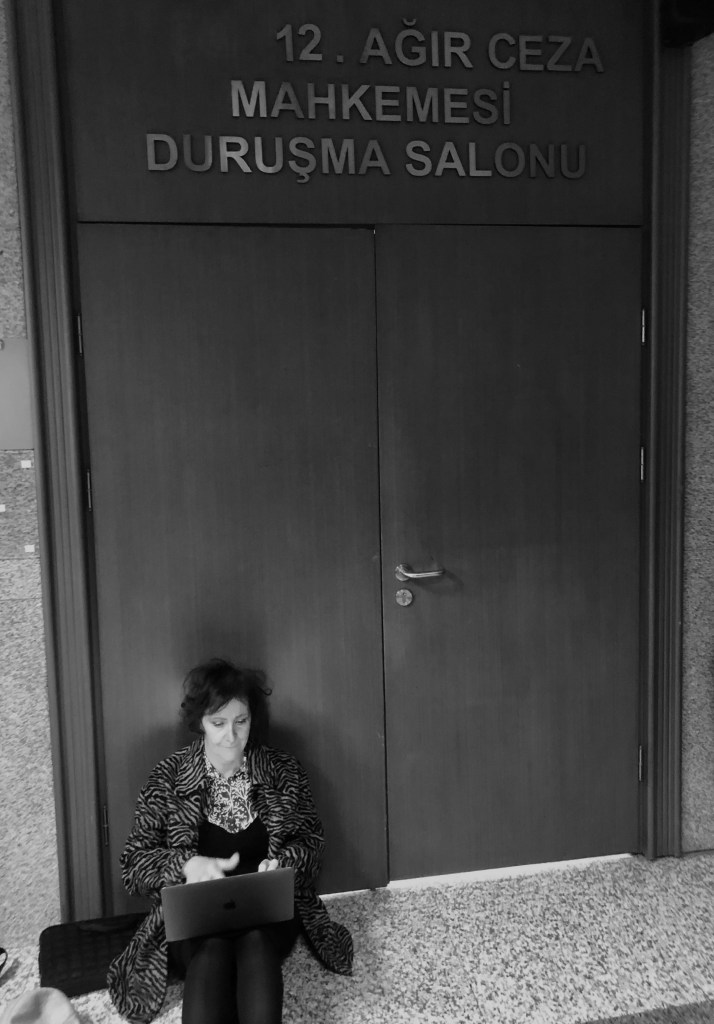
The first court case you monitor will be Zaman newspaper, the journalist, editor, author and unliked man Ahmet Altan. Why don’t you sit in the front row, a copy of the OSCE Trial Monitoring guidelines on your knee? That’s how you monitor a trial, you see? Are they abiding by procedure? How much spare paper do you have? The trial will begin and you’ll write it all down. Then comes an undercover cop. He’ll lean his whole upper body onto you, staring down at the pad on your lap to read what you’ve written, “Are you with Human Rights Watch?” You should go on to record the rest of the hearing in Welsh shorthand. Barmouth Welsh.
You’ll fly over Mount Ararat, fancy that, with a lawyer called ‘the arrow’. Your combined presence, the lawyer’s arguments will get Berzan out on bail that day. You can change things if you put your energy right into the room. In these times of outsourcing intelligence, of never meeting, of cost-saving, if we stop meeting face to face, stop putting our physical, personal energy in the place where it is needed, where it will be seen and counted, then we will fall down either side of the abyss that is separating us, and will meet in a bloody mess at the bottom, wondering how it happened. The best advocacy strategy meetings will be twelve people around a table in Berlin, or in Brussels, or Istanbul, all equal in struggle and all winning. Slowly some of the elitist ones will unpick themselves like the decoration on a shawl, unwind and leave others in the cold. You’ll work on. Your reports will change the law.
How much is the ticket, you ask. Is it a time machine that will eat tokens made of years, of intimacy, friendships, of all else that exists outside the job? Will it be fuelled by all the poems you wrote and never published? You might only take one day off in seven months in lockdown. What else was there to do but work? When you see how bad it is every moment feels like the threshold of a potential win, of standing with them. And every time you think you’ve made a difference, the state will impress you with their newly proposed law to ban all mention of homosexuality on the internet; their throttling of the airwaves. One small squeeze is all you need once you’ve mastered and collected the horse of freedom, put in the brutal bit of police violence backed up by millions of canisters of poison gas at protests.
You will continue on this journey until the road kinks back and kicks you off the path. You will cling on by your fingernails, while life floats far away. You will stay on the road until a new boss steers the car into the back of a truck marked ‘Investment Bank’ and steals your integrity. Then you will lie about your reasons, out of politeness, and you will leave. You might believe that you can still go on, and that the road will welcome you back, but the road knows you can leave no more tread. That you belong in a field, walking over a bog with a small dog, looking up at the range near where you were born, thinking about sixth century poets, because the remaining road travellers, those local dissenters and human rights defenders, they will go on along the road, two thousand miles away. The fight was always theirs, and they will win. It was never about you.
. . .
Line Stockford is a Welsh poet, editor and translator of Turkish literature. An adviser on Turkey for PEN, she designed and ran human rights projects around linguistic rights and media freedom. She studied the History of Turkish at SOAS, London. Her book-length translations are published by Parthian, Palewell Press and Smokestack Books.
Through a grimy window open fields small houses by tracks people standing or sitting in doorways watching the train
. . .
6.30 p.m. muezzin’s call to prayer
. . .
The battered, rusted pans the workmen use are as beautiful as things in a museum.
. . .
names of butterflies Sahyadri Birdwing Sahyadri Grass Yellow Sahyadri Rosy Oak Blue Malabar Banded Swallowtail
. . .
Nightfall. A lamp, its shadows
All morning, rain. Thousands of cicadas sing at once. I sit by the window and sip coffee, watching rain pour from the eaves. I’ve lost touch with old friends. Lizard droppings lie scattered on the window sill.
. . .
I’m not useful like a carpenter or plumber. I sit alone on veranda steps, gaze at the evening sky. Neighbors are quiet; the road to the village is empty. The moon set an hour ago.
. . .
Shadows blur on whitewashed walls. Serrated, spinning: leaf midair. Sensitive cells know day from night. Chitin, bone, shell.
A street barber squats on the pavement. Mirror, comb, scissors, razor, soap neatly arranged on a threadbare blanket. Coins fall like stars.
. . .
moth shadow, web let the mind rest
. . .
I’m a stranger, outcaste passing through
. . .
A dog limps past, vagabond. Whisper of river grass.
Drums reverberate. An oil lamp gleams. Heat. Sweat. Gods and heroes dance through the night.
. . .
The rain doesn’t end. Fungus eats our nails, books grow white mold. Pillows and sheets smell of mildew. The whitewashed walls turn green. A huntsman spider clings to a corner of the ceiling all day. There’s no daylight. The rain doesn’t end.
. . .
Fog at dawn. The smell of cook fires, feces, wet earth. The sky stays dark. My heart: a withered seed.
. . .
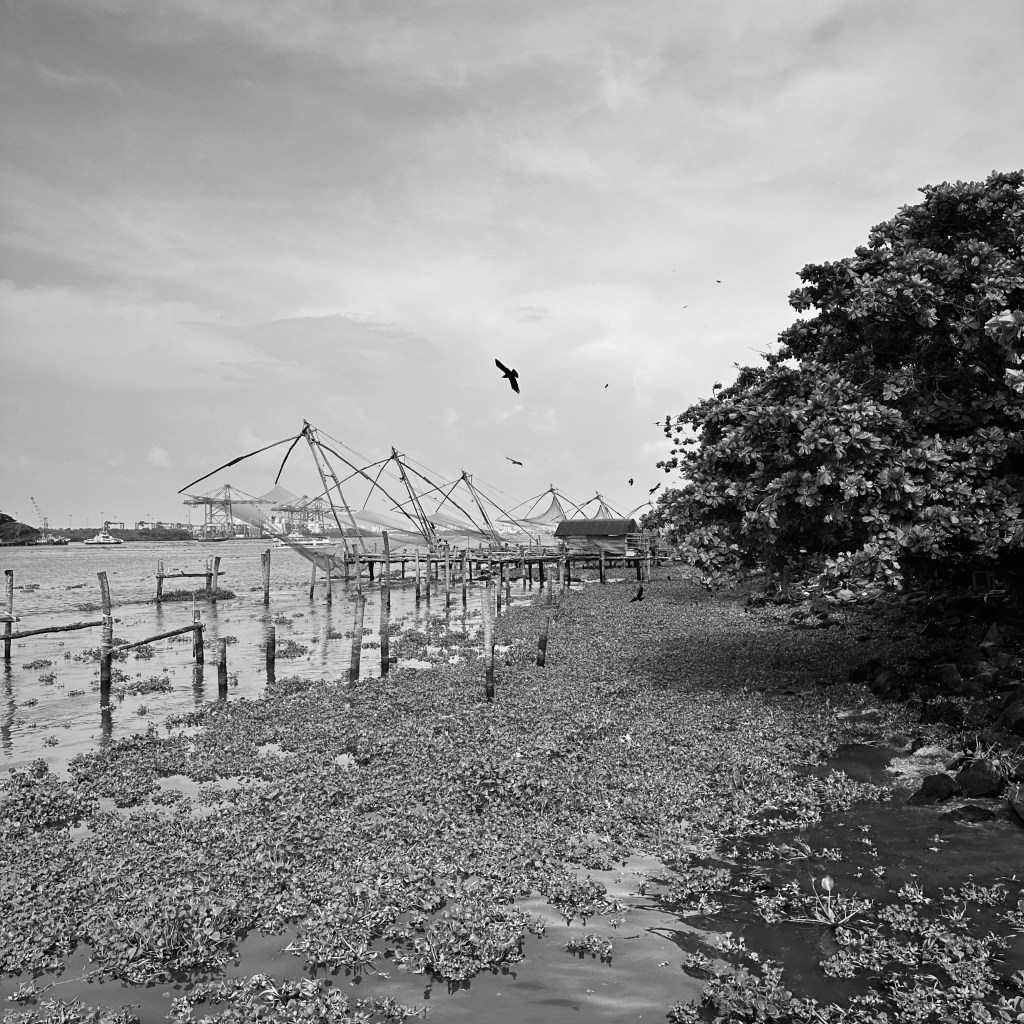
Last night I dreamed I was walking by the sea and came upon a group of thatched huts. I asked an old man, “What place is this?” “Nelcynda” he said.
. . .
I light a citronella stick. Bullfrogs roar in the flooded paddy field. Already the road is quiet. My lamp flickers and then goes out.
. . .
Kim Dorman was born in Little Rock, Arkansas, and raised in Oklahoma and Texas. He has worked and traveled in North America, from Mexico to Alaska, and spent time in France, India, and Sri Lanka. His books of poetry include Owner (Longhouse, 2016) and Kerala Journal (Corbel Stone, 2021). He currently resides with his wife in Kerala, India.
There is a moment in the film version of Gavin Maxwell’s Ring of Bright Water when the main character, Graham, gets off the MacBraynes’ bus and for the first time looks across the Firth of Lorne towards Mull in the distance.
Ben Buie, Sgùrr Dearg, Dùn da Ghaoithe are all there in front of him, each a distant grace note to something that isn’t there anymore. Of course the movie takes vast liberties with both the book and indeed the story of Gavin Maxwell himself but somehow for me, with that scene, it all gets forgotten.
And so I watch the grass as it gets moved by the wind
and the sound of it
And I think of us there in Fishnish all those years later
The sweetness of that sound on Aird a’Mhorain.
Traigh Iar
and I think of those landscapes now that we’re not there,
the spaces where we used to be.
Your presence as it shifts into abstraction
and distant thought now
the space between you and me and the lines that I draw.
. . .
Born in Belfast, Northern Ireland, Brian McHenry is an artist and illustrator whose work has appeared in various publications — including The New Yorker — and featured on record covers, books, and even the odd beer can. He currently lives on the north-east coast of Ireland with his two children. His recent combines elements of portraiture, symbolism, and abstraction to explore the physical and emotional landscape of remembering.
There are people with real names and there are those who will never know such a thing. Those with real names have had them called out loud in the valley of their soul. Those people are not the property of weeping angels. I have an angel assigned solely to weep by me day and night. The river of  an angels tears is a damned thing. A cursed dash of the darkest rapids. The creatures that swim there! Winged eels with electric teeth. Octopi in buttonhole suits. They see my faded scales. I sit by their mirror smoking. I am unafraid of damnation. Such a thing was foretold for me. There are those with addresses and amalgamations of numbers and streets they know for some time. I have never known anything for long. It isn’t my way. There are those who have something they may call home and it may be bad or it may be good but they are not tied to it by invisible ribbons or bows. They will have seen it. They will have slept in it. Their feet understand they must return their owner to there and so that is where they go. The bones of my feet ache. They resent shoes. They resent places. They want to return to the river. There are those that are vouched for by others who have known them since they were a drunken night, or since an uncle danced in a way that his not yet conceived a nephew would later copy his particular show of movement (or lack of) whichever it may be. There are those who are defended by mother to suspicious father. There are those who have people who know them. There are those who sit with those they know under to the glare of nurses inspection. When they stand before teachers and bus drivers and the tyranny of all other children there are those who are in some way vouched for and then there are those that are not. No concept of what it means to truly know their face in another eyes, or to actually have the right to even a few letters they should be recognised by. Or perhaps another human who knows them for more than a second or a day. Raised by people paid to keep them for a contracted time. There are those who feel death may be their only truthful companion. They have a longing to return at all times. Even when they do not know where that place might be exactly — that they could return to. So they do not! There are those who are considered suspicious by nearly all who encounter them on some deep and primal level. Like foundlings, or fairies, or any other being who arrives unknown — their presence can incite revulsion or cruelty or pity at best. If lucky their presence might even incite care. They are an open wound. Lacking the kind of a skin that can protect from bacteria. Devoid of layers. They pass without concealment. Those who will never have the right to a name! I am of those. Somehow always assumed to be guilty, unworthy, most certainly contagious. We must be contained. I gave you kindness, what did you take from me? That’s what they often say. It is not often kindness that they have given. The things they have done would render the river of the damned even more impenetrable than it already is. They will always deny it. What they did, they will always blame the one to whom it has been done to. Always! I never met one of them or they or those kinds who would not say I was a liar, they said it to themselves, they said it to everyone else but most hideously — they said it repeatedly for their entire lives to me — so here is my lie, you may read it as truth but it would not be, it would be more than truth, it would be certainty. To those who will also not-be-named I must point out — I did not believe them then and I do not now.
	I know words.
	I know terrors.
	I know monsters.
	The truth of irrevocable realities — do not belong to them: cannot be named by them: cannot be contained by them — truth is the most garish of foundlings, it is the eternal spirit companion of weeping angels.
	This is my imprint.
	It belongs to me.
. . .
Dr Jenni Fagan is an award-winning, critically acclaimed novelist, poet and artist.Published in global translations the author of four fiction novels, one non-fiction memoir, eight poetry collections, exhibitions, adaptations and with another two new fiction novels due out next year.She has won The Gordon Burn Prize 2025, was a Granta Best of British Novelist (a once in a decade accolade), Scottish Author of the Year and has been on lists from The Women’s Prize, BBC International Short Story Prize, The Sunday Times, Encore and more. Fagan has worked extensively with vulnerable groups including those in prison, and the care system where she herself grew up. Described as The Patron Saint of Literary Street Urchins, Fagan’s work responds to the centre always from the margins and without compromise.
I get disheartened when an artist tells me they’re bored. It’s especially brutal if I’ve adored you and the art propels my own rhetoric, research, collections of folders some might besmirch. I think Stanley Kubrick would have approved though I’ve no warehouse of boxes when I’m extinct to prove my passion for working still thrives between poems and books. We live amidst fascinations. If we stay spry, wide eyed enough, work is transformative. Suture eyes shut someday after I die with the stories I’ve written, some I hoard. I’ll die exhausted. I never lived bored.
Rambles past ringlets, ruffles, rouge to you, end of the queue, interviewed for the show, television lady forgets your debut — segment you are someone she chose to know.
Her fascinations are fleeting and slight, provincially dressed princess one night. Lives she catalogues on oak shelves in plain sight. Decades of ingenues in her archives,
In middle school, bullied for body hair. Matched hair, eyes, contrasted fair skin, a shroud I wear everywhere. Was so scared to shave above the knee. Was told no one should look there anyway. Was whispered of so many days in locker rooms by some with blonde peach fuzz which was what love looked like, at this time, to me, Florida yellow/tan uniformity. Was called a fiend, witch from another place, not of the beach I breach, a plaited pouting pall their boyfriends chased, animal they want to taste, shadow to hide inside this golden place.
The following is a brand new poem written for The Meadow, my bdsm themed poetry collection about my time in the world of bdsm as a young woman. I wrote this piece as well as the Reader’s Guide I published below to enhance your pleasure and understanding of the text. Order your own Meadow at apeppublications.com.















 BURNING HOUSE PRESS