Through a grimy window open fields small houses by tracks people standing or sitting in doorways watching the train
. . .
6.30 p.m. muezzin’s call to prayer
. . .
The battered, rusted pans the workmen use are as beautiful as things in a museum.
. . .
names of butterflies Sahyadri Birdwing Sahyadri Grass Yellow Sahyadri Rosy Oak Blue Malabar Banded Swallowtail
. . .
Nightfall. A lamp, its shadows
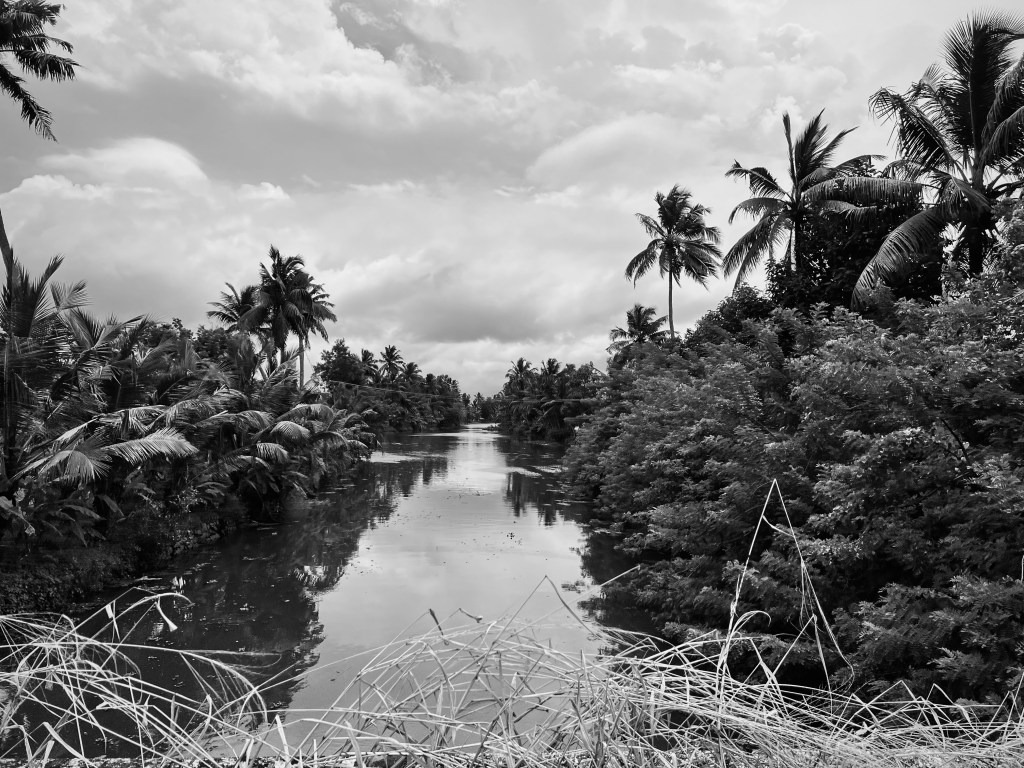
All morning, rain. Thousands of cicadas sing at once. I sit by the window and sip coffee, watching rain pour from the eaves. I’ve lost touch with old friends. Lizard droppings lie scattered on the window sill.
. . .
I’m not useful like a carpenter or plumber. I sit alone on veranda steps, gaze at the evening sky. Neighbors are quiet; the road to the village is empty. The moon set an hour ago.
. . .
Shadows blur on whitewashed walls. Serrated, spinning: leaf midair. Sensitive cells know day from night. Chitin, bone, shell.
A street barber squats on the pavement. Mirror, comb, scissors, razor, soap neatly arranged on a threadbare blanket. Coins fall like stars.
. . .
moth shadow, web let the mind rest
. . .
I’m a stranger, outcaste passing through
. . .
A dog limps past, vagabond. Whisper of river grass.
Drums reverberate. An oil lamp gleams. Heat. Sweat. Gods and heroes dance through the night.
. . .
The rain doesn’t end. Fungus eats our nails, books grow white mold. Pillows and sheets smell of mildew. The whitewashed walls turn green. A huntsman spider clings to a corner of the ceiling all day. There’s no daylight. The rain doesn’t end.
. . .
Fog at dawn. The smell of cook fires, feces, wet earth. The sky stays dark. My heart: a withered seed.
. . .
Last night I dreamed I was walking by the sea and came upon a group of thatched huts. I asked an old man, “What place is this?” “Nelcynda” he said.
. . .
I light a citronella stick. Bullfrogs roar in the flooded paddy field. Already the road is quiet. My lamp flickers and then goes out.
. . .
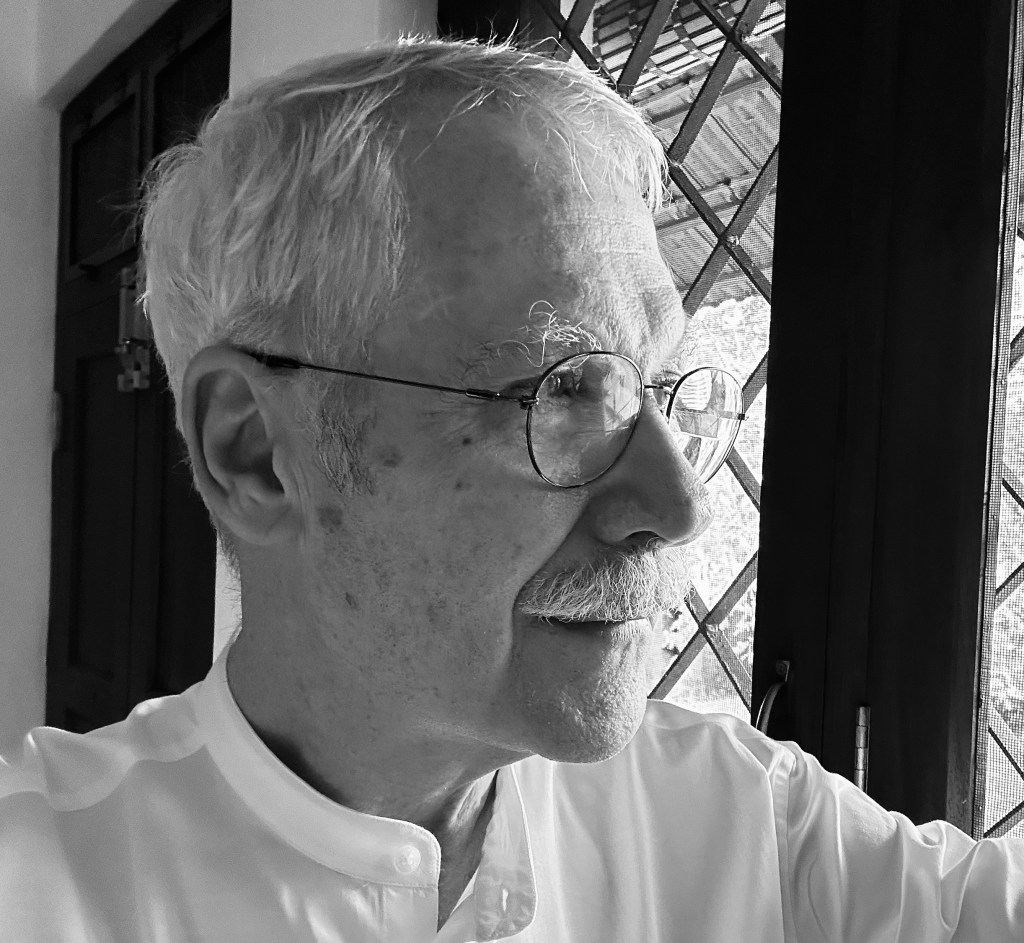
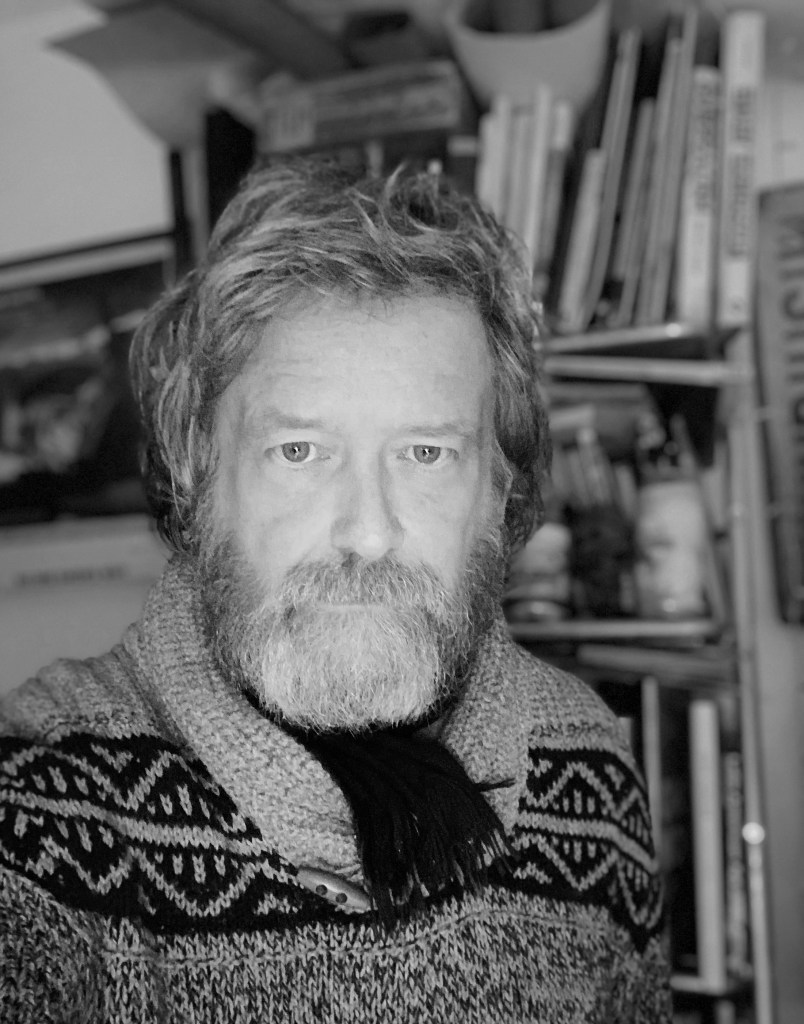
Kim Dorman was born in Little Rock, Arkansas, and raised in Oklahoma and Texas. He has worked and traveled in North America, from Mexico to Alaska, and spent time in France, India, and Sri Lanka. His books of poetry include Owner (Longhouse, 2016) and Kerala Journal (Corbel Stone, 2021). He currently resides with his wife in Kerala, India.
as blue-antlered dawn falls vertiginous over mountains
ii.
deadfall, muskeg
flakes of mica
the cryptic living tinted with winter
(each nivean heart an individuated star)
high bright tooth of winter moon
hill-spines arc – every vertebra a birch
iii.
the lake rim glows but its eye is dark
clouds and rain dissolve there
(and shores and rock)
within catacombs of willow
a bobcat ruby-throated attends to its altar of rabbit
and the forest, dimming
snaps shut its anthracite wings
iv.
the river is coal-blue sap
deadfall tamarack
there are flickerings at the edge of my vision –
movements through the long-bodied pines
(wolves are stirring, elk are stirring in the cold embers of this forest)
and water is a dark bloom, is never still
hylae swell
bones blacken
v.
between blue-skinned spruce and a fire calving light and heat
at an altar of water where all are subsumed or broken
darkness is drawing everything open – a long-stemmed and leaning dark
within which I may be scented or seen
and so I try to be silent
to intuit each movement within this catacomb of branches
to not give myself away
vi.
in a place wholly inaccessible I arrive to sticks and cold rain
beside white birch at the edge of a silent lake I rest and wait
for the one voice of night to share with me its oldest name
. . .
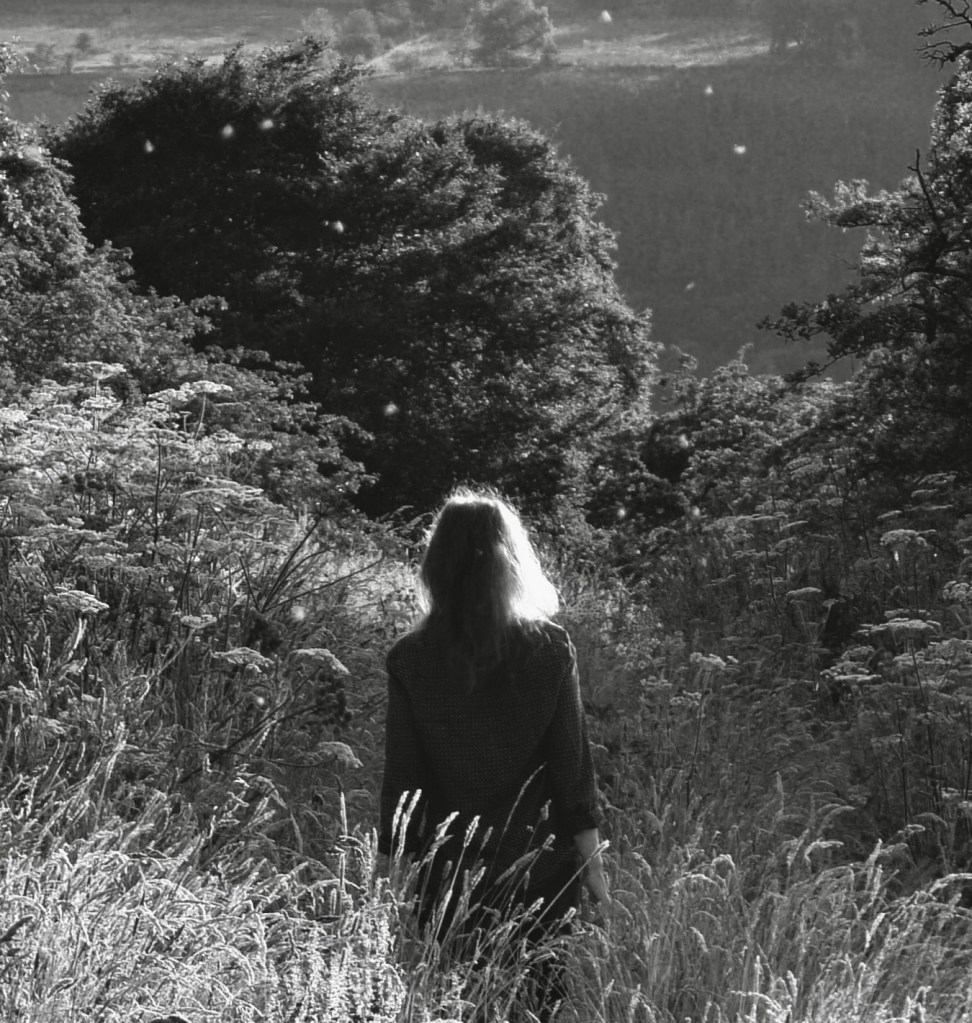
Autumn Richardson is a poet, editor and translator. She has authored 5 collections including Heart of Winter, An Almost-Gone Radiance and Ajar To The Night. Since 2009 she has been co-director of the multi-media publishing house Corbel Stone Press alongside British artist Richard Skelton. Between 2013 and 2022 she co-edited the influential journal of ecopoetics and esoteric literature, Reliquiae. Originally from Canada, she now lives on the west coast of Ireland.
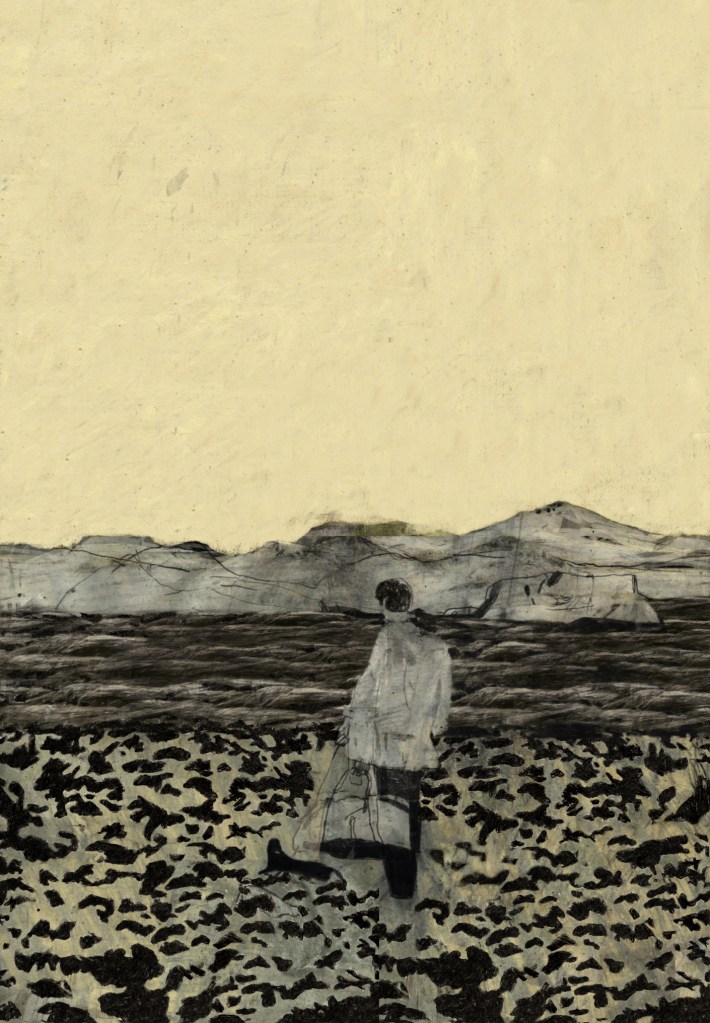
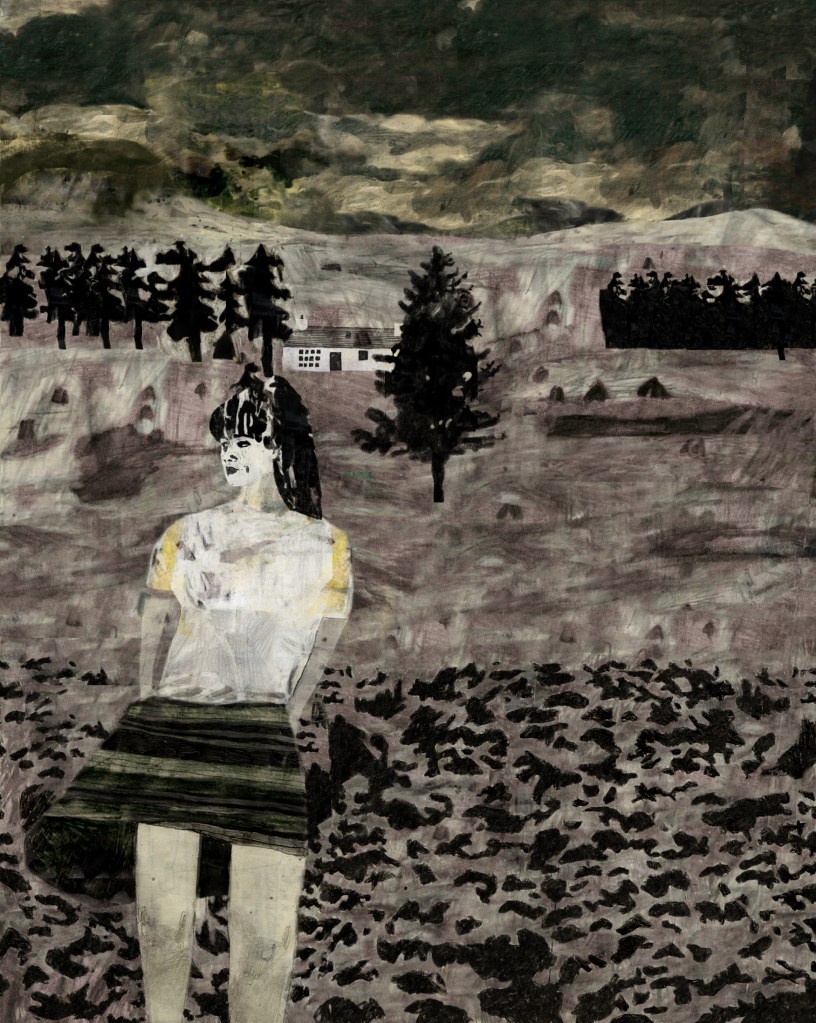
There is a moment in the film version of Gavin Maxwell’s Ring of Bright Water when the main character, Graham, gets off the MacBraynes’ bus and for the first time looks across the Firth of Lorne towards Mull in the distance.
Ben Buie, Sgùrr Dearg, Dùn da Ghaoithe are all there in front of him, each a distant grace note to something that isn’t there anymore. Of course the movie takes vast liberties with both the book and indeed the story of Gavin Maxwell himself but somehow for me, with that scene, it all gets forgotten.
And so I watch the grass as it gets moved by the wind
and the sound of it
And I think of us there in Fishnish all those years later
The sweetness of that sound on Aird a’Mhorain.
Traigh Iar
and I think of those landscapes now that we’re not there,
the spaces where we used to be.
Your presence as it shifts into abstraction
and distant thought now
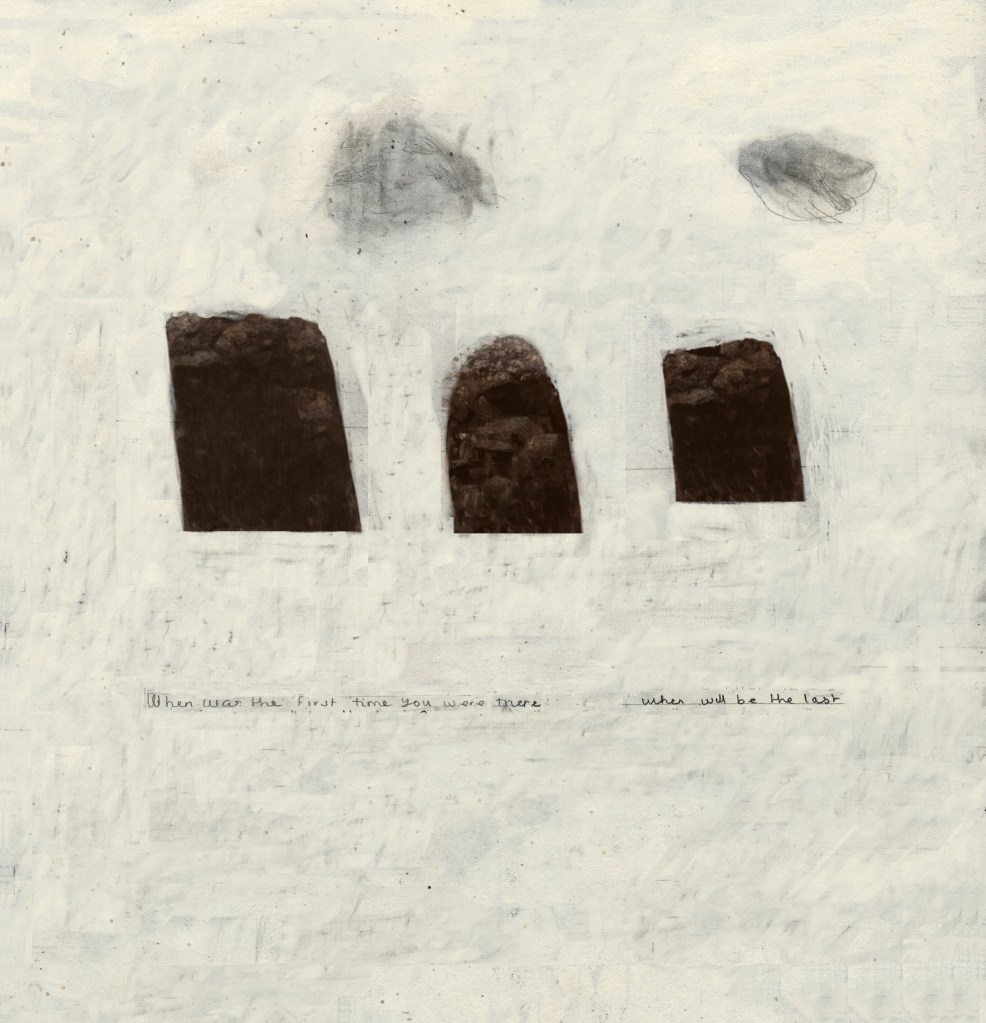
the space between you and me and the lines that I draw.
. . .
Born in Belfast, Northern Ireland, Brian McHenry is an artist and illustrator whose work has appeared in various publications — including The New Yorker — and featured on record covers, books, and even the odd beer can. He currently lives on the north-east coast of Ireland with his two children. His recent combines elements of portraiture, symbolism, and abstraction to explore the physical and emotional landscape of remembering.
There are people with real names and there are those who will never know such a thing. Those with real names have had them called out loud in the valley of their soul. Those people are not the property of weeping angels. I have an angel assigned solely to weep by me day and night. The river of  an angels tears is a damned thing. A cursed dash of the darkest rapids. The creatures that swim there! Winged eels with electric teeth. Octopi in buttonhole suits. They see my faded scales. I sit by their mirror smoking. I am unafraid of damnation. Such a thing was foretold for me. There are those with addresses and amalgamations of numbers and streets they know for some time. I have never known anything for long. It isn’t my way. There are those who have something they may call home and it may be bad or it may be good but they are not tied to it by invisible ribbons or bows. They will have seen it. They will have slept in it. Their feet understand they must return their owner to there and so that is where they go. The bones of my feet ache. They resent shoes. They resent places. They want to return to the river. There are those that are vouched for by others who have known them since they were a drunken night, or since an uncle danced in a way that his not yet conceived a nephew would later copy his particular show of movement (or lack of) whichever it may be. There are those who are defended by mother to suspicious father. There are those who have people who know them. There are those who sit with those they know under to the glare of nurses inspection. When they stand before teachers and bus drivers and the tyranny of all other children there are those who are in some way vouched for and then there are those that are not. No concept of what it means to truly know their face in another eyes, or to actually have the right to even a few letters they should be recognised by. Or perhaps another human who knows them for more than a second or a day. Raised by people paid to keep them for a contracted time. There are those who feel death may be their only truthful companion. They have a longing to return at all times. Even when they do not know where that place might be exactly — that they could return to. So they do not! There are those who are considered suspicious by nearly all who encounter them on some deep and primal level. Like foundlings, or fairies, or any other being who arrives unknown — their presence can incite revulsion or cruelty or pity at best. If lucky their presence might even incite care. They are an open wound. Lacking the kind of a skin that can protect from bacteria. Devoid of layers. They pass without concealment. Those who will never have the right to a name! I am of those. Somehow always assumed to be guilty, unworthy, most certainly contagious. We must be contained. I gave you kindness, what did you take from me? That’s what they often say. It is not often kindness that they have given. The things they have done would render the river of the damned even more impenetrable than it already is. They will always deny it. What they did, they will always blame the one to whom it has been done to. Always! I never met one of them or they or those kinds who would not say I was a liar, they said it to themselves, they said it to everyone else but most hideously — they said it repeatedly for their entire lives to me — so here is my lie, you may read it as truth but it would not be, it would be more than truth, it would be certainty. To those who will also not-be-named I must point out — I did not believe them then and I do not now.
	I know words.
	I know terrors.
	I know monsters.
	The truth of irrevocable realities — do not belong to them: cannot be named by them: cannot be contained by them — truth is the most garish of foundlings, it is the eternal spirit companion of weeping angels.
	This is my imprint.
	It belongs to me.
. . .
Dr Jenni Fagan is an award-winning, critically acclaimed novelist, poet and artist.Published in global translations the author of four fiction novels, one non-fiction memoir, eight poetry collections, exhibitions, adaptations and with another two new fiction novels due out next year.She has won The Gordon Burn Prize 2025, was a Granta Best of British Novelist (a once in a decade accolade), Scottish Author of the Year and has been on lists from The Women’s Prize, BBC International Short Story Prize, The Sunday Times, Encore and more. Fagan has worked extensively with vulnerable groups including those in prison, and the care system where she herself grew up. Described as The Patron Saint of Literary Street Urchins, Fagan’s work responds to the centre always from the margins and without compromise.
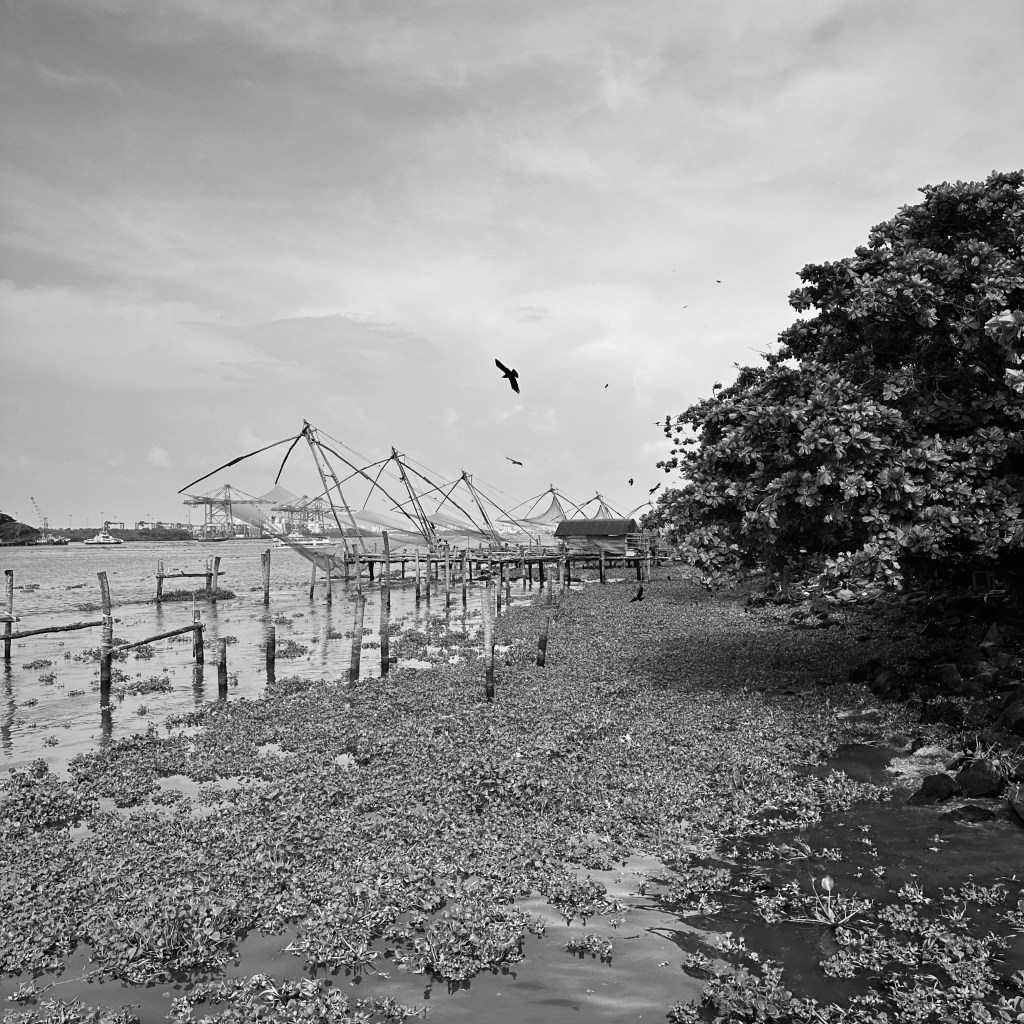
Watercress abundant, pooled, fed by a freshwater stream that leaks a channel, a winding furrow carving an arc across the sands. Joining the Atlantic salt waters. Diluted.
Conas ta tu a stor? How’re you love? Bhfuil tusa ann? Are you here? Where are you?
Under the rocks……..caught in the weed………….? A remnant of yourself…. a fragment, flotsam, tiny bones bleached out over time.
First child, the one and only first, spent in the sands and carried away unseen.
Pause, sigh, and breathe. Slow. Clearing. In and out breaths. Fuck it …
The stream’s absorbed when it reaches the sea. Red standing stones guard the shoreline. Dug in, bulk undiminished through the years. Smooth blank faces peppered with tiny lives. Living creatures in spiraling whorls, paint-box colours distinct from the rest with their blend of muddy greys, blacks and browns. The discreet, minding their own business ones.
Keeping to the low formation, leaning into these sentinels, pushing up hard. Limpets impress their determination into my back, encouraging them to leave their marks on my skin, through the layers of time and guilt. Tiny bruises, kissed into my shell.
Cá bhfuil tu mo stor, where are you my love? Still here? Shape shifting your small self, half formed baba deas, lovely baba? Or have you vanished into mists of salt water and weed? Níl fhios agam, I don’t know, may never know.
Sins for which I alone hold no charge, spoken in my head. Not then, had no clue back then.
Busy in the kiddish world of long summers, heat hazed early mornings blended into same grey days. School and holidays, home and here, the Red Strand. First beach out of Clonakilty, Cloich na Coillte, stone castle of the woods.
The brother, older but no wiser through the passage of summers, collects the tiny vivid shells under instruction from his know it all little sister. All through our early rising summers for as long as it pleases him. Mostly in the absence of anyone else. (He’d prefer the other boys, tardy, sleeping-in boys, almost always with a ball).
We sort the shells into currency for our long playing games, oblivious to any lives inside the whirly chambers. Red, yellow and green defining value, same as fruit pastilles or wine gums;sticky pleasures. Flavours imparted by the power of suggestion.
In truth they all tasted much the same, the richer the colour the more they’re desired, sweeties and shells. No truth to either.
He is obliging, patient and generous, prepared to share a vision of the day, playing shop? Or being rich for our new life ahead. Content til he gets a better offer……at least til then.
A big brother like no other, he is dark to my fair, tall where I am slight, brave while I am cautious. Protective and free running altogether in one certain self. His infectious self-belief sweeps us into his limitless foolhardy world and we’re away. Climbing rock faces, out of windows and trees, into danger without looking back. Running for miles with no sense of the dinner time clock. It chimes without our ears to mind it. Into trouble over and over he brought me, with no regrets.
Not true, baba deas. My one regret. The original sin.
Hours we spend under the towering protection of this headland. Obscured from view by the remains of an over-ground tunnel. Giant concrete slabs scattered about, fallen, impotent, discarded. Marooned in the sands.
A hidey hole, a place of travel from one gloomy tunnel end to the other, between the stream and the sea.
Fresh water and salt, fishing in both, crazy laughter and messing, all the way to tears and squabbles on rare days, high days and holidays, tense sort of days.
Status Quo, the quo, ruled the roost for his whole gang, while we, the girls, follow the Bay City Rollers. Uniform in our tartan trousers, Baby love, oh baby love, skimming our thighs cutting into our vain attempt to hold the boys attention. All the while loving our idols, the special one, he who holds our gaze on the telly. A band member for all the seasons of our pre-teen crushes.
Teenage years we return to the Red Strand with beer and tents. The sea is the place to be rather than the shore. Trailing friends, boyfriends, girlfriends, cousins once from overseas, to share the magic that no longer exists. Red Strand’s too full of childhood and original sin. Better beaches round the corner, further along the coast, closer to the shore life of pubs, craic and caravan parks.
All these places we never saw as children, never knew were there, so determined was this family not to mix with the noisy ones, the drunken ones. The families that might know us from life at home ones. The sleeping in, lying in their beds half the day ones.
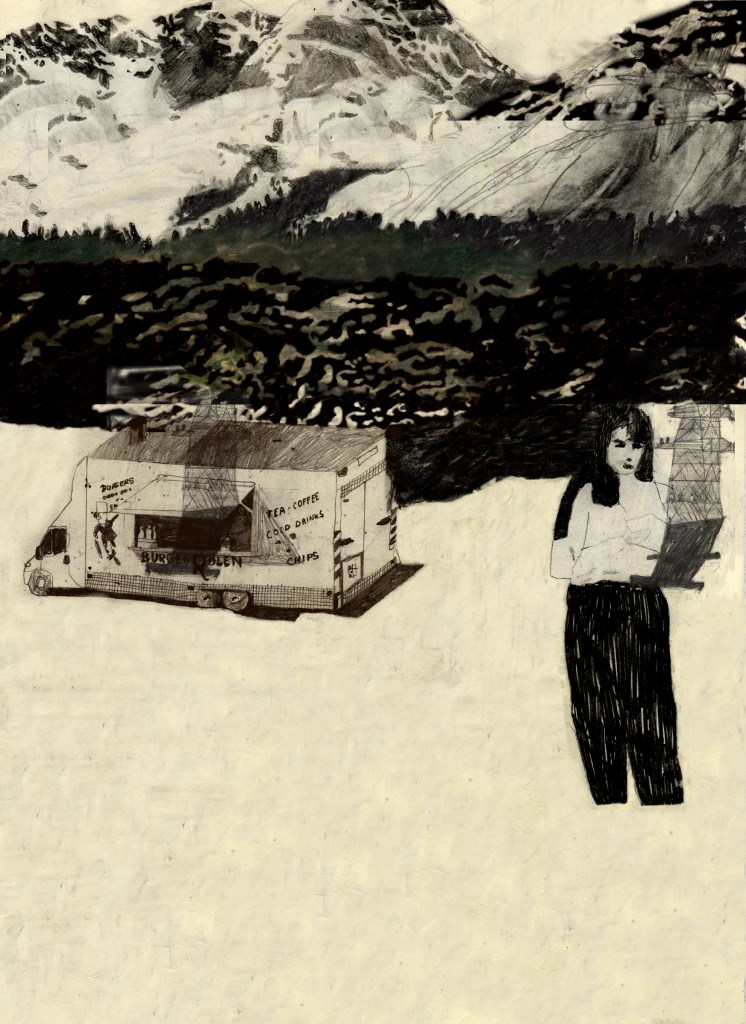
Mothers and fathers equally corrupt longside their offspring, in the gospel of our English origins. They lined up daily at the chip van for their tea. We ate freshly caught mackerel with bread and butter, the food of the Gods, and so it was. Free, from the sea.
We ate mussels plucked from the rocks. Sometimes lobsters, captured in pots thrown off the shore. Squealing their way from blue black to bright scarlet in a pot alive with boiling water, delicious, with butter dripping from our chins, stinking of garlic. No one ate that stuff, famine food still reeking of the sea but we did. Set apart, positioned above, looking down, while trying to squeeze in.
We were blessed, apparently.
The beach welcomed us back annually, sharing its curves, a safe return into the familiar crook of embracing rocks. The concrete tunnel sheltering our comings and goings from year to year, constant, never-changing. The strand,, our part in it, had a rhythm, a ritual of its own making. It bent slightly each year as we grew up, new faces appeared, alongside the familiar caravans.
Softly whispered voices, rememberings from the sea, in the sand dunes, where courting couples played out their pleasure. Mostly undiscovered, known by all and avoided, quietly sidelined. Not allowed, and still they were always there. Bless me father for I have sinned. Curled up in warm grasses on heated sand that threatened collapse without the tough spines that held it altogether.
All through the early Summers a man ploughed his way, twice a day from the dizzy height of the headland, traveling from his smallholding, along a narrow sunken track. He trailed a donkey and a jennet down onto the strand, on a single rope. Their arrival a Mr Whippy of excitement in the day trippers, our prior knowledge fattening our superior position. Privileged with familiarity, without names, we are known to each other. The donkey man and us, the regulars.
Some days I follow them on their return pilgrimage through the steep channel, the sharp, dry grass nicking my bare shoulders, a minor penance, a small offering. I daydream a change of identity, assuming a place in their holy family on the homeward climb. Shifting from child to blessed mother, to partner and devoted animal whisperer. The donkey man never seems to notice my presence or acknowledge it at any rate.
Codladh samh, sleep safe, a stor, love, where ever you are, under the deep sand or washed clean among the creatures that flow back and forth, in and out of the tides. Three hail Marys and one our father the regular gift for telling lies. How could you not tell lies when caught between the father and the son. I have no idea, only one idea possesses my mind, escape and protection.
First love learned at the foot of the should be protector and corrupt for ever after while nuns whispering lies and responsibility into the shell like of every girl child and what would they know about it anyway? Brides of Christ, be lady-like, be Marylike the impossible mantra, the ideal that will never be matched.
They can’t control themselves, they confide, it’s up to ye to take control, female pleasure, unknown, unspoken.
Is it any wonder a stór beag, my small love, my tiny not fully hatched firstborn that you were conceived and lost on the shore of my innocence. Bless me father, I don’t fucking think so, thank you very much and goodnight.
Transformation, a daily event as the sea wipes out the story of the sand and shore. Washing and rinsing rocks and strand in a matter of hours, filling and emptying the pools closest to the rushing waters.
Anemones, the most tantalising transubstantiation of all. Still to this day, a miracle. Brown jelly mounds stranded in the air of low tide become flowering tendrils of soft pinks submerged in the salt water. Waving gently, they invite touch, dipping a finger into a shallow pool and softly, softly stroking the water closest to the fleshy petals. Too close, they fold themselves in, abruptly resuming their impenetrable personae. Still here, always here, since the beginning of time. Stuck fast to their ways.
Echoing through the years, on every return I pay homage to their beauty hidden in the dark brownness of the rock pools, discomfited in the air heavy world.
Tabhair aire, take care, precious one, watch out for the sidewards crabs lurking out of sight among the weed. Sharp little nipping pincers, painful beyond belief to the unwary, bi curamach, be careful, mind your little fingers and toes.
A fully grown woman this visit, kneeling in a hollow scraped out of the sand. Lost but keeping watch on the tide, inching closer and closer, washing clean its own. Soothing the grains with the patterns of waves, licking into the holes dug out with plastic reds and yellows. Further out to sea, waves churn up the red sandstone rocks lining the basin of the strand. Fractured thoughts coming and going rolling back and forth, testing the present with the past, seeking out long gone shapes amongst the weed, carried and tossed, lifted along the breadth of the curve.
Nothing clear, no single sound, a rag bag of rattling stones to hang from my feet. Uneasy flickerings in the corner of an eye. Glimpses of the jennet’s flashing whites and straining head. His unpredictable nature printed in my memory, a familiar refrain, a chord that echoes in my pulse. He was half donkey and half horse, we said, the mixture of breeding, his magic. Also his devilish power, tempting fate with its unnaturalness.
The water, freezing, has reached me, frothing at my knees and trickles begin to fill the spaces around and between my legs, my feet folded into the dugout. How long could I last? The cold drove me out half way between head and toes, intimate with my belly. Enough already. This time.
. . .
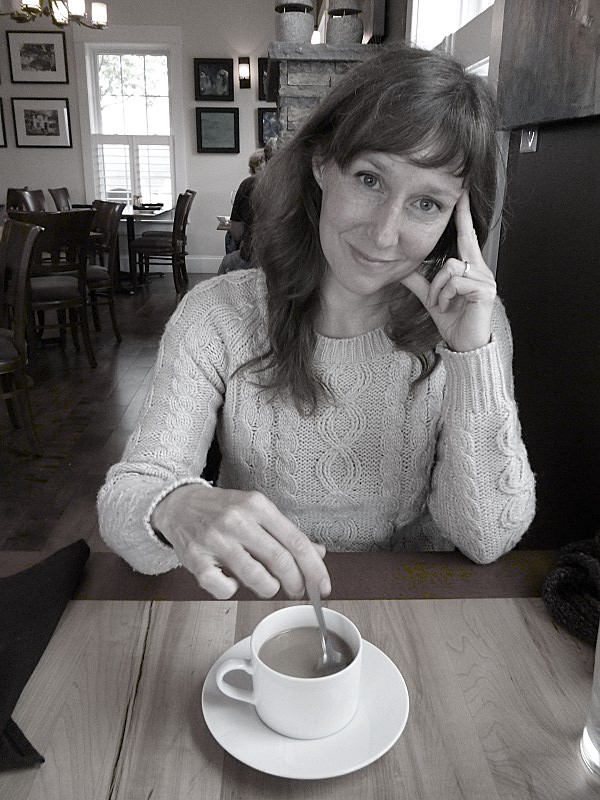
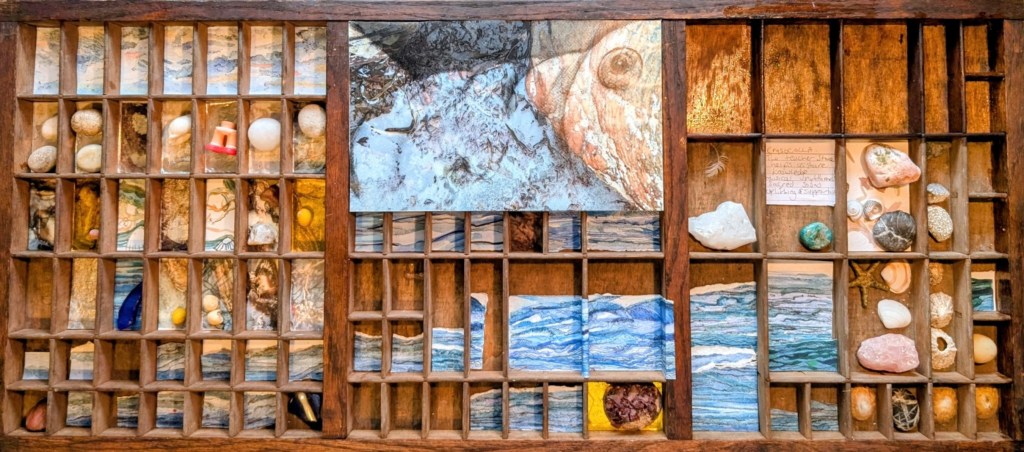
Inter-disciplinary artist Liz Cullinane is a storyteller in words and pictures. Her Belfast based practice is rooted in community activism, theatre design and film collaborations with poets and musicians. Liz’s academic research on early 20th century Irish women artists focusses on Mary Swanzy (1882-1978). Published by the Irish Museum of Modern Art (IMMA), she has innovated a digital opera on Swanzy. Recent exhibitions & writing reflect her engagement with the Achill Island landscape in Mayo.
Burning House Press are excited to welcome C.C. O’HANLON as the fifth BHP guest editor of our return series of special editions! As of today C.C. will take over editorship of Burning House Press online for the month of November.
Submissions are open from today 1st November – and will remain open until 25TH November.
C.C.’s theme for the month is as follows
—JOURNEYS
~~~
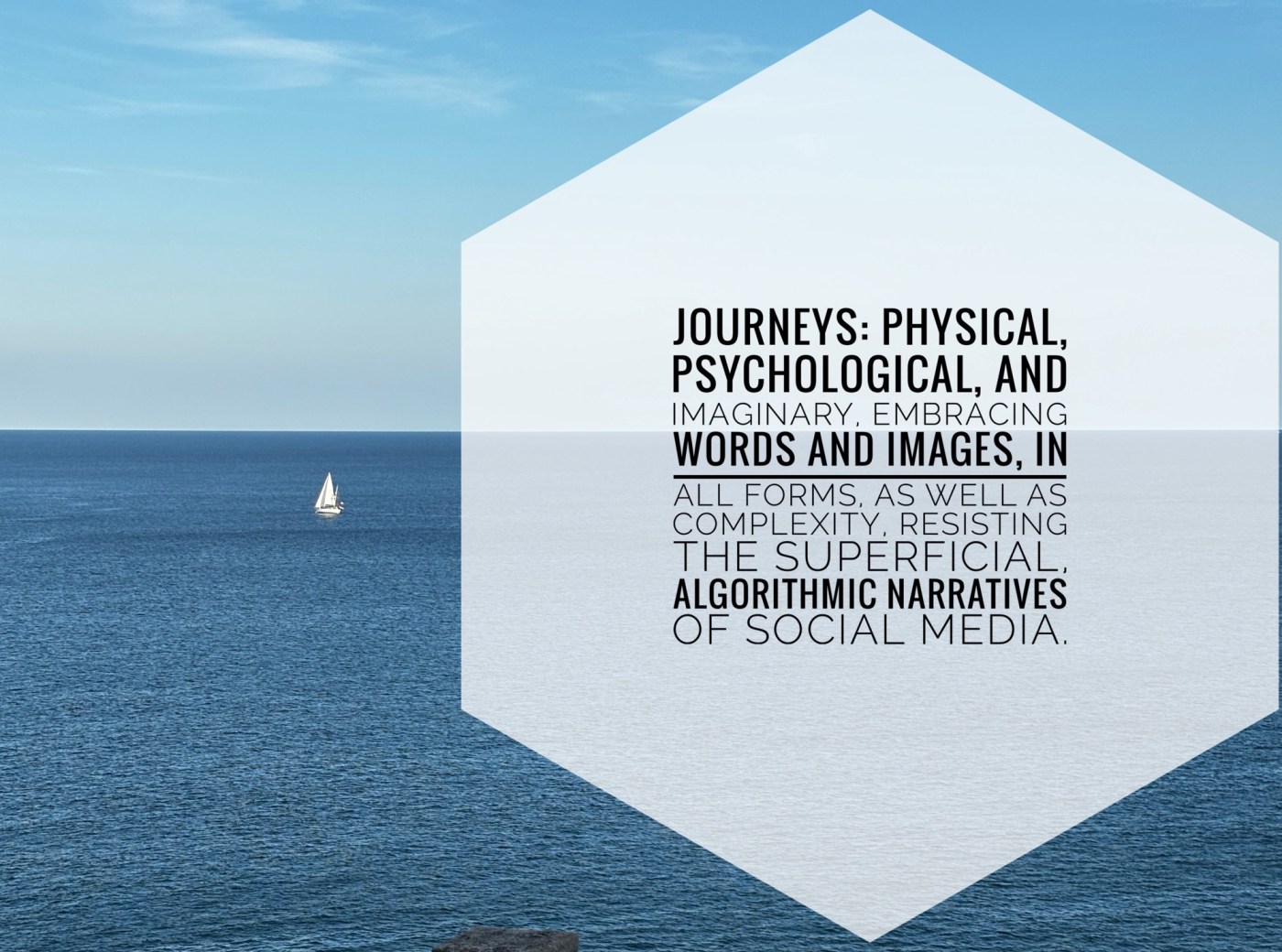
JOURNEYS: Physical, Psychological, and Imaginary, embracing words and images, in all forms, as well as complexity, resisting the superficial, algorithmic narratives of social media.
~~~
Photo by Given Rozell.
~~~
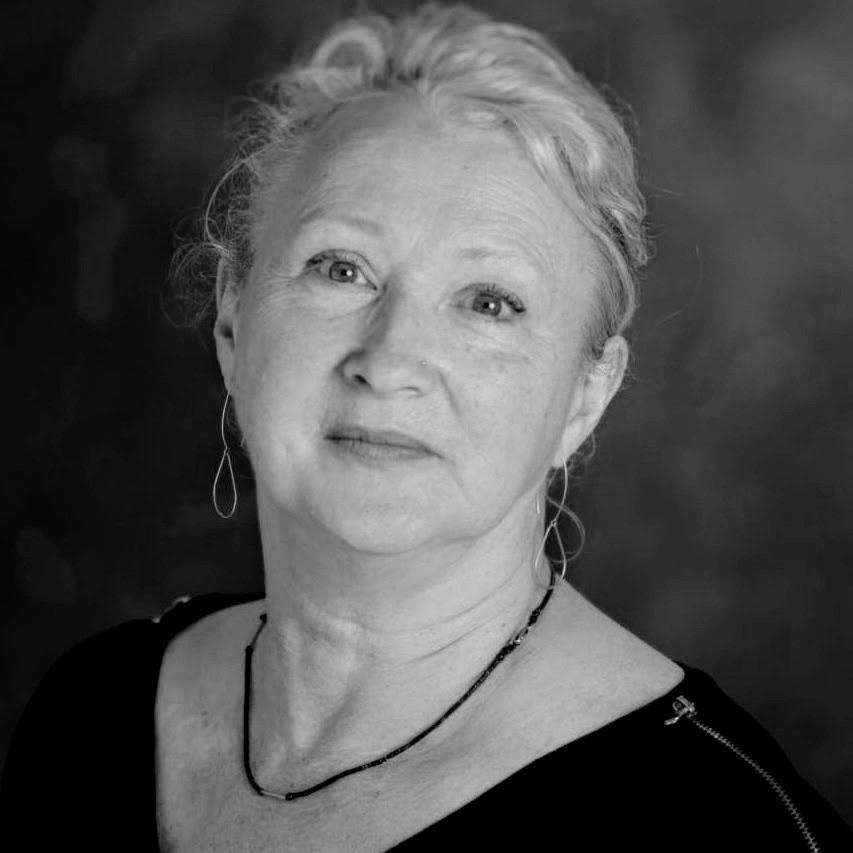
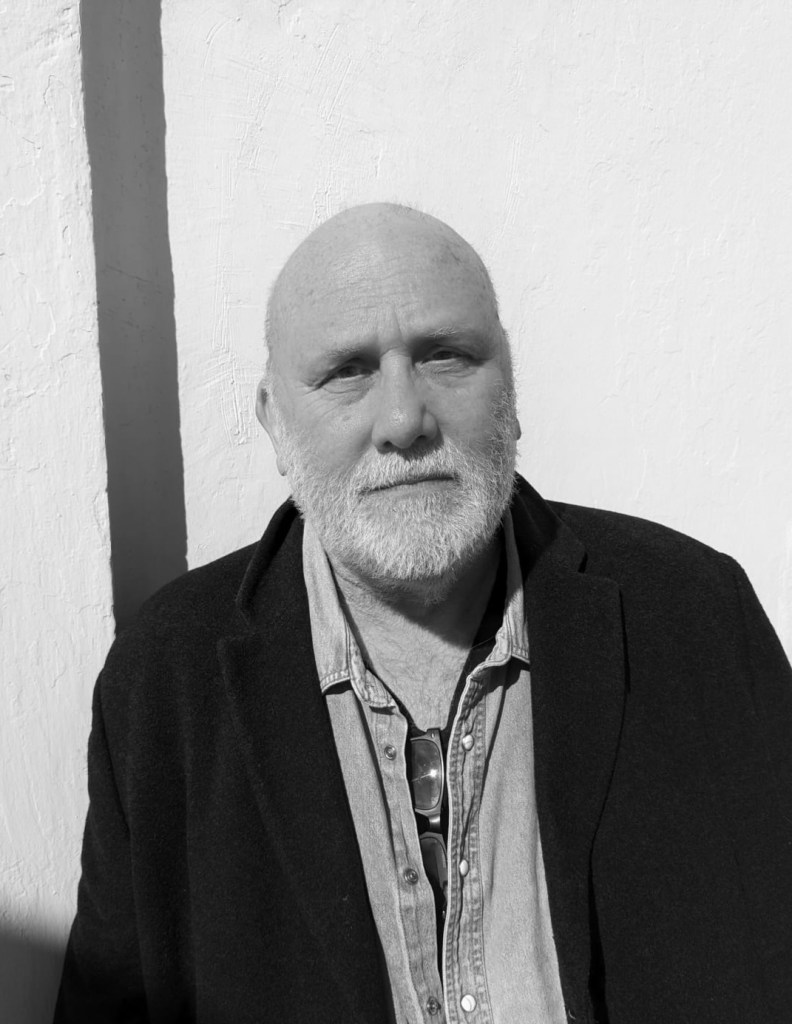
A self-described ‘vagabond, diarist, and wreck’, C.C. O’Hanlon’s fragmentary memoirs have been published in various anthologies, including Best Australian Essays 2005 and Best Australian Stories 2004 (both published by Black Inc, Australia), A Revealed Life: Australian Writers And Their Journeys In Memoir (ABC Books, Australia), The Odysseum: Strange Journeys That Obliterated Convention (John Murray, U.K.), Zahir: Desire & Eclipse (Zeno Press, U.K.), and Dark Ocean (Dark Mountain Project, U.K.). A founding features editor of Harper’ Bazaar Australia in the late ’80s, his mainstream journalism and images have appeared in The New York Times, The Sydney Morning Herald, Variety, Travel & Leisure, the Australian editions of Vogue and Harper’s Bazaar and scores of other newspapers and magazines.
He now lives a nomadic life with his American wife of 38 years aboard a small, sea-worn old sailboat named Wrack in the southern Mediterranean. They have three adult children.
_______
Submission Guidelines
All submissions should be sent as attachments to guesteditorbhp@gmail.com
Please state the theme and form of your submission in the subject of the email. For example: JOURNEYS/POETRY
Poetry and Fiction
For poetry submissions, submit no more than three of your best poems. Short stories should be limited to 1,500 words or (preferably) less. We encourage flash fiction submissions, no more than three at a time. Send these in as a .doc or .docx file, along with a short third-person bio, and (optional) photograph of yourself.
Art Submit hi-res images of your works (drawings, paintings, illustrations, collages, photography, etc) with descriptions of the work (Title, Year, Medium, etc) in the body of the email. Files should be in .JPEG unless they are GIFs or videos, and should not exceed 2MB in size for each work. File names should correspond with the work titles. Video submissions can be uploaded onto Youtube or Vimeo for feature on our website. Send these submissions along with a short third-person bio, and (optional) photograph of yourself.
Virtual Reality/ 3D Artworks
For VR Submissions, please submit no more than three (3) individual artworks. For Tilt Brush works, please upload your artwork to Google Poly (https://poly.google.com/), and mark it as ‘public’ (‘remixable’ is at your own preference). A VR/3D artwork can also be submitted as a video export navigating through the artwork. If you prefer this method, please upload your finished video file to YouTube or Vimeo and provide a URL. With either format, please provide a 150 word artist’s statement.
Non-fiction Non-fiction submissions (essays, reviews, commentary, interviews, etc) should be no more than 1, 500 words and sent as a .doc or .docx file along with your third-person bio/and optional photograph.
Submissions are open until 25th November – and will reopen again on 1st DECEMBER 2025/for new theme/new editor/s.
BHP online is now in the capable hands of the amazing C.C. – friends, arsonistas, send our NOVEMBER 2025 guest editor your magic!
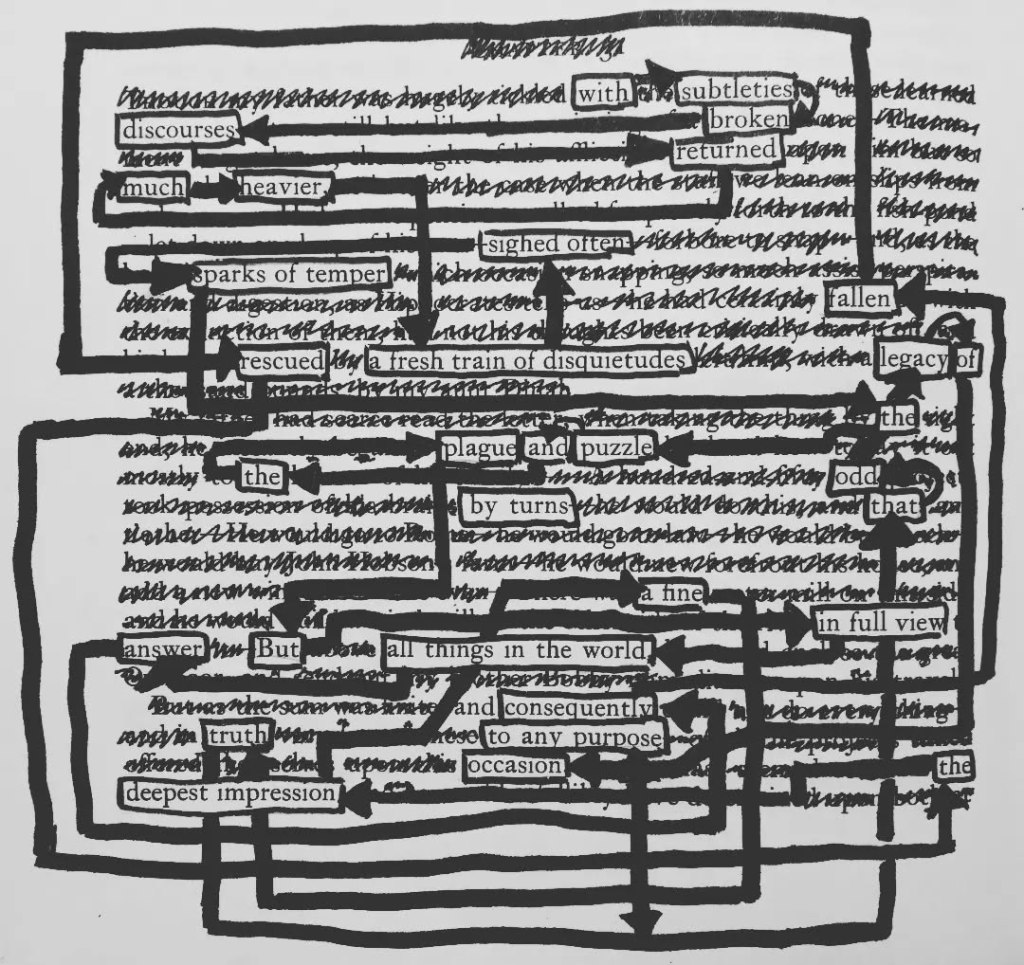
With subtleties broken, / discourses returned / much heavier / A fresh train of disquietudes / sighed often /Sparks of temper; / the puzzle and the plague / But, in full view, / all things in the world / answer consequently: / fallen, rescued / The deepest impression, / a fine truth to any purpose — / that odd legacy / of occasion
Teresa Mestizo is a Chicagoan Xicana currently based in a small mountainous town in Mexico where she writes, teaches, translates & makes art. These poems are part of her recent erasure series using Laurence Sterne’s The Life and Opinions of Tristram Shandy, Gentleman (1759-1767). More of her work can be found at teresamestizo.com
can the most mundane can it (not) shine in my eye?
a rock gets lost but ppl forget
then nothing much done today
sometimes sleep but sometimes not. washed away
an interesting turn of phrase
someone walks into a bar but someone someone tries to convince me of something but i’m conversing with a desk lamp
the problem w the world today:
the problem w the world today
Austin Miles is from southeast Ohio. He is the author of the chapbook Perfect Garbage Forever (Bottlecap Press) and has poems published in Touch the Donkey, Reap Thrill, Don’t Submit!, and elsewhere.
Brick Professional Building enislanded by offramps.
Asphalt Curbs Pushed onto the Mulch by the plow service spell something broken in the lot of the brick professional building.
Black Plastic Rat Traps every twenty paces under dead brown junipers ring the brick professional building.
Box for Patient Samples bolted to the masonry outside the back basement door of the brick professional building.
Five People in Cars Eating by Phonelight two of them wearing scrubs each of them alone behind the brick professional building.
Oft-Gnawed Fisher Price People collect pathogens in the children’s corner of the brick professional building.
* Inholding
Where feral bloodroot blooms prettily, where knotweed and bittersweet are bad ideas that have won the meadow where there are wells and springs and cairns and cellars there is a heavy chain and hook hanging from a maple too old to tap where her late husband butchered their cow.
Corwin Ericson is the author of Swell, a novel, and the collection Checked Out OK. His work has appeared in Volt, Jubilat, Harpers, and elsewhere.
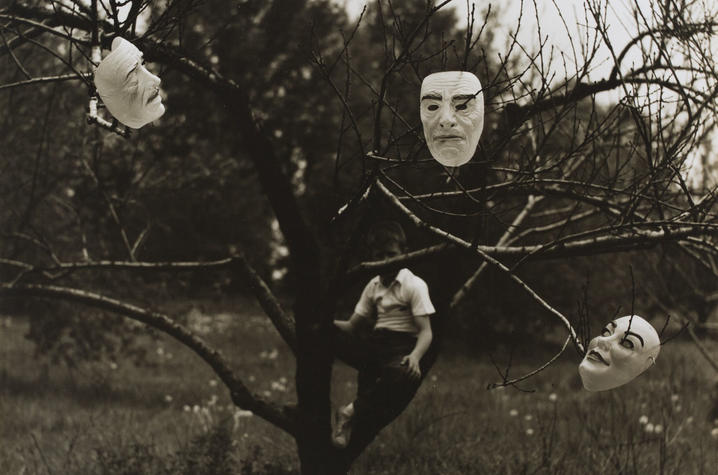
(Image: Ralph Eugene Meatyard. “Untitled,” 1963. Courtesy of Fraenkel Gallery)
A Tense to Describe a Duck That Isn’t There
After Asger Jorn’s The Disquieting Duckling

Duck would have been erupting.
Duck would have erupted.
Duck continuous erupt
in the would / have been. Future
duck the perfect erupts. The never duck
eruption.
present simple farmer
haybales fowl in the is and ises in the ed
of rural whitewash 	each breath
	a flesh of brushstrokes.
a tense to describe the temporal
stretch of canvas. Dapples
of birch leavings to stack
in impasto. An erupt

	to duck a basal ganglia.

*
A-Political Self-immolators

We fizzy & piffy lakeside straight shooter boys
shoot stray cats from the Baroque balcony boys
we’re landslide boys eat crab boys big bullet
bully boys hooligan melodies & tenebrous eyes boys
sparkle sparkle little pig we ride rapid boys wide
boys locked safe boys sink to the depths the Davy
Jones boys real boy’s boys’ boys locker room
boys’ talk boys neck foam boys nick phones boys rock
-a-bye baby boys the blue-eyed boys bish bash
bosh job’s a good’un boys we’re those landgrab boys
swamp stab boys drain the blood dig the liver
boys pile-driver boys we’re deep-sea diver boys
black-lung coal miner boys real DH Lawrence boys
big tough boys with big tough toys oioioi boys
make some fucking noise boys we’re poison boys
burn the fields salt the earth shatter seas stone skim
boys we’re the make room boys the me-first boys
the boys with a fire in our fists we’re pollution boys
we’re gruesome boys those lumpen laymen men
of the earth serf boys we’re wind & rain boys fight
through snow sludge through mud we breathe gas
boys bottle rocket shrapnel boys we’re front-line boys
Gulf War Syndrome born alone die alone eight
pawn boys dethroned boys deflowered & defaced
face the music boys on my mark we go over
trench foot shell shock whizz-bang boys no man’s
land landless boys no stake in society ASBO boys
we’re high fire boys burn like mustard boys
we burn water baptisms of gas explosions stop
drop & roll up a fatty we’re rock n troll star
boys steal your hearts & leave a scar life sentence no
possibility of parole we’re born to die boys beautiful
corpse cheap funeral Amazon coffin & BYOB
boys search & destroy boys given no quarter hung
drawn & quartered we’re those coup de grâce
coup d'état boys raze the dead seize the day gone
tomorrow boys we’re the lost boys the last boys
last of our name last of our nature we’re ouroboros
boys anonymous boys we see things say things
you wouldn’t dream boys you wouldn’t feed us
to your dog you wouldn’t touch us with his you’d
off with our heads you wouldn’t be seen dead.
Dan Melling is a writer from the UK. He holds an MFA in Poetry from Virginia Tech and teaches creative writing at Liverpool John Moores University, where he is also pursuing a PhD. His work has appeared in The Rialto, X-R-A-Y, HAD and elsewhere. He co-edits Damnation literary journal.
                                         How will I ever get out of this labyrinth?
                                                                                 After defeating
                                                                   the bull-headed monster,
                                                        not once but
                                                                over and over again,
                                              I hung my sword up
                                   on the bullet-pitted wall,
                      and tried to find my way back home.

                                              The thread was broken, though,
                                       and now I wander in this fearful light
                                                                   and search for darkness.
Peter J. King was active on the London poetry scene in the 1970s. Since his return to poetry in 2013 after a long absence he’s published four collections (the latest being Contact Light, Alien Buddha Press, 2025), and appears widely in journals and anthologies. He also translates, mainly from modern Greek and German, writes short prose, and paints. Bluesky @rock-rex.bsky.social
1. Stone is tone sat, shone sibboleth, antic serve antique observe quiescence essence deliquescence whence as just majesty or jest, Rome. Adjust fallen sigh stupor brain aspic apical outward placid not much. Acid esteem unsated teeming, for that although also, can vain humane vanity admired humanity mired option self enraged and assuage, turn. Bound unto found object object prime self lowered mind loured petite. Alms of psalm, sole incarnadine, hoary before turn whore not then prey custom, give. Penitent pen it in prayer custom unsaid repent end to end, soul. Wretched ashen etched in deceit do, dawn stir fall rare jewel out impending whom, who; fault line twine twin fault win turn in time or afterthought fit flee.
3. Quim, ass, seed—open! So-so inquest, O, sass! O! Idyll antic car, O Maat! Err! A mere O. Llamaest, a cad. Hoot. (& he’s sus.) Peer, O! Ape wrestled a stupor. None, mofo. I’ll pass. O, none sat Z, O deepen czar-anchor. Kayla’s so. Lovin’ it. Ah! Delu, man. Fast! Tome mirror. Idyll me, O van, edging me. Cum! Ah, dear!—O! A purely-meant, a villagette, a bus—O! All maudy, prick, I miss ’im. Be! Ankh? Eel? Cree? Nay. Ski? Evil costume? Dick? Whey? Casey? Dan?—O! Imp-ray? Dolls? Sense? O, perp & tears. Seal? Fee? Nay. Me sir! O, key! Trouble Cain. Tallin gone, no? Ra? Dough? Eh? Kettle more eerie. Insult confit. Nay. See raw Vega, deaf alley—foo! Golden, no?
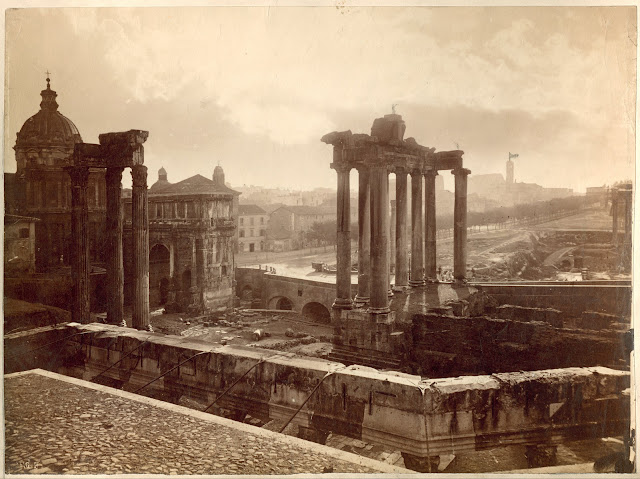
5. All pensive on this rock I sit and watch an empire gone to shit— cracked columns, bricks & broken blocks, like cat turds in a litterbox. My weary mind can only see the pomp of human vanity, and though I find it rather crass, I too’m a vain and pompous ass. I beg you, soul—it’s getting late— do not be like the profligate, whose life on worldly pleasure’s spent, deferring when he should repent, for when death’s door such blind men gain they rarely rue and flee the pain.
6. From: Satya Nadella Sent: Tuesday, July 03, 2024 5:33 AM To: Microsoft – All Employees; All MS Store Employees FTE Subject: Reflection on the Impermanence of Success
Team,
I find myself contemplating the fleeting nature of worldly pursuits. While we strive for success and recognition, it is important to remember that these achievements are ultimately transient. History is replete with examples of empires that have crumbled, leaving behind only remnants of their former glory.
The pursuit of material wealth and fleeting pleasures can often distract us from what truly matters. It is essential to cultivate a sense of perspective and to prioritize enduring values over ephemeral ones.
As we navigate the complexities of life, let us strive to live with purpose and meaning. May we find solace in the pursuit of knowledge, compassion, and the betterment of ourselves and our communities.
Sincerely, Satya
7. Escape the Flames: Your Roman Sanctuary Awaits
Imagine yourself, seated upon a stone terrace, overlooking the timeless beauty of Rome. The ancient city unfolds before you, a tapestry of history woven into the very fabric of the earth. Lost in thought, you witness the ruins of Rome, her fallen majesty, and linger in a stupor most profound. But this is no melancholic reverie. This is the beginning of your new life, a life free from the pomp of human vanity and the beguiling claims of the mundane.
Here, in our exclusive condominium, you can finally shun the ways of the man who only aims at worldly bliss. Repenting on death’s day is a fate you can avoid. Come, my soul, before your hair turns grey, and embrace a life of tranquility and sophistication.
Our meticulously restored residences offer a haven of peace and luxury, nestled amidst the heart of Rome’s vibrant history. Rare it is, when held in death’s fell sway, to see one's own mistake, and flee the flames. But here, you can escape the flames of worldly distractions and embrace the true treasures of life.
Don’t let your dreams run aground on base things. Come, discover your own Roman sanctuary. Contact us today to learn more about our exclusive condominium offerings.
translated from the german by Ann Cotten & Anna-Isabella Dinwoodie
* first true story (from “three true stories”)
the fence is a window and the window is a room and the room is a table and the table is a speck and the speck is a girl and the girl is a knife and the knife is a clock and the clock is a letter and the letter is a neighbor and the neighbor is a flowerbed and the flowerbed is a city and the city is a street and the street is a friend and the friend is a summer’s day and the summer’s day is a hill and the hill is a field and the field is a tower and the tower is a woman and the woman is a wave and the wave is glasses and the glasses are an evening and the evening is a tree and the tree is a mound and the mound is a key and the key is a coin and the coin is a sheet of ice and the sheet of ice is a hole and the hole is a bridge and the bridge is a pillar and the pillar is a look and the look is a colleague and the colleague is a stick and the stick is a mountain and the mountain is a journey and the journey is a cafe and the cafe is a camp and the camp is a wolfhound and the wolfhound is a grate and the grate is an abyss and the abyss is a toilet and the toilet is a school
* great authorizations
you may be expected to you may be able to you may be required to you may be allowed to
you may be expected to be expected to you may be able to be expected to you may be required to be expected to you may be allowed to be expected to
you may be expected to be able to you may be able to be able to you may be required to be able to you may be allowed to be able to
you may be expected to be required to you may be able to be required to you may be required to be required to you may be allowed to be required to
you may be expected to be allowed to you may be able to be allowed to you may be required to be allowed to you may be allowed to be allowed to
you may be expected to be expected to be expected to you may be able to be able to be expected to you may be required to be required to be expected to you may be allowed to be allowed to be expected to
you may be expected to be expected to be able to you may be able to be able to be able to you may be required to be required to be able to you may be allowed to be allowed to be able to
you may be expected to be expected to be required to you may be able to be able to be required to you may be required to be required to be required to you may be allowed to be allowed to be required to
you may be expected to be expected to be allowed to you may be able to be able to be allowed to you may be required to be required to be allowed to you may be allowed to be allowed to be allowed to
Liesl Ujvary (1939) is an Austrian writer in the concrete tradition. Her oeuvre includes experimental electronic music & video Good & Safe (Sicher & Gut), her debut, was originally published in 1977 / Ann Cotten is a writer & translator from Vienna, Austria. Translations from English to German include books by Isabel Waidner, Legacy Russell, Rosmarie Waldrop & others / Anna-Isabella Dinwoodie is a translator & writer who makes visual poetry & performance art. She lives in Berlin.
Holy Grail, hollowed bone, half buried in the dirt. Above the
Brow God is moving his furniture, wardrobes of thunderclouds,
heavy     driving migraines into your skull

Within these hills there are buried museums. Gleaners,
looters, archaeologists scrape the dust, sift for clues. When
the rain comes flashfloods will turn this dirt to mud,
exposing doll’s prams, tin bathtubs, a mangled accordion wheezing

Boy on a stolen moped dragging it uphill towards the church
               cowboy swagger

I sit by the shrine of plastic flowers rolling a joint with
shaking fingers. A cracked Now That’s What I Call Music CD
hangs from a tree, a fetish token for the homeless woman
                winter-death, grief-moon

Dig into the dirt with the heel of my boot remembering the Dog
King. Somewhere down there in an old tin can are his tethering
ropes, latch keys, can-opener, flick knife      cassettes of mad
muttering, dog-howl

In buried museums beneath these hills, your memories, earth-
weighted mad saint’s bone relics, nightmare archive.
Jeff Young is a Liverpool based writer for radio, theatre & screen. His memoir ‘Ghost Town’ was shortlisted for the Costa Prize and his second memoir, ‘Wild Twin’, tells of his years hitching around Europe & living in Amsterdam squats. Poet, performer, visual artist & broadcaster, collaborator with artists & musicians, he is currently writing ‘Lucid Dreamer’, an alternative history of Liverpool counterculture. Bluesky http://@wildtwin.bsky.social
Burning House Press are excited to welcome Alexander Booth as the fourth BHP guest editor of our return series of special editions! As of today Alexander will take over editorship of Burning House Press online for the month of September.
Submissions are open from today 1st September – and will remain open until 25TH SEPTEMBER.
Alexander’s theme/s for the month are as follows
—LANDSCAPE
LABYRINTH—
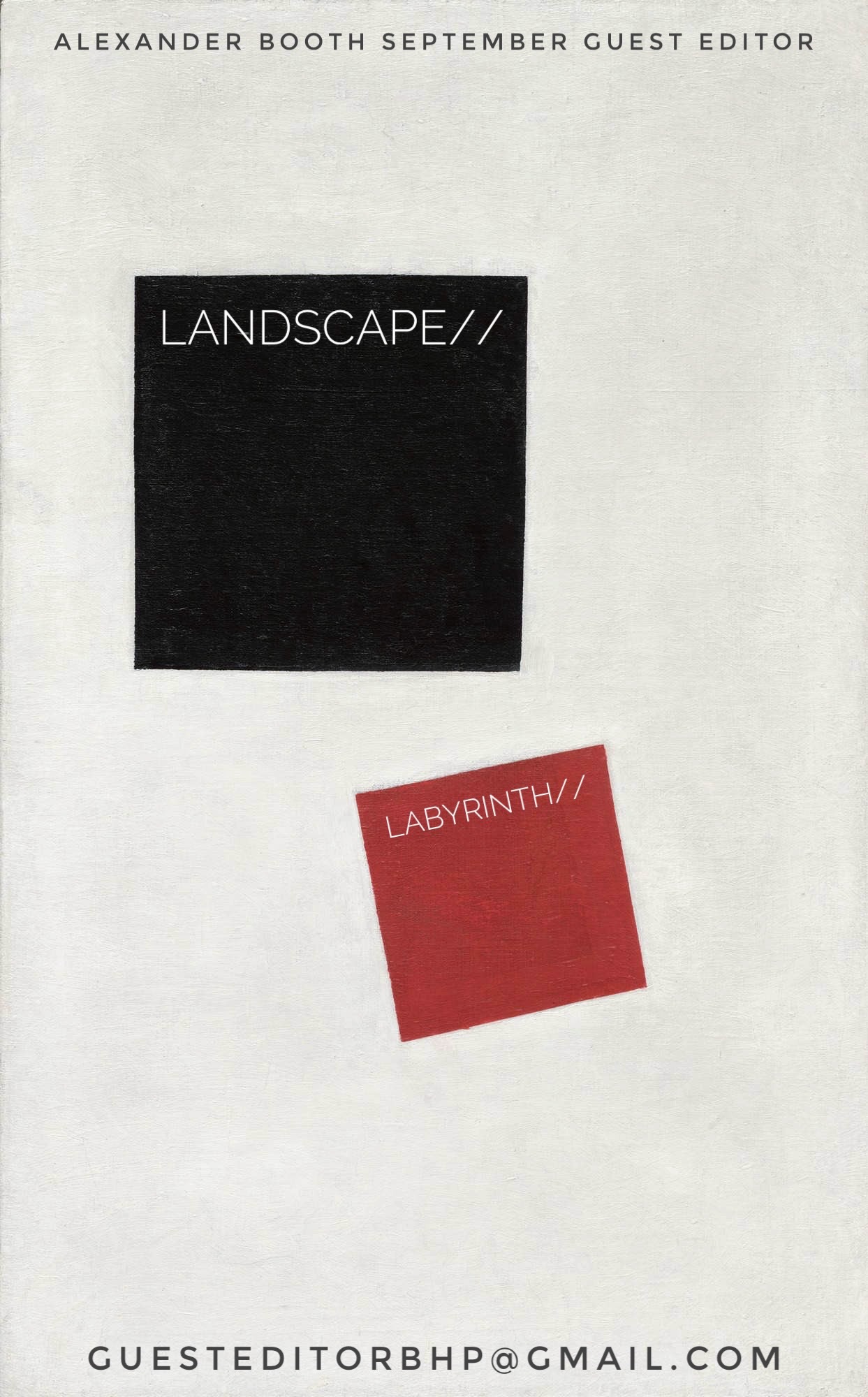
Black Square and Red Square by Kazmir Malevich
_____
LANDSCAPE // LABYRINTH
*
When the painter’s friends, however, looked around for the painter, they saw that he was gone—that he was in the picture. There, he followed the little path that led to the door, paused before it quite still, turned, smiled, and disappeared through the narrow opening.
– Walter Benjamin, Berlin Childhood around 1900 (trans. Howard Eiland)
*
Each one of us, then, should speak of his roads, his crossroads, his roadside benches; each one of us should make a surveyor’s map of his lost fields and meadows.
Gaston Bachelard (trans. Maria Jolas)
*
“Though Minos blocks escape by land or water,”
Daedalus said, “surely the sky is open,
And that’s the way we’ll go. Minos’ dominion
Does not include the air.”
– Ovid, Metamorphosis (trans. Rolfe Humphries)
_____
Alexander Booth is a poet, translator, collage artist and printmaker who lives in Berlin. Recent translations include books by Friederike Mayröcker, Alexander Kluge, Gerhard Rühm, and a new translation of Ludwig Wittgenstein’s Tractatus Logico-Philosophicus. His collection of poems Triptych was published in 2021 and Kantor in 2023.
__________
Submission Guidelines
All submissions should be sent as attachments to guesteditorbhp@gmail.com
Please state the theme and form of your submission in the subject of the email. For example: LANDSCAPE/POETRY Or LABYRINTH/FICTION
Poetry and Fiction
For poetry submissions, submit no more than three of your best poems. Short stories should be limited to 1,500 words or (preferably) less. We encourage flash fiction submissions, no more than three at a time. Send these in as a .doc or .docx file, along with a short third-person bio, and (optional) photograph of yourself.
Art Submit hi-res images of your works (drawings, paintings, illustrations, collages, photography, etc) with descriptions of the work (Title, Year, Medium, etc) in the body of the email. Files should be in .JPEG unless they are GIFs or videos, and should not exceed 2MB in size for each work. File names should correspond with the work titles. Video submissions can be uploaded onto Youtube or Vimeo for feature on our website. Send these submissions along with a short third-person bio, and (optional) photograph of yourself.
Virtual Reality/ 3D Artworks
For VR Submissions, please submit no more than three (3) individual artworks. For Tilt Brush works, please upload your artwork to Google Poly (https://poly.google.com/), and mark it as ‘public’ (‘remixable’ is at your own preference). A VR/3D artwork can also be submitted as a video export navigating through the artwork. If you prefer this method, please upload your finished video file to YouTube or Vimeo and provide a URL. With either format, please provide a 150 word artist’s statement.
Non-fiction Non-fiction submissions (essays, reviews, commentary, interviews, etc) should be no more than 1, 500 words and sent as a .doc or .docx file along with your third-person bio/and optional photograph.
Submissions are open until 25th SEPTEMBER – and will reopen again on 1st OCTOBER 2025/for new theme/new editor/s.
BHP online is now in the capable hands of the amazing Alexander Booth – friends, arsonistas, send our SEPTEMBER 2025 guest editor your magic!


 BURNING HOUSE PRESS