Search

BURNING HOUSE PRESS

Not For Profit/For Prophecy

Tag

Nico

When John Waters Met Nico by Graham Russell

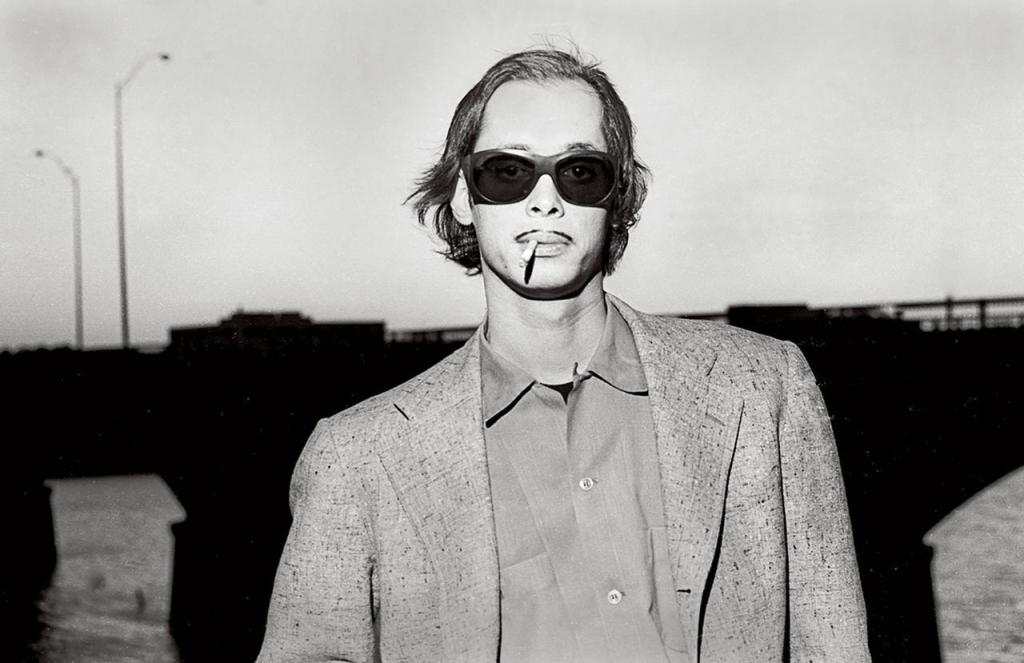
John Waters by Nicolas Russell, Austin, Texas, January 1976.

For so many of us malcontents, the riotous 1981 book Shock Value: A Tasteful Book about Bad Taste by cult filmmaker extraordinaire John Waters represents a sacred text. (I would have first bought it in the late 1980s as a university student, and it’s been a profound cultural touchstone ever since). In the chapter entitled “Sort-of-famous” the peoples’ pervert writes “I know you’re supposed to name-drop in these kinds of books, so here goes: People I Always Wanted to Meet, Did, and Wasn’t Disappointed …” and proceeds to list the likes of Andy Warhol, David Lynch, William S Burroughs and Douglas Sirk. But most tantalizingly for me, he recalls encountering …

“… Nico, my favourite singer, who was so out of it when I met her that she asked, “Have I ever been here before?” (I had to tell her I really had no idea).”

I yearned to know more about this historic meeting between cinema’s Sleaze King and the heroin-ravaged Marlene Dietrich of punk. Flash-forward to December 2010: I interviewed Waters for the sadly long-defunct art and culture magazine Nude in December 2010 when he was in London promoting his book Role Models, so I finally had the opportunity to get him to elaborate on his encounter with Nico. 


So here it is: when John Waters Met Nico…

Graham Russell: Tell me about the time you met Nico.

John Waters: Nico … I met her when she played in Baltimore. Well, (before that) I saw her play with The Velvet Underground at The Dom on St Marks Place (in New York) with The Exploding Plastic Inevitable. I have the poster still. But I met her much later when she had her solo career, which I loved. She was a total heroin addict. Did you ever read that book The End(The 1992 book is a jaundiced and not exactly objective account by her former keyboardist James Young). It’s so hilarious. It was that – although it wasn’t that, that was later when she was touring England. She played at this disco, and I went. And people went, but not a lot, it wasn’t full. And she was heavy and dressed all in black with reddish dark hair, and she did her (he makes guttural moaning noise). Afterwards I said, “It’s nice to meet you, I wish you’d play at my funeral”, and she said (mimics doom-laden Germanic voice), “When are you going to die?” I told her, “You should have played at The Peoples Temple; you would’ve been great when everyone was killing themselves!” Then she said, “Where can I get some heroin?” I said, “I don’t know.” I don’t take heroin, so I don’t know. But even if I did, I wasn’t copping for Nico!

“But that was basically it. But I’ll always remember her, and I love Nico. I remember when she died, when she fell off the bicycle (in 1988). Every summer my friend Dennis and I, we play Nico music on the day she died (18 July). I saw that documentary Nico-Icon (Susanne Ofteringer, 1995), which was great. It’s a shame: she was mad about being pretty! She was sick of being pretty, being a model. And I remember her when she was in La Dolce Vita (1960), even before. Nico … great singer; and even The Velvet Underground hated having her. And her music can really get on your nerves. You have to be in the mood. Sometimes it gets on my nerves. You have to be in the mood to listen to it. To put on a whole day of Nico can be … my favourite song of Nico ever, and I only have it on a tape that someone made, it’s a bootleg. Did you ever hear her sing “New York, New York”? It’s great! I wish she’d done a whole album of show tunes! Like “Hello Dolly” or “The Sound of Music”! (Mimics Nico singing “Hello Dolly”).
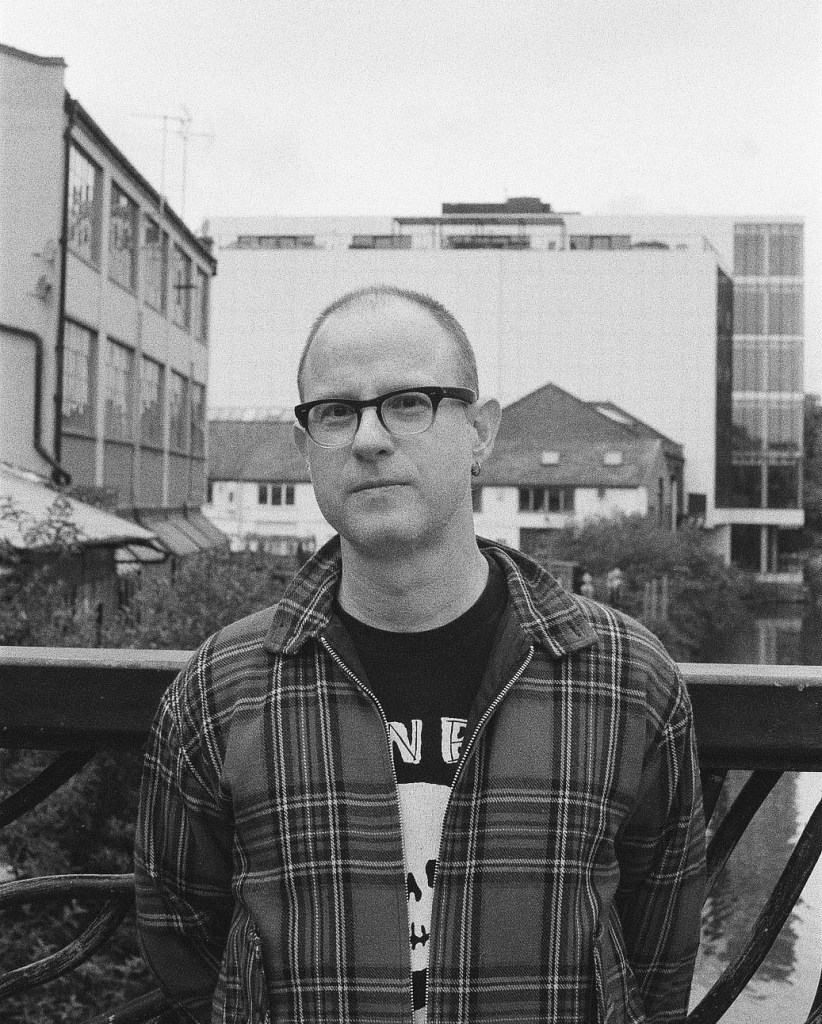

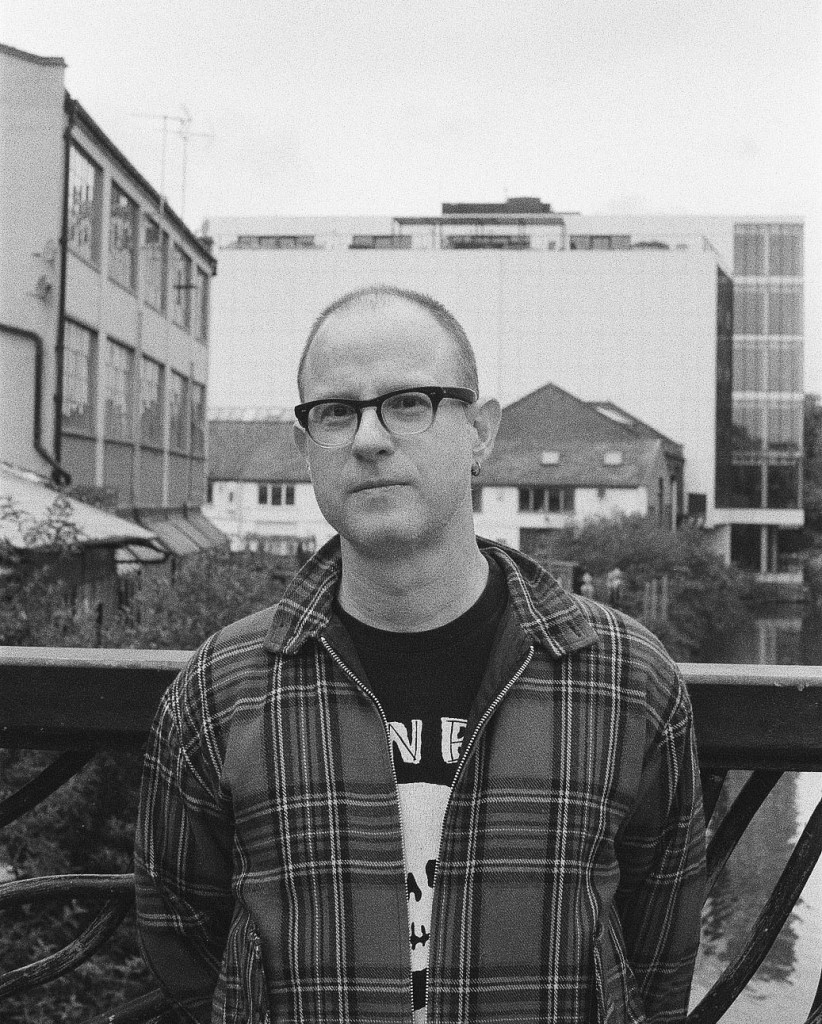
Like the Shangri-Las song, Graham Russell is good-bad, but not evil. He’s a trash culture obsessive, occasional DJ (Cockabilly – London’s first and to date, only gay rockabilly night), and promoter of the Lobotomy Room film club (devoted to Bad Movies for Bad People) at Fontaine’s bar in Dalston. As a sporadic freelance journalist, over the years he’s contributed to everything from punk zines (MAXIMUMROCKNROLL, Flipside, Razorcake) to The Guardian and Interview magazine and interviewed the likes of John Waters, Marianne Faithfull, Poison Ivy Rorschach, Lydia Lunch, Henry Rollins and Jayne County.

Nico Restored by Nicholas Rombes

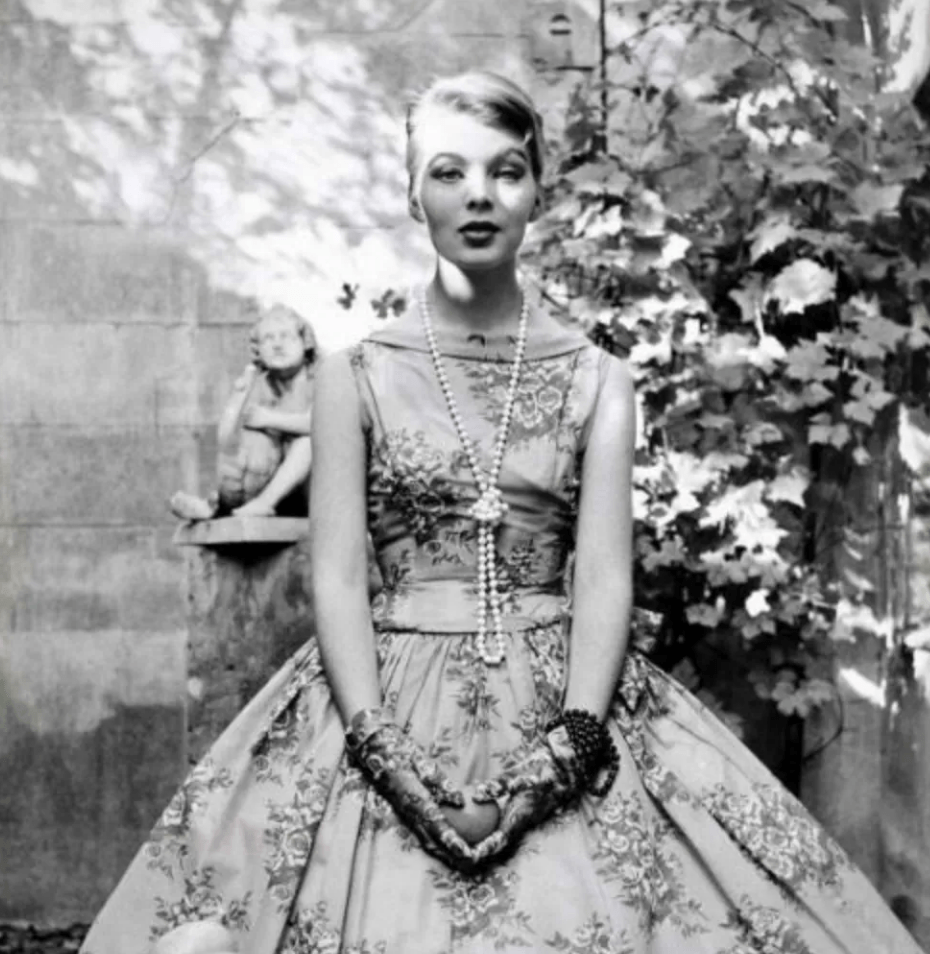
A young Nico in Berlin, photographed by Herbert Tobias.

Nico Restored

I.
Because Nico could not foresee the danger ahead.
She was not careful, she was a child.
Above her Hell’s Sun
moved blackly—How far away? Shall I touch it?–
Like some shiny wet ink spot, or a stuck wet leaf.

II.
Before her journey back Nico slept and slept and
dreams: back then it was all right.
Back then it was a wall of black crickets and her baby
sitter’s ventriloquil voice.
As she slept It watched over her, and
loved her in Its brief, iron-lung heart.
It did not want to let her go, but knew, but knew.
It did not think of itself as lost, it did not think of itself at all.
It just was. It just wanted.

III.
Nico did not think of herself as lost
she did not think of herself at all.
She just was. She just wanted.
Christa wanted.
It has changed, she thinks.
Nico’s Nico. Come for Nico. She just
wanted the image of her lost face.
Herself. For a moment Nico could not imagine Nico, nor recall
the green of green, the hum of wires,
the flash of fires, the sound of sound
had come apart

IV.
It has changed.
She was nowhere.
Her heart. Inside her.
Christa wanted gravity. The thing that was not flat
watched her from behind a red cliff.
When she laid her white hand across her red heart Its mouth opened.
Her ears could not catch her own dripping sound.
She said her name to hear it, the sound
When It moved Its knotted head It pushed Itself out of gravity.

V.
Nico says: When I stand on the roof of the opera it’s amazing I don’t fly off.
Nico sits atop a red cliff, atop an expanse of red sand.
As red as far as the eye can see.
She is red, too, from the sand, mixing with her sweat.
She takes off her sweater, and
tosses it aside.
She takes off her shoes, and lies back.
She touches her body. It has changed. Her body is red.
Afterwards she leans forward to shake her hair
until grains of sand fall out like thunder.

VI.
Nico marvels that although she has not eaten she is not hungry.
It has fed her food while she slept, careful to remove each and every
crumb from her face with tweezers. It has spent an eternity
using its tweezers to move
mountains, grain by grain.
It does not want Nico to escape, but It does not know how to stop her.
The thing it does best is observe. It does not know how to stop things.
Back then it was all right.

VII.
Back then, Nico, thinks, it was all right.
It finally comes for Nico while she sleeps, curled in the sand.
It cleans her face, grain by grain, not even touching her skin.
It spread its wings over her to measure her size.
It considers its sack full of potions.
It worries she is dead and leans close in to her face.
It loves her so gently.
Take me back to back then.

VIII.
The marble index of a mind forever.
Christa wanted.
To free her mind, because it was caught.
I wouldn’t want a different variety, thinks Nico.

Nico thinks in shapes
more and more.
Round and Square.
Truth or Dare

are not shapes.

Not sound.
Not gravity.
The Absolute Zero.

Nico’s mind is a shape that comes
to free her mind, because it was caught
with Its claws
and retraces her footprints
she just wanted to free her mind, because it was caught
with Its claws
retraces her footprints
squares and triangles, circles and cones.

Her own shape, the pattern of sunlight
just wanted to free her mind, because it was caught
with Its red mountain claws and triangular imagination,
circles and cones.

Fright and dread, fear and bones, Wehrmacht dreams.
Her own
but a King.

Come for Nico.
But a King.
Come for Nico.

Her very own body in the night,
beneath the Ibiza sheets, the shape her hands make.
The real Nico, more real than real, her old self

a Sleeping Beauty for some fierce Prince
but It is not a Prince.
Shape, the pattern of moonlight upon
more and more, the hospital floor.

Her very own body in the night
beneath the light, the shape the world makes.

The real Nico, more Nico than Nico, her old self
a Sleeping Beauty for some fierce Prince.

But It is not a Prince.
Come for Nico, no fangy King
beneath the sheets
the shape her hands make.

The real Nico, more real than real, her old self
a Sleeping Beauty for some fierce Prince.

She just wanted to free her mind to be
the hunting thing with claws of shade.
Where It went, Nico wonders, and retraces her footprints.
Sleeping and murder.
Squares and triangles.

Fright and dread, fear and bones.
Her own melodic shape, the pattern of moonlight upon
the institutional floor. Her very own body in the night
beneath the white cold sheets, the red triangulated claws
of Greek thought.

The real Nico, more real than real, her old self
but this thing–this It–is not a Prince.
Rather a King.
Come for Nico.

Sleeping Beauty for some fierce Prince.
But this thing—this It—is not a Prince
rather a Devil.
come for Nico.

She just wanted to free her mind, because it was
a trick and retraces her footprints
squares and triangles, circles and cones.
She just was. She just wanted.
Christa wanted.

Her own shape, the pattern of moonlight upon
the hospital floor. Her very own Nico in the night,
beneath the sheets
she just wanted to free her mind, because It was caught
with Its Trick
and retraces her footprints, Squares and Triangles
circles and cones
fright and dread fear and bones.
Her own shape
Red-sanded body and mountain side
her cold linoleum floor.
Her very own body in the night
come for Nico.

IX
Back then it was all right.
Take me back.

Come for Nico.


Nicholas Rombes is author of the novels The Absolution of Roberto Acestes Laing (Two Dollar Radio), The Rachel Condition (CLASH Books), and Lisa 2, v 2.0 (Calamari Archives). He co-edits TIMECODES (Bloomsbury), a film book series dedicated to slow criticism and is author of 10/40/70 (Zer0 Books). He’s an English prof. in Detroit, Michigan.

Boy or Girl by James Nulick

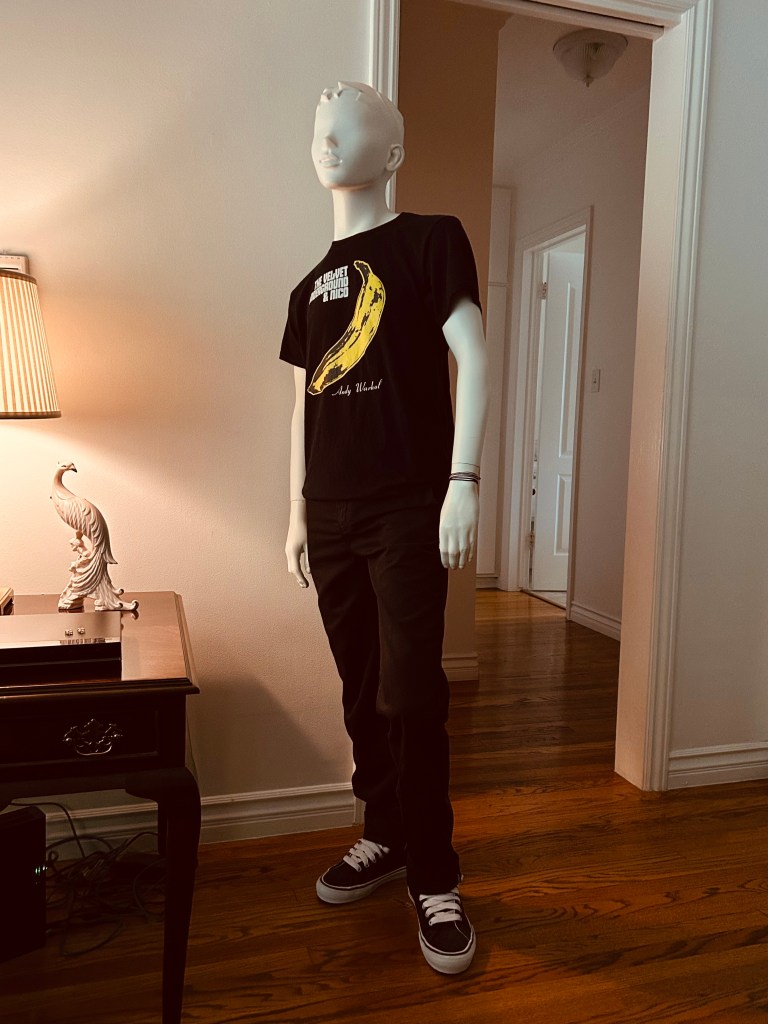
Nico in his The Velvet Underground & Nico shirt.

My name is Nico. It has always been Nico. It felt like a good name when I tried it on. My mother named me after a singer most people my age don’t even know. On most days it sounds like a boy’s name, though on some days, usually a Sunday morning, it sounds like a girl’s name, but I’m definitely not a girl. My name sounding like a girl’s name doesn’t bother me anymore. It used to, like when I was a kid, hey faggot, how come you got a girl’s name, but not anymore. There aren’t very many Nicos, maybe a barber once in one of those ghetto barbershops where everyone is tripping over themselves to look cool, a skin fade kid with a Wahl in one hand and a girl’s digits in the other, grey sweatpants and black Vans and a drooping eyelid that’s somehow endearing, I’m stealing glances of him while in the chair waiting for the next call, hoping he’s the one, the double quicksilver echoing my reflection in a thousand shop windows, I’ll be your mirror, and when you have an unusual name like mine you always pay attention to others you share it with, like when you notice all the cars just like your car, my mother’s favorite song, Sunday morning, a song father approved of, when my days were laid out for me, my life simple because everything was preplanned, I didn’t have to think of what to wear, what to say, deciding if I was a boy or a girl, the fate of the nation trapped in the web of my lattice fingers. I pull on my threadbare brown corduroy pants and a green cardigan mother found at Goodwill for 12.99, so today I will be a boy. 


James Nulick is the author of several highly acclaimed novels including Plastic SoulThe Moon Down to Earth, and Valencia. He is working on a new novel. 

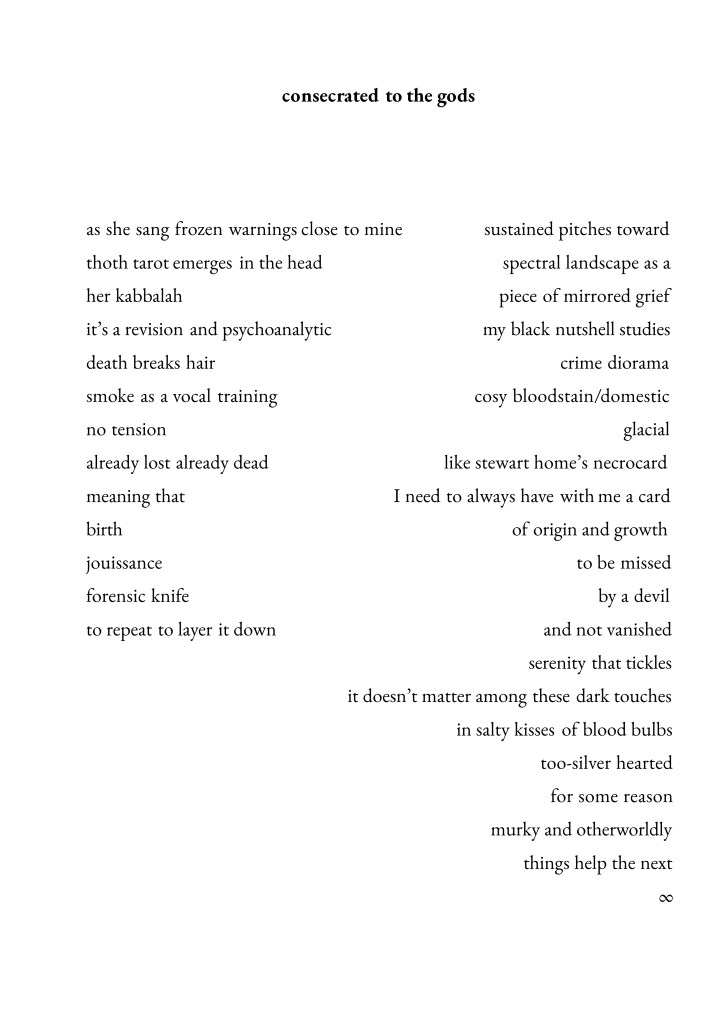
consecrated to the gods by Misha Honcharenko


Misha Honcharenko is a Ukrainian writer based in Todmorden, West Yorkshire. Their debut novel, Trap Unfolds Me Greedily, was published by Sissy Anarchy in 2024, following their first poetry collection, Skin of Nocturnal Apple (Pilot Press, 2023). Their work has been featured in Vogue Ukraine, Erotic Review, i-D, AnOther, Tank, Worms, Manchester Review, and minor literature[s].

In the Dark by Nate Lippens

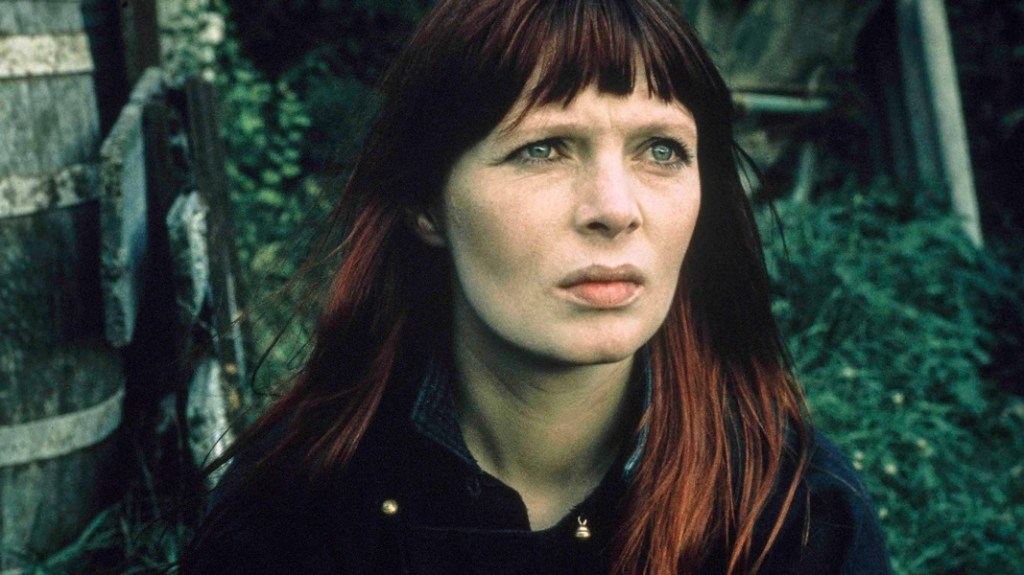
Still from the film Athanor (1972) by Philippe Garrel

In the dark room at night, the walls enameled black, so dawn arrives as a violation, she smokes. She smokes without conviction, almost without need, but then deeply as if to prove something to herself. Flicks the butt into the grate of the ruined fireplace, heaped with little cartons, each cigarette emptied and smoked, each added to a mountain. A plate of ashes. She makes sure, twice, that her cigarette is extinguished before she does this. Philippe scolded her. Ari found one smoldering and rubbed it out on the floor. How could Philippe be angry? When they moved from the Montparnasse Hotel into this apartment, he gutted the place, tore out the twentieth century and some of the nineteenth too. Gone: gas, electricity, hot water, heater, lighting, furniture, carpets. A penitentiary but there are no locks. 

She yearns to go back to New York though nothing good comes to or from there. The not-good is familiar. She needs that now with her mother dead. Can still smell the air’s heavy scent in the room where she knelt before the empty bed and cried. She hadn’t wanted it to be like that and knew her aunt Helma blamed her for not visiting the last two years of her mother’s life. It had always been hard, then became impossible. The immobility she feels now, lying in bed undead, waiting for light to come in the room and peepshow the mess. Philippe shifts beside her, groans. They are covered by his overcoat which doubles as mattress and bedding, sleeping partly on it, partly on the floor, the faint smell of piss. Ari makes sounds across the room, asleep or awake, she can’t tell. She’s never alone lately but never accompanied either. Everything has fallen to repetition. They score, they get high, they have no money, no need for food after they’ve fed, only to make certain the boy eats, he must eat. Then they go to museums or wander the docks, up and down the same streets of Paris. Was it last week or the one before—prior has no hold here, all is prior but there is no history, only the past—that she saw someone, a London person from New York, who startled at her appearance and said what did you do to your hair. The blonde dyed crimson, bluntly cut. You like it, she responded, nearly leering, surfacing from the not-slumber, suddenly awake on the street in the face of that collaged ghoul made of the spare parts, all mean, all pushing, all saying her songs weren’t good, she needs a manager, she needs to be blonde again, she needs better clothes, not these ugly robes and caftans Philippe sewed himself for the film. The film! They hate it, just the idea of it. A woman and a man and a child in the desert, shot across three—Sinai, Death Valley, and Iceland. All blend together to her. She knew they weren’t one. Each had its own qualities and peculiarities, but like people, places were mostly the same. You met one or two and you’d met all of them. The man on the street, upset or disappointed by her appearance, had scurried off, back to his little life, perhaps some lunch in a café. The thought made her feel ill. 

She would get back to New York and show them, she would book some gigs. She practices the harmonium every day now and she has new songs. The best she’s done, she’s sure, or thinks she’s sure, but can already see the faces of Danny and Paul and others who will tell her what is wrong with them, not knowing they are about her mother, Jim, the deserts, Brian’s death. Misadventure by accidental drowning, the coroner’s report stated. She knows no accidents and no misadventures. Dark spirits, yes. A man goes for a swim and never surfaces as himself again. A woman in a bar, her face cut, a fury and a glass thrown and stitches. The voices of New York, seeing Lou in a rehearsal space, having to flee, first to New Jersey, then the country. Shows canceled. Back to this room. Can she ever escape this room. Will she look over and find Ari is now a man and Philippe is dead or nearly, and they will still get up and find dope and not eat and wander the streets and walk the docks and pretend to see new things, pretend they are attuned to things other people don’t register. And the people don’t but they do see two junkies and a child and worry for the child and maybe they will do something about it or call someone to do something about it. Maybe they will make a problem, make her become a problem. Then what, when someone appears to ask about the child and she doesn’t even have blonde charm now, or good skin. Cheekbones still but hollow not haughty. This is why Ari must be a man. It is better for twenty years to pass this morning, the hour before dawn or is it. The black night and room seem to have changed a bit, added a bit. Not the usual things she sees on these mornings. Not the nights Philippe taught her to liquefy and use the needle, not broth and Coca-Colas in the palace, not the circle of fire in the desert and the boy unable to cross it to his father, not all the words she wrote only moments before she spoke them to the camera, the way time slid in and out of view in those long shots, hours stretching, and one day no longer waiting for Philippe to yell cut, just riding, swaying slightly on the horse’s back, the sound dropped out, and the sky grown dark but never like the room or the nights here. A vast star-punched ongoingness. Her mother’s bed in the sand, Ari the boy hungry always hungry, Pierre Clémenti naked and ranting lines, a pleasant body, good cock, eyes like Brian’s, Jim passing in his car not recognizing her, a box of books beside him, then the news of his death later that night, the long line, the drone she had found she could follow and it would vary, it would create the sound she craved, defeat. No one else heard it. They heard failure. Defeat is not failure. It isn’t surrender. There is no grace or wisdom or beauty in it. Defeat holds itself. A friend at last. She wants another cigarette. She can make out the outline of the pack. Dawn but not yet light. One more cigarette before the day again. 


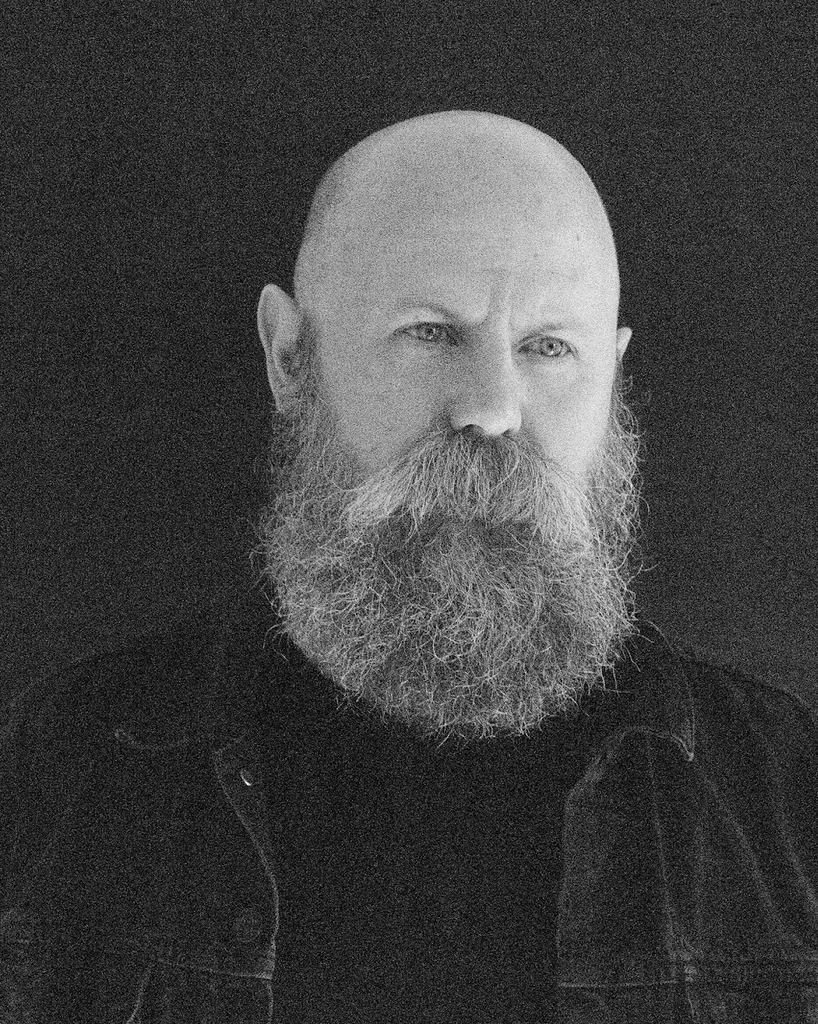
Nate Lippens is the author of My Dead BookRipcord, and two forthcoming novels, Box Office Poison, co-written with Matthew Kinlin, and Bastards

Author photo from Carolyne Loreé Teston.

Nico in The Closet (1966) by Graham Russell

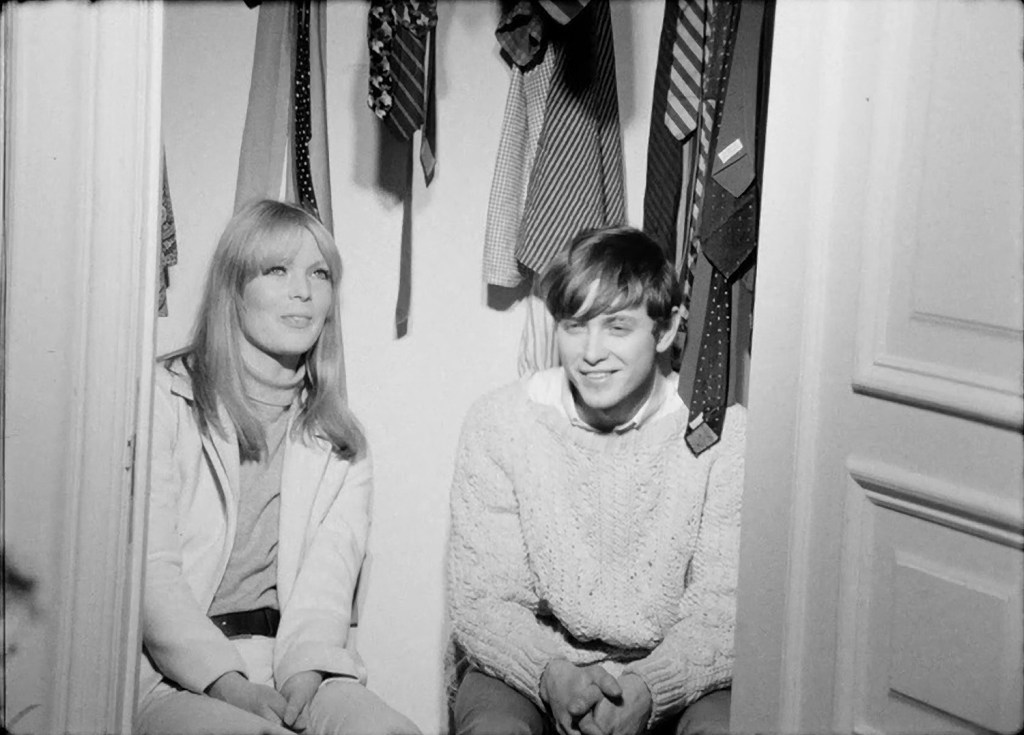
Nico and Randy Bourscheidt in The Closet (1966)

The Closet (1966) was Nico’s first film with cadaverous Pop Art visionary Andy Warhol and thus represents her cinematic unveiling as a Warhol Superstar. It would be a fruitful relationship. As the Factory’s inscrutable Garbo / Dietrich equivalent she would star in several more Warhol films (most famously Chelsea Girls (1966)) while also featuring as chanteuse for Warhol’s proto-punk “house band” The Velvet Underground.

The  Closet’s “plot” is absurdist and minimal: a couple living in a closet kill the time (they make small talk, split a sandwich, share a cigarette, kvetch about their cramped surroundings) and contemplate leaving but never do.

For the first few moments the camera is focused on the exterior of the shut closet door in grainy black and white as we hear only their voices (audible but muffled; in fact the sound remains muffled for the rest of the film, poor sound quality being a stylistic trademark of Warhol’s films at the time). Creeping horror that the entire 66-minute film will stay like this is averted when the door belatedly does open and we are finally permitted to see Nico and leading man Randy Bourscheidt (a cute, preppy art student-type) seated inside the closet surrounded by hangers, ties, clothes, etc. While the couple talk or sit in silence, Warhol’s camera either sits totally stationary or prowls restlessly and randomly.

The film is unscripted: instead, we get an improvised, wandering conversation between the duo who have obviously been instructed to ad-lib for the 66-minute duration. Most Warhol Superstars were amphetamine-fuelled, garrulous motormouths and exhibitionists; Nico and Bourscheidt are atypically more reticent. Both seem shy and hesitant, and their conversation is often stilted but characterized by a genuine sweetness on both parts. Some viewers have deciphered the hint of a physical attraction between them which is complicated by the pretty, long-lashed and collegiate-looking Bourscheidt’s apparent homosexuality (The expression “coming out of the closet” was already in use in the 1960s and could be a relevant coded meaning to the film’s title).

Certainly Bourscheidt seems dazzled by Nico, which is understandable: The Closet presents her at the height of her flaxen-haired beauty. It also reveals the complexity of her persona. The performers in Warhol films are essentially playing themselves, so The Closet is a snapshot of Nico the woman at this particular point in her life rather than an actress performing a role. She looks like a statuesque Nordic Amazon but is wispily spoken, reserved and uncertain rather than intimidating or forbidding — her sweetness dispels the cliché of Nico as ice maiden. And her voice – routinely described as guttural or “Germanic” – is infinitely softer than you expect.

As an avant-garde filmmaker Warhol withholds most of the conventional pleasures audiences expect from films (narrative, character development, editing, technical proficiency , etc) but with his Superstars in lead roles he does provide one of the enduring attractions of film-watching: scrutinizing beautiful people. So, while “nothing happens” in The Closet, we do get to appreciate the physical attractiveness and hip wardrobes of both Nico and Bourscheidt at great length. Nico wears what was then her signature look: an androgynous white pantsuit, turtleneck sweater and boots combo that would be the pride of any Mod boy, feminized by a curtain of long blonde hair.

Nico would have been in her late twenties by the time of The Closet, and Bourscheidt (at a guess) between 19 and 21. She speaks to him in tones that shuttle between maternal concern and big sister-ly teasing. Both seem vaguely embarrassed and self-conscious on screen, but unlike Bourscheidt Nico possesses the poised armour of sophistication: by 1965 she travelled the world as an in-demand fashion model, spoke several languages, acted in films like La Dolce Vita (1959) and Strip-Tease (1963) in Europe, was the mother of a young son, and had started her singing career.

In addition to this hauteur, Nico utilizes her experience as a seasoned model: she is clearly un-phased by the camera’s roaming gaze and is skilled at graceful self-presentation. She has a neat trick of looking down moodily so that her long blonde bangs obscure most of her face and then suddenly looking up and tilting her head, dramatically revealing sculpted cheekbones, Bardot lips and sweeping false eyelashes.

“Are you afraid of me?” Nico suddenly asks Bourscheidt towards the end of their awkward filmic encounter. He looks startled and doesn’t know how to reply. “I’m not trying to embarrass you!” she assures.

At the film’s conclusion Bourscheidt teasingly asks Nico if she’s forgotten his name. Indeed, she has, and tries to cover by asking him, “Is it Romeo?” He says no and she answers, “Why not?” He asks if she wants him to be Romeo and should he get down on one knee. She replies, “Oh, no. You be Juliet and I’ll be Romeo.”


Like the Shangri-Las song, Graham Russell is good-bad, but not evil. He’s a trash culture obsessive, occasional DJ (Cockabilly – London’s first and to date, only gay rockabilly night), and promoter of the Lobotomy Room film club (devoted to Bad Movies for Bad People) at Fontaine’s bar in Dalston. As a sporadic freelance journalist, over the years he’s contributed to everything from punk zines (MAXIMUMROCKNROLL, Flipside, Razorcake) to The Guardian and Interview magazine and interviewed the likes of John Waters, Marianne Faithfull, Poison Ivy Rorschach, Lydia Lunch, Henry Rollins and Jayne County.
Blog at WordPress.com.

Up ↑